-
-
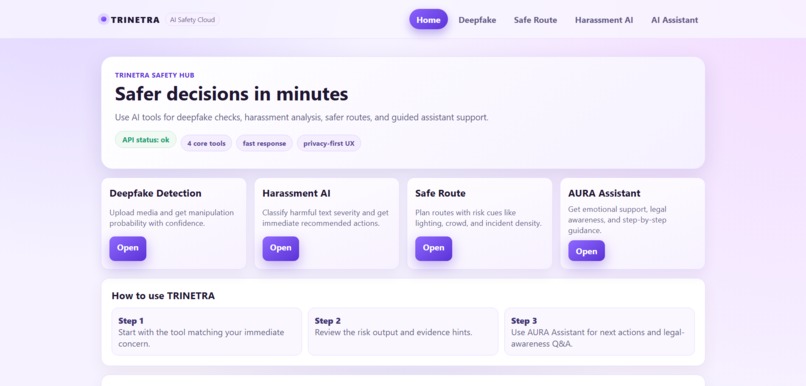
Frontend ui/ Home page
Inspiration
The rise of deepfake misuse, online harassment, and unsafe environments for women inspired us to build TRINETRA. We wanted to create a platform where AI actively protects users instead of being misused against them. Our goal was to combine multiple AI tools into one system that helps detect threats, guide safer decisions, and support victims in real time.
What it does
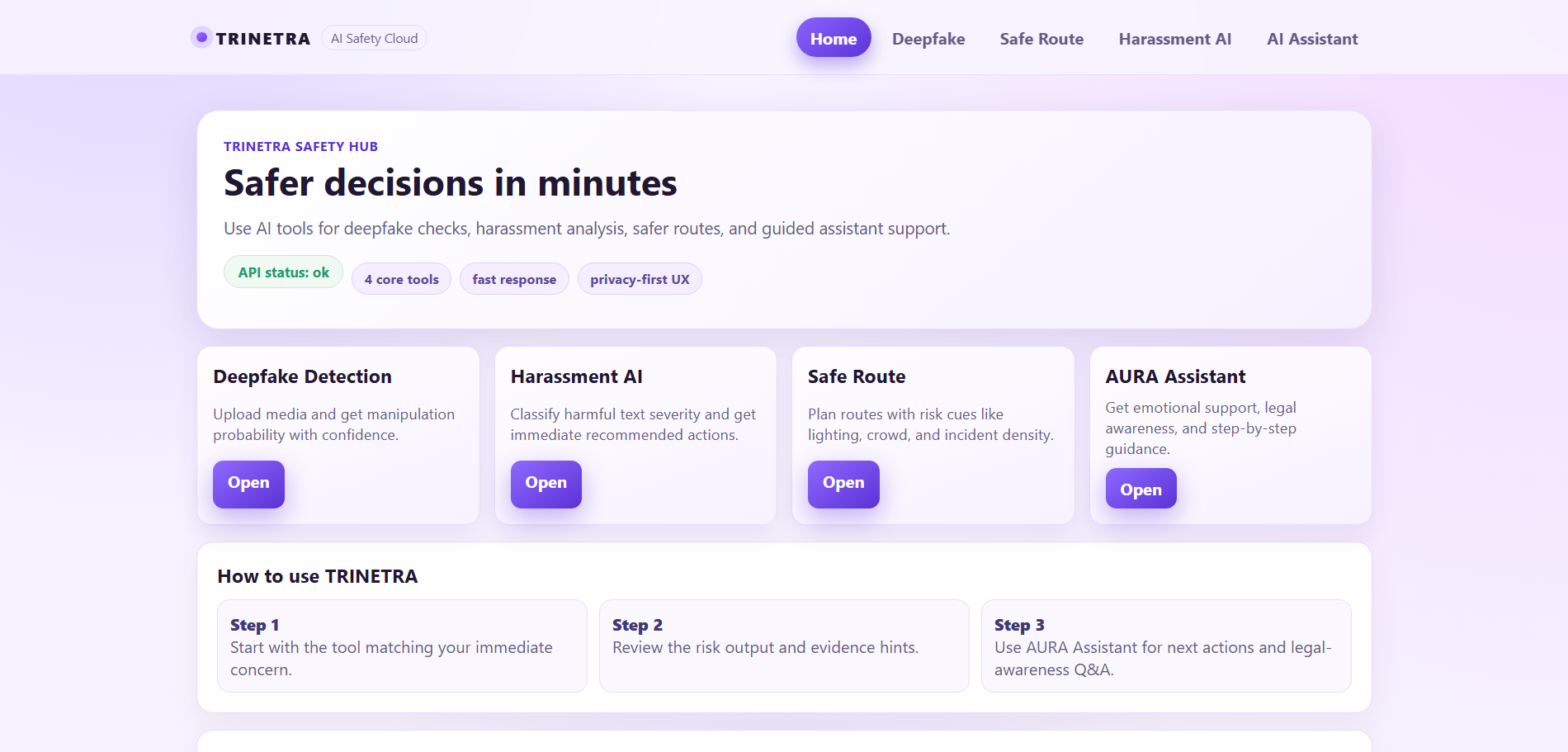
TRINETRA is an AI-powered safety platform that helps women detect and respond to threats both online and offline. It includes deepfake detection, harassment threat analysis, safe route risk evaluation, an emergency complaint system, and an AI emotional support assistant. The platform analyzes messages, media, and route data to provide safety insights, risk levels, and recommended actions.
How we built it
We built the frontend using React.js for an interactive user interface and FastAPI for the backend. AI capabilities were implemented using Groq’s Llama-3 models for reasoning tasks and HuggingFace vision models for deepfake detection. OCR technology extracts text from images for harassment analysis, and mapping tools like Leaflet and OpenStreetMap enable safe route visualization. The application is deployed using Vercel (frontend) and Render (backend).
Challenges we ran into
One of the biggest challenges was integrating multiple AI services and ensuring reliable responses from different models. We also faced issues with API parsing, response formatting, and maintaining stable backend communication between the frontend and AI systems. Deploying and managing environment configurations across services was another technical challenge we had to overcome.

Log in or sign up for Devpost to join the conversation.