-
-
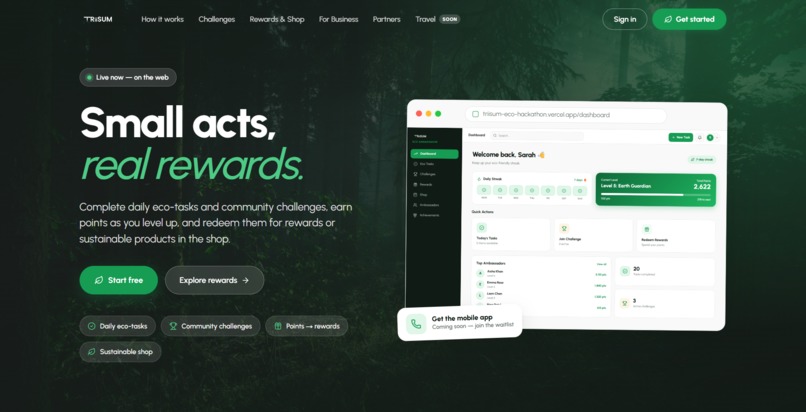
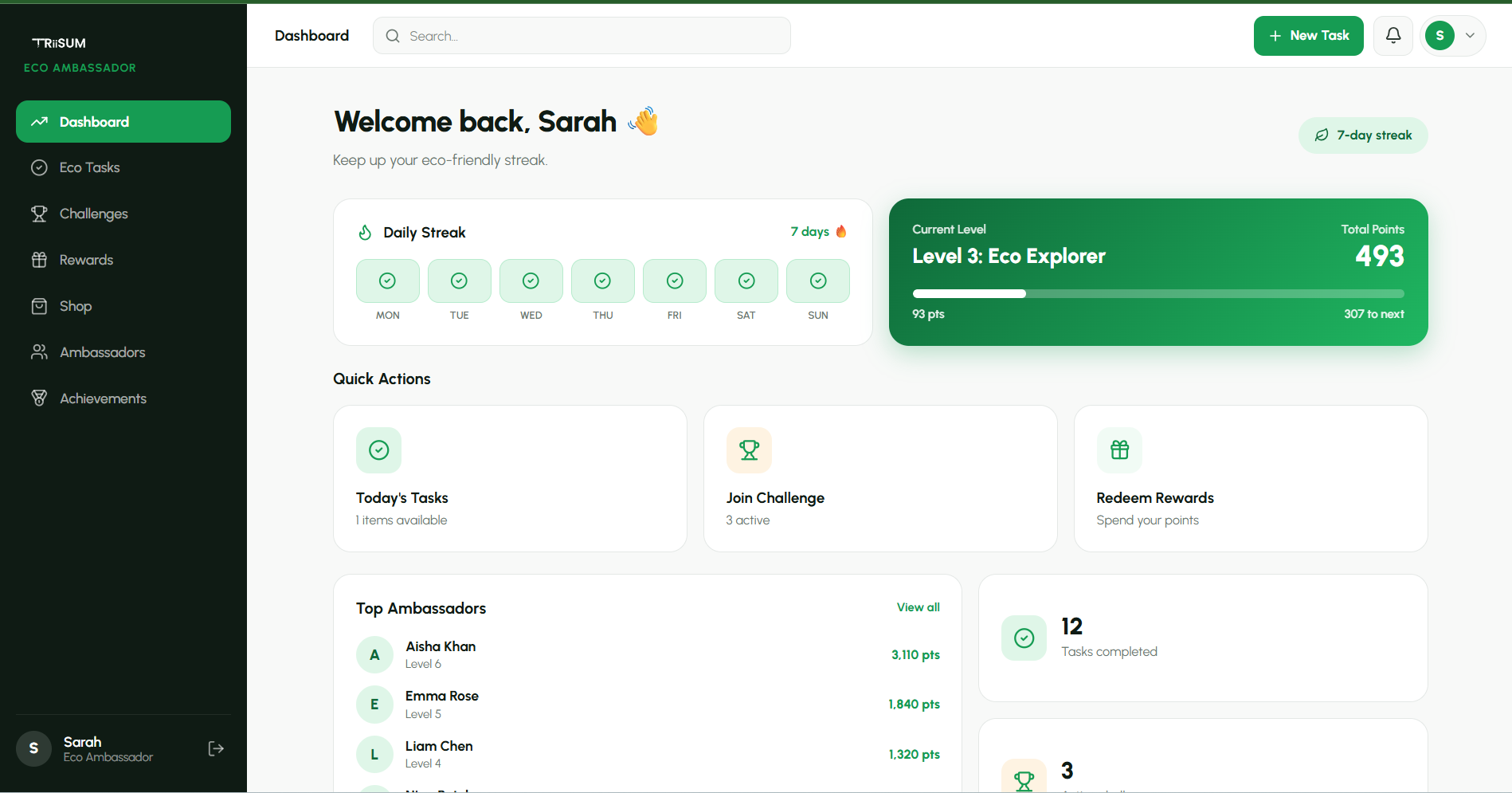
Home Screen
-
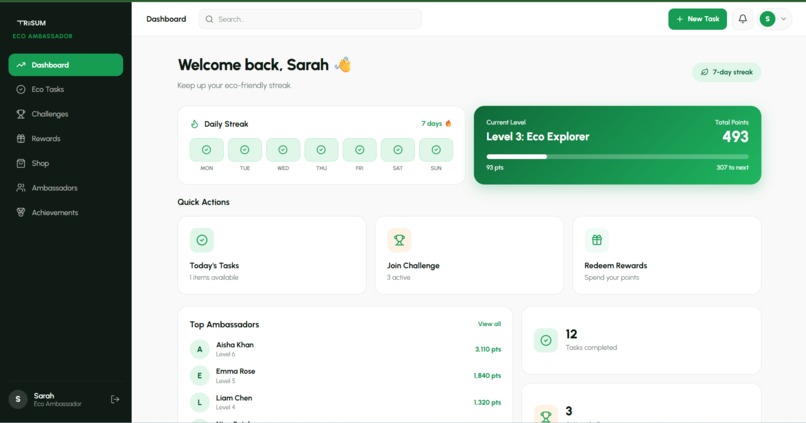
Dashboard
-
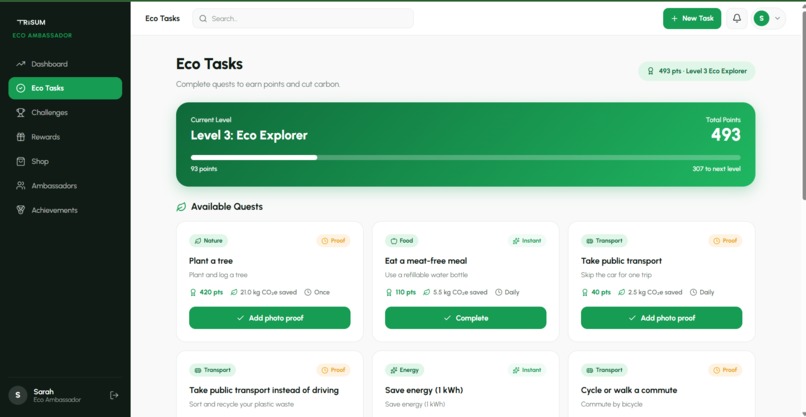
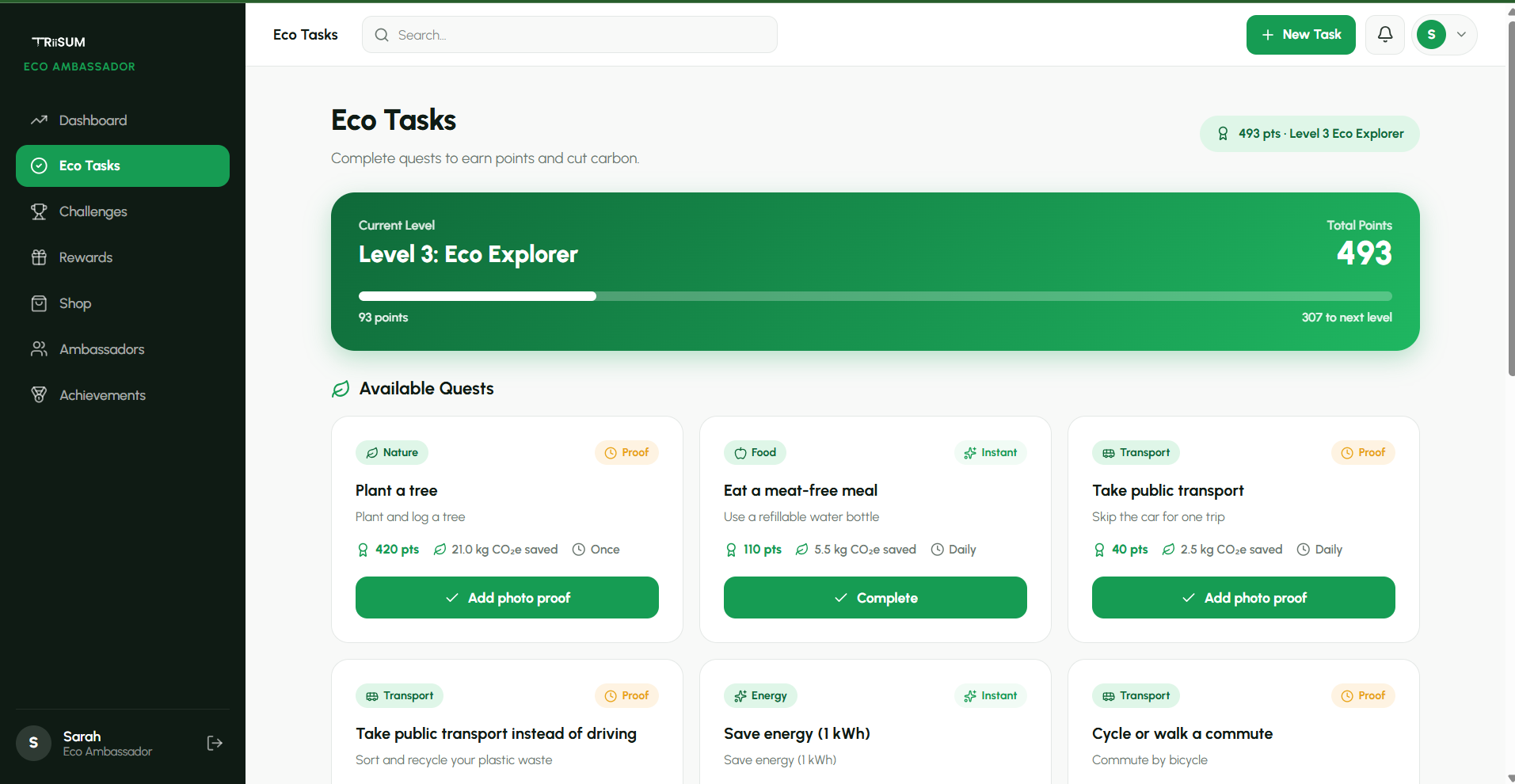
eco-Tasks
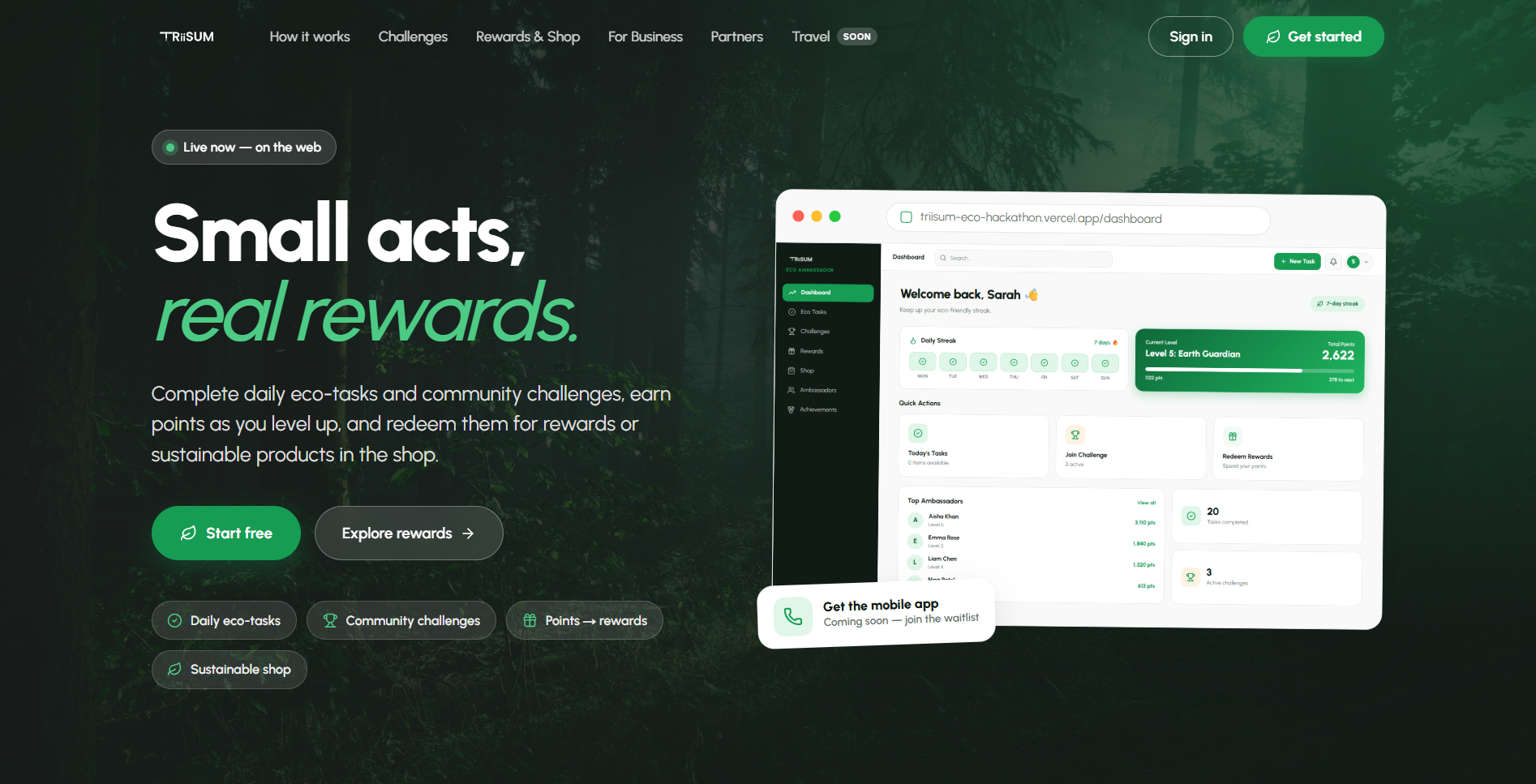
Inspiration
Every day, millions of people do small things for the planet — they take the bus instead of driving, skip single-use plastic, eat a meat-free meal, recycle. And almost none of it is ever recognized or rewarded. The effort is invisible, the impact feels abstract, and the motivation fades.
Meanwhile, the apps that are brilliant at building habits — Duolingo, fitness streak apps — have nothing to do with sustainability. We kept asking: what if doing the right thing for the planet earned you something real, and felt as addictive as keeping a streak?
That's Triisum Eco. We wanted to turn everyday climate action into a habit that pays — measurable, social, and economically rewarding — for consumers and for the brands and employers who want to reach them.
What it does
Triisum Eco is a social sustainability web app — think Duolingo meets an eco-rewards shop.
- Eco users complete real-world eco-tasks (public transport, meat-free meals, recycling, saving energy), upload proof, and earn points. They keep daily streaks, climb levels from Eco Starter to Earth Guardian, join team challenges with live leaderboards, and redeem points for partner rewards or sustainable products in the shop.
- Partners (sustainable brands & merchants) list rewards and products and track redemptions from a dedicated portal.
- Corporates run staff sustainability programs — employees link their eco-activity to the organization with a join code, and the company sees the collective impact.
- Admins create and approve quests, grounding each one's carbon value in real emission factors, and approve user proof submissions before points are awarded.
The whole points economy runs on an immutable ledger, and every quest's carbon saving is grounded in real published science — not invented numbers.
How we built it
The stack: Next.js 16 (App Router) on Vercel, with Amazon Aurora PostgreSQL (Serverless v2) as the single source of truth. Auth is NextAuth v5 (email/password, bcrypt) with role-based middleware for the four roles. Proof photos go to Vercel Blob.
The data model is the heart of it. A rewards economy is really a ledger, so we modeled it like fintech does:
- Points live in an immutable
points_ledgertable. A user's balance is never a mutable counter — it'sSUM(amount):
  SELECT COALESCE(SUM(amount), 0) FROM points_ledger WHERE user_id = $1;

- Redemptions are ACID transactions: verify balance >= cost and stock > 0, insert a negative ledger row, decrement stock, and mint a coupon — all-or-nothing, so there's no oversell and no negative balances.
- Leaderboards are aggregate SQL queries, not denormalized counts.

Honest carbon, by design. Each quest's CO₂e saving comes from a real published emission factor — EPA, UK DESNZ/BEIS, IPCC, ADEME/Agribalyse — sourced via Climatiq. Crucially, we call Climatiq only at seed and admin quest-creation time, store the value and its provenance in Aurora, and serve everything from the database at runtime. No third-party API ever sits in a user's request path. Points are derived deterministically:

$$\text{points} \approx 20 \times \text{kg CO}_2\text{e saved} \quad (\text{minimum } 5)$$

Why Aurora Serverless v2: we wanted a database we wouldn't have to throw away. Real SQL, transactions and constraints from day one — and with 0.5–2 ACU scale-to-zero auto-pause, it cost us a few dollars during the hackathon while scaling to production traffic without a re-platform.

Challenges we ran into

- Designing a ledger, not a counter. The naive "add points to a number" approach invites race conditions and cheating. Committing to an append-only ledger with transactional redemptions was more work upfront but made the whole economy auditable and tamper-resistant.
- Keeping carbon numbers honest and fast. Live-calling an emissions API on every page would be slow, fragile, and expensive. Moving Climatiq to seed/admin time and persisting the factors (with provenance) in Aurora gave us real-science grounding with pure-database runtime.
- A web-first product from mobile-first designs. Our original mockups were mobile screens; the hackathon is web. We rebuilt the landing and dashboards natively for desktop web and replaced every phone mockup with real web-app screenshots.
- Telling the truth on the marketing site. We audited the landing page and removed anything we hadn't actually built — fabricated "impact" totals, a non-existent social feed, unbuilt features — and replaced them with verifiable claims. Unbuilt items (native app, social sign-in) now honestly say "coming soon" and capture a waitlist.
- Cost discipline on AWS. With a small credit budget, we leaned hard on auto-pause, set spend alerts, and kept the footprint tiny.

Accomplishments that we're proud of

- A production-grade economy on real infrastructure — an immutable Aurora ledger with ACID redemptions — not a fake demo.
- Carbon values you can trace to a source. Every quest stores which standards body the factor came from.
- A complete four-role product (eco-user, partner, corporate, admin) with a real end-to-end loop: act → upload proof → admin-approve → points → redeem → coupon.
- A polished, honest web experience: real screenshots, branded link previews, and no claims we can't back up.

What we learned
- Model the hard part first. Treating points as a ledger instead of a number shaped every feature after it — and made cheating, auditing, and leaderboards fall out naturally.
- "Grounded in real data" beats big round numbers. Storing provenance for each carbon factor is more convincing than any impressive-looking total.
- The Vercel + AWS "zero stack" is real. A weekend prototype genuinely runs on the same data foundation a production app would use — Aurora's transactions and constraints meant we never had to compromise on correctness to ship fast.

What's next for Triisum Eco
- Per-point expiry with FIFO spend and a daily earning cap (anti-abuse, already specced).
- Referrals and partner payouts.
- An AI, weather-aware campaign scheduler so partners can target eco-challenges to the right moment.
- Native iOS & Android apps (web today; waitlist is already collecting interest).
- The full travel marketplace — trips, hotels, cars, Umrah, and an AI trip planner — redeemable alongside eco-rewards.
Built With
- amazon-aurora
- amazon-web-services
- bcrypt
- climatiq
- html
- javascript
- next-auth
- next.js
- node-postgres
- node.js
- playwright
- postgresql
- react
- sql
- tailwindcss
- typescript
- vercel
- vercel-blob


Log in or sign up for Devpost to join the conversation.