Inspiration
Families plan a service in two or three days while grieving. The defaults are generic: the same hymn, the same slideshow. Funeral homes, celebrants and hospice social workers have minutes per family. What everyone wants is simple: for the day to feel like the person. A person's taste is the most honest way to describe them, and taste is exactly what Qloo models. We wanted to use a taste graph for something other than "what should I buy": who was this person, in the language of what they loved?
AI memorial tools already exist (CelebrateAlly, Funeral Folio, endoflifetools.com, MyWishes, My Wonderful Life, ZSky). They either format the list a family types or ask a language model to guess. None has a taste graph behind the picks.
What it does
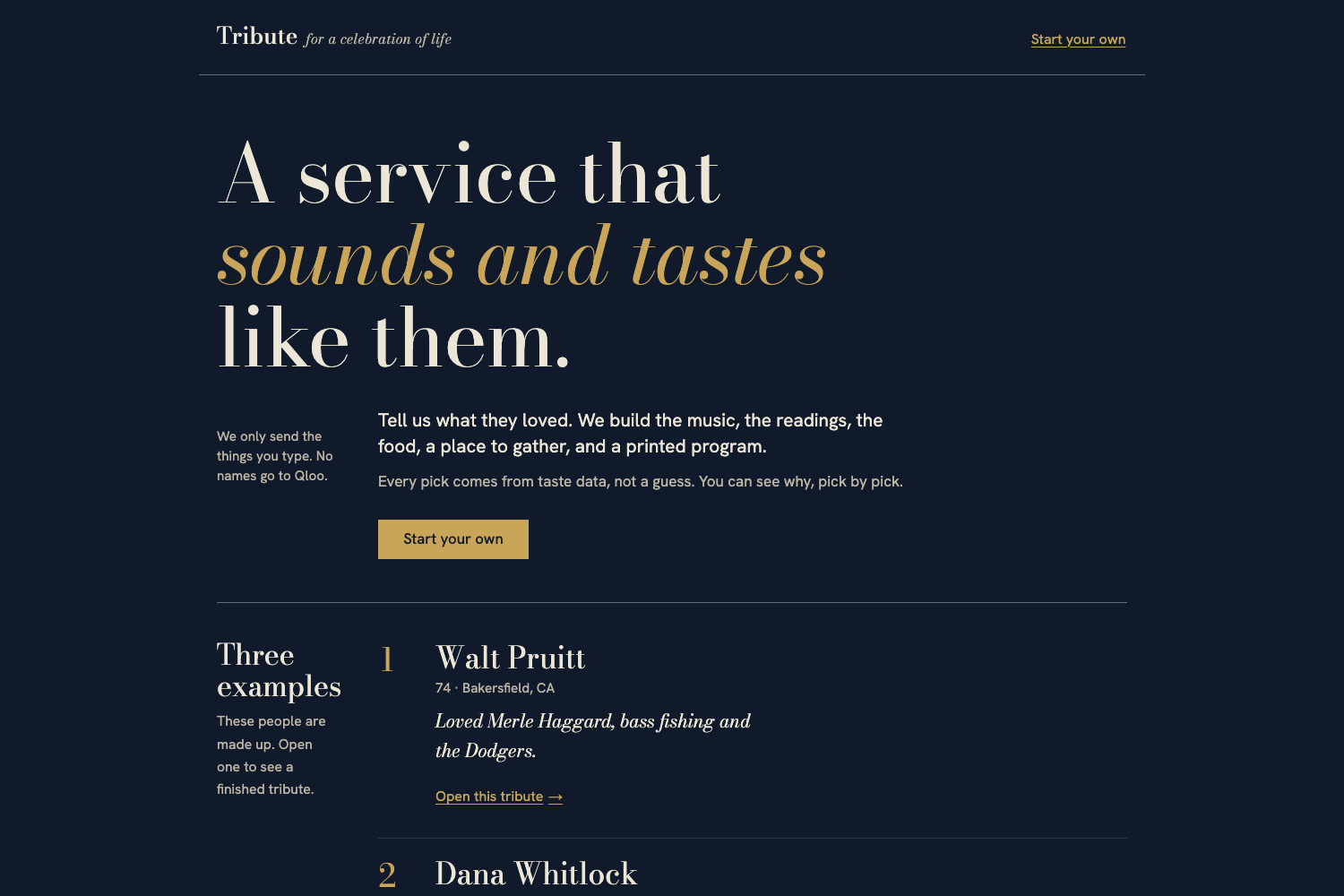
You type five to ten things they loved: a singer, a food, a hobby, a team, a show. Tribute resolves each one in Qloo, asks at most one question if something is ambiguous, then expands across music, books, film, podcasts and places. It builds six sections: music, readings, food, a place to gather, on the screen (photo eras and films), and a printed order of service.
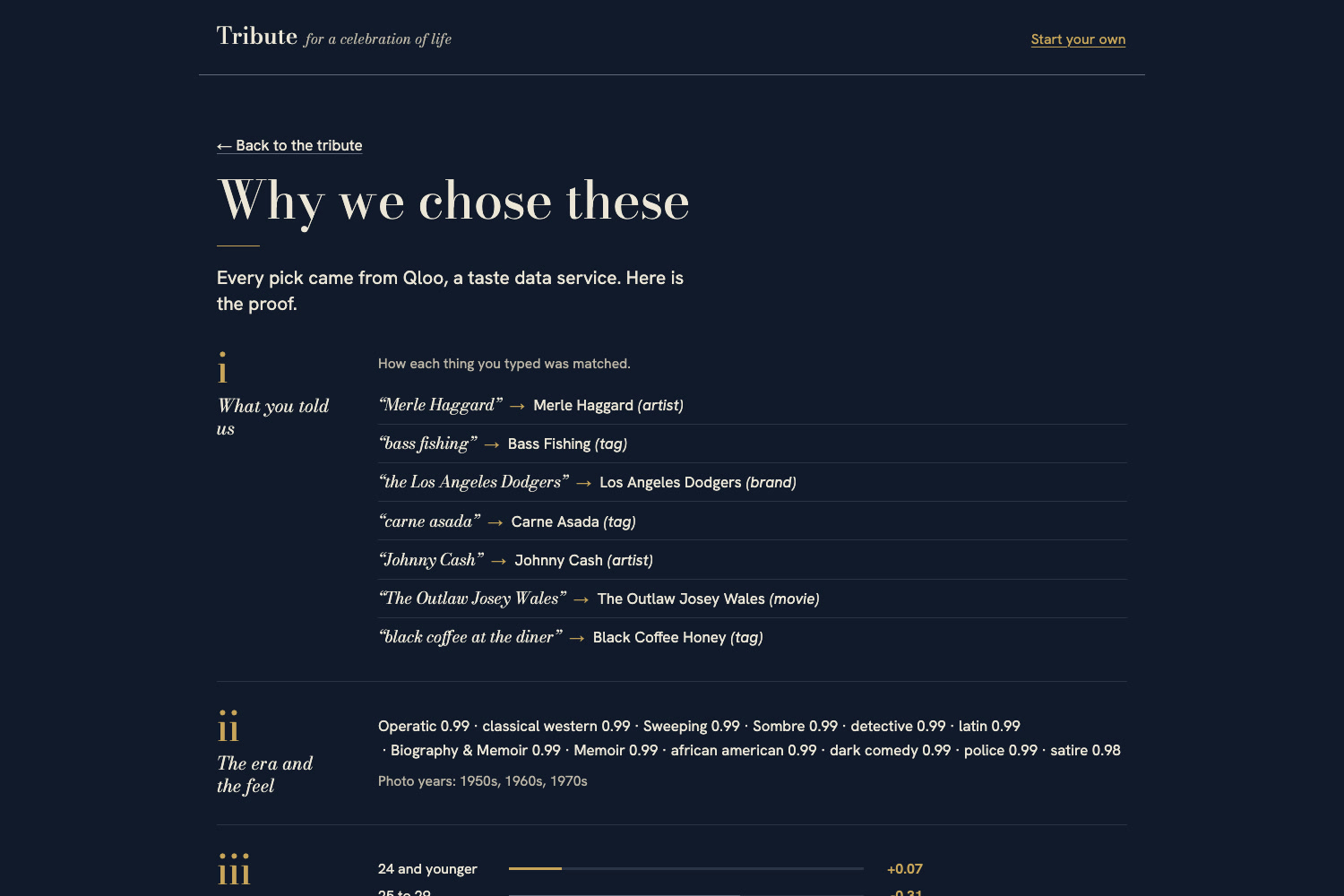
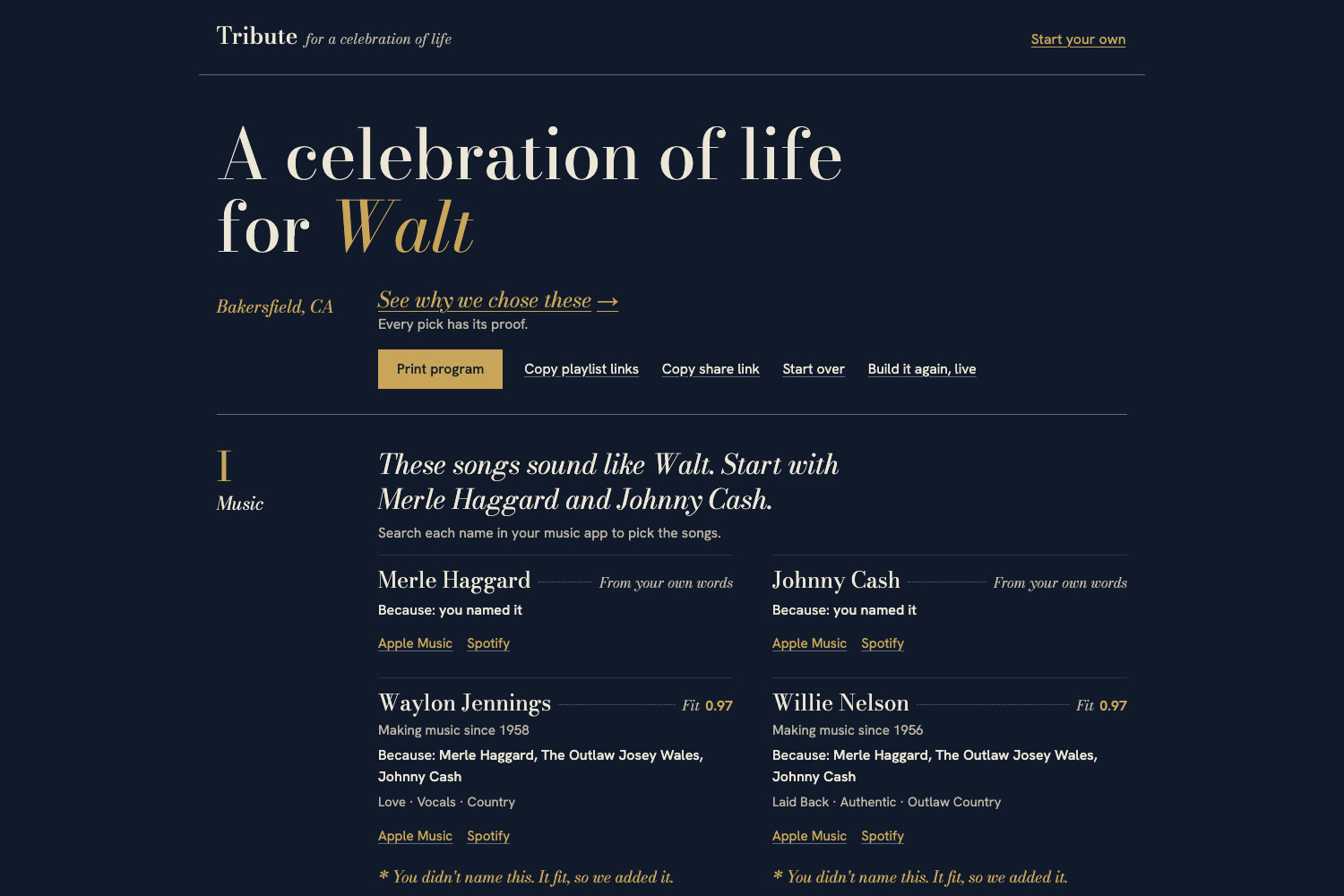
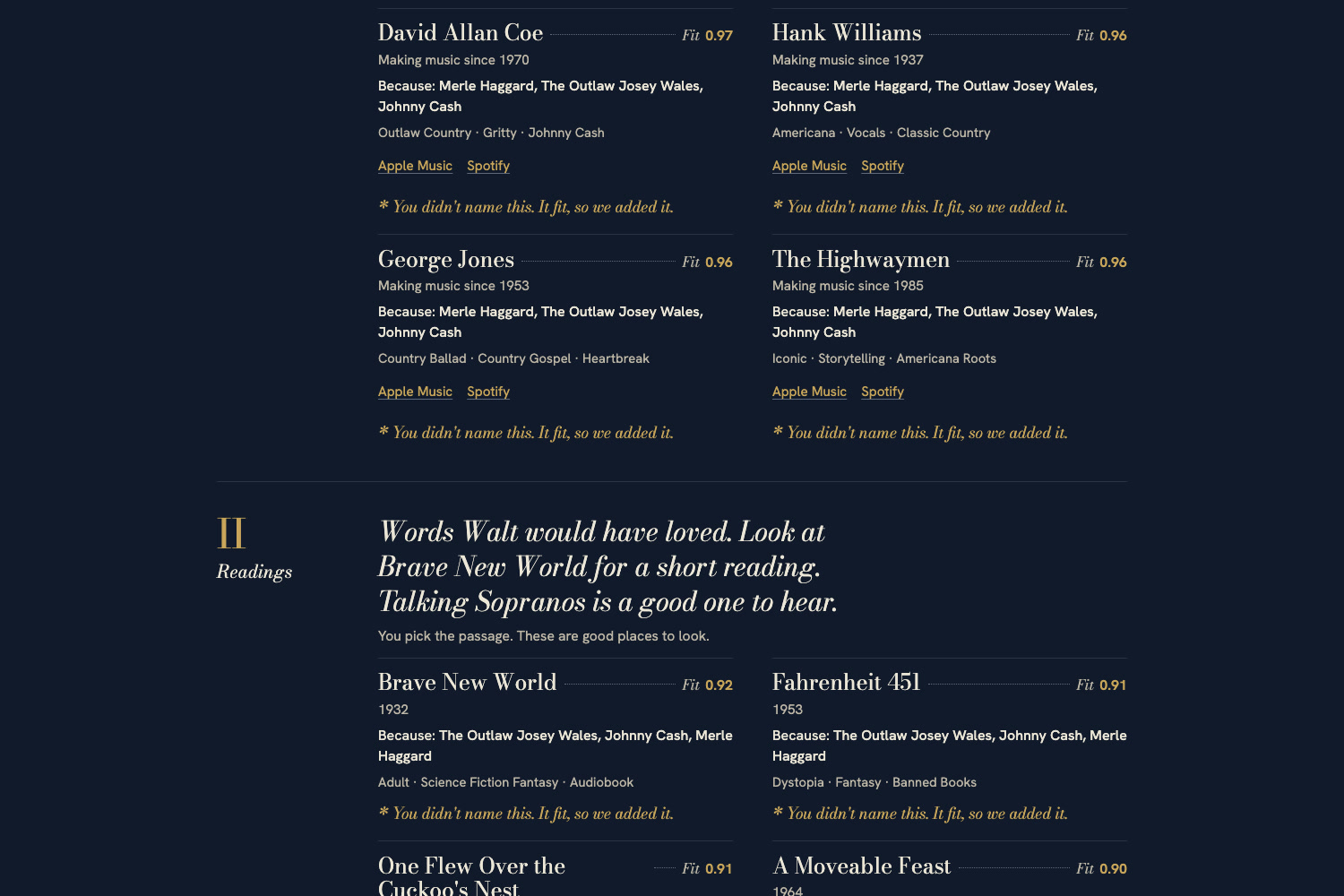
Every pick card shows its evidence right on the card: a "Because" line naming the loves that produced it, a fit bar with the Qloo affinity score, and tag chips. Picks the family never mentioned carry a "You didn't mention this" mark; those are the moments where a family says "we didn't tell it that, but yes." A "Why we chose these" page collects the proof and prints on its own. A folded two-sheet booklet prints from the browser.
How we built it
- Qloo, six surfaces in one flow:
/search,/v2/tags, and/v2/insightsfor tag analysis (urn:tag), audience shape (urn:demographics), five entity types (artist, book, movie and tv_show, podcast, place) withfeature.explainability, place queries with location, price, rating and exclude-tag filters, andfilter.results.entitiesfor ranking. - A real tool-calling agent whose tools mirror the official Qloo harness: same names, same input fields, the same result envelope and the same six statuses. A language model (Claude Haiku 5.5) drives the loop; a deterministic planner enforces a required-steps checklist and fills any gap, so a wandering model cannot break the demo.
- Grounding by construction:
write_sectionrefuses any id Qloo did not return in this run, so the planner cannot invent a song, author or caterer. The ledger and the why page are rendered from the stored trace. - Self-critique: the agent checks the plan against faith or secular, budget and older-guest constraints and re-queries Qloo with exclude-tag, price and rating filters when a pick breaks a rule. The revision shows in the ledger with its reason.
- Product: vanilla TypeScript front end with live Server-Sent Events, print CSS for a folded booklet, 4th to 6th grade text enforced by a readability gate, Lighthouse accessibility 100.
- Operations: SQLite caches for Qloo and model calls, a hard model spend cap, per-IP rate limits with hashed IPs, identical inputs replay for free.
Challenges
- Qloo returns artists, not songs, and books and authors, not passages. We made that a feature: the family picks the song or passage through search links, and Tribute narrows the field to what fits.
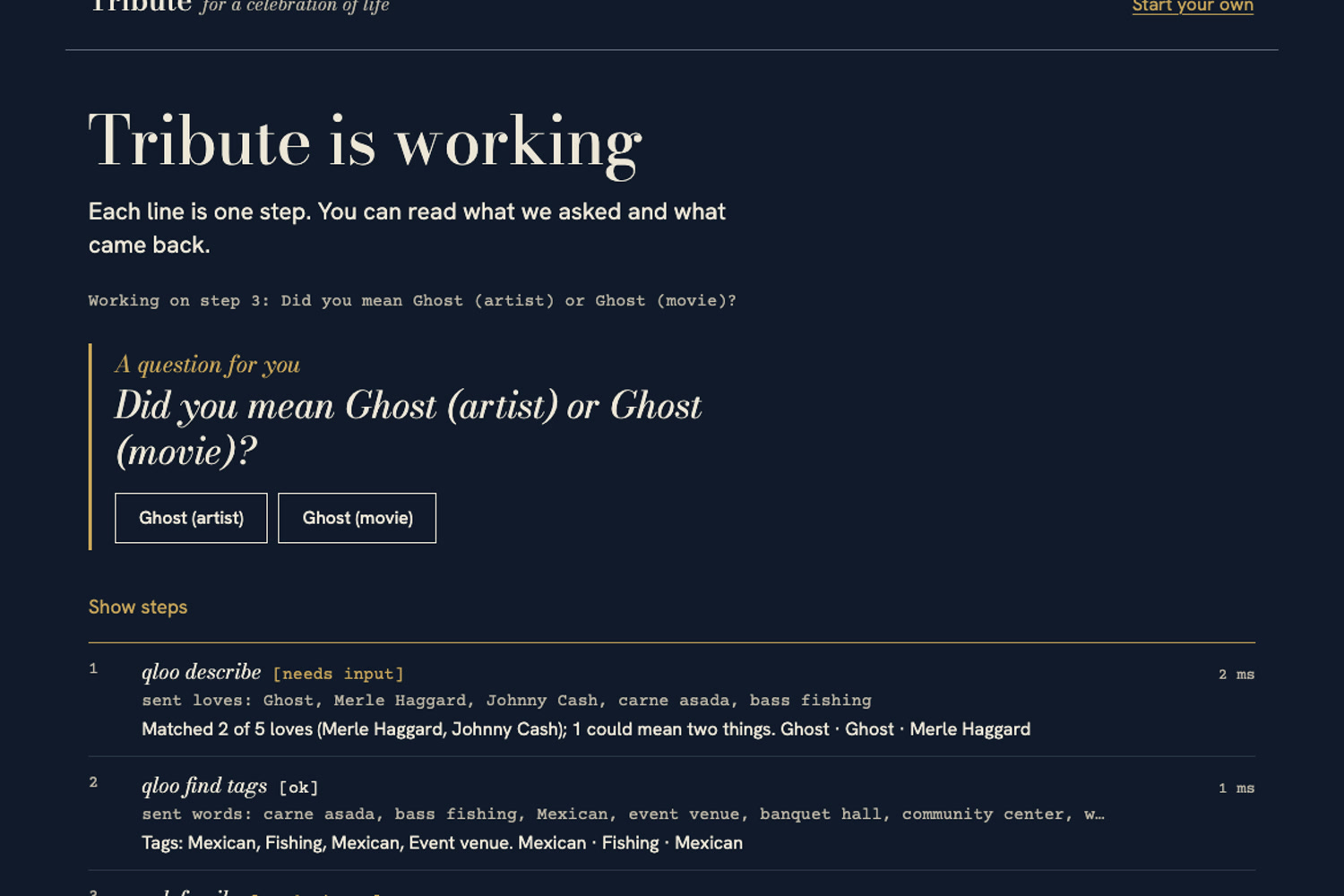
- Ambiguity ("Ghost": the band or the film) can change a whole plan. We used the harness's
needs_inputpattern and capped it at one question per run. - Cheap models drift. The required-steps checklist and the deterministic planner mean the product works even when the model stops early or writes sentences that are too hard to read; those get replaced with a plain default.
- Tone. This is a heavy topic. We wrote the product in warm, plain words, tested the reading level, and avoided anything morbid.
- Privacy. Only typed loves and a city reach Qloo. No names, no dates. Demographics describe the audience of what they loved, never the person, and the page says so.
Accomplishments we are proud of
- Every pick has visible evidence next to it, not behind a link.
- The agent's work is visible and traceable: ledger, one question, a revision step.
- It works on the real Qloo API: real affinity scores and explainability contributions on every card, real place data in three US cities.
- A finished product, not a proof: landing, intake, live ledger, program, why page and print, usable on a phone.
- It stays honest and safe: grounded picks, spend cap, rate limit, no captured Qloo data in the repo.
What we learned
A taste graph is a good way to describe a person. The same cross-domain expansion that powers shopping recommendations can turn "Merle Haggard and the Dodgers" into a reading list, a caterer and a slideshow era. We also learned how much trust comes from showing the work: the evidence on the card did more than any claim could.
What's next
- Pilot with a funeral home or celebrant, who plan dozens of services a year, as a planner-side tool with a shared link for the family.
- Song-level picks through a music service once artists are chosen.
- Obituary and program wording that uses the same evidence.
- More regions and languages as Qloo's coverage grows.
Try it
No sign-up, no keys, free. Open https://tribute.swellstackco.com and open any of the three example tributes (Walt, Dana or Rosalind); each opens in about a second. Every pick card shows its evidence. Open the why page for the full proof, print the program as a folded booklet, or rebuild an example live to watch the agent work step by step. Then start your own with five or more loves and a city (try "Ghost" as one to see the one-question pause).
The live site runs on real Qloo data (/health reports "qloo":"live"). The three example people are fictional; their loves are real public artists, shows and brands.
Live demo: https://tribute.swellstackco.com · Code (MIT): https://github.com/swellstackco/tribute
Built With
- anthropic
- claude
- cloudflare
- express.js
- nginx
- node.js
- playwright
- qloo
- server-sent-events
- sqlite
- typescript
- vite
- vitest
- zod

Log in or sign up for Devpost to join the conversation.