Inspiration
As fitness enthusiasts, we found ourselves constantly switching between apps Strava for tracking, Instagram for sharing progress, Carousell for buying gear, and Eventbrite for finding local runs. We thought: why not one platform that connects all of these? Tribefit was born from the idea that fitness is inherently social and commercial you train with a community, you share milestones, and you buy and sell gear along the way.
What it does
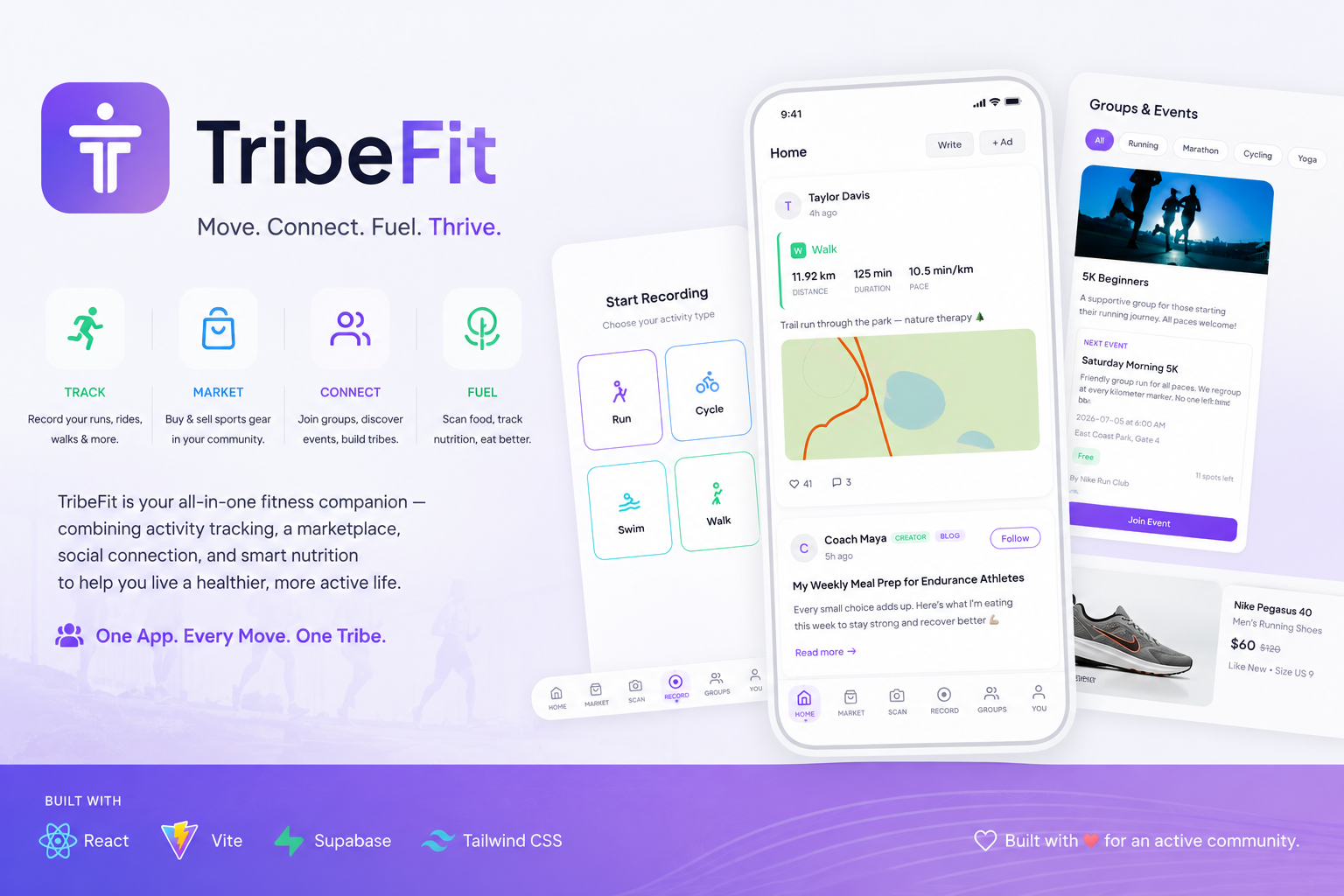
Tribefit is a mobile-first fitness social platform that combines:
- GPS activity tracking — Record runs, cycles, swims, and walks with live distance, pace, and speed using the Haversine formula: $$d = 2R \arcsin\left(\sqrt{\sin^2\left(\frac{\Delta\phi}{2}\right) + \cos(\phi_1)\cos(\phi_2)\sin^2\left(\frac{\Delta\lambda}{2}\right)}\right)$$ -Social feed — Share activities, like, comment, and follow other athletes
- Marketplace — Buy and sell fitness gear with real-time chat between buyers and sellers
- Groups & challenges — Join fitness communities, participate in merchant-hosted events and group challenges
- Merchant ecosystem — Merchants list products, host events, and engage directly with the fitness community
- AI food scanner — Snap a photo of any meal to receive an estimated nutritional breakdown, helping users make healthier food choices and monitor their daily intake.
How we built it
- Frontend: React 18 + Vite, styled with custom CSS variables for dark/light theming
- Backend: Supabase (PostgreSQL, Auth, Realtime, Row Level Security)
- Maps: Leaflet + OpenStreetMap for live route tracking and activity maps
- GPS: Custom
useGPShook with iOS-specific workarounds (polling fallback, relaxed accuracy thresholds, extended timeouts) - Real-time chat: Supabase Postgres Changes pub/sub on the
chat_messagestable with exponential backoff reconnection - Deployment: HTTPS dev server via
@vitejs/plugin-basic-sslfor mobile GPS testing over local network
Challenges we ran into
- iOS Safari GPS throttling — Safari stops delivering
watchPositioncallbacks after a few readings. We had to implement a 3-secondgetCurrentPositionpolling fallback specifically for iOS devices. - HTTPS requirement — iOS blocks geolocation on non-HTTPS origins. Vite 5 removed the
--httpsflag, so we needed to configure a plugin — and re-apply it every time a merge overwrote our config. - Supabase
.single()crashes — Queries that return 0 rows throw "Cannot coerce the result to a single JSON object" instead of returning null. This caused silent failures on profile updates until we switched to.maybeSingle(). - Mock vs. real data — The marketplace initially only displayed mock listings. Connecting to real Supabase data while keeping mocks as filler required careful tagging to prevent chat operations on non-existent records.
- Team merge conflicts — Multiple teammates editing the same pages meant frequent conflict resolution while preserving each other's features.
- Cross-feature integration — Because our app combines tracking, marketplace, nutrition and social networking, changes in one feature often affected another. Ensuring a smooth user experience across multiple interconnected systems required careful testing.
Accomplishments that we're proud of
Working GPS tracking on iPhone — Reliable distance tracking in a web app on iOS, with live map visualization and automatic fallback to manual input
- End-to-end marketplace chat — Buyers can message sellers directly from a listing, with real-time message delivery via WebSockets
- Role-based platform — Clean separation between Individual and Merchant experiences, enforced at both the UI and database level with Row Level Security
- Zero external infrastructure costs — GPS via the browser Geolocation API, maps through OpenStreetMap, backend on Supabase's free tier and a lightweight frontend kept operating costs minimal.
- Mobile-first responsive design — Works seamlessly on phones with bottom tab navigation, and adapts to desktop with a top nav
What we learned
- The browser Geolocation API behaves very differently across platforms — you can't write it once and expect it to work everywhere
- Supabase RLS is powerful but requires careful testing — a silent policy denial looks identical to "no data" from the client's perspective
- Real-time features (chat, live tracking) require resilience patterns: reconnection backoff, missed message recovery, optimistic UI
- Team collaboration with Git requires discipline — feature branches, atomic commits, and communication about which files you're touching
What's next for Tribefit
- Route snapping via Mapbox Map Matching API to improve GPS distance accuracy by fitting raw points to real roads and trails
- Push notifications for chat messages and event reminders
- Activity photos — attach images to activities and feed posts
- Leaderboards — weekly/monthly distance rankings within groups
- Payment integration — in-app transactions for marketplace purchases
- Native app wrapper (Capacitor/React Native) for better background GPS and notifications
- Wearable integrations with Garmin, Apple Health and Google Fit for automatic activity synchronisation.
- Smarter AI nutrition by expanding the existing food scanner into personalised meal recommendations based on activity history and fitness goals.
Built With
- css
- github-testing:-vitest
- html-frameworks/libraries:-react-18
- leaflet.js
- mobile-first)
- node.js-cloud-services/backend:-supabase-(auth
- openstreetmap-tiles-platforms:-web-(pwa
- react-leaflet-build-tools:-vite
- react-router
- realtime
- sql
- storage)-database:-postgresql-(via-supabase)-apis:-browser-geolocation-api


Log in or sign up for Devpost to join the conversation.