-
-
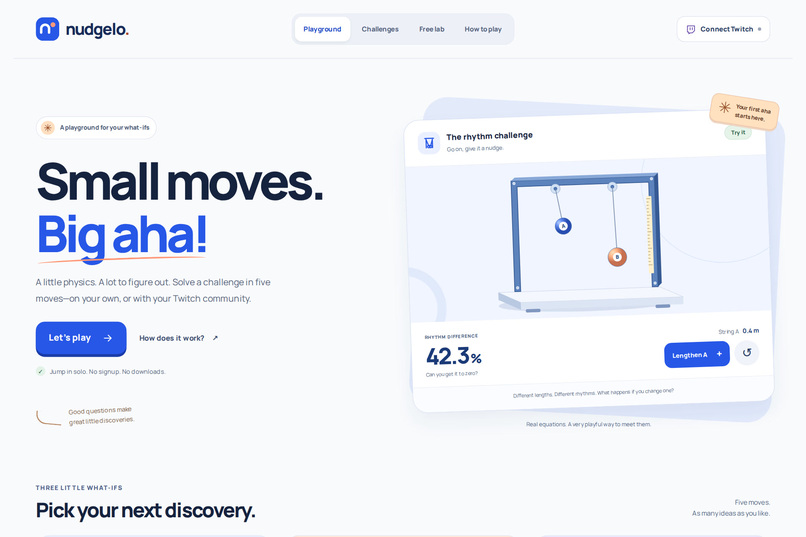
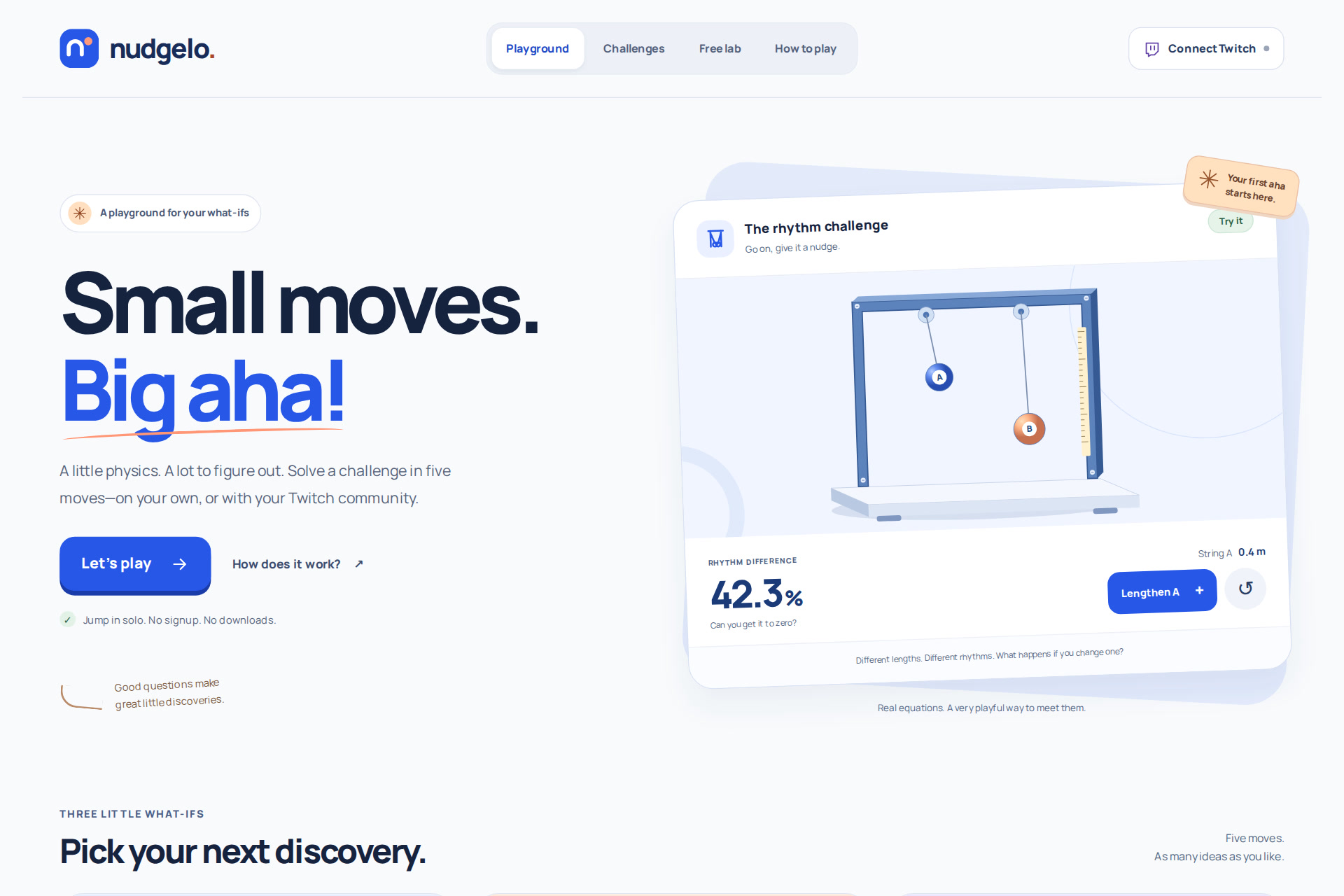
Small moves, big aha: the interactive playground is ready without an account.
-
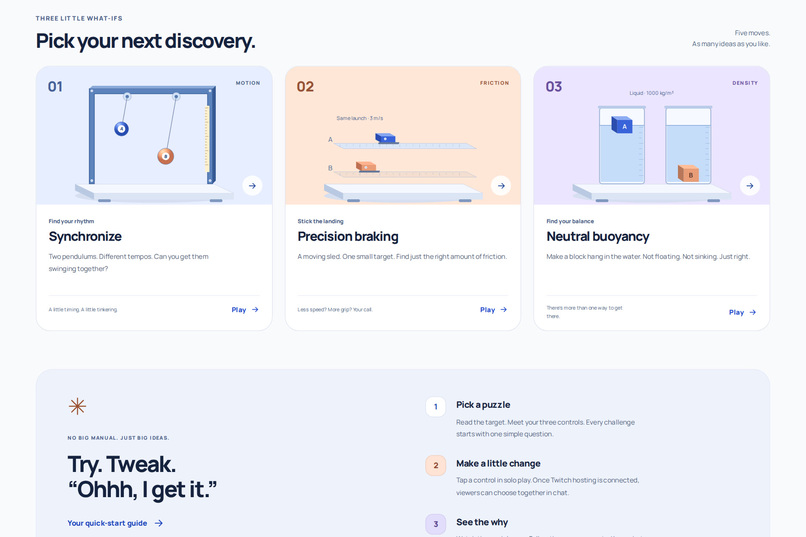
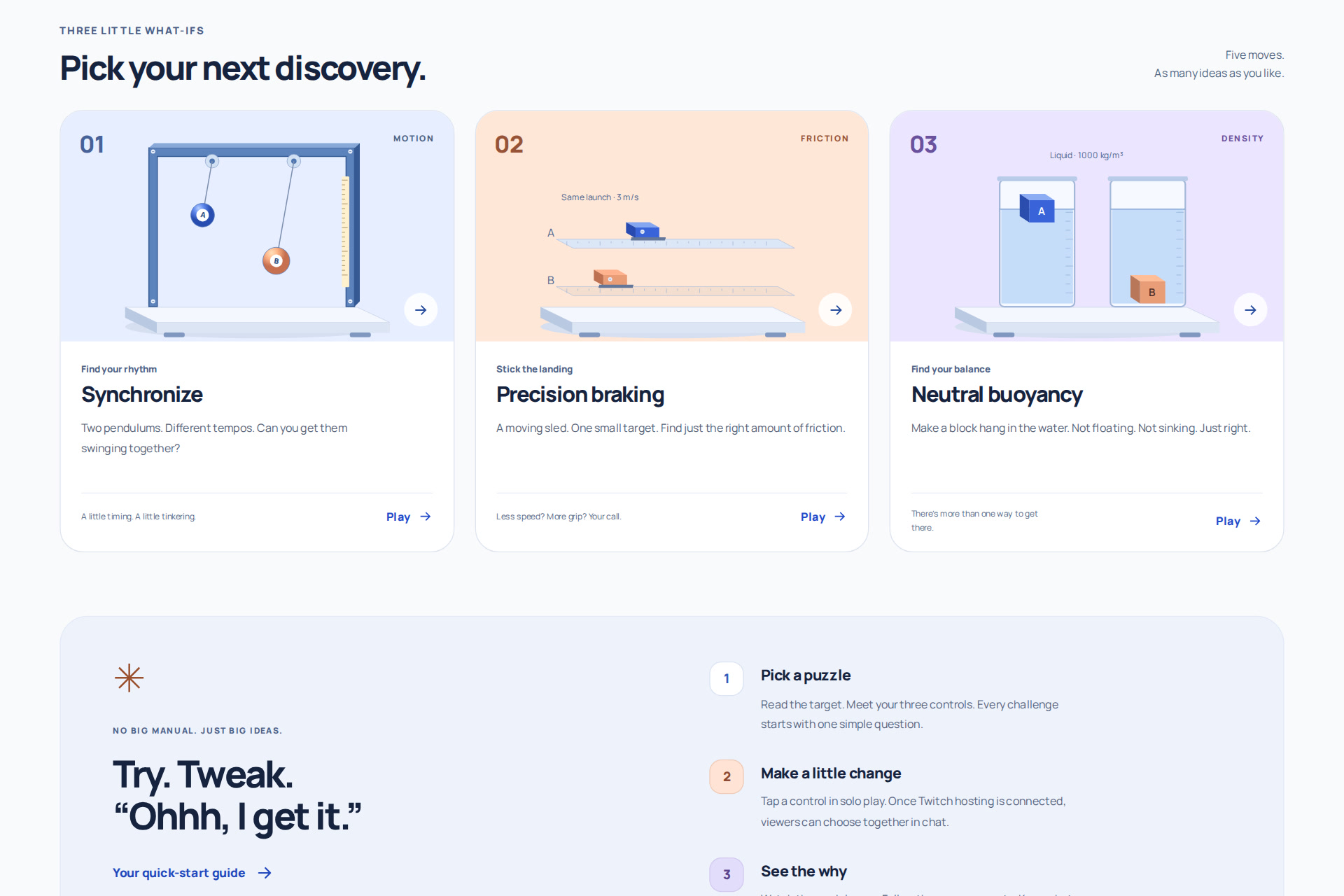
Three distinct challenges: synchronize pendulums, brake precisely, and balance buoyancy.
-
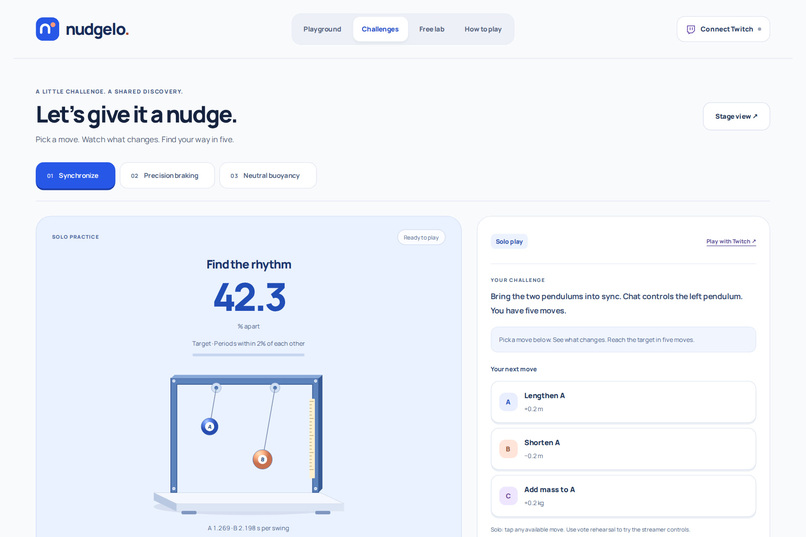
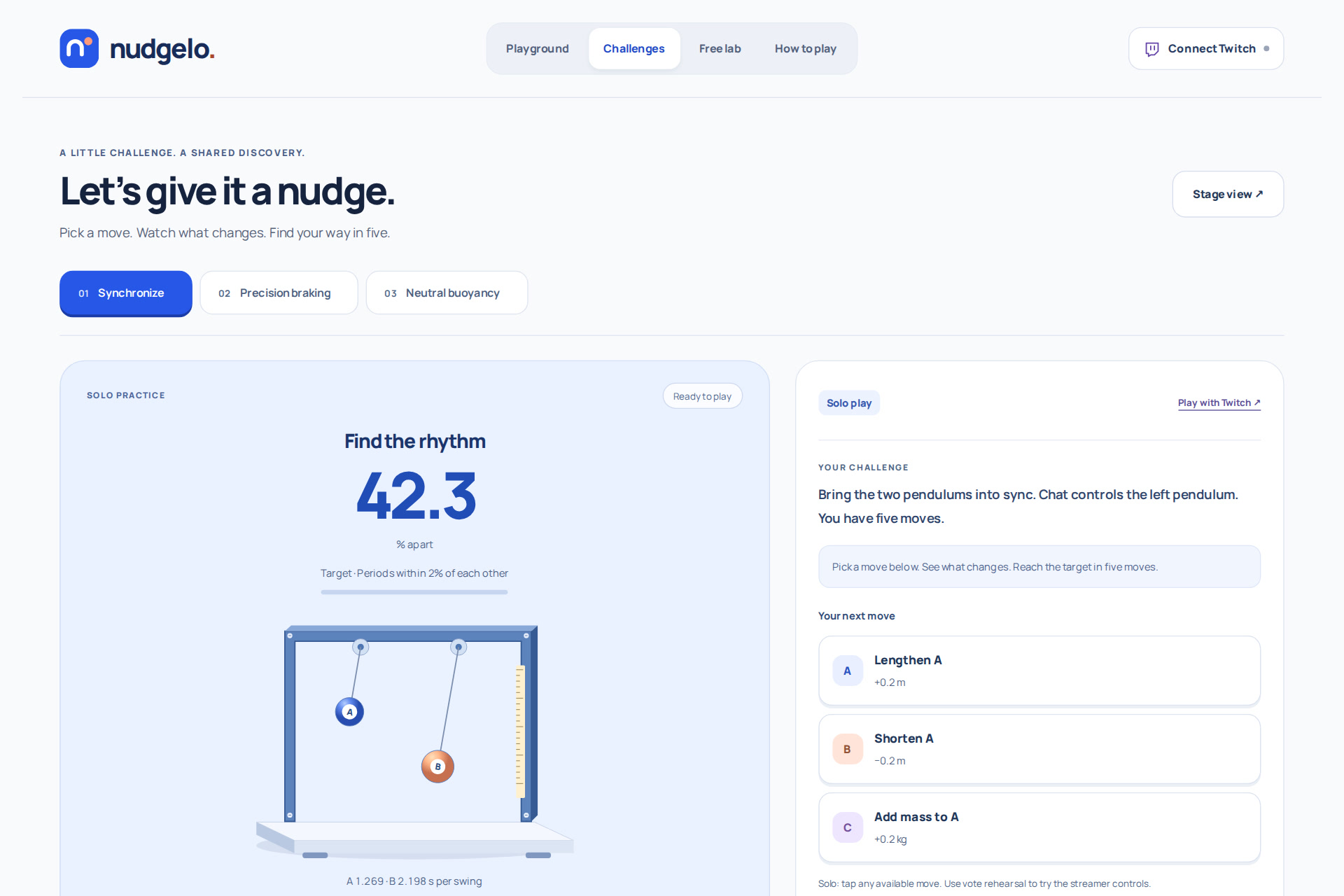
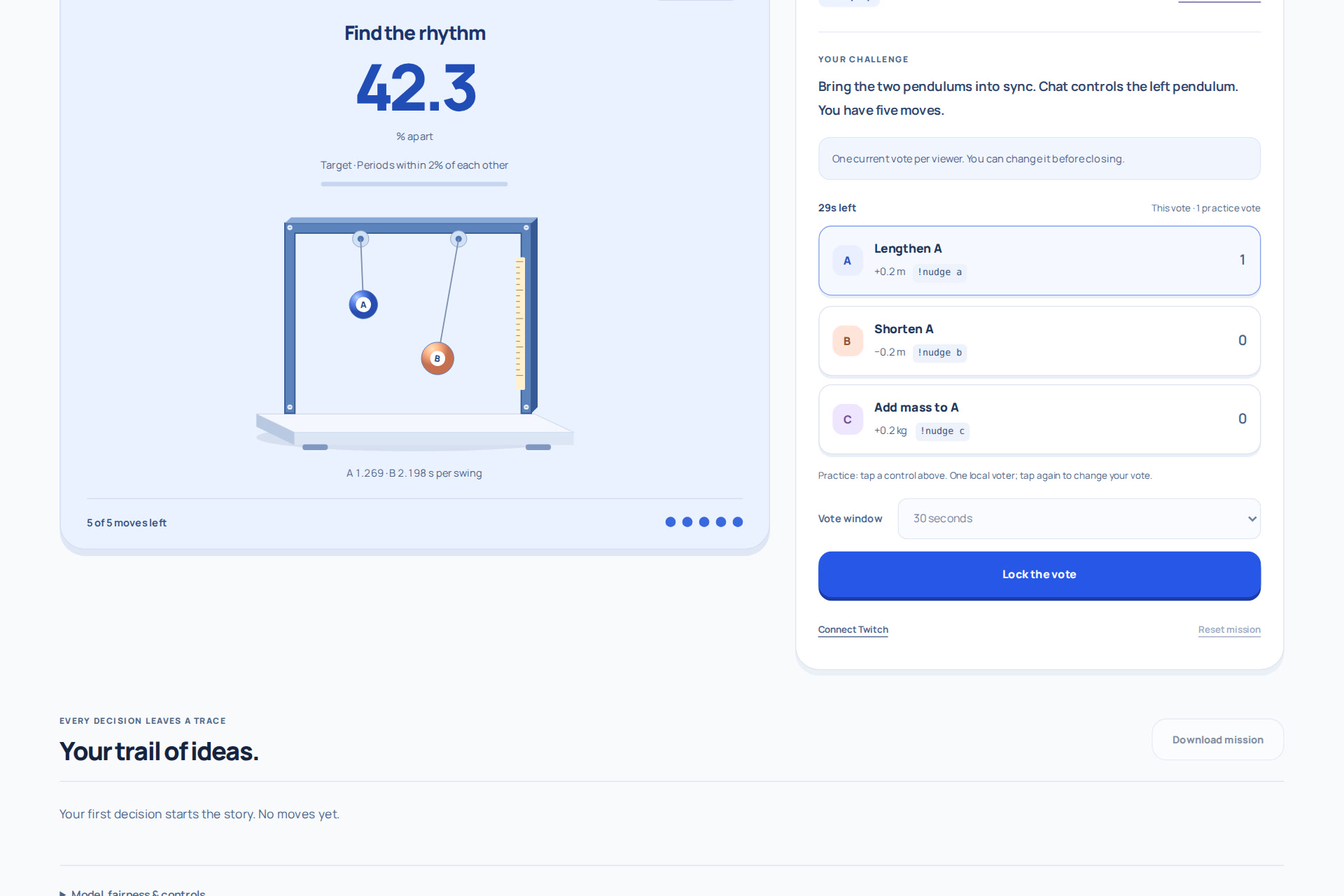
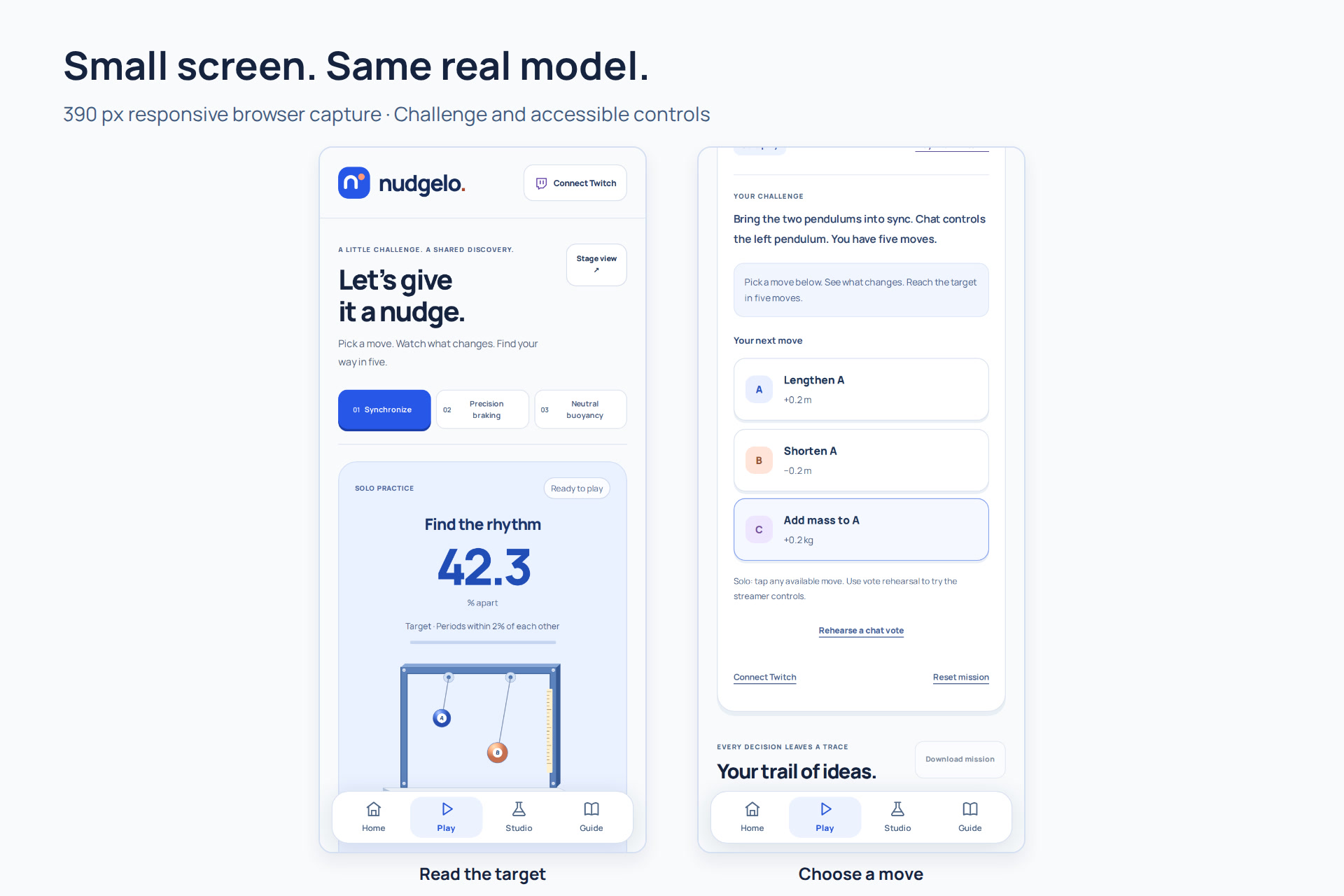
Synchronize starts with a 42.3% rhythm difference and five moves to reach the target.
-
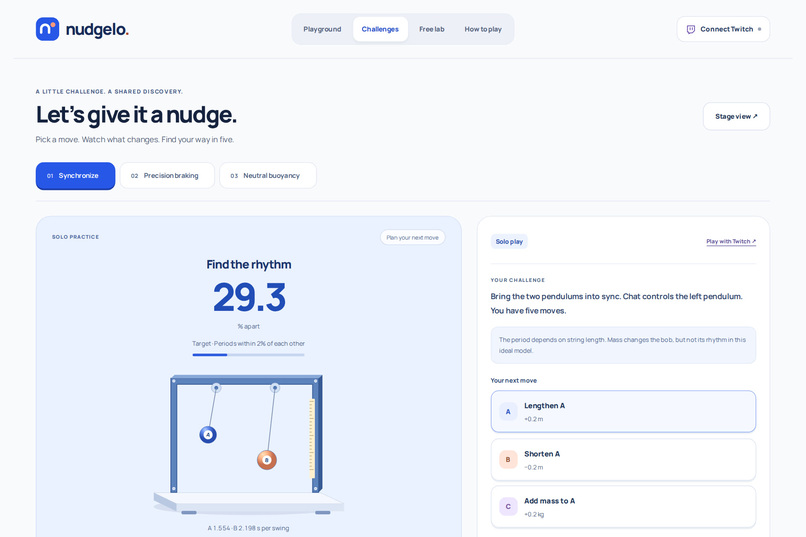
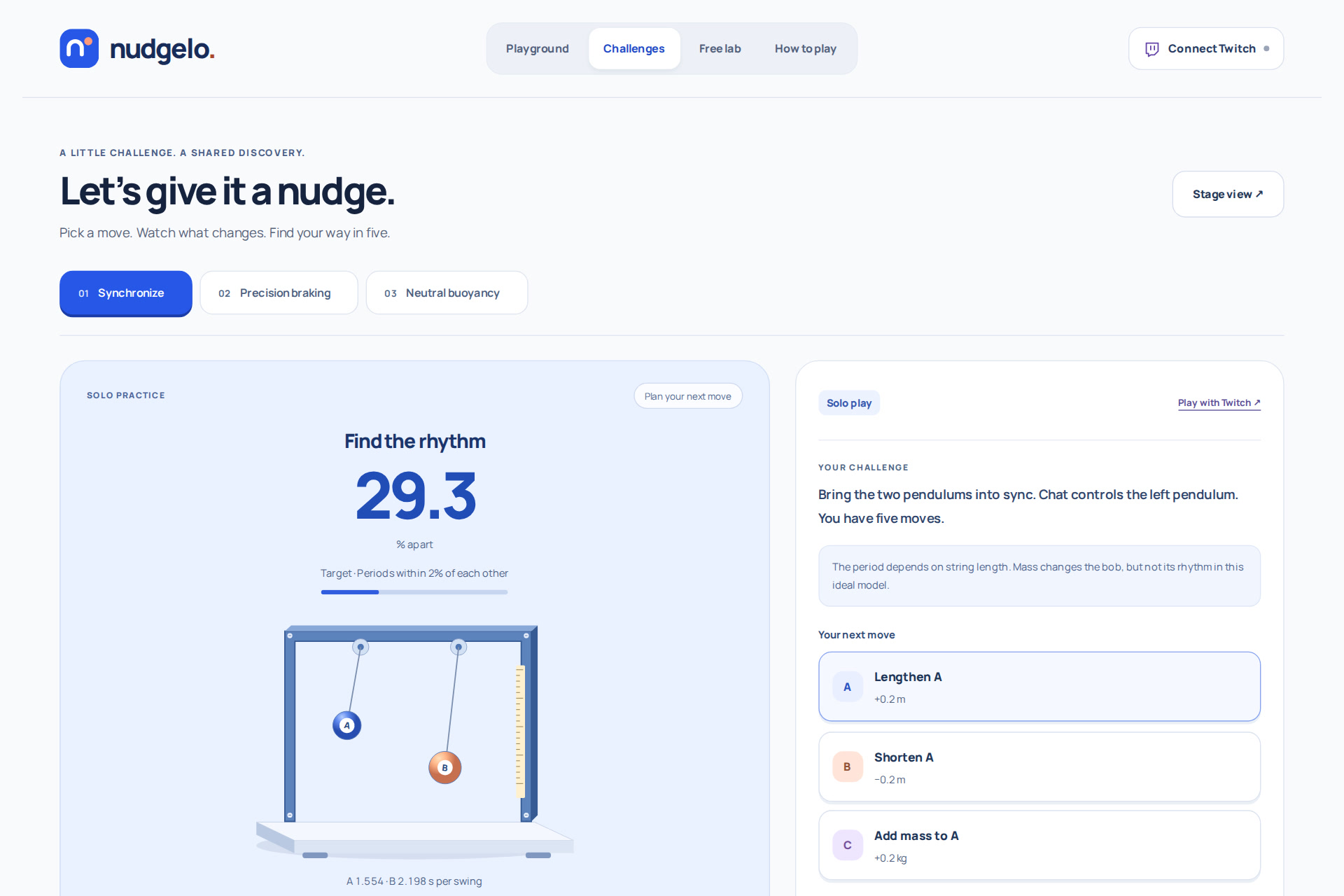
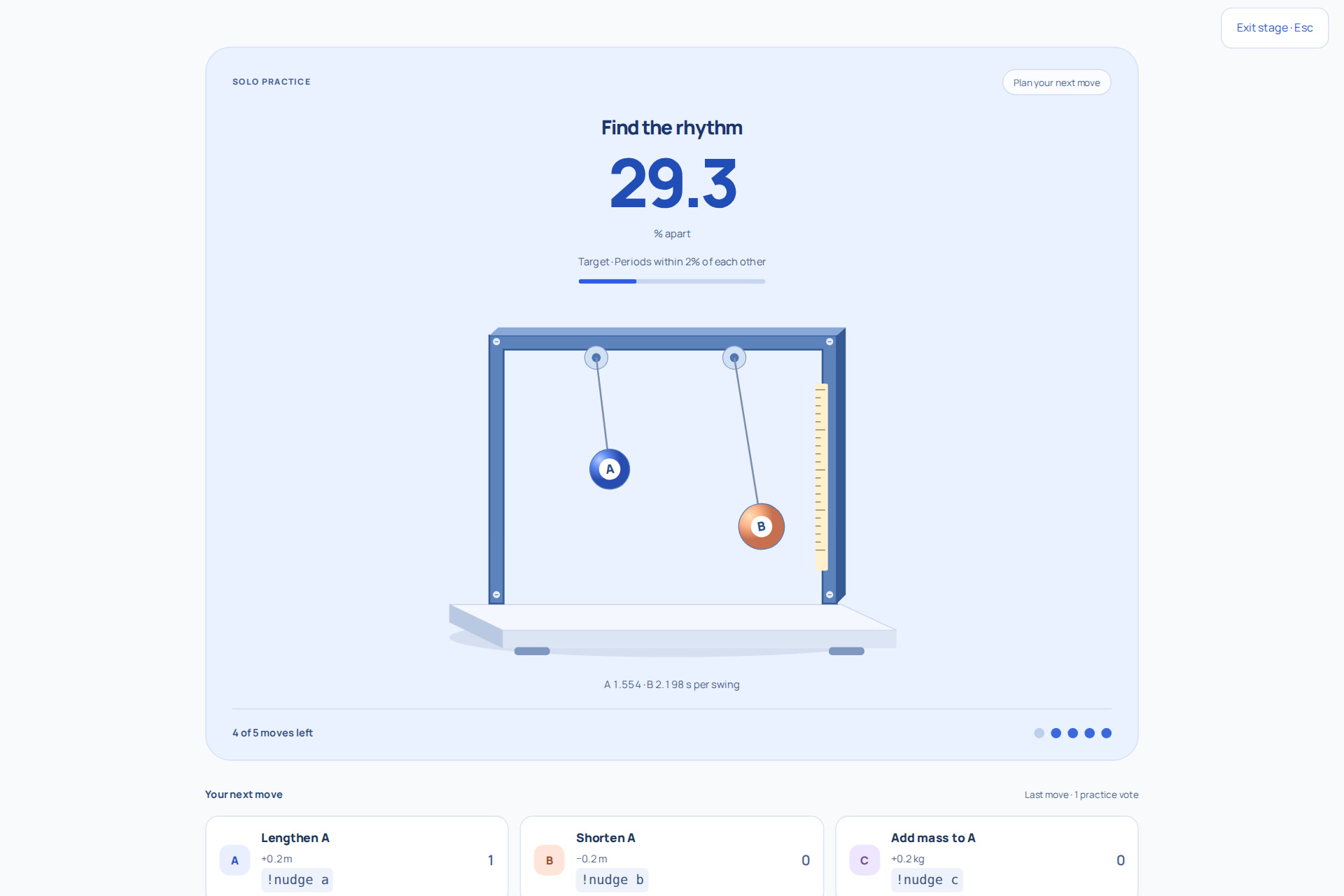
One real length change updates the moving model and its calculated period to 1.554 seconds.
-
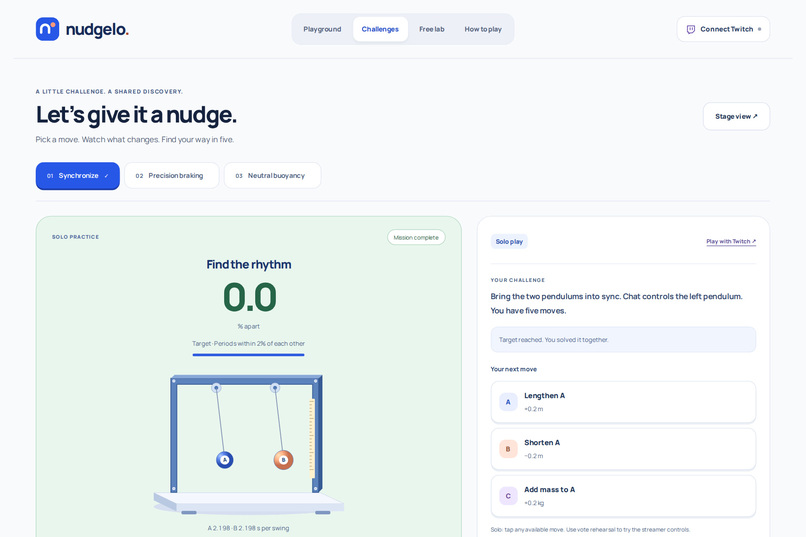
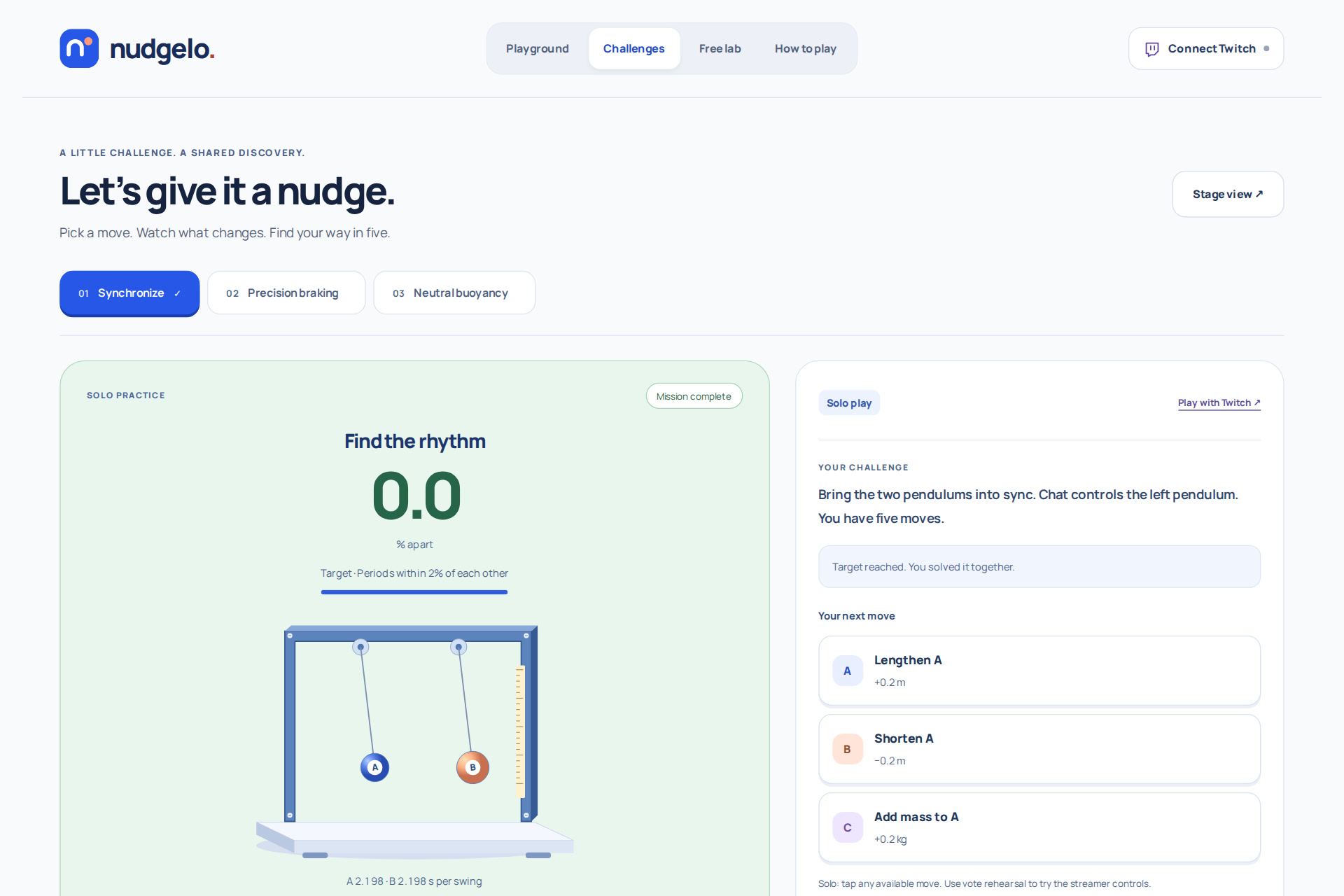
Four length changes reach a 0.0% rhythm difference, with one move left.
-
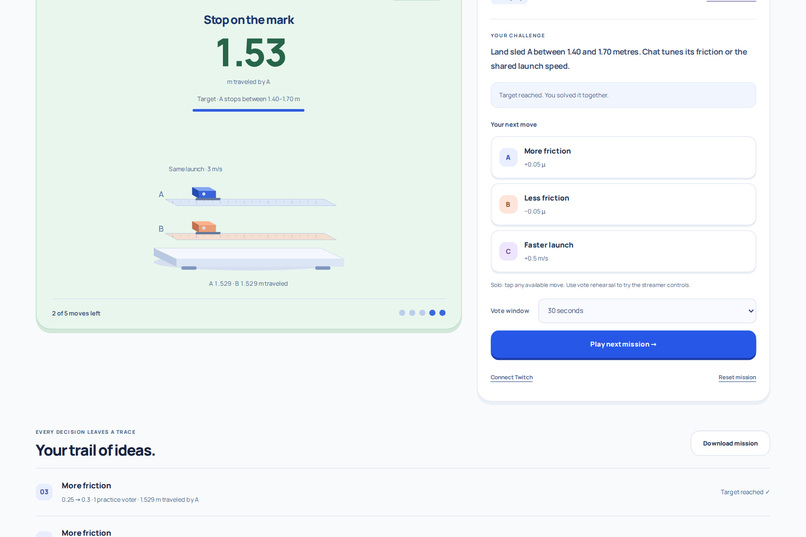
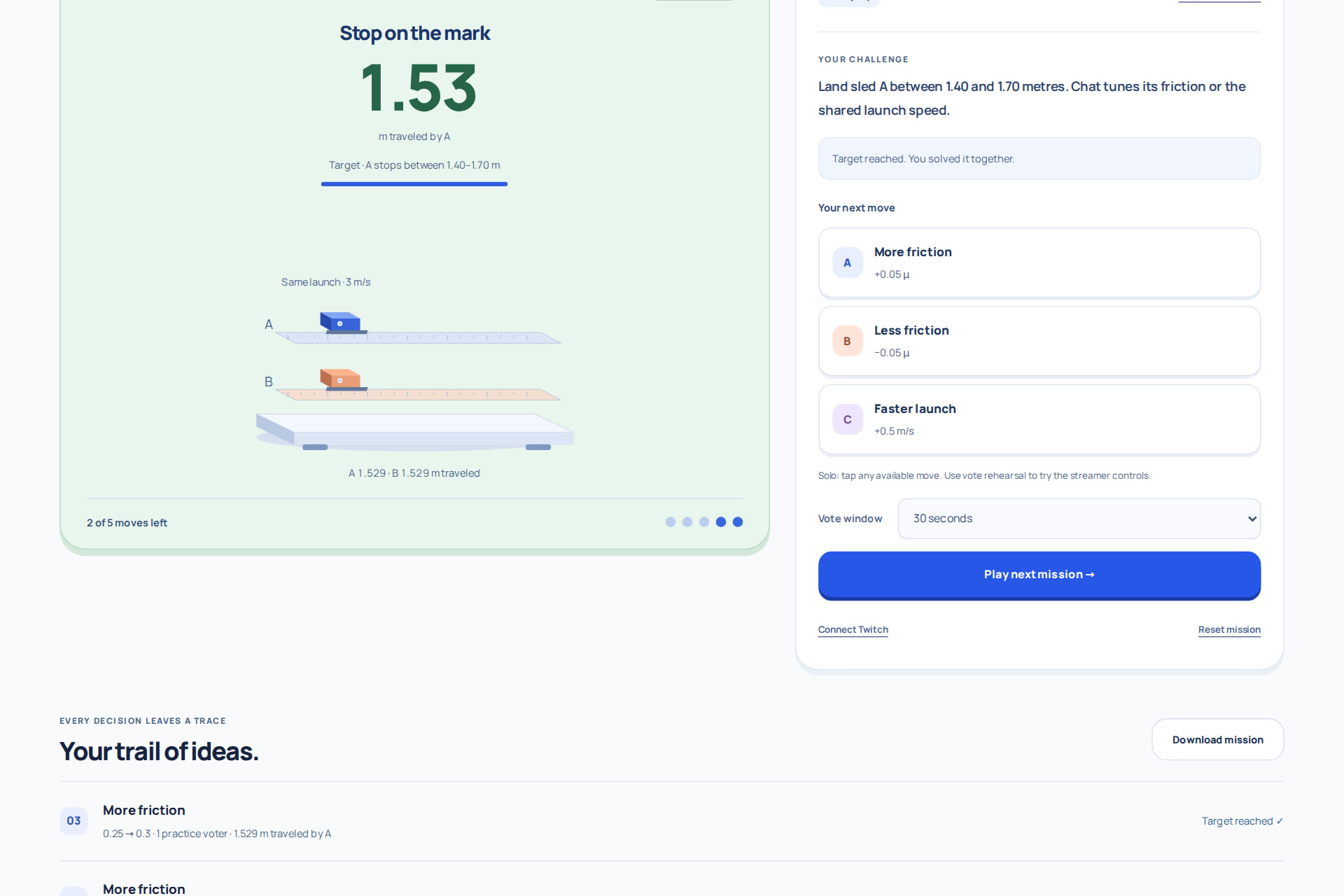
Three friction changes stop the sled at 1.53 m, inside the 1.40–1.70 m target.
-
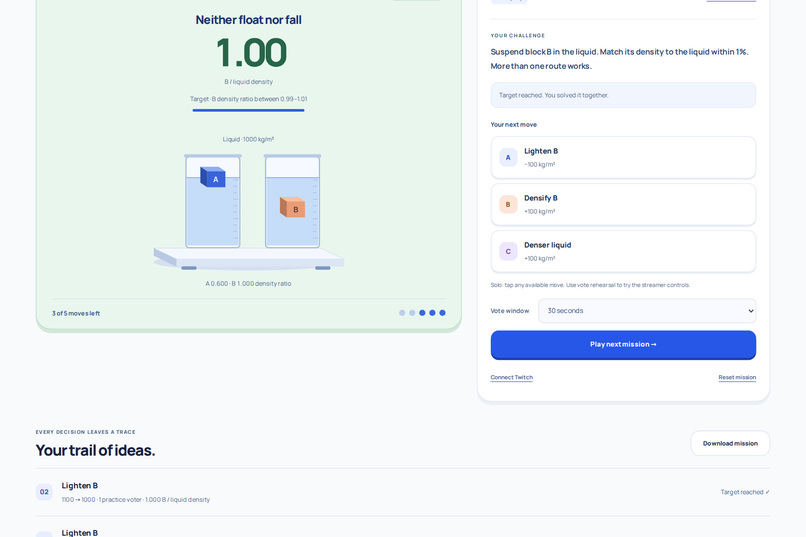
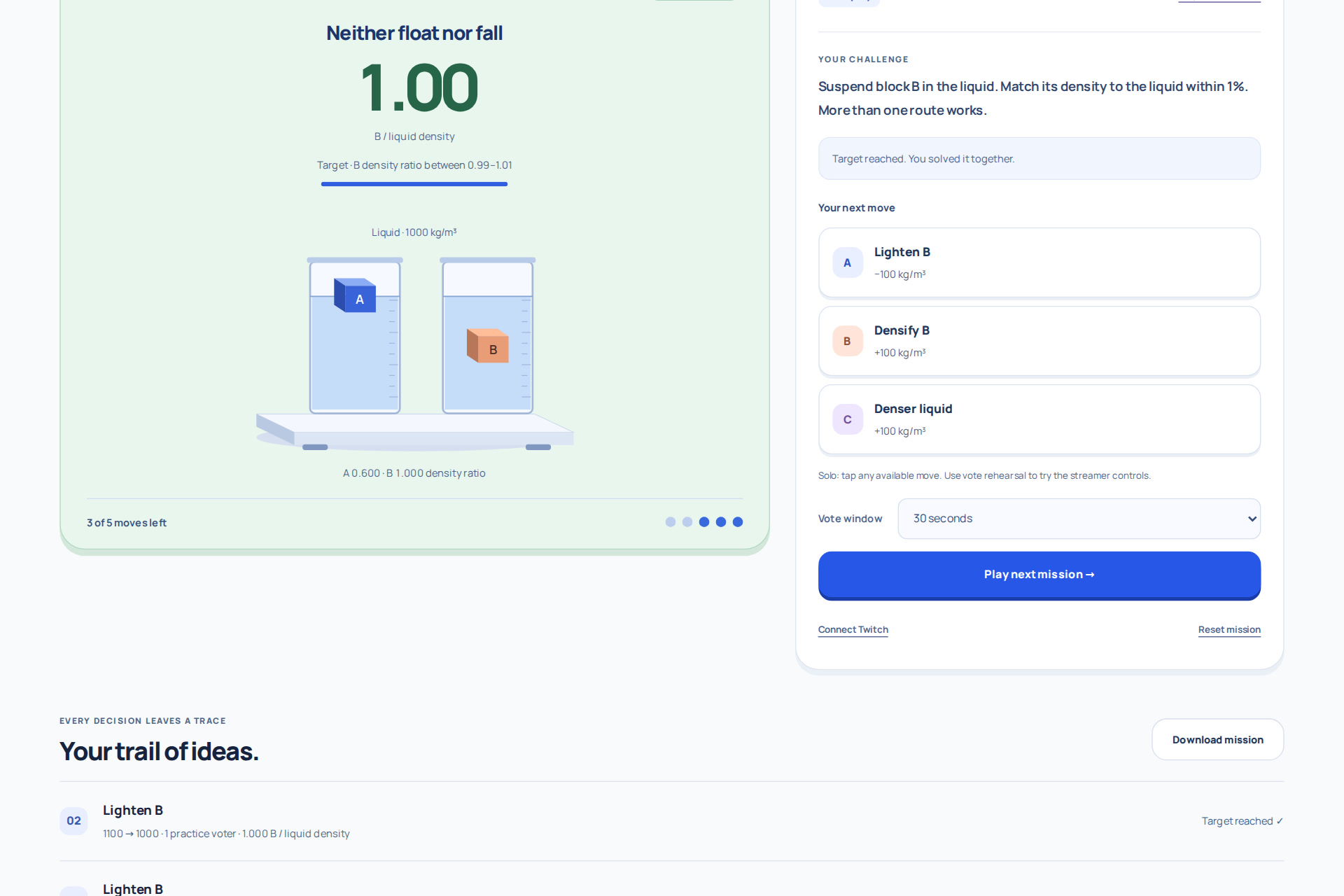
Two density changes reach a neutral buoyancy ratio of 1.00.
-
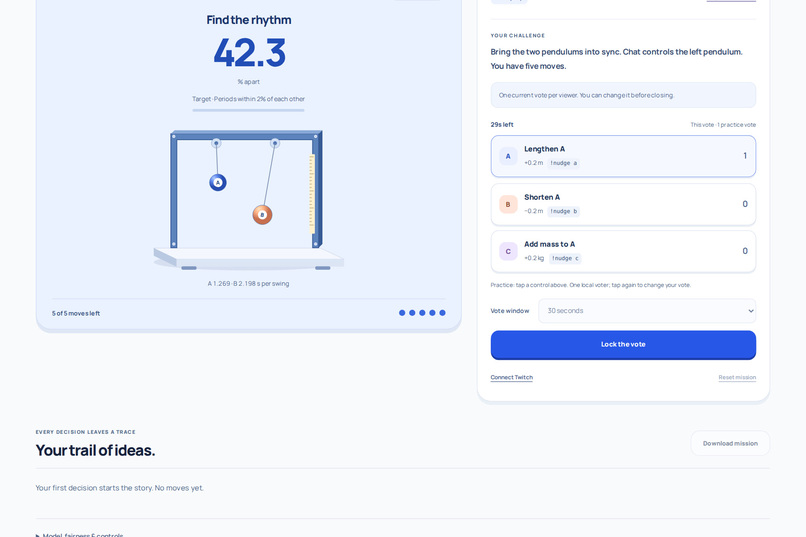
The host can rehearse opening and locking a vote. This is explicitly one local practice voter.
-
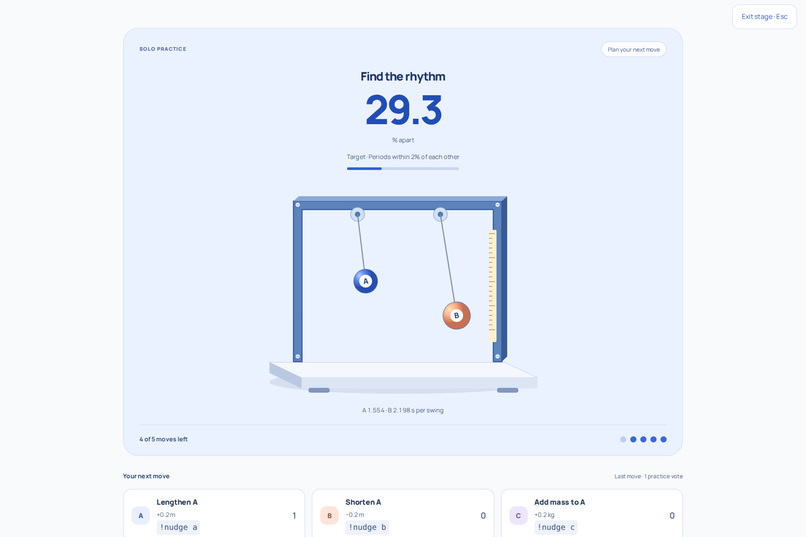
Stage view exposes the model, target and !nudge commands for OBS Window Capture.
-
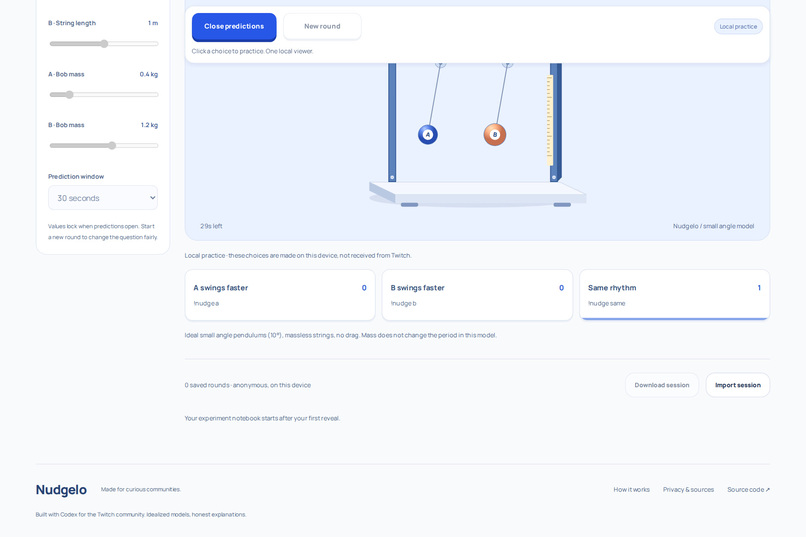
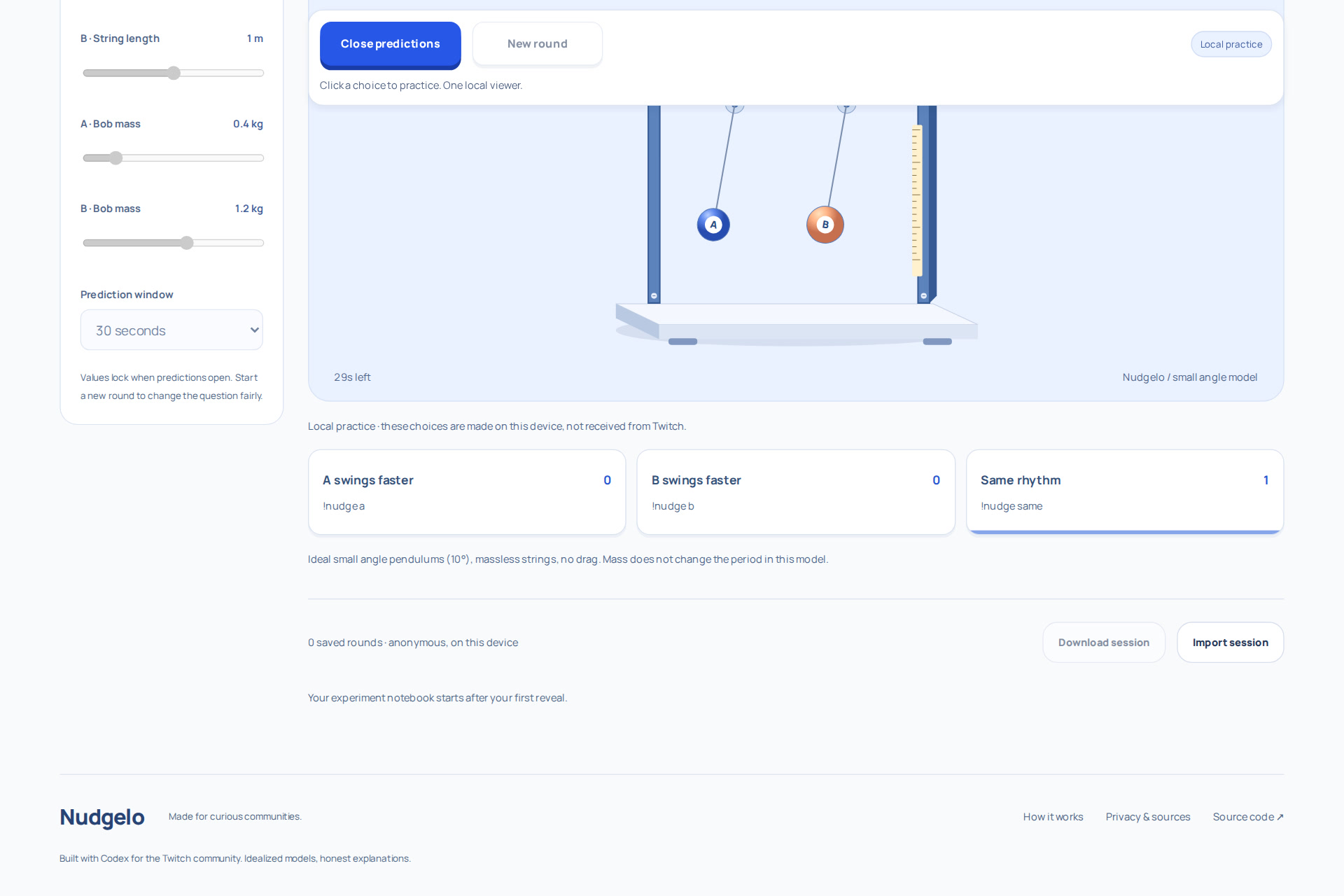
A guided question asks whether changing mass changes a pendulum’s rhythm. Values lock during predictions.
-
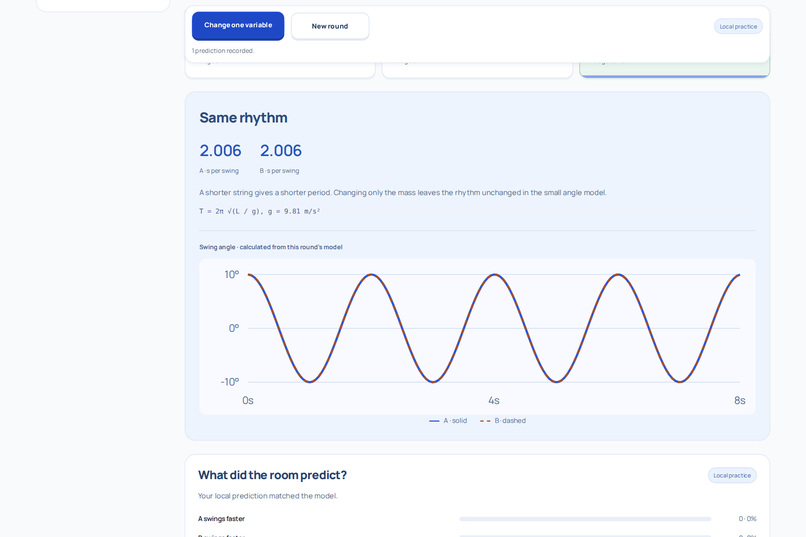
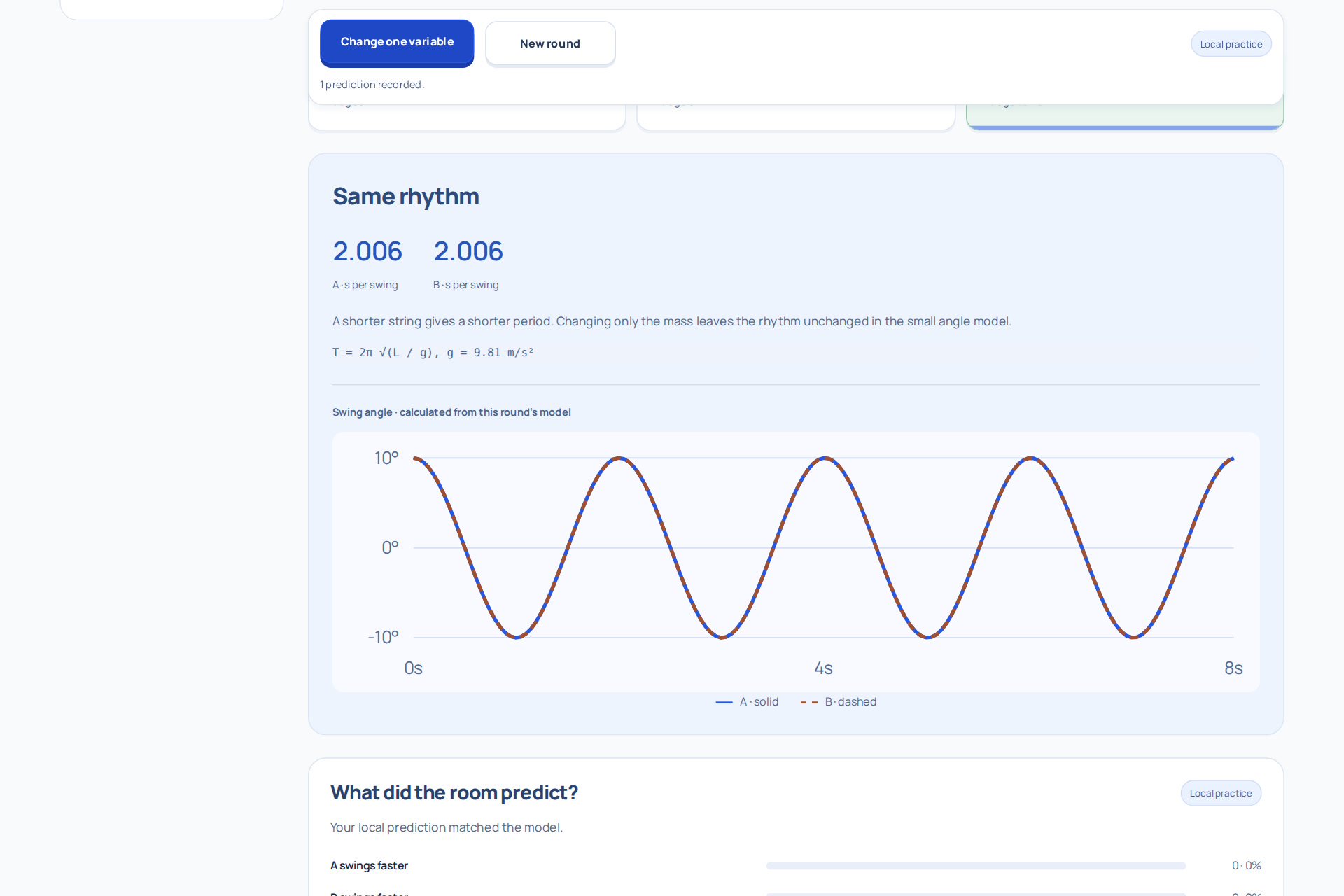
Equal string lengths produce the same 2.006 s period despite different masses, with a model trace.
-
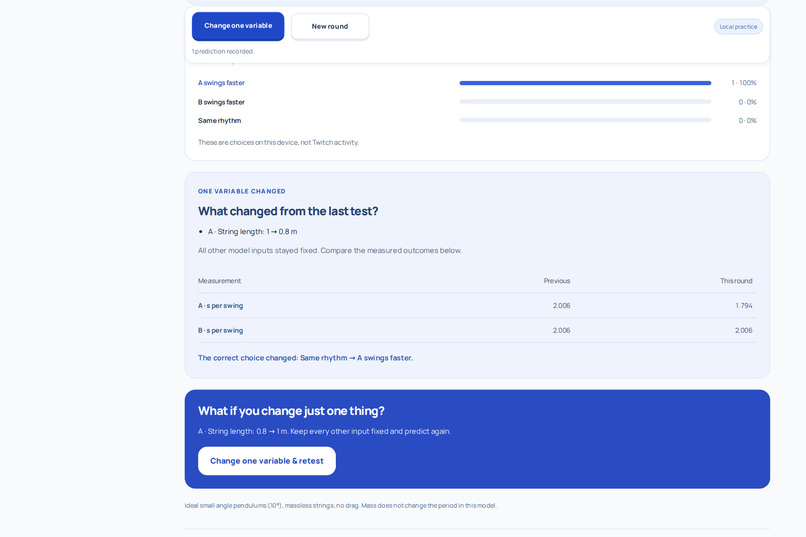
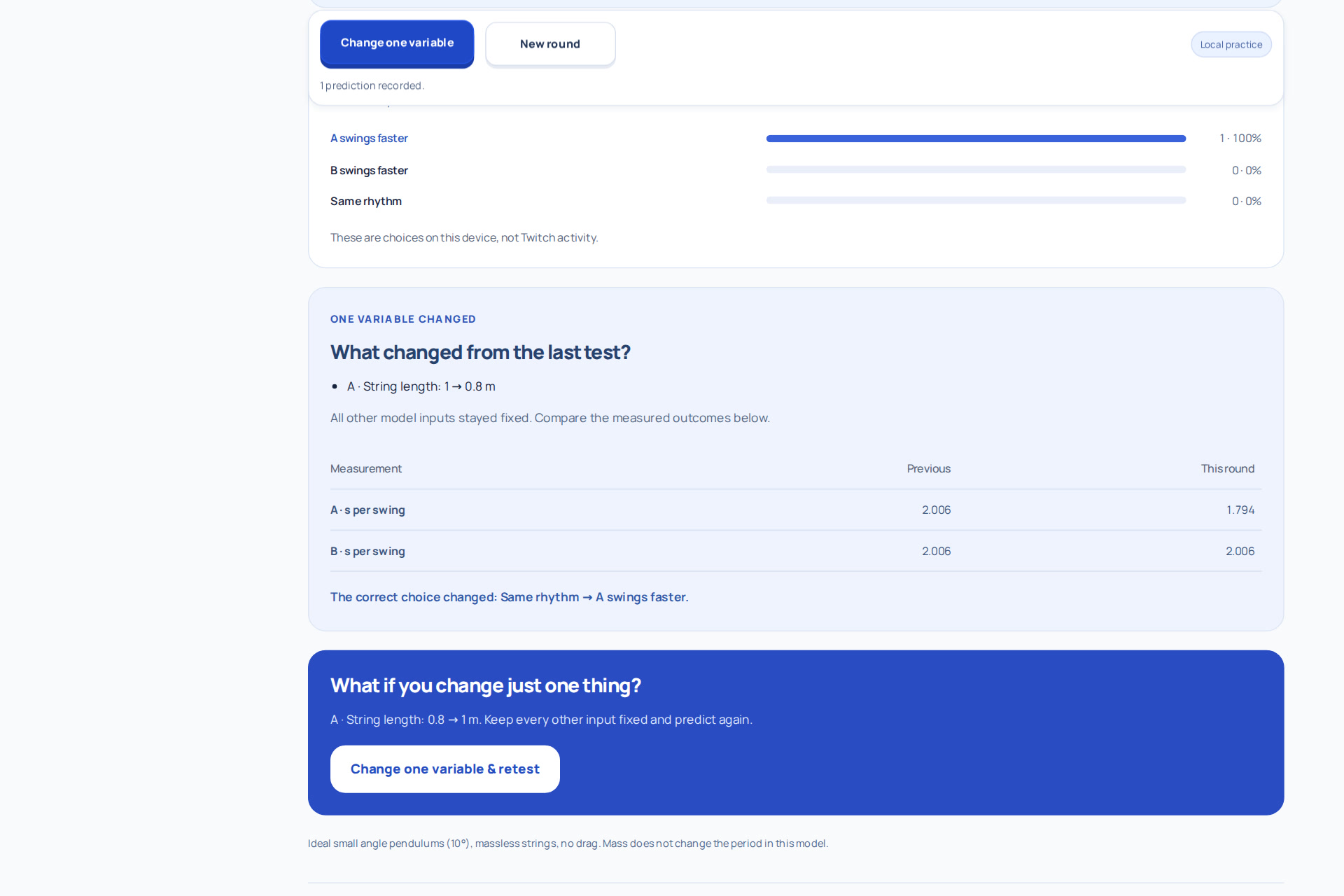
Change one variable and compare the real before-and-after periods: 2.006 s versus 1.794 s.
-
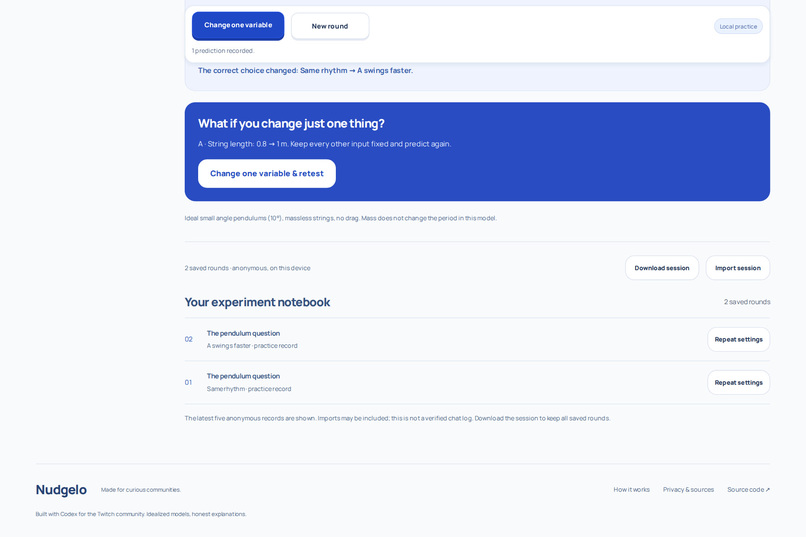
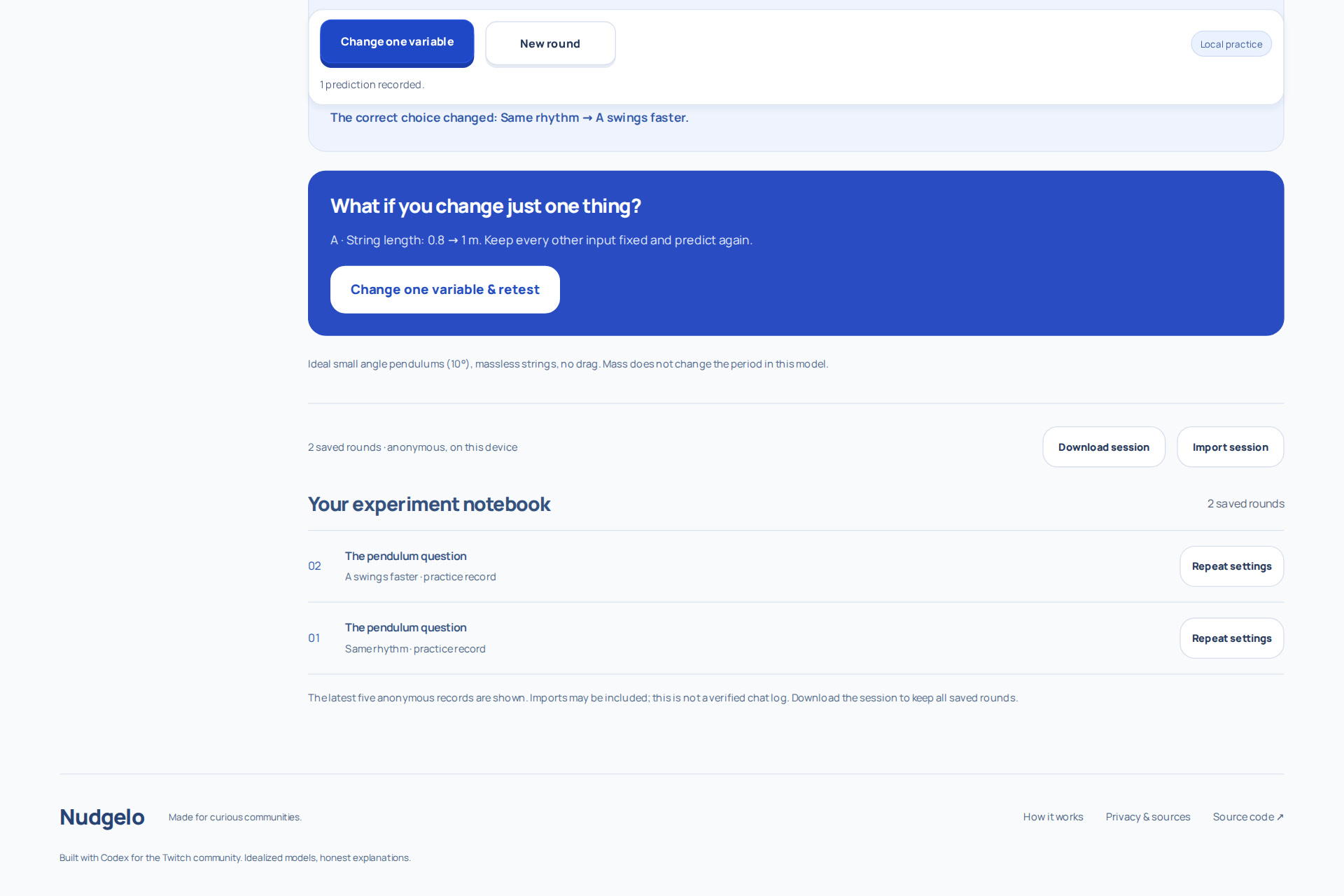
The local notebook retains reproducible rounds. Session downloads omit viewer identities and Twitch tokens.
-
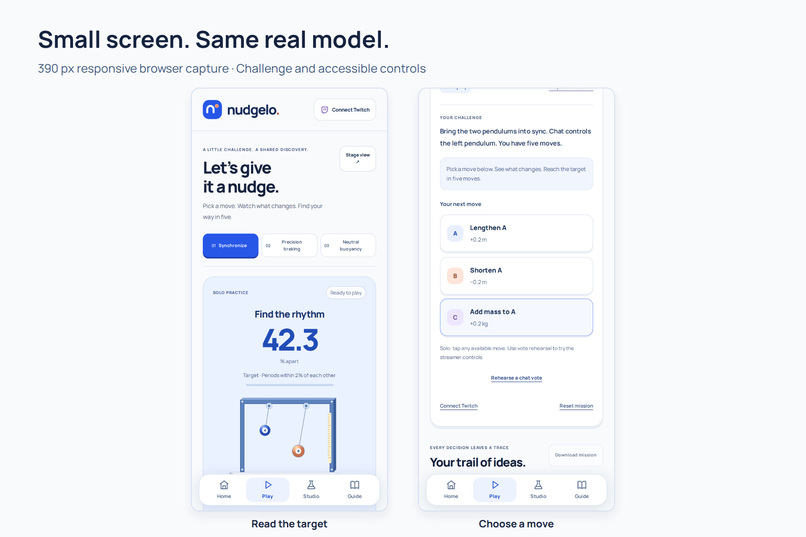
Responsive browser capture at 390 px: Choose a move brings the mobile controls into reach.
-
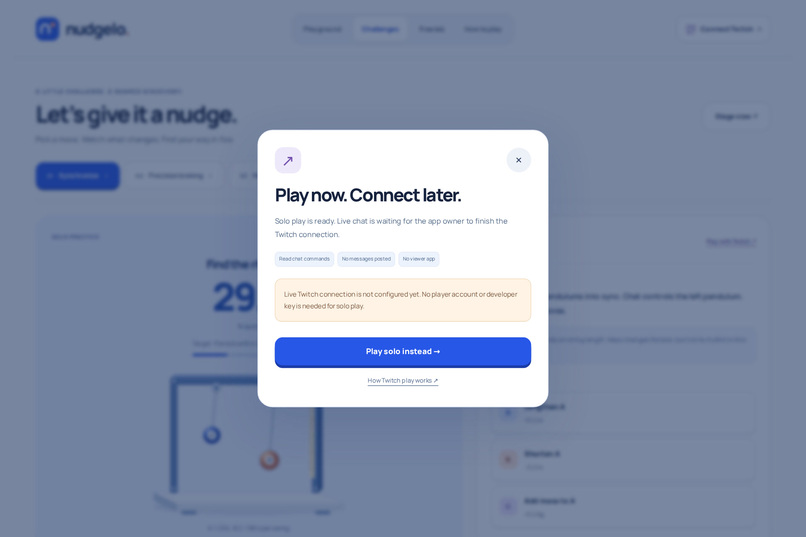
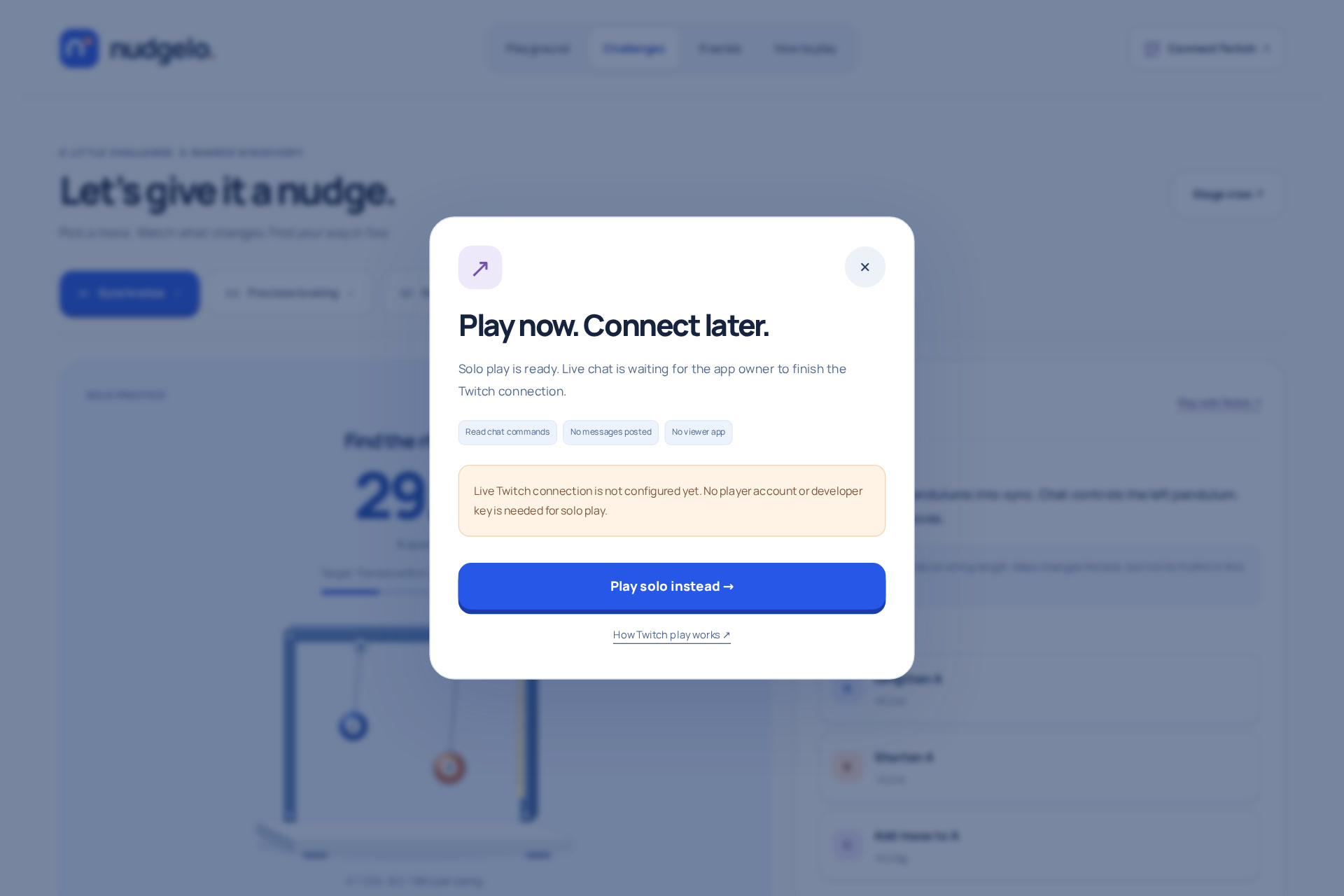
Live Twitch is not configured yet. The app states this clearly and keeps solo play available.
Inspiration
A poll can collect opinions while leaving the audience on the sidelines. We wanted chat to change what actually happens on a stream. Science gives that decision a clear consequence: change a physical input, see the model respond and find out whether the idea helped.
Our first studio let people predict an outcome. Reviewing that flow exposed its weakness: the audience still had no control. We rebuilt the main experience around cooperative calibration missions while preserving the free experiment studio.
What it does
Nudgelo gives a Twitch community five moves to solve one shared physical problem. Viewers choose a control through !nudge a, !nudge b or !nudge c. The unique most-voted action changes one bounded input. The instrument moves, the measurement updates and the group plans its next decision.
Three missions are included: synchronize two pendulums, stop a sled inside a 1.40–1.70 metre target, and suspend a block at neutral buoyancy. Some tempting moves do not help; changing pendulum mass, for example, cannot fix its period in the ideal small-angle model. Buoyancy permits more than one valid strategy.
Nudgelo opens with a working interactive toy, clear top navigation and colorful puzzle cards. Original blue/coral instruments carry the same design through the missions and free lab. The game shows the target, remaining moves, commands, current input source and anonymous action trail. Ties, empty ballots and controls at their limits do not consume a move. Solo play applies a move with one tap. Chat-vote rehearsal is explicitly one local voter. Once the owner finishes the shared Twitch application setup, players authorize with one button without entering developer credentials. Stage view exposes the instrument and commands for OBS Window Capture. It does not synchronize an independent OBS Browser Source.
The new !nudge command preserves compatibility with existing !trial commands. For open-ended exploration, the studio supports custom inputs, predictions, calculated traces, one-variable retests, actual before/after comparisons and a validated anonymous notebook.
How we built it
Codex supported official-rule research, competitor comparison, the product revision, physics and voting modules, responsive interface, Twitch integration, regression tests and deployment. No runtime AI or paid inference key is needed.
The application uses HTML, CSS, browser JavaScript modules and original SVG instruments. Pure equations supply both the movement and reported measurement. The game engine keeps ballot state, applies bounded actions and evaluates the target. Twitch OAuth, Helix and EventSub WebSockets provide an own-channel read-chat path. Tokens remain in memory/sessionStorage and never enter source or downloads. There is no client secret, chat-writing permission or remote chat archive.
Challenges we ran into
Audience control needs a fair boundary. A viewer changing a choice must replace a vote, not add another. Duplicate delivery and stale messages must not count. An interrupted Twitch ballot must not apply partial results. We reuse a guarded ballot lifecycle, then apply a single consensus action only after voting closes.
Browser checks caught a native fetch binding bug that Node mocks missed. Later game tests caught a fixture session-reset mistake; the fixture now reloads its controlled connection explicitly. The mobile review also moved the primary turn action into reach and scrolls between choices and the instrument at the appropriate step.
Accomplishments we're proud of
The three targets are reachable through the actual UI and model. Browser checks also verify a five-move loss, anonymous action export, Stage view commands, no-vote handling, navigation cancellation and controlled Twitch tie/disconnect behavior. The existing studio's guided retest remains functional.
38 model/protocol/security tests and 35 browser journeys passed. 72 route/width combinations at 320–1920 CSS pixels had no horizontal overflow. Twelve automated accessibility states had no detected WCAG-tagged violations; incomplete checks remain documented. Dependency audit reported no known advisories. These are bounded engineering checks, not accessibility or penetration-test certification.
What we learned
Giving chat agency changes the product more than adding decorative features. A measured target, a small move budget and a clear consequence create something people can discuss together. Scientific honesty matters too: a calculated model output is not a sensor reading, neutral buoyancy is not surface floating, and a protocol fixture is not proof of real Twitch operation.
What's next
Complete real-channel verification, record the actual Twitch-and-Codex demonstration, then test with creators and assistive-technology users. Creator adoption, learning outcomes and engagement improvements have not been measured.
Integration status: Real-channel verification awaits the application's owner registration and channel authorization. Protocol fixtures are development tests, not live Twitch evidence.
Live: https://nudgelo.vercel.app/
Code: https://github.com/adeelfalaksher900-creator/nudgelo
Built with: OpenAI Codex, JavaScript, HTML, CSS, SVG, Twitch API, Twitch EventSub, OAuth, WebSocket, Vercel, Playwright, axe-core.
Built With
- axe-core
- css
- eventsub
- html
- javascript
- oauth
- openai-codex
- playwright
- svg
- twitch
- vercel
- websocket