Inspiration
Clinical trial recruitment is often slow, repetitive, and frustrating for both participants and research coordinators. Potential participants may fill out long forms or repeat the same information across several studies, while coordinators spend valuable time manually reviewing incomplete responses and scheduling follow-ups. We wanted to make early trial discovery more accessible: one friendly conversation that can help identify potential matches across multiple studies, while keeping final decisions in the hands of clinical research staff.
What it does
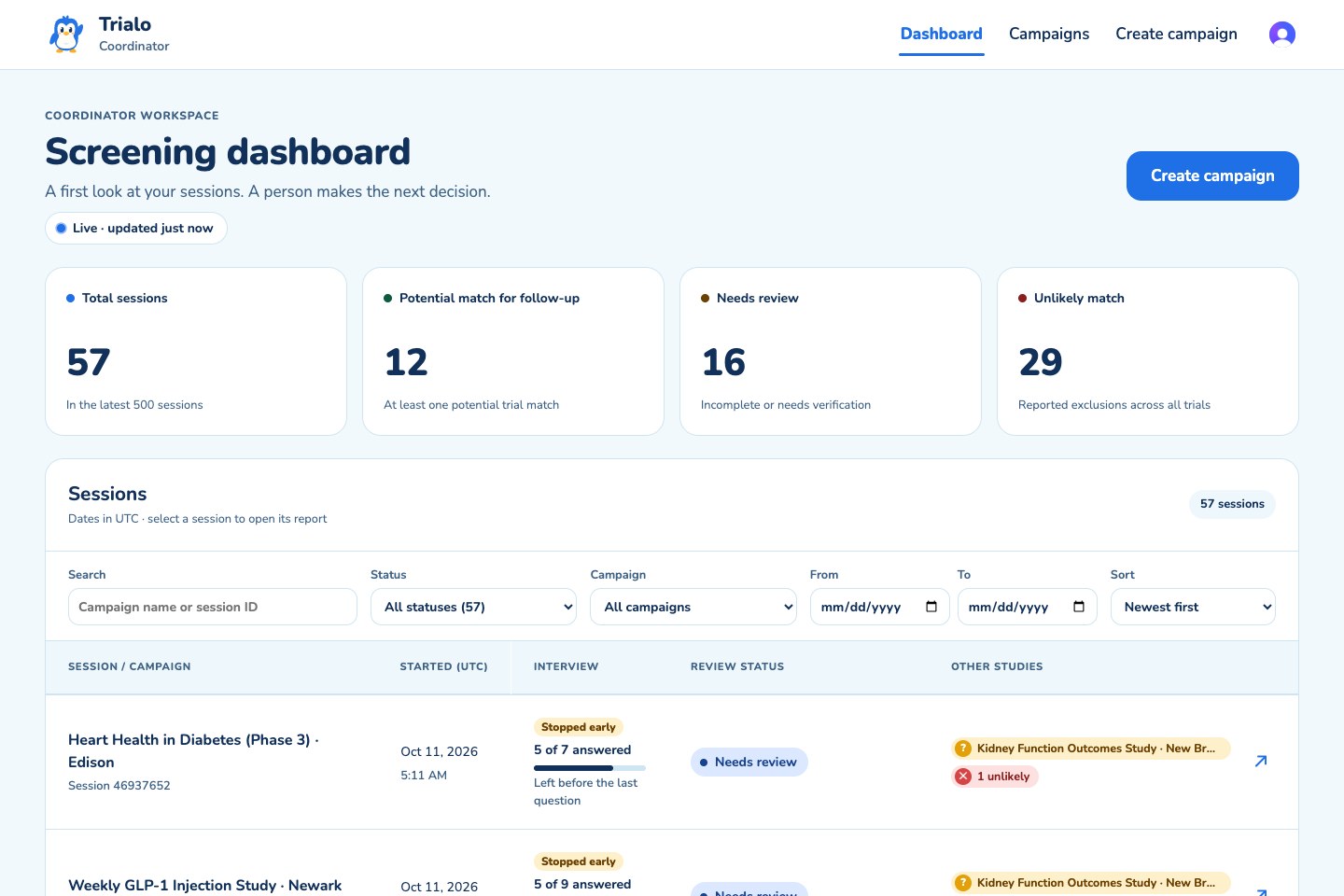
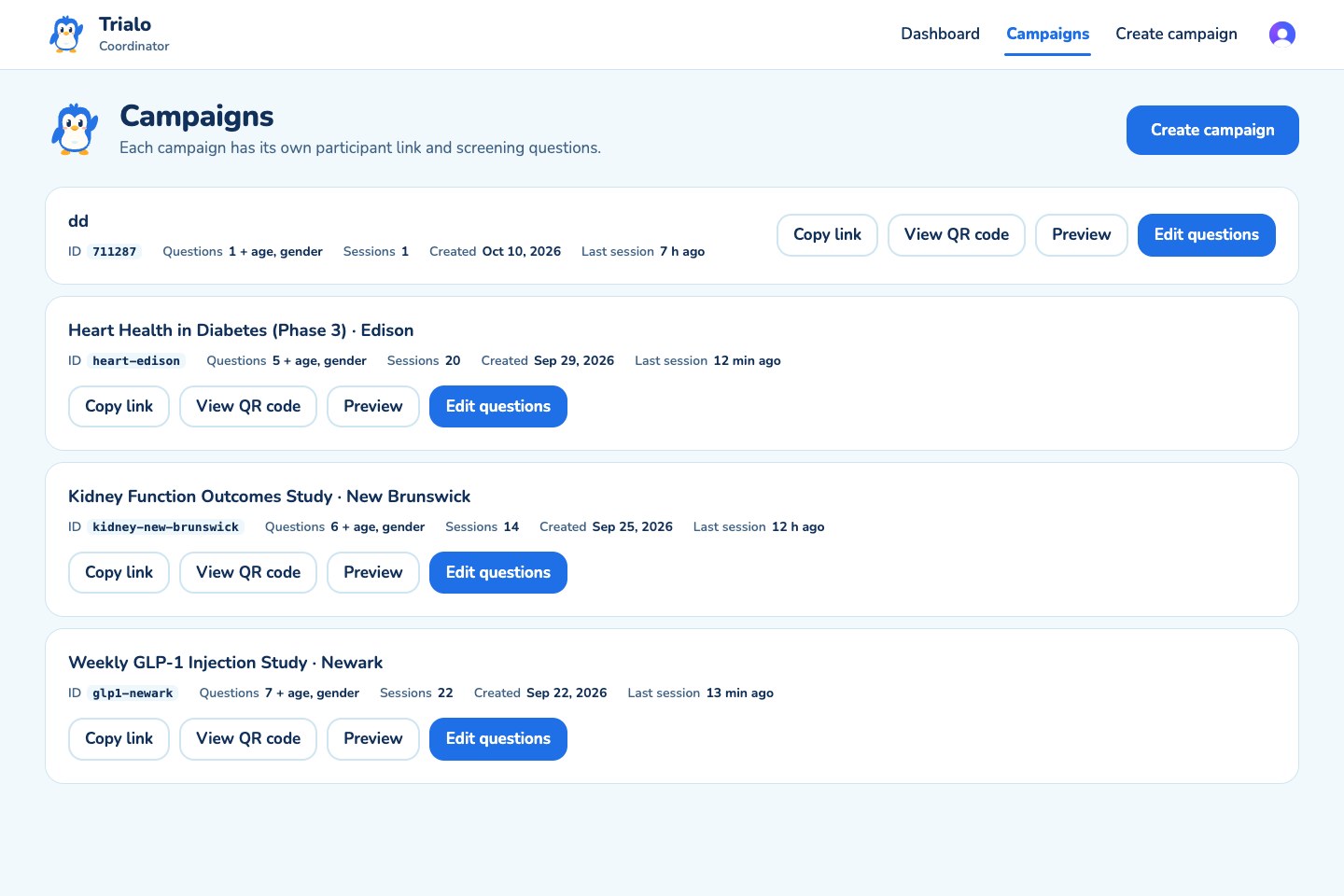
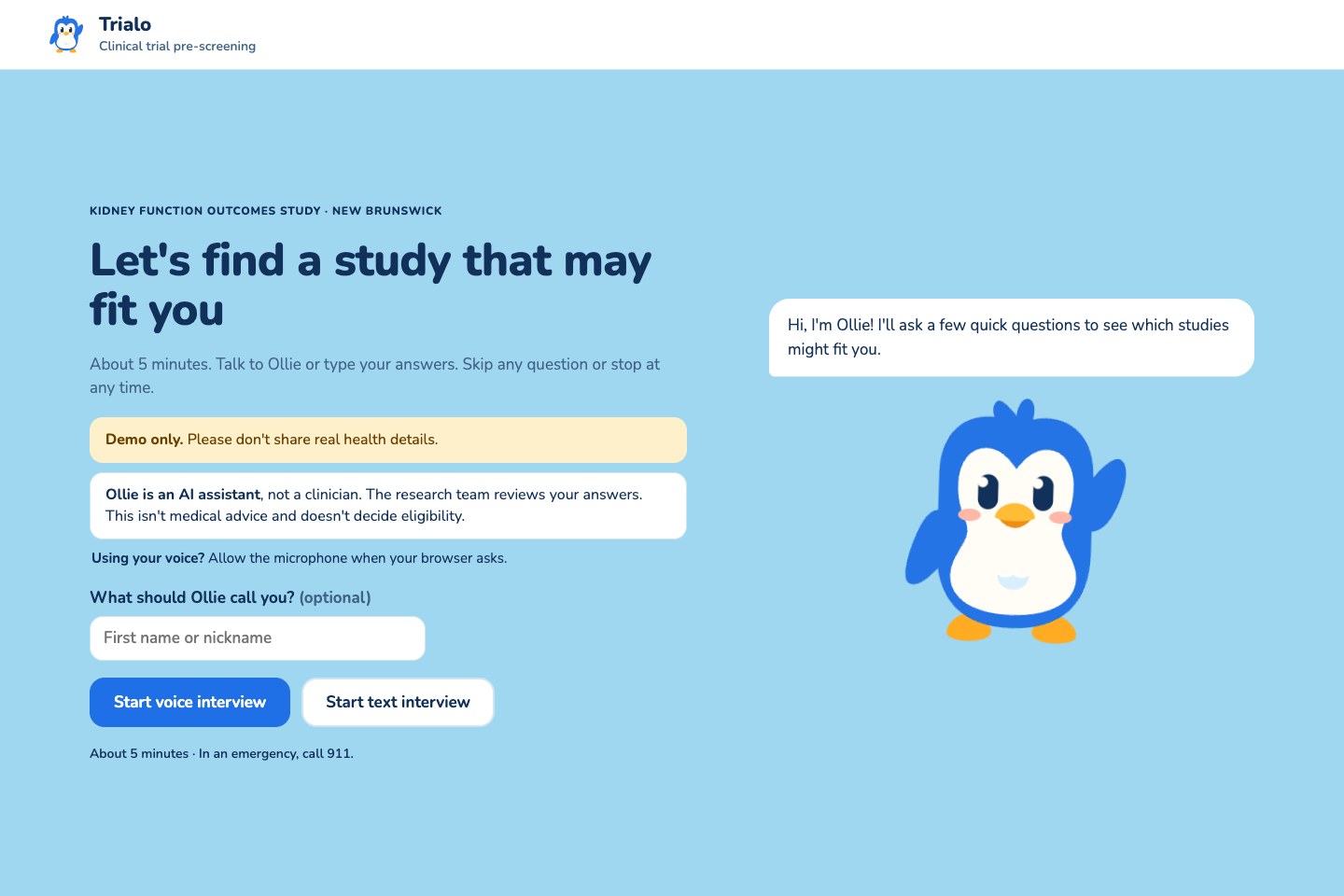
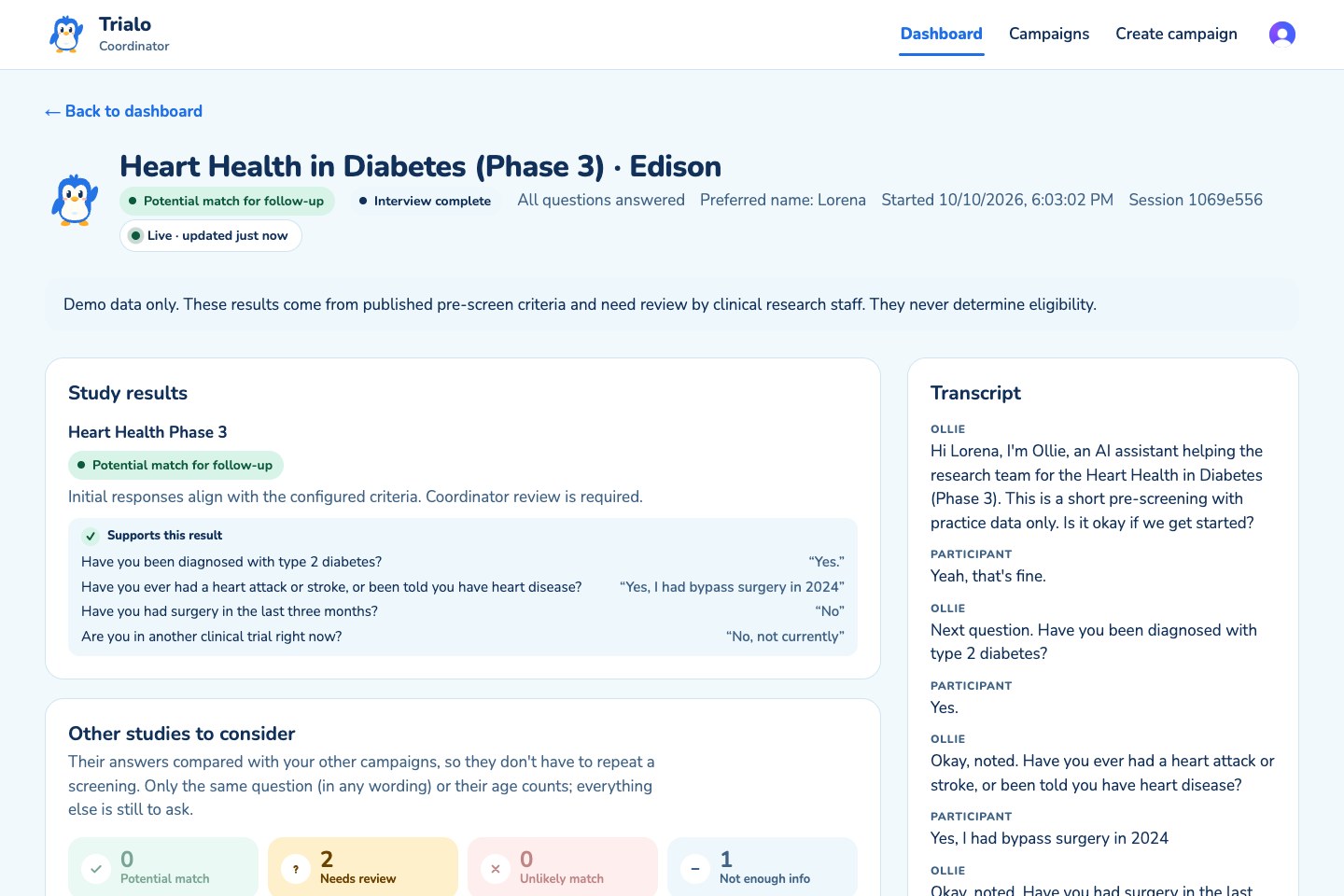
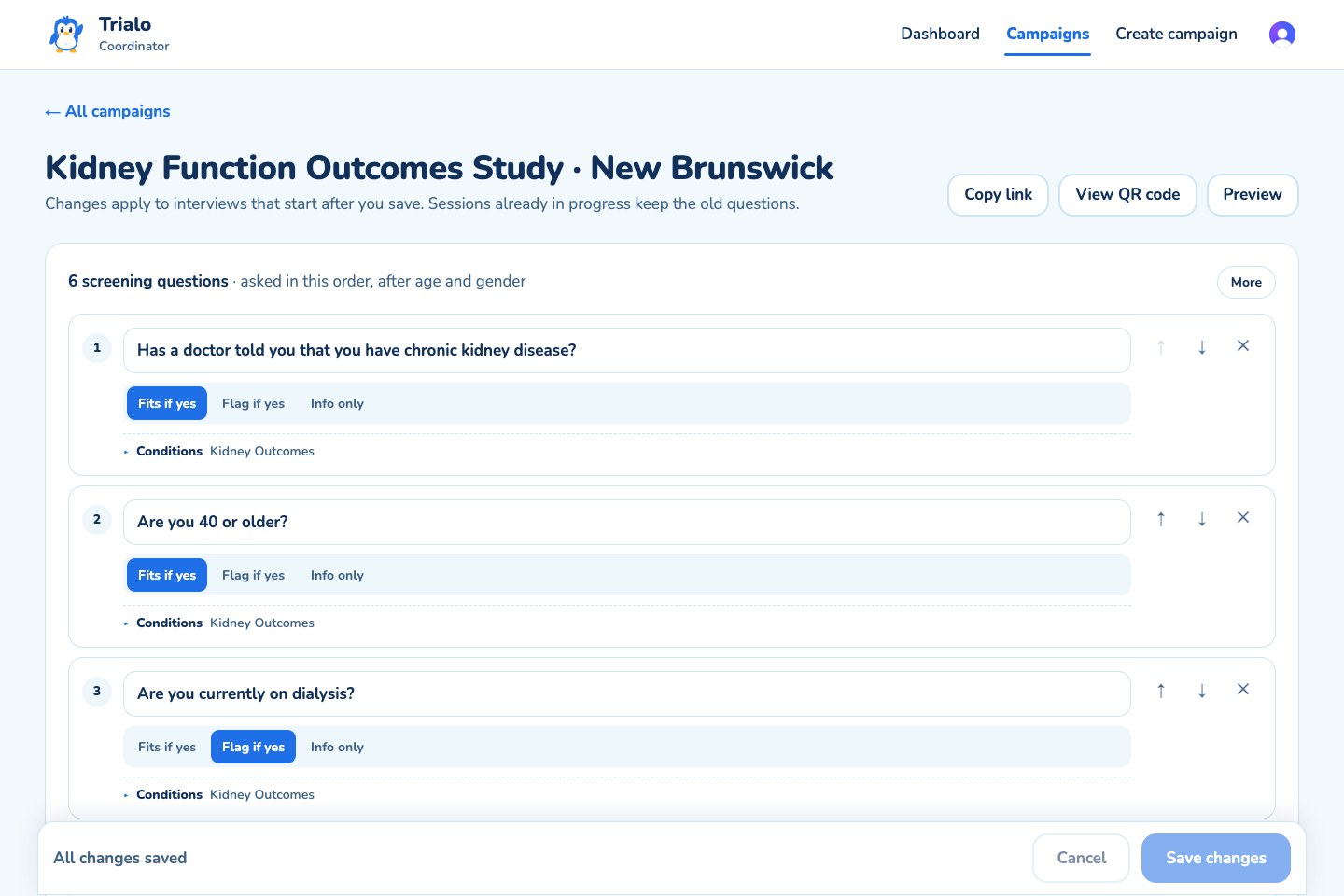
Trialo is a voice-powered clinical trial pre-screening platform. A coordinator creates a screening campaign, adds inclusion, exclusion, and informational questions, then generates a shareable link and QR code. Participants can scan the QR code on their phone and speak with Ollie, Trialo’s ElevenLabs voice agent, or use a text-based alternative. Ollie asks one question at a time, saves confirmed answers as structured data, and flags each study as a potential match, possible exclusion, or needing more information. Coordinators can view participant sessions, responses, preliminary results, and follow-up needs in a centralized dashboard. Trialo performs preliminary screening only. It does not provide medical advice, determine eligibility, or promise enrollment.
How we built it
We built Trialo with:
- Next.js and React for the participant and coordinator experiences
- ElevenLabs Conversational AI for Ollie’s voice interview
- ElevenLabs dynamic variables to provide each campaign’s specific question list
- ElevenLabs client tools to save confirmed responses during a conversation
- Supabase for campaign, session, answer, and matching-result storage
- Netlify for deployment
- QR codes for quick mobile access to participant interviews The coordinator workflow supports creating and editing question sets, labeling questions as inclusion, exclusion, or informational, and sharing a unique campaign QR code. The participant workflow includes voice and text options, captions, progress indicators, quick responses, and a clear AI and demo-data disclosure. ##Challenges we ran into The biggest challenge was making a conversational voice agent behave like a structured clinical pre-screening flow. We needed Ollie to sound natural and supportive while also asking questions in order, collecting data consistently, and avoiding medical advice or eligibility claims. We solved this with explicit guardrails, structured question fields, dynamic variables, and a blocking client tool that saves each confirmed answer. We also encountered platform-level medical-content guardrails that initially interrupted the conversation when participants mentioned diagnoses or medication. We adjusted the agent configuration so it could collect non-diagnostic screening information while preserving safety rules around medical advice, emergencies, and eligibility decisions. Another challenge was balancing a polished participant experience with a coordinator workflow that remained simple enough to demonstrate clearly during a hackathon. ##Accomplishments that we're proud of
- Built an end-to-end coordinator-to-participant screening workflow.
- Created a friendly voice agent that collects structured answers rather than only producing a transcript.
- Enabled one participant interview to support preliminary matching across multiple studies.
- Built mobile-friendly QR-code access, voice interaction, text fallback, captions, and progress tracking.
- Created a coordinator dashboard for live session monitoring, preliminary outcomes, and detailed participant reports.
- Kept human research staff in the loop for all final decisions.
- Used synthetic data and clear disclosures to keep the hackathon demo responsible. ##What we learned We learned that voice AI can make healthcare workflows feel more approachable, but only when trust and boundaries are designed into the experience from the start. We also learned that clinical-trial workflows require more than a good chatbot. They need structured data capture, transparent uncertainty, clear coordinator handoff, and careful language that does not overstate what AI can decide. Most importantly, we learned that the best use of AI here is not replacing coordinators. It is reducing repetitive intake work so coordinators can spend more time on meaningful participant support and study operations. ##What's next for Trialo Next, we would focus on making Trialo production-ready:
- Add coordinator authentication and role-based access control
- Verify ElevenLabs webhook signatures
- Add consent records, audit logs, data retention, and deletion workflows
- Complete privacy, security, and HIPAA review before handling real participant data
- Support multilingual interviews and accessibility improvements
- Integrate with approved clinical-trial management and site systems
- Work with research teams to convert real, protocol-reviewed inclusion and exclusion criteria into screening workflows
- Add analytics that help teams understand recruitment bottlenecks and common follow-up needs
Built With
- accessibility
- clerk
- clinical-trials
- conversational-ai
- elevenlabs
- healthcare
- healthtech
- nextjs
- patient-recruitment
- pre-screening
- react
- supabase
- typescript


Log in or sign up for Devpost to join the conversation.