Inspiration
When we explored the Regeneron starter kit, we kept returning to one difficult problem in clinical trials: a study can have a promising treatment, but still struggle to recruit enough eligible participants.
Protocols often contain long, overlapping eligibility criteria. Researchers need to understand which criteria are most restrictive, which patients are excluded by multiple rules, and whether a recruitment problem can be addressed without weakening medically important safeguards. We built TrialMax to make those trade-offs easier to inspect before a protocol is changed.
What it does
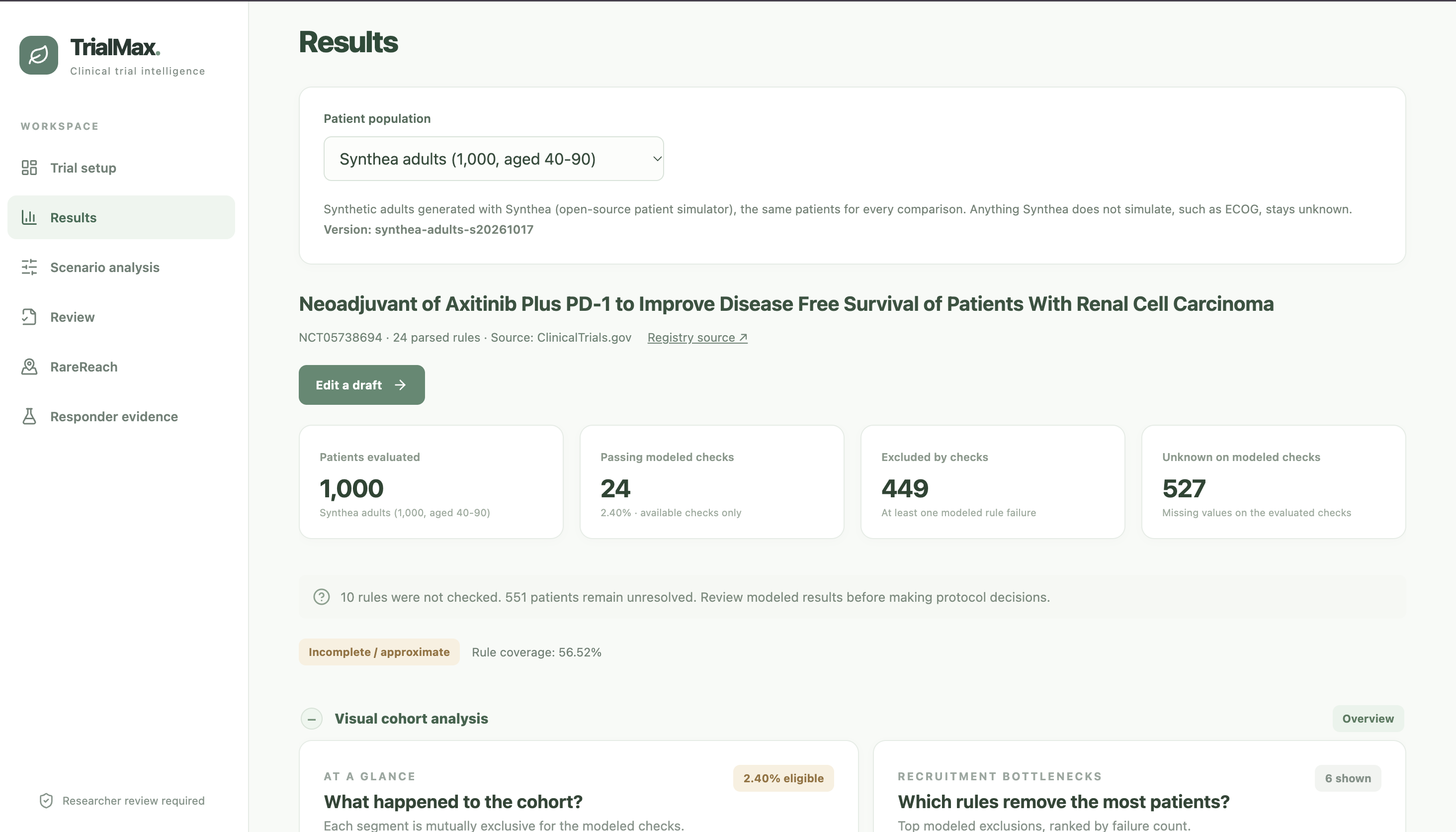
TrialMax turns a public ClinicalTrials.gov protocol into an interactive eligibility and recruitment analysis.
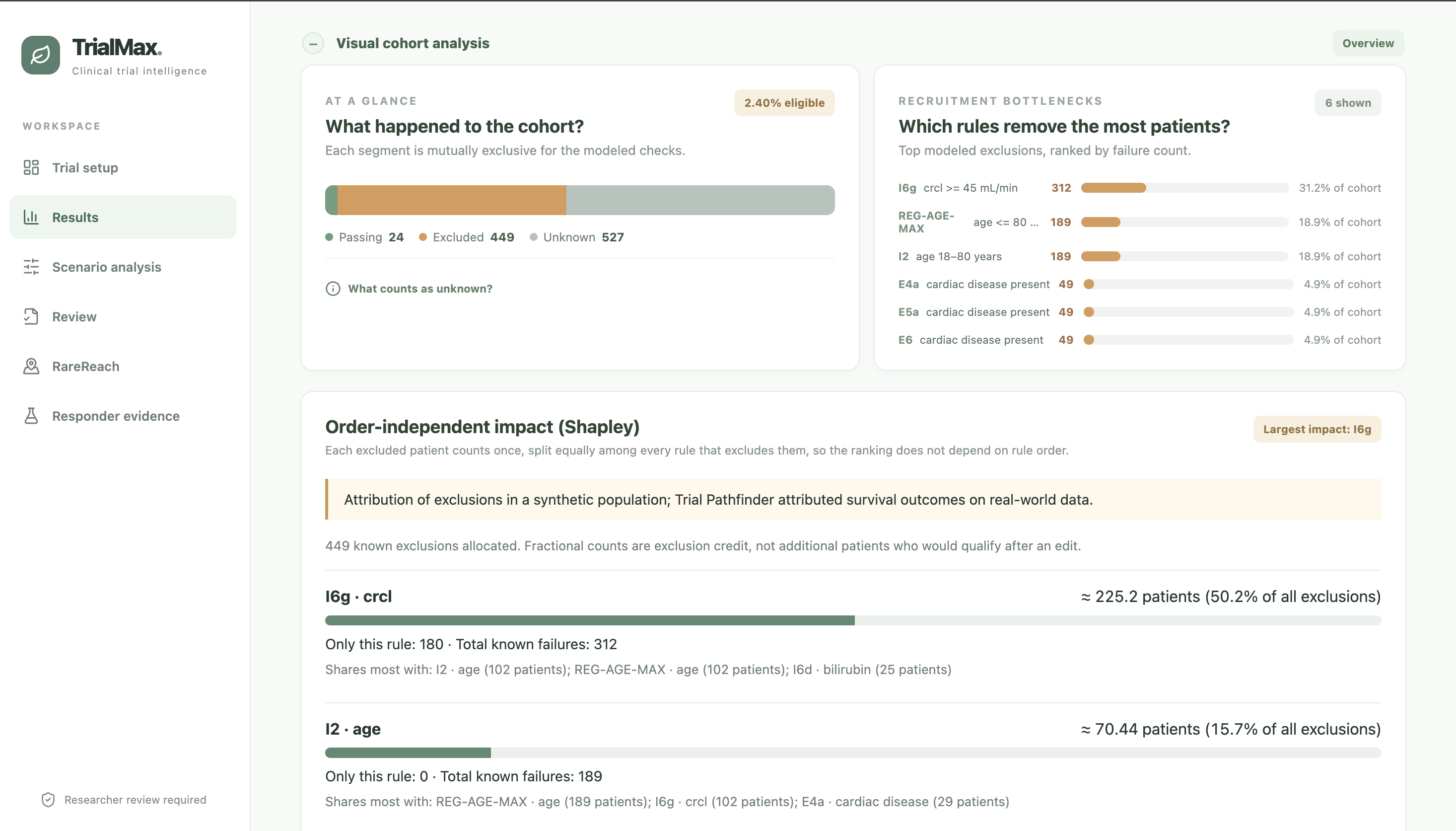
A researcher enters an NCT ID. TrialMax retrieves the public protocol, breaks eligibility text into individual rules, and evaluates modeled rules against a synthetic Synthea patient cohort. It helps researchers see:
- Which criteria exclude the most modeled patients
- Where exclusions overlap
- Which criteria are Pass, Fail, Unknown, or Not checked
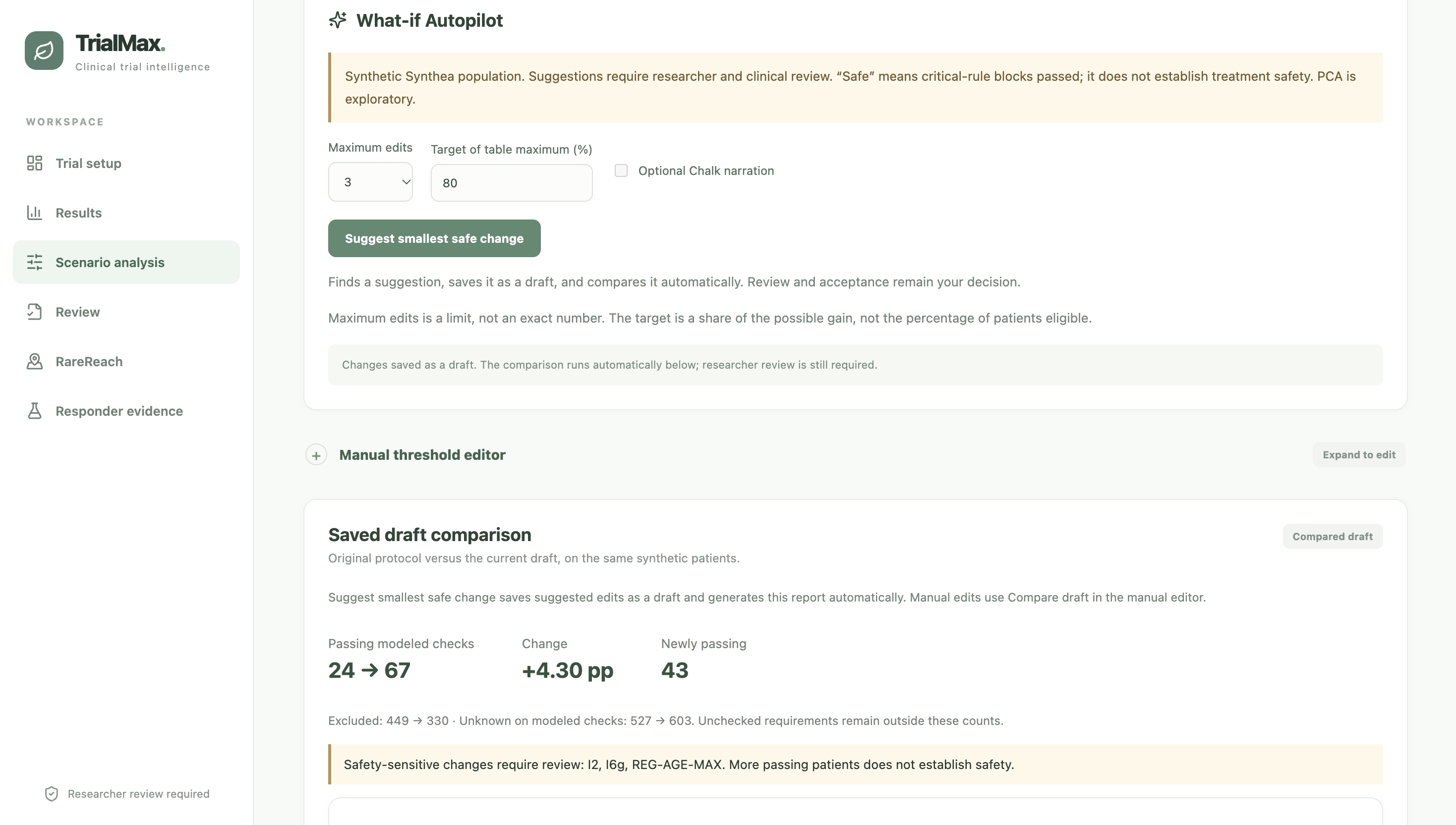
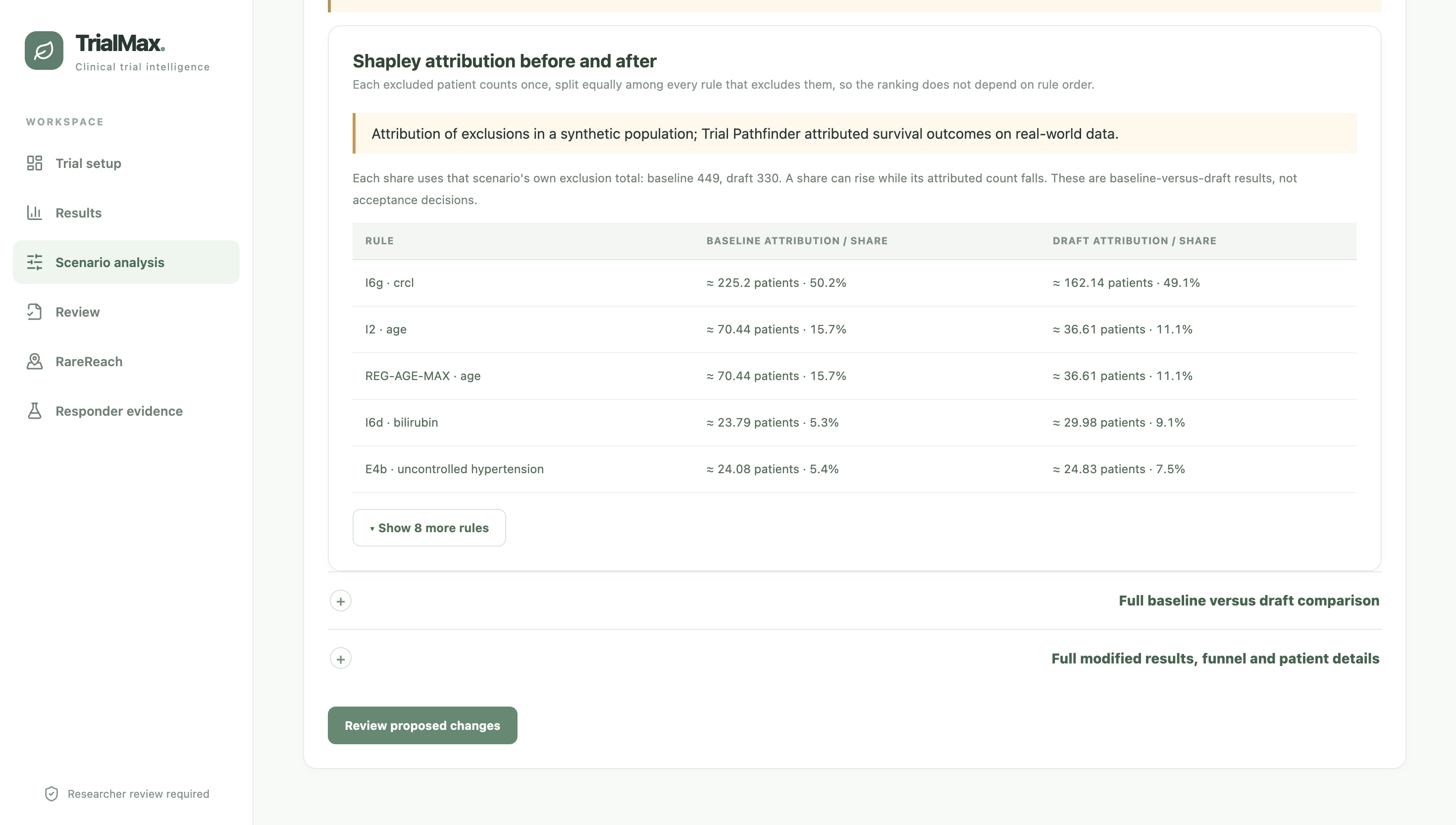
- How supported numeric threshold changes affect the same cohort
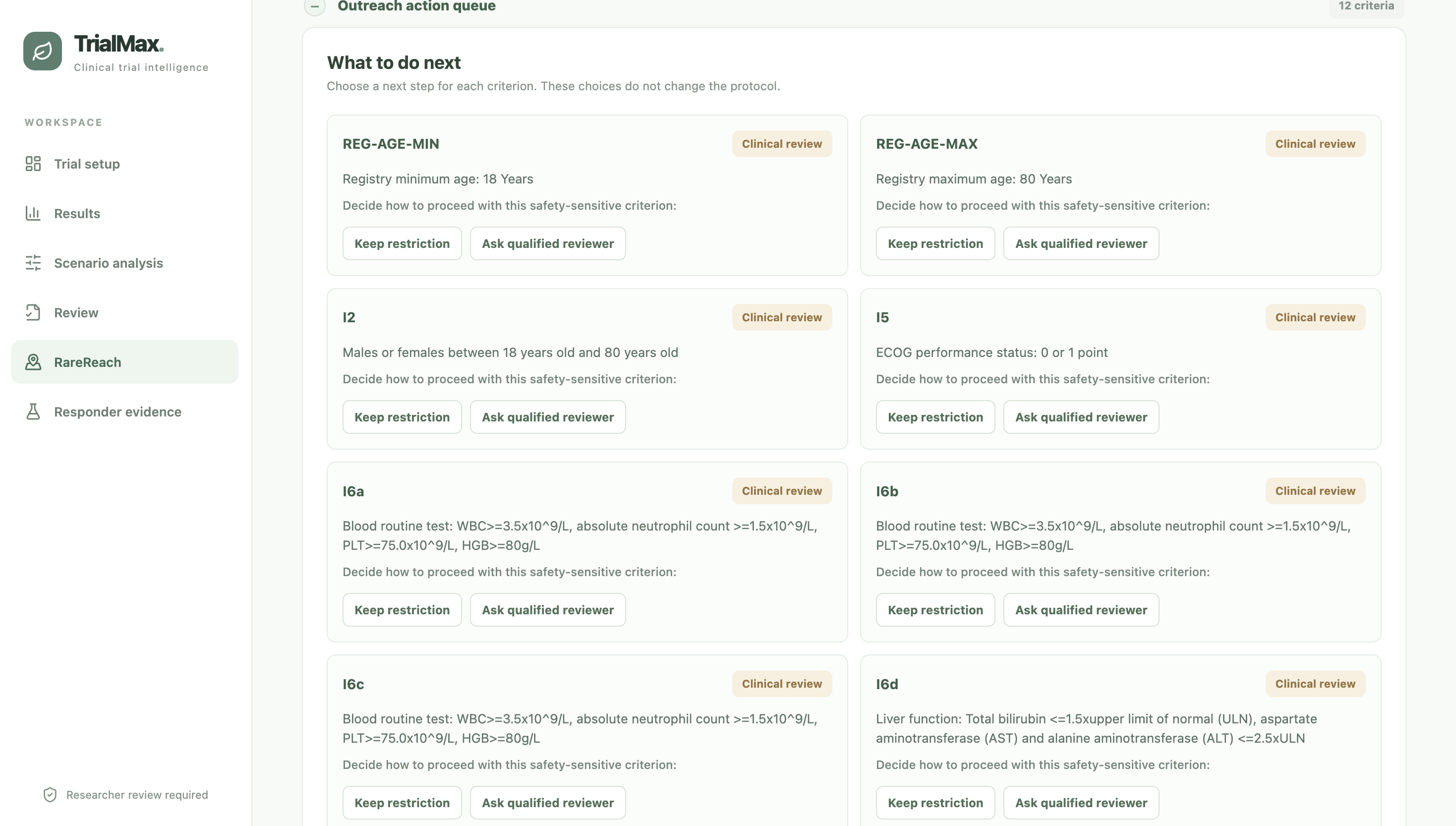
- Whether outreach research may be more appropriate than relaxing a safety-sensitive criterion
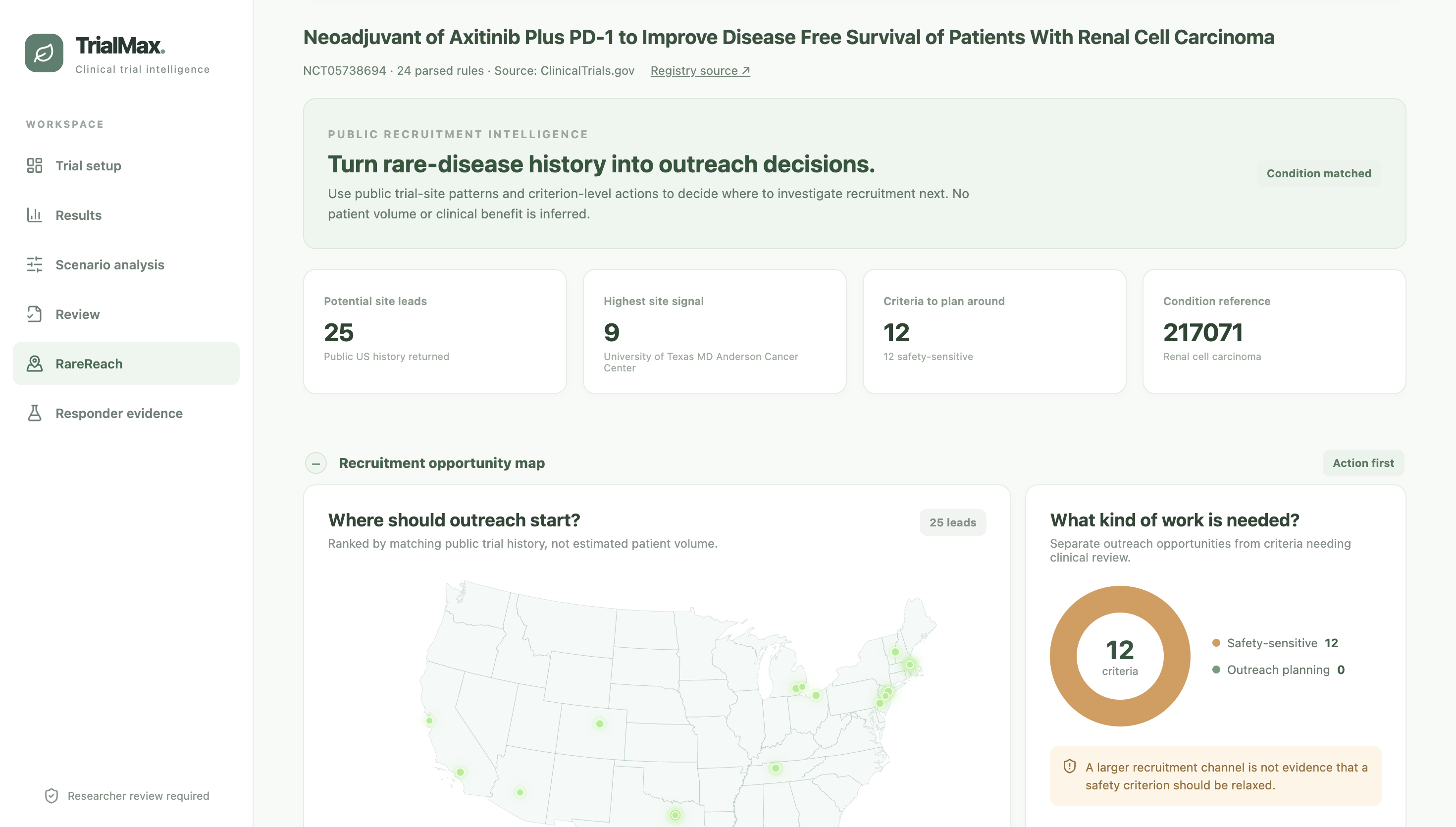
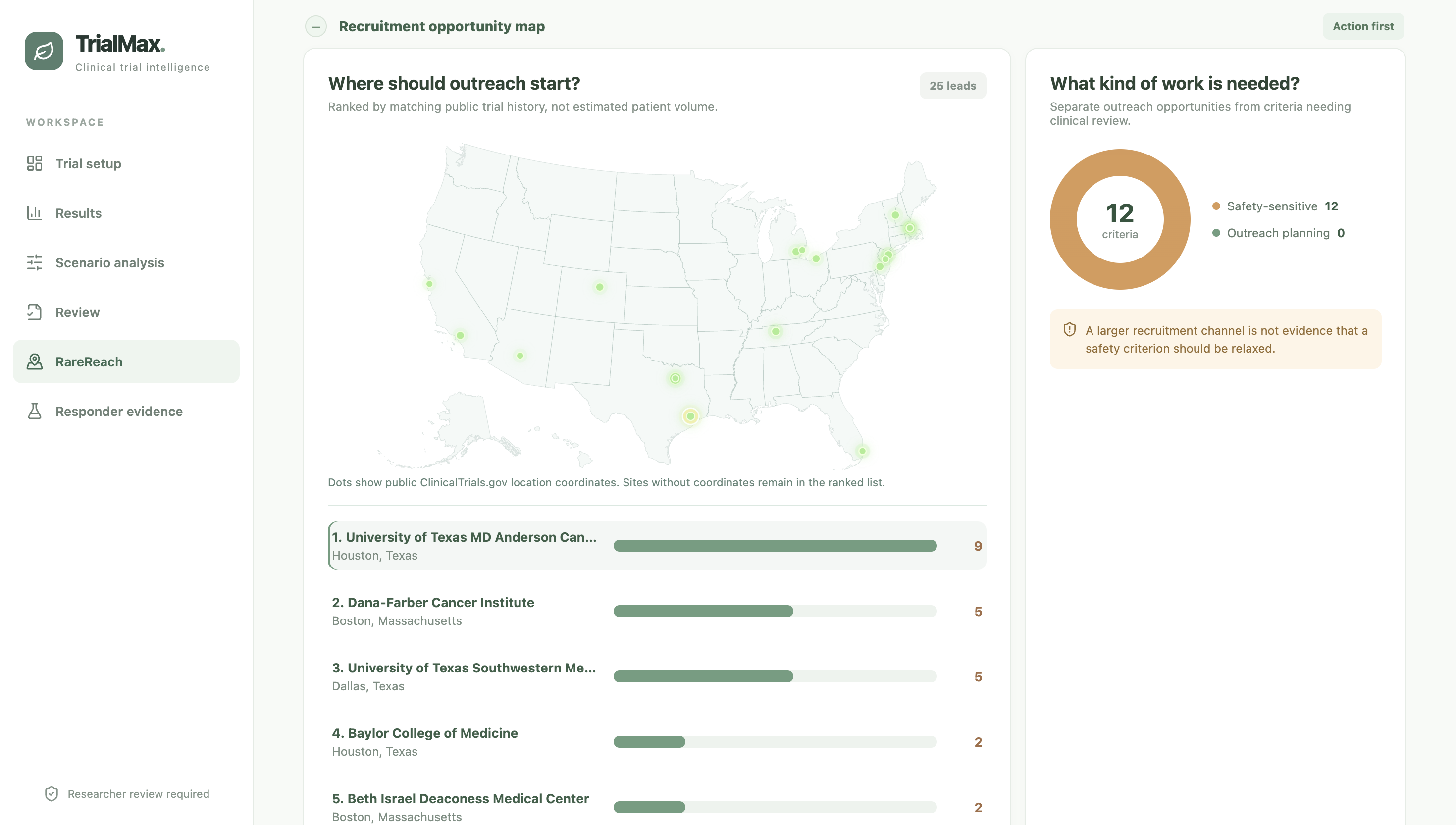
For verified rare-disease trials, RareReach confirms the condition through Orphadata before showing ORPHAcode information, synonyms, public US trial-site history, an interactive map, and public Orphanet and NORD resources.
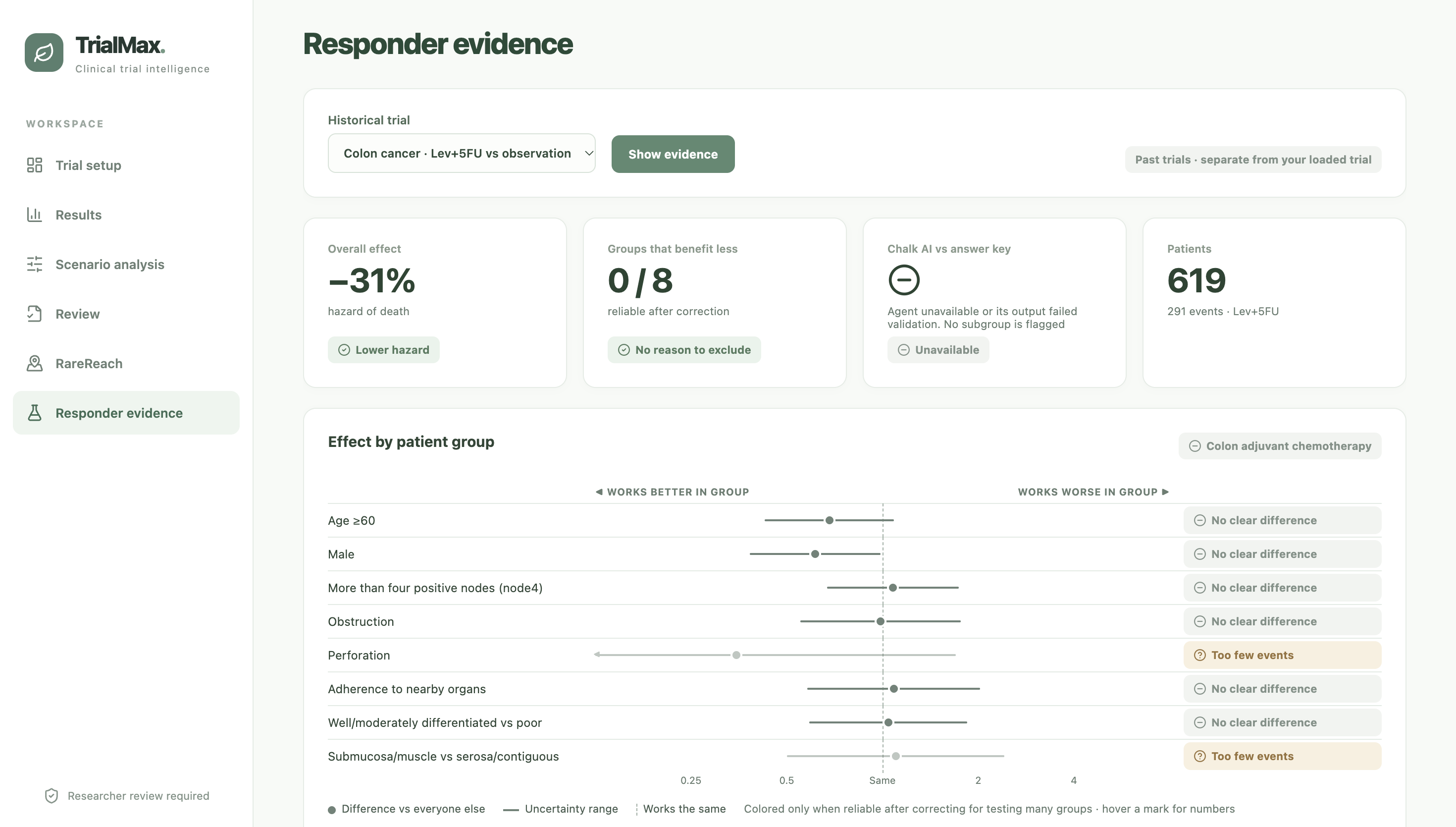
TrialMax also includes a separate Responder evidence feature. It explores subgroup treatment-effect patterns in three real historical datasets — Colon, Veteran, and GBSG — while clearly separating this historical evidence from the NCT trial currently being analyzed.
TrialMax is a research-support tool. It does not estimate real patient volume, guarantee recruitment, replace clinical judgment, or automatically recommend changing eligibility criteria.
How we built it
We built TrialMax as a full-stack clinical-trial intelligence platform.
- Frontend: React, TypeScript, Vite, D3 Geo, TopoJSON, and US Atlas
- Backend: Python, FastAPI, Pydantic, and NumPy
- Eligibility simulation: Deterministic rules engine using a Synthea-generated synthetic patient cohort
- Trial data: ClinicalTrials.gov API
- Rare-disease verification: Orphadata / Orphanet terminology API
- Recruitment research: Public US ClinicalTrials.gov site history, plus public Orphanet and NORD resources
- Responder evidence: Historical Colon, Veteran, and GBSG study datasets from R's public
survivaldatasets - Chalk: Optional structured fallback for unread criteria, Chalk SQL trial lookup when configured, and bounded responder-evidence evaluation
We intentionally keep deterministic code as the source of truth for eligibility outcomes. Chalk does not decide whether a patient passes a criterion or whether a protocol should change.
Challenges we ran into
We started with limited background in clinical-trial design, rare diseases, and statistical subgroup analysis. We spent substantial time learning how eligibility criteria, safety safeguards, recruitment workflows, survival outcomes, hazard ratios, and confidence intervals should be interpreted responsibly.
Integrating several data sources was also challenging. ClinicalTrials.gov provides trial protocols and site history, Orphadata provides rare-disease terminology and ORPHAcodes, and the Colon, Veteran, and GBSG datasets provide historical outcome data for our responder-evidence feature. Each source has different formats, limitations, and intended uses.
We faced the challenge of exploring whether treatment response differs across patient subgroups without creating misleading links between historical studies and a new trial. We addressed this by building a deterministic responder-evidence benchmark using real historical trial datasets, while keeping uncertainty, statistical limitations, and researcher review visible at every step.
We also had to ensure that public trial-site history was not presented as patient volume, hospital capacity, clinical expertise, or a confirmed partnership. RareReach labels these results as public research leads, not recruitment guarantees.
Finally, we needed to make dense clinical-trial information understandable through funnels, charts, maps, scenario comparisons, and clear explanations without oversimplifying safety-sensitive decisions.
Accomplishments that we're proud of
- Built an end-to-end workflow from an NCT ID to eligibility analysis
- Created deterministic Pass / Fail / Unknown / Not checked criterion outcomes
- Made overlapping exclusions visible instead of treating every criterion independently
- Added scenario comparison while preserving the original protocol baseline
- Built RareReach with rare-disease verification, ORPHAcode details, public US site-history mapping, and source links
- Added safeguards so public site history is never treated as patient volume or a verified partnership
- Built responder evidence using the real Colon, Veteran, and GBSG historical-study datasets
- Calculated subgroup hazard ratios, confidence intervals, multiplicity-adjusted results, and underpowered-result warnings deterministically
- Added interactive light and dark modes, animated charts, and hoverable map markers
- Integrated Chalk in a bounded, explainable role while keeping core eligibility decisions deterministic
What we learned
We learned that clinical-trial recruitment is not only about increasing the number of potential participants. It is about balancing broader access with scientific validity, safety, and feasibility.
We also learned that explainability matters as much as prediction. Researchers need to know where a result came from, what data was used, and what the system cannot determine. That is why TrialMax distinguishes synthetic simulation, historical evidence, public site history, unknown information, and human-review decisions.
What's next for TrialMax
- Support protocol-document upload and traceable extraction with source citations
- Add visit-burden analysis to identify opportunities for hybrid or remote participation
- Expand simulations with additional approved synthetic and real-world datasets
- Improve rare-disease center discovery through permitted specialist-center sources
- Add collaboration tools so research teams can save and review scenarios together
- Continue improving Chalk-based evaluations while keeping eligibility logic transparent and auditable
Built With
- chalk
- clinical
- clinicaltrials.gov
- d3.js
- diseases
- fastapi
- healthcare
- numpy
- orphadata
- orphanet
- pydantic
- pytest
- python
- rare
- react
- render
- synthea
- synthetic
- topojson
- trials
- typescript
- visualization
- vite


Log in or sign up for Devpost to join the conversation.