-
-
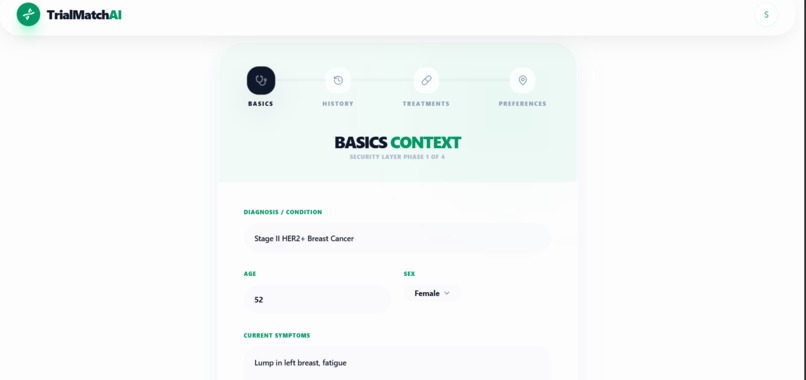
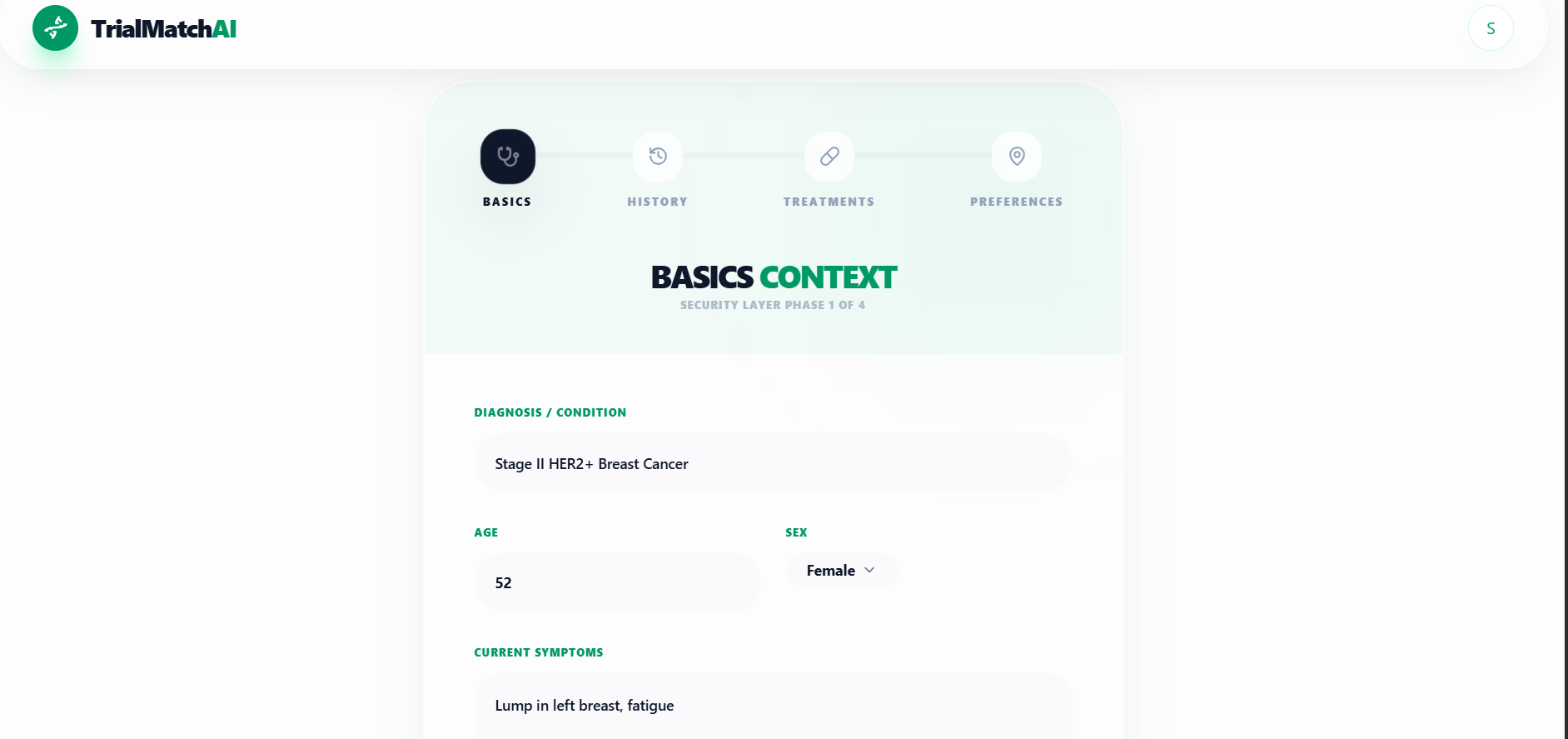
form info
-
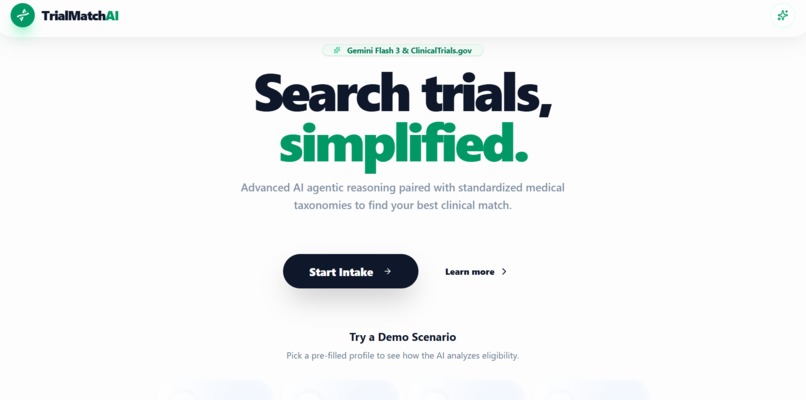
search
-
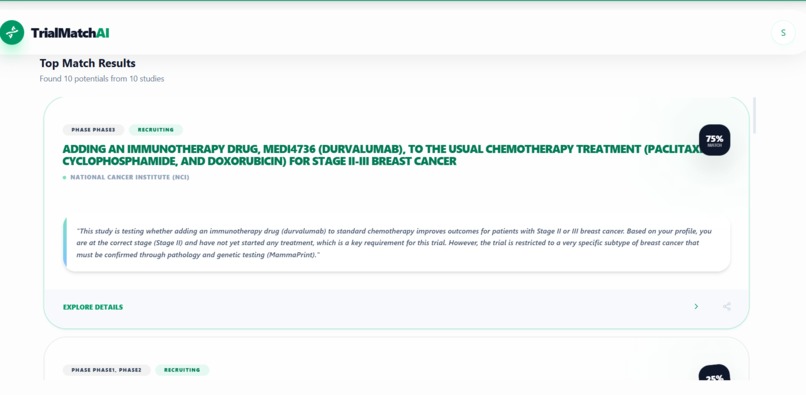
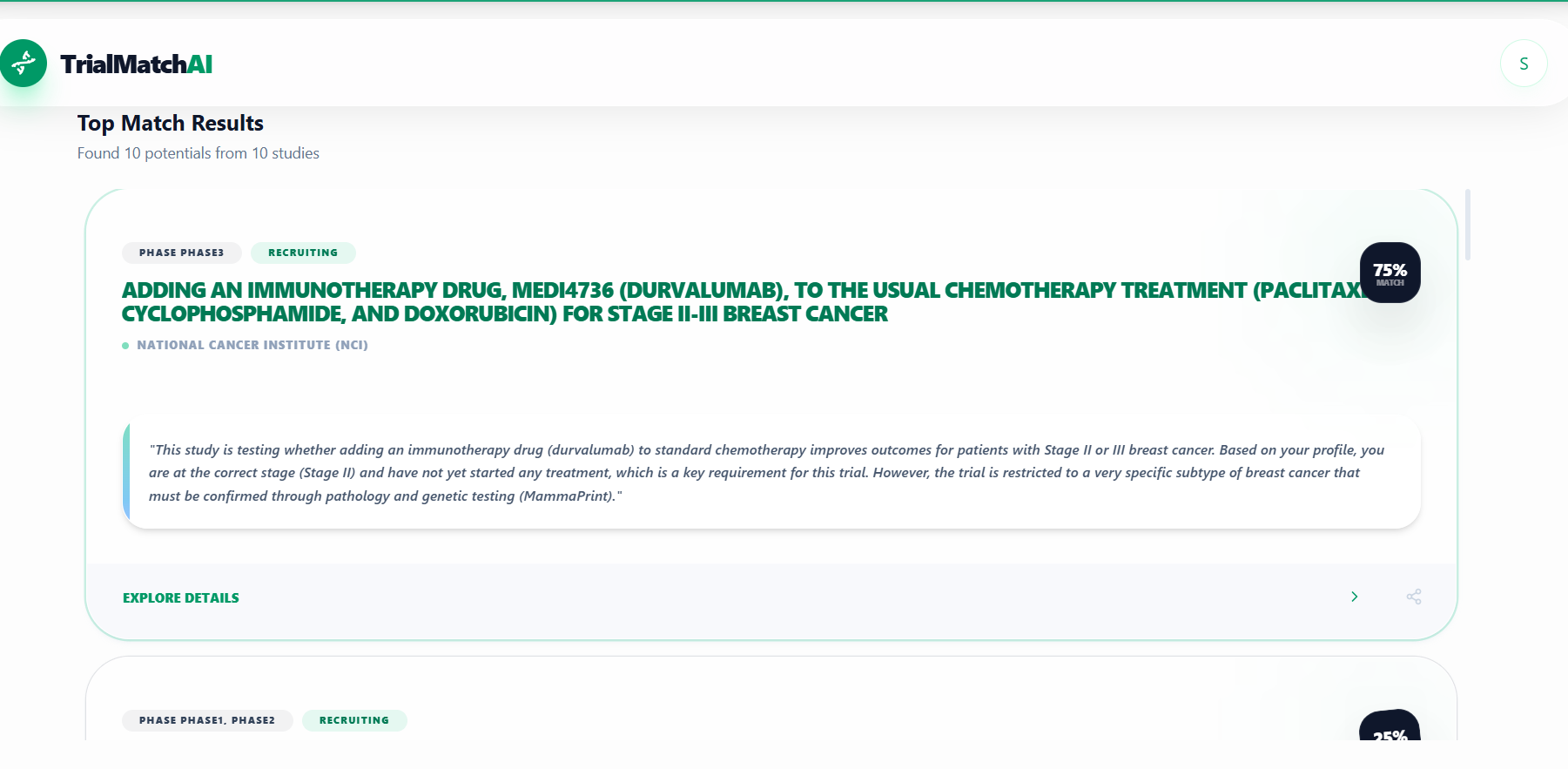
results
-
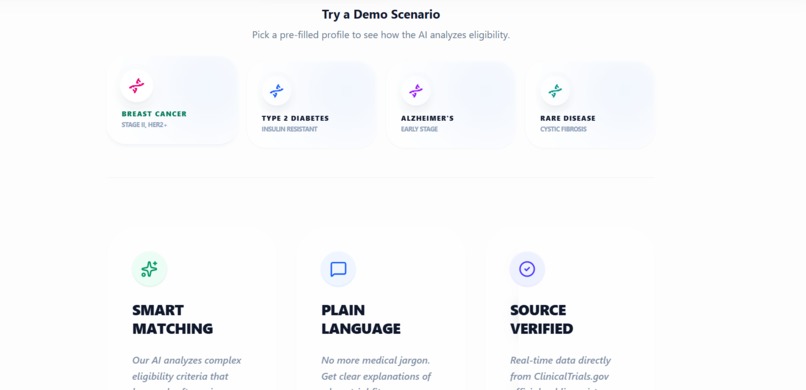
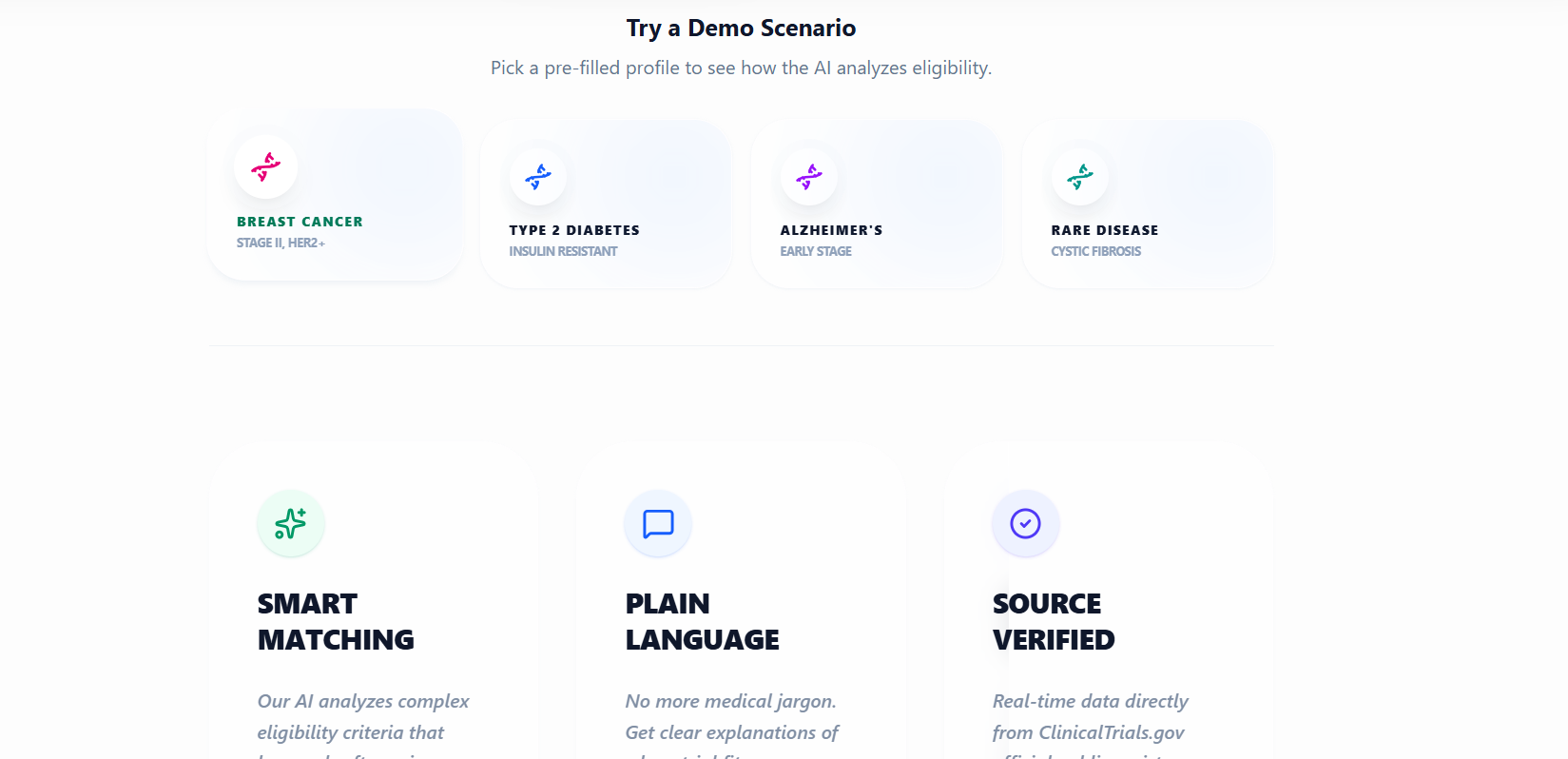
demo search
-
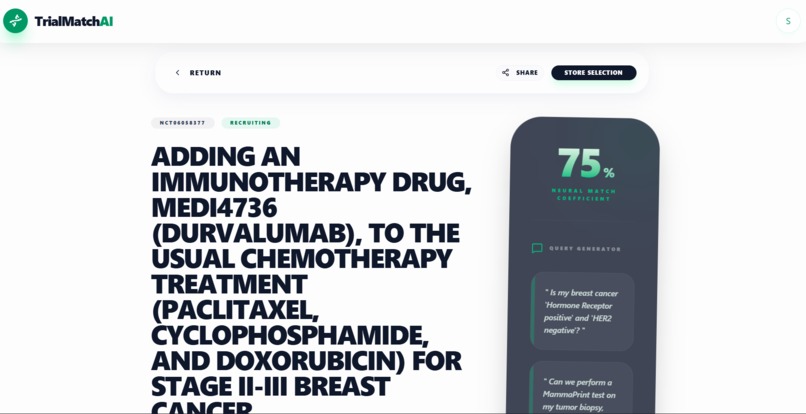
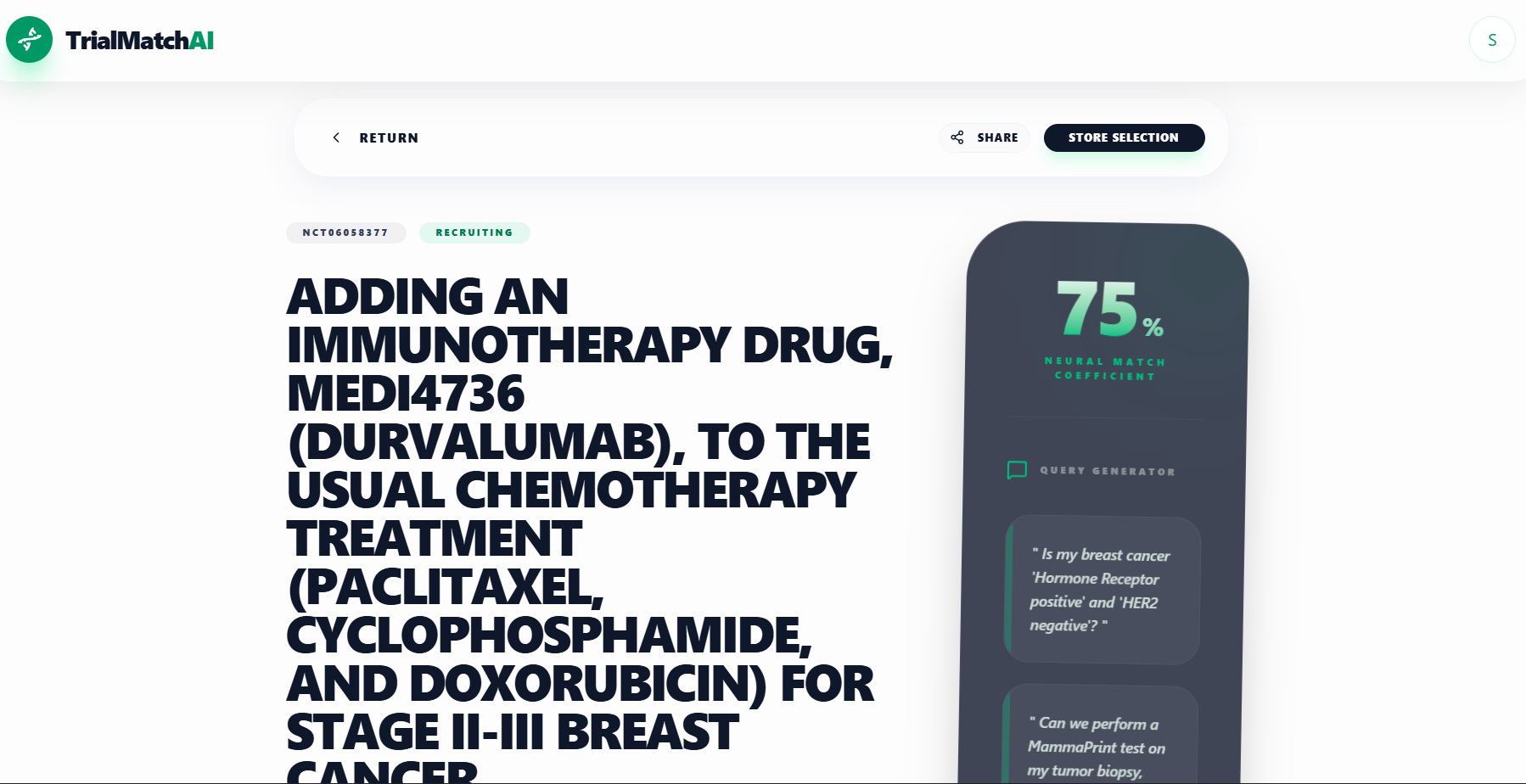
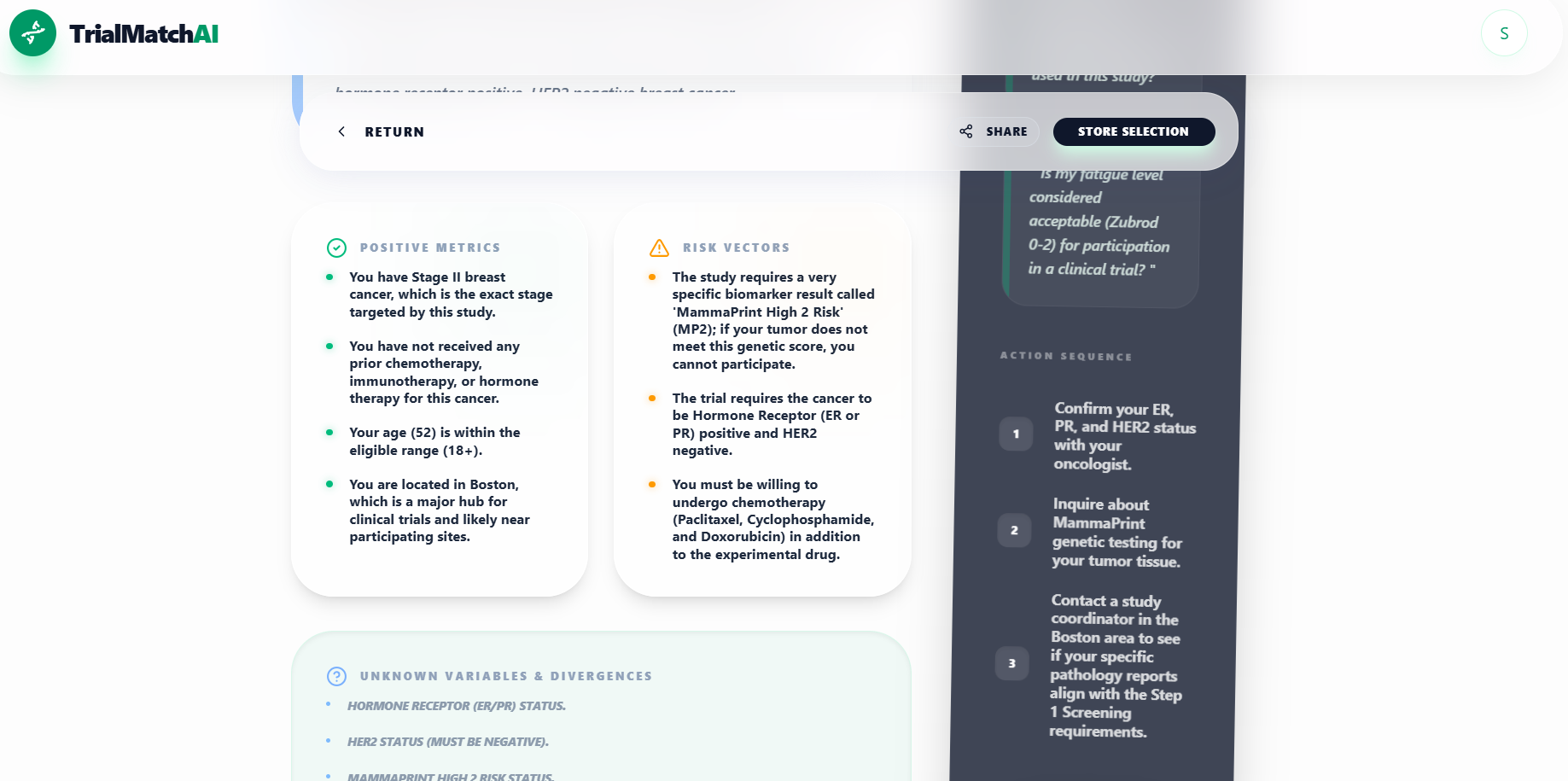
complete ai trial match details
-
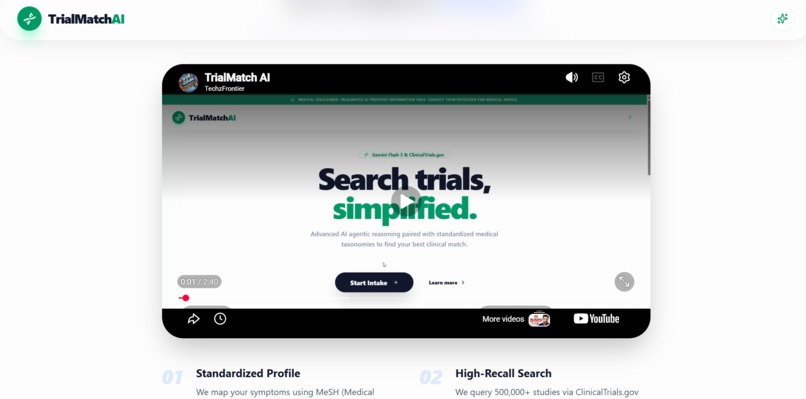
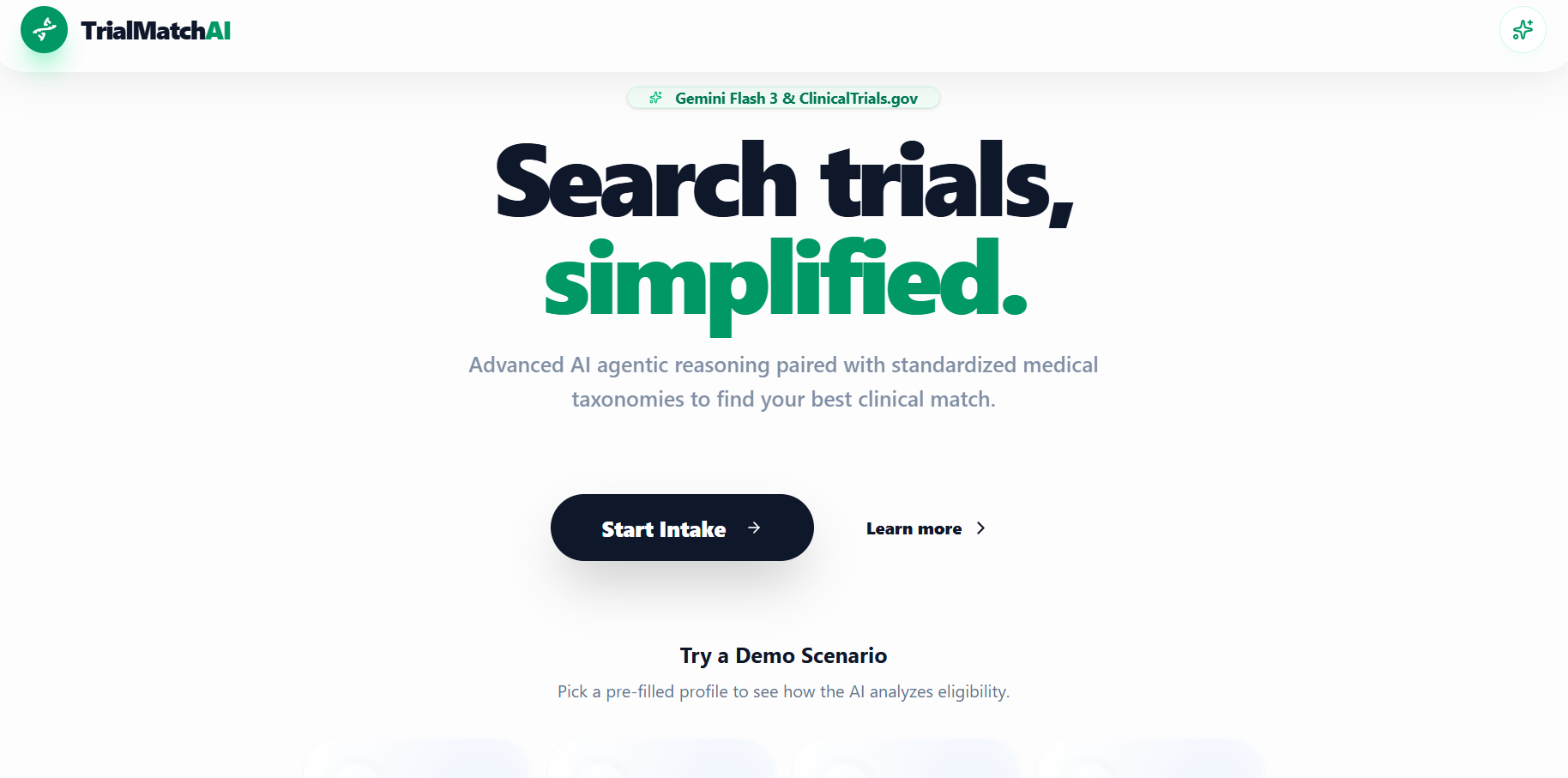
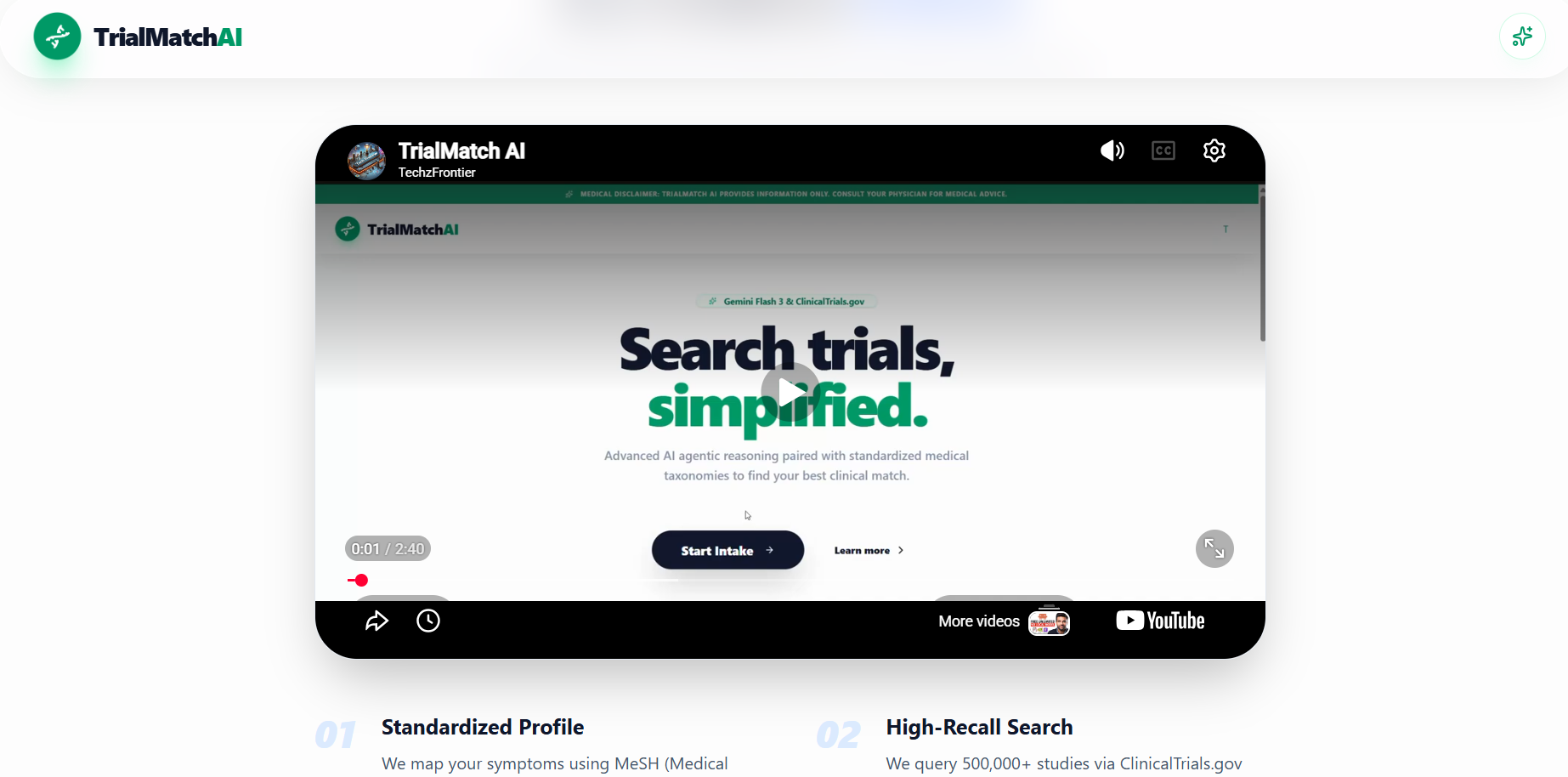
startpage
-
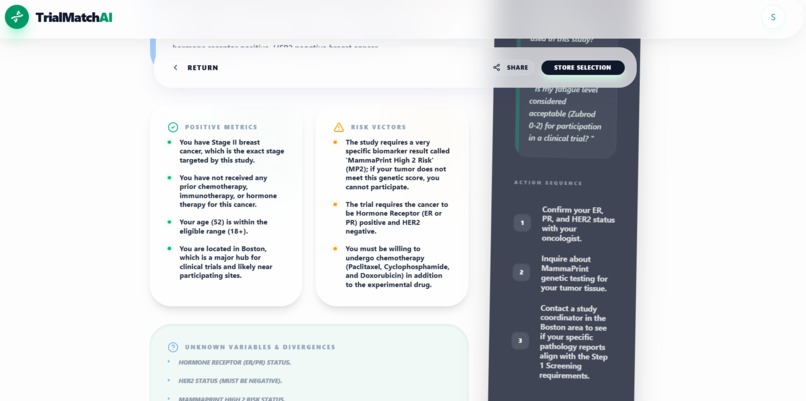
share your details
-
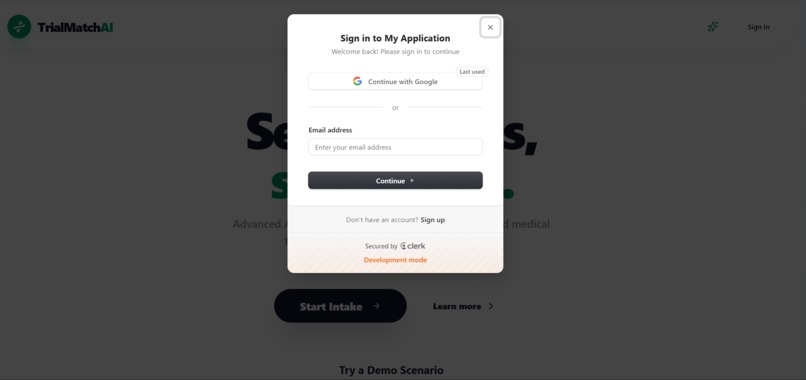
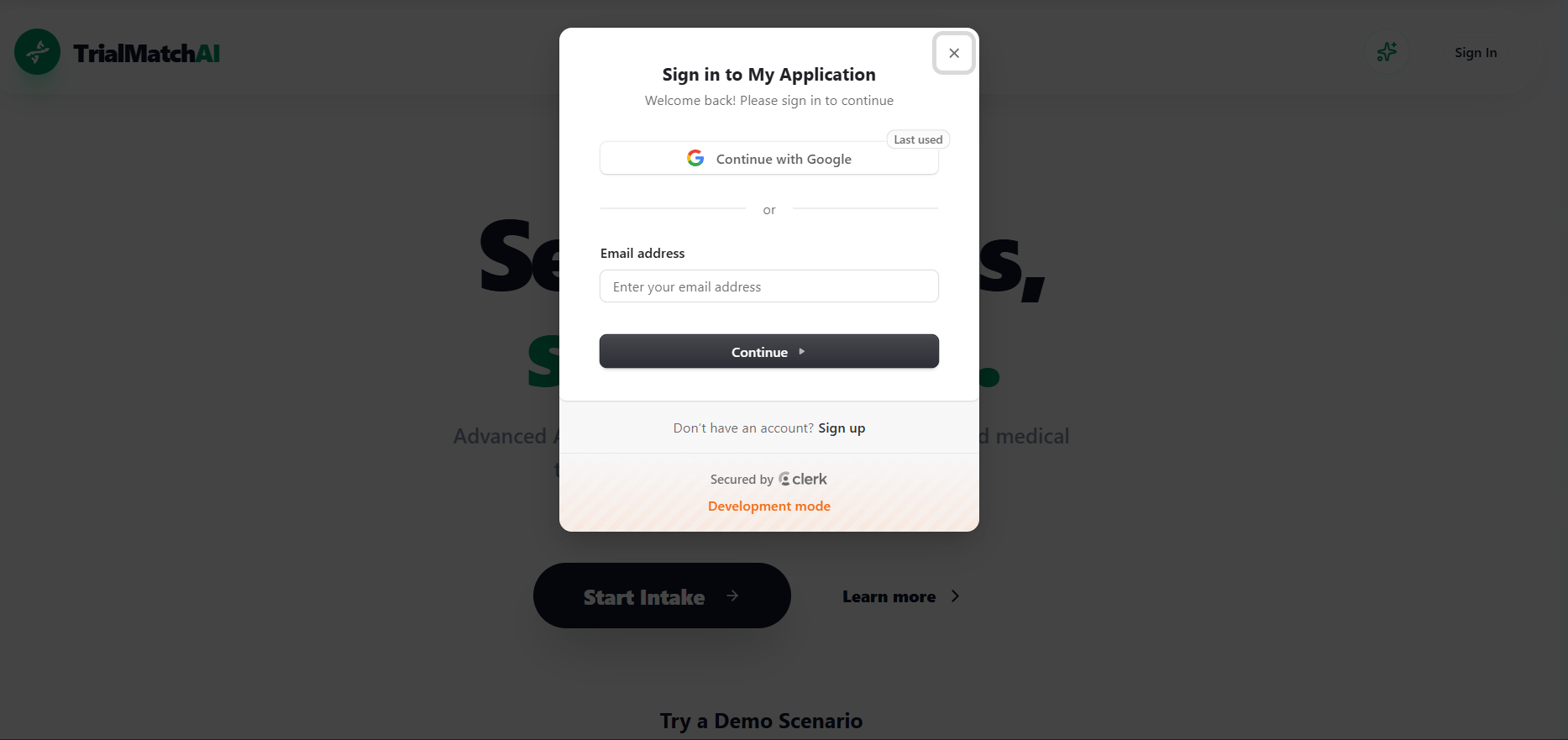
authentication page
## Inspiration
Finding a clinical trial today is surprisingly difficult for most patients.
While ClinicalTrials.gov contains hundreds of thousands of studies, the experience is still largely built around keyword searches and highly technical medical terminology. Eligibility criteria are often written in complex clinical language that can be difficult for patients and caregivers to understand.
We were inspired by a simple question:
“What if AI could act like a patient-friendly research assistant and explain clinical trial eligibility in plain language?”
Our goal was to reduce the gap between medical research and real people by building an AI-powered system that helps users discover potentially relevant clinical trials while clearly explaining why a trial may or may not be a fit.
## What it does
TrialMatchAI is an AI-powered clinical trial matching assistant.
Users provide:
- Symptoms
- Diagnosis
- Age
- Location
- Medical history
- Prior treatments
The platform then:
- Searches real studies from the ClinicalTrials.gov public API
- Filters relevant recruiting trials
- Uses AI reasoning to analyze eligibility criteria
- Explains matches in plain human language
- Ranks trials based on relevance and compatibility
Instead of showing overwhelming medical text, TrialMatchAI provides:
- Match score
- Eligibility explanation
- Trial phase
- Recruiting status
- Possible concerns
- Questions to ask a doctor
- Recommended next steps
The system is designed to help patients better understand trial opportunities before discussing them with healthcare professionals.
## How we built it
We built TrialMatchAI as a modern AI-powered healthcare web application.
Frontend
- Next.js
- React
- Tailwind CSS
- Framer Motion
- Responsive UI components
Backend & APIs
- ClinicalTrials.gov API v2
- Node.js API routes
- Trial normalization and ranking pipeline
AI Layer
We used Claude as the reasoning engine to:
- Parse complex eligibility criteria
- Compare patient profiles against trial requirements
- Generate human-readable explanations
- Identify unknown eligibility factors
- Produce safe, non-diagnostic summaries
AI Workflow Pipeline
Patient Input
      ↓
ClinicalTrials.gov Search
      ↓
Trial Filtering
      ↓
Claude Eligibility Analysis
      ↓
Ranking Engine
      ↓
Human-Readable Results
We also implemented:
- Match scoring logic
- Safety disclaimers
- Structured AI outputs
- Trial ranking system
- Plain-language explanation engine
## Challenges we ran into
One of the biggest challenges was dealing with clinical eligibility criteria.
Most trial requirements are written in highly technical and inconsistent formats. Some studies contain long paragraphs with nested inclusion and exclusion conditions that are difficult even for humans to interpret quickly.
Another challenge was balancing:
- AI usefulness
- Medical safety
- Simplicity
We wanted the system to feel helpful without crossing into medical advice. Designing prompts and safeguards that kept explanations informative but responsible required careful iteration.
We also had to optimize:
- API filtering performance
- Ranking relevance
- Clear patient-friendly UI
- AI response consistency
## Accomplishments that we're proud of
We are proud that TrialMatchAI transforms a traditionally difficult research process into something approachable and understandable.
Some accomplishments we are especially proud of:
- Successfully integrating real ClinicalTrials.gov data
- Building a multi-step AI reasoning pipeline
- Translating complex eligibility criteria into plain language
- Creating a clean and accessible healthcare UI
- Designing a system focused on patient empowerment rather than just search
Most importantly, we built something that addresses a real-world healthcare accessibility problem.
## What we learned
This project taught us a lot about:
- Clinical NLP
- AI reasoning workflows
- Healthcare UX design
- Responsible AI communication
- Public healthcare APIs
- Structuring multi-agent pipelines
We also learned how important explainability is in healthcare AI systems. Users do not just need answers — they need understandable reasoning they can trust.
## What's next for TrialMatchAI
We see significant future potential for TrialMatchAI.
Next steps include:
- EHR/FHIR integration
- Multilingual support
- Doctor collaboration tools
- Trial application assistance
- Advanced semantic matching
- Rare disease support
- AI-powered trial recommendations over time
- Mobile app support
- Patient advocacy organization integrations
We also want to improve:
- Geographic trial matching
- Personalized ranking
- Eligibility confidence estimation
- Accessibility for non-technical users
Our long-term vision is to make clinical trial discovery more transparent, understandable, and accessible for patients everywhere.

Log in or sign up for Devpost to join the conversation.