-
-
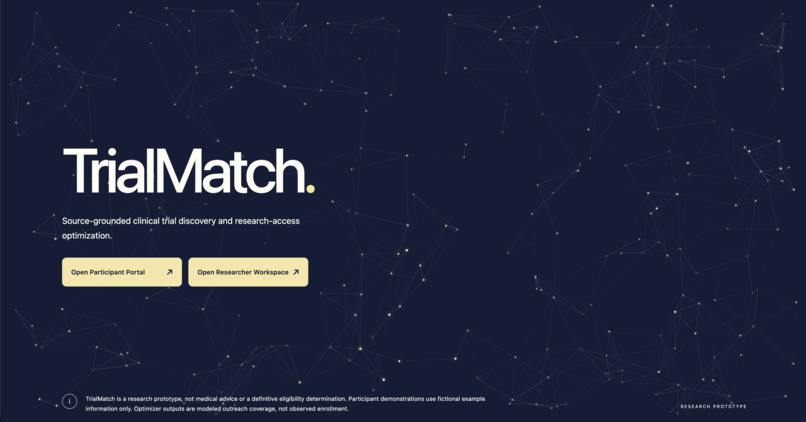
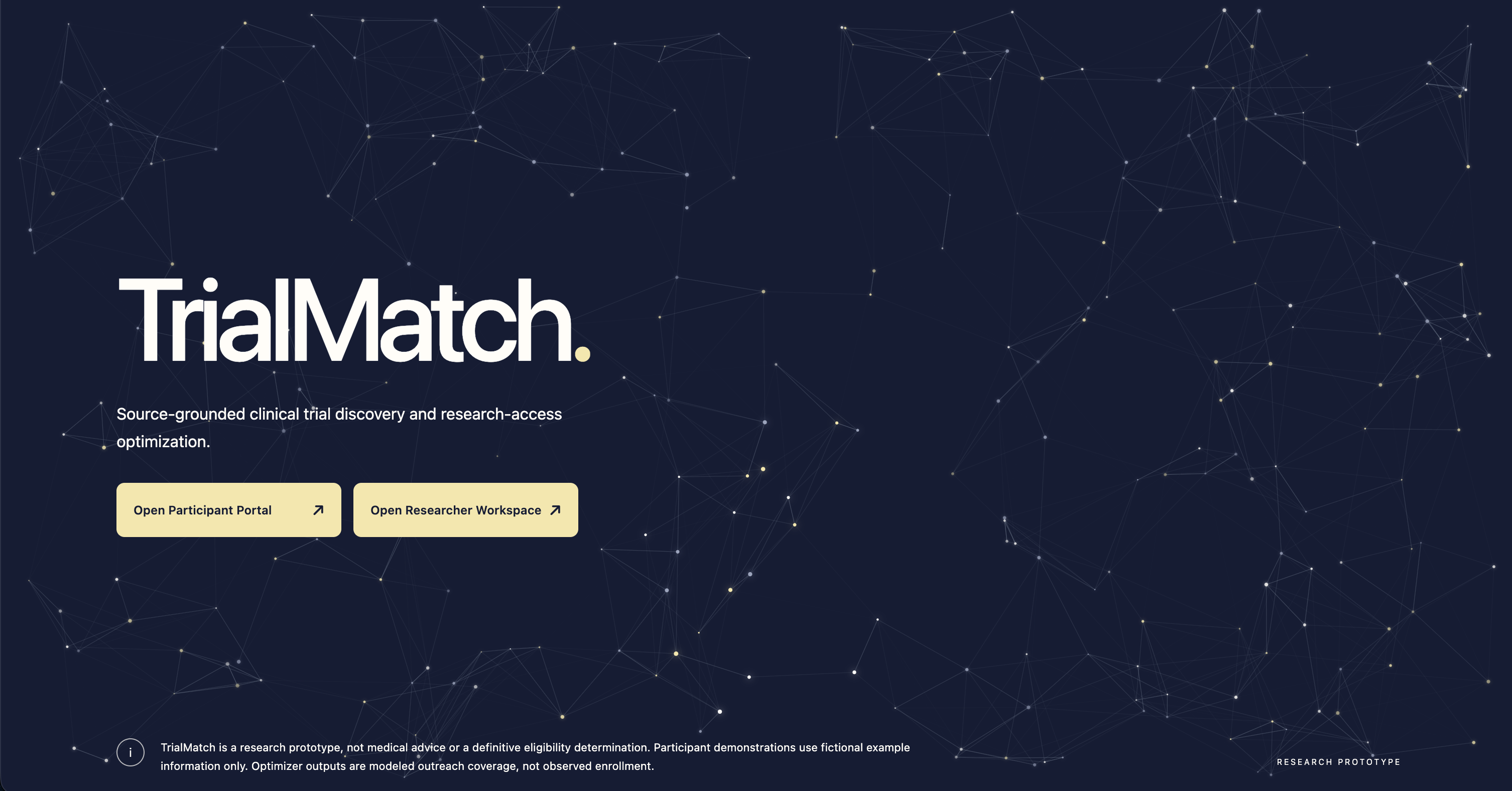
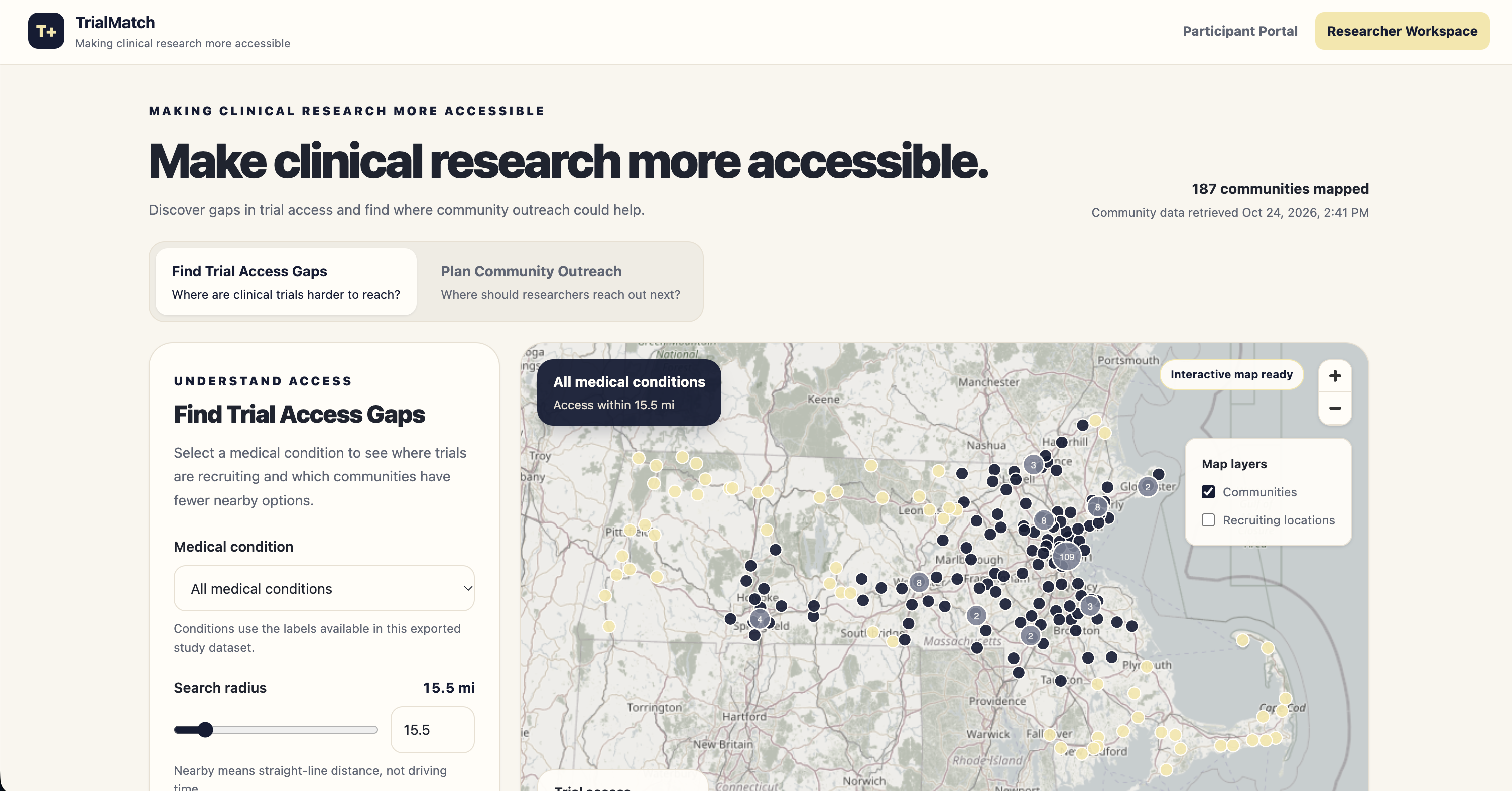
Landing page
-
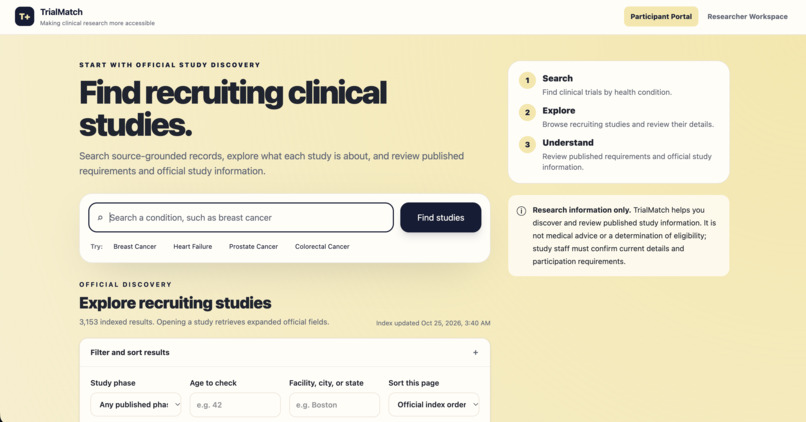
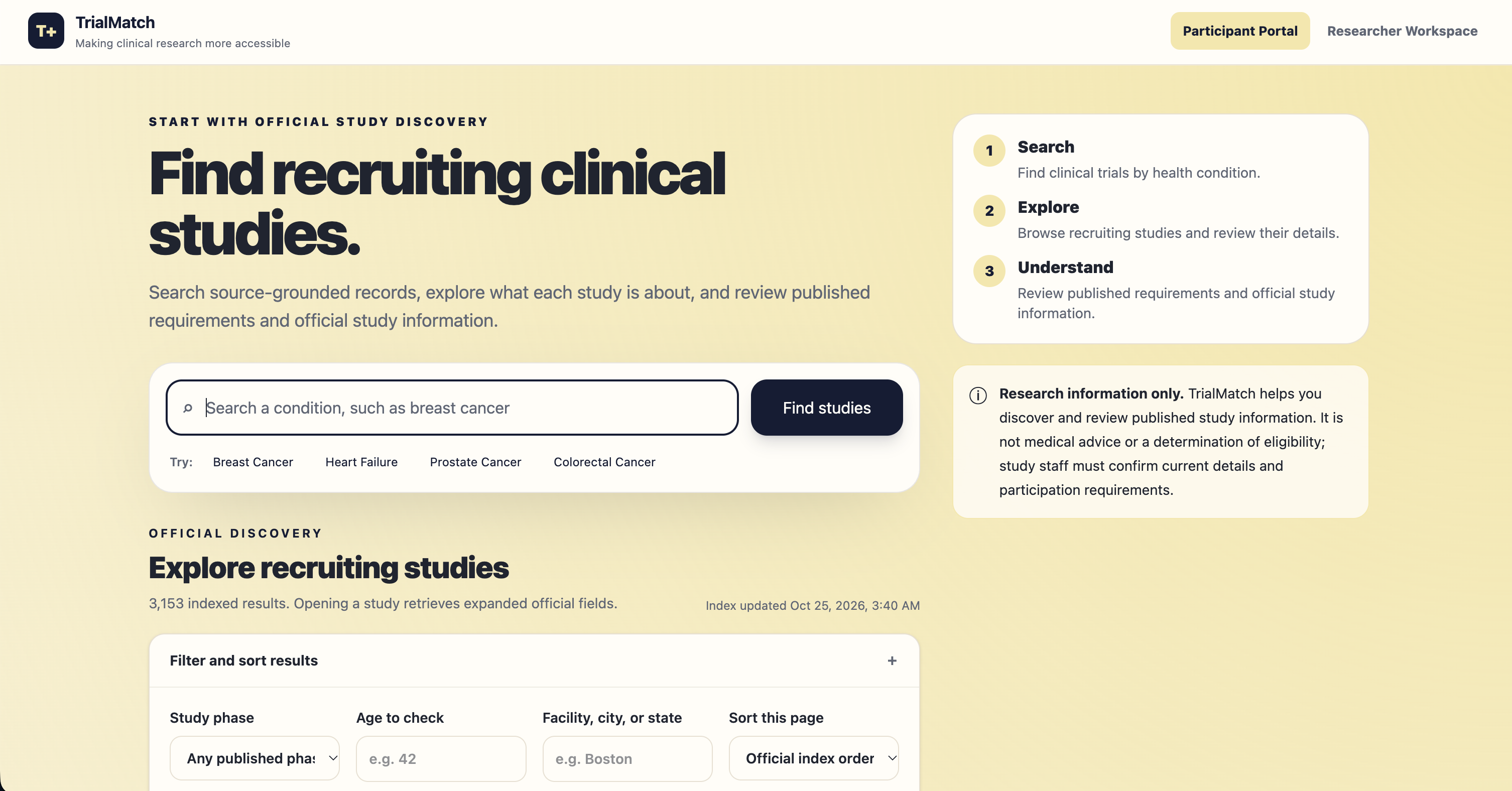
Participant Portal
-
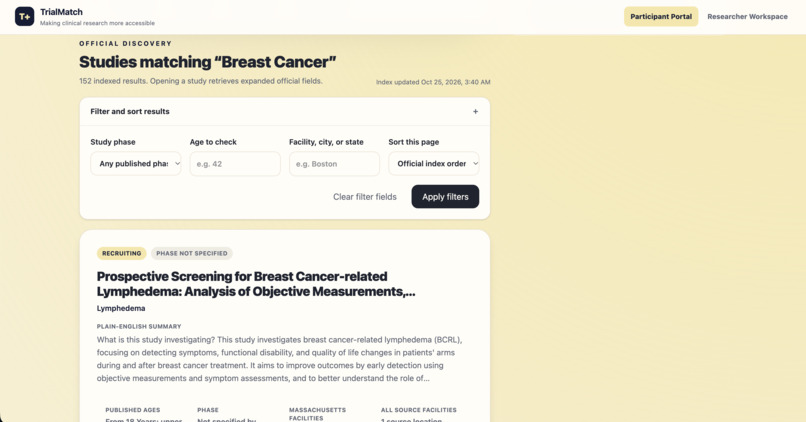
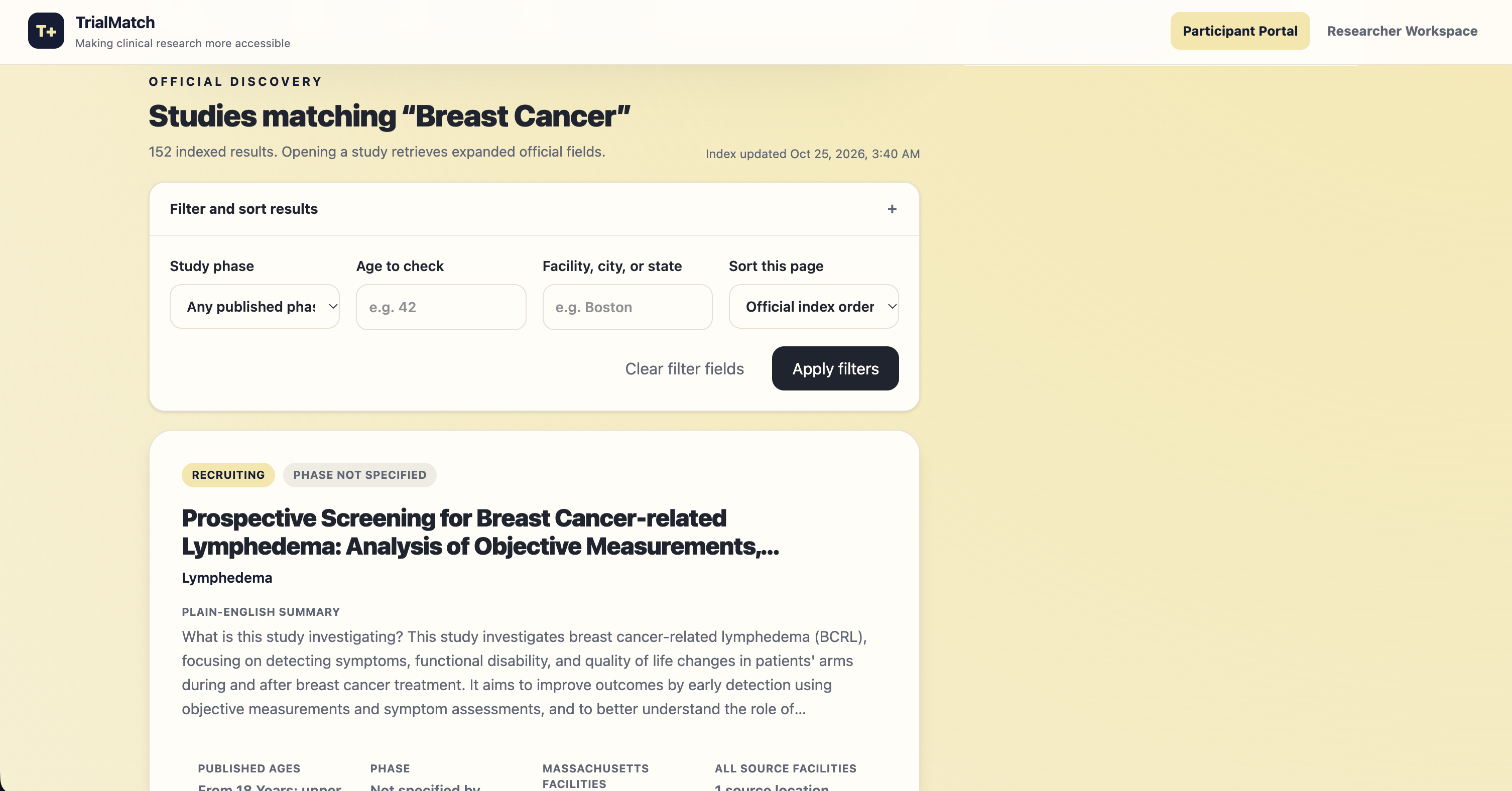
Search results for a study
-
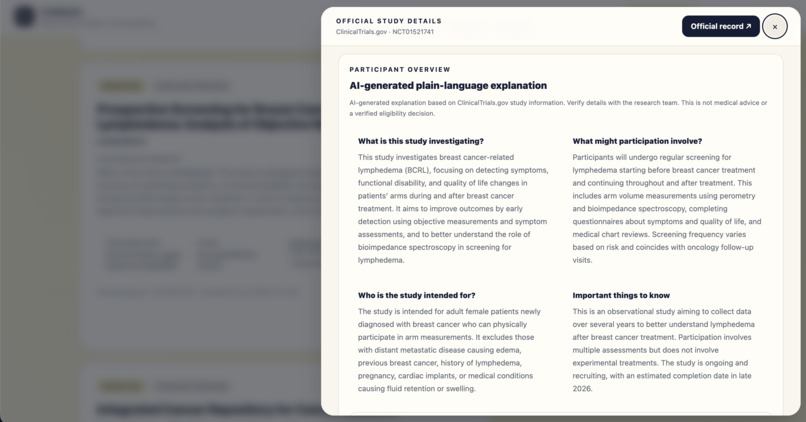
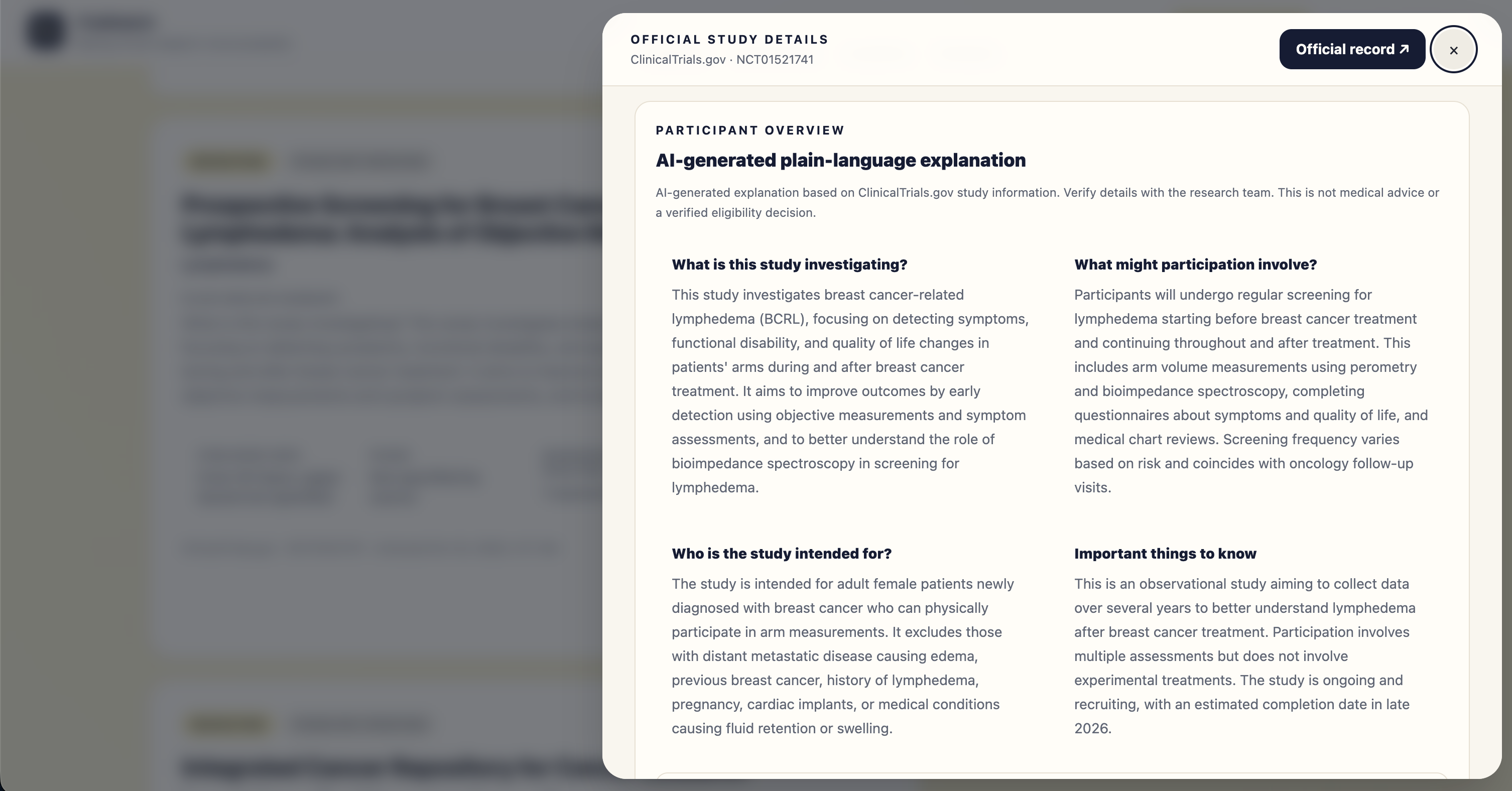
AI generated plain-language explanation for chosen study
-
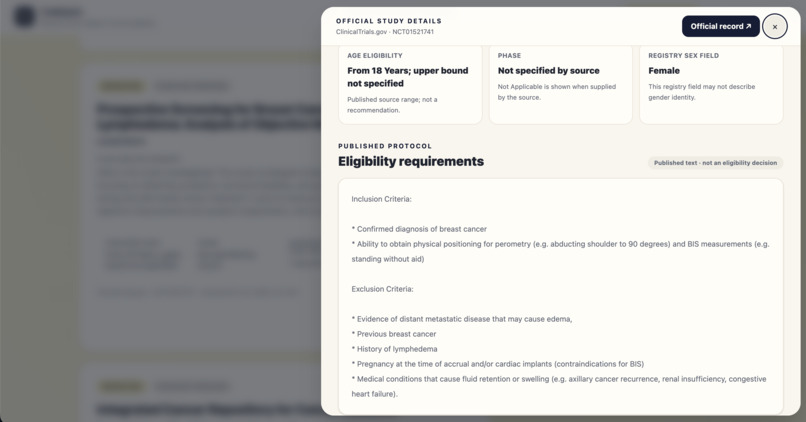
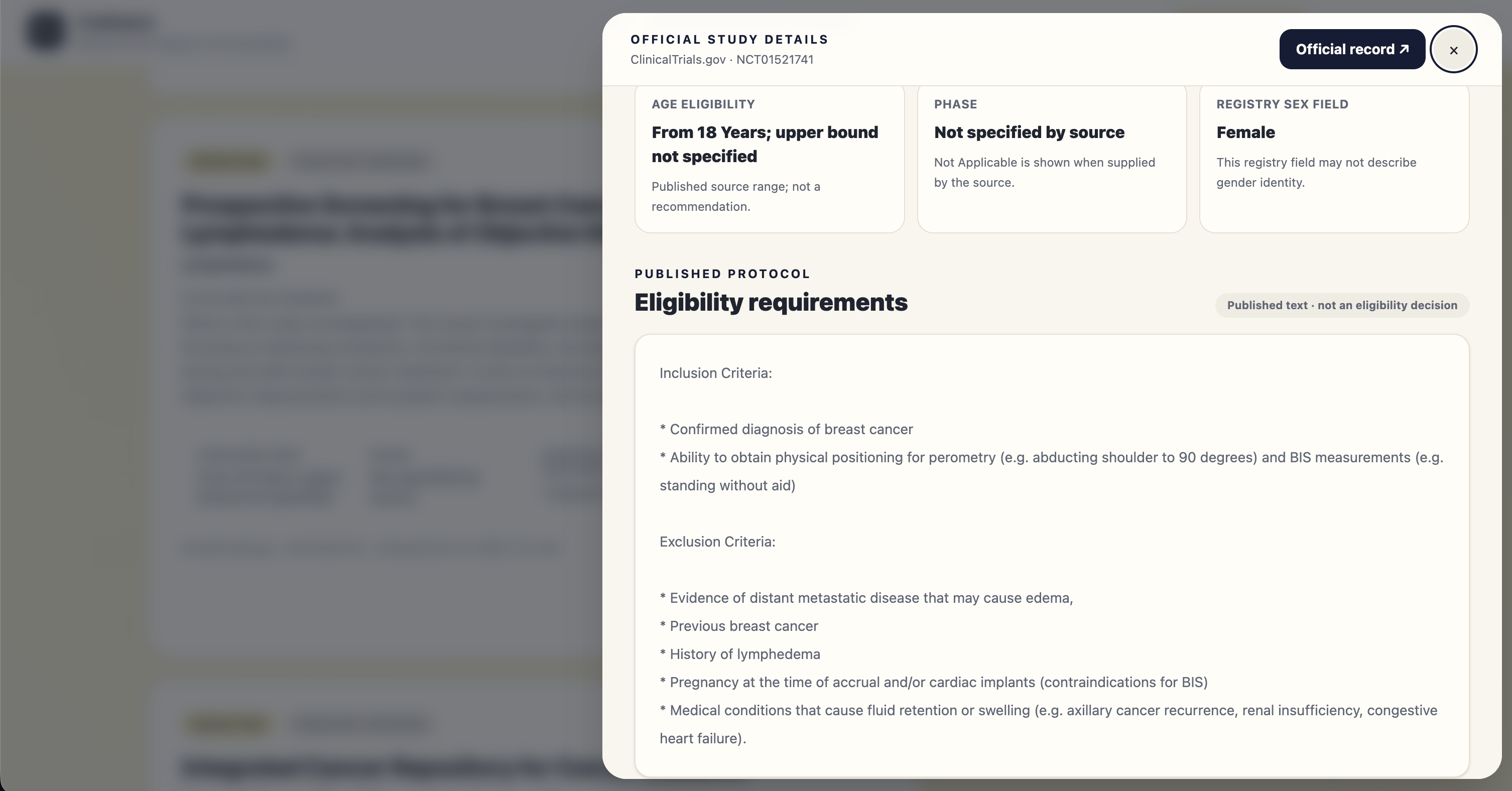
Other important details regarding study, parsed from our dataset
-
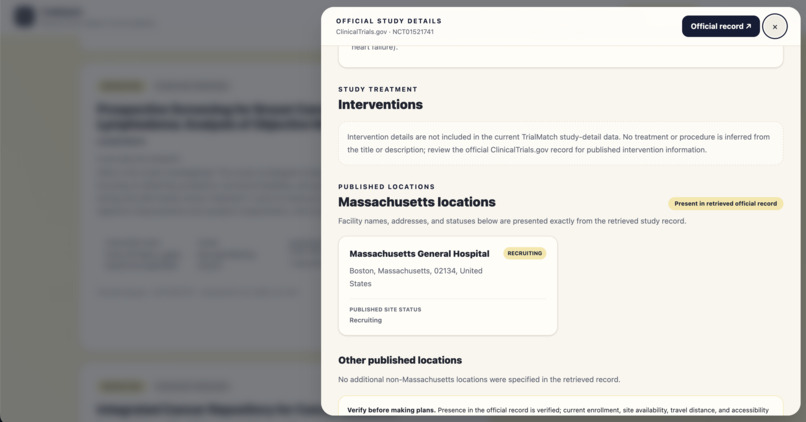
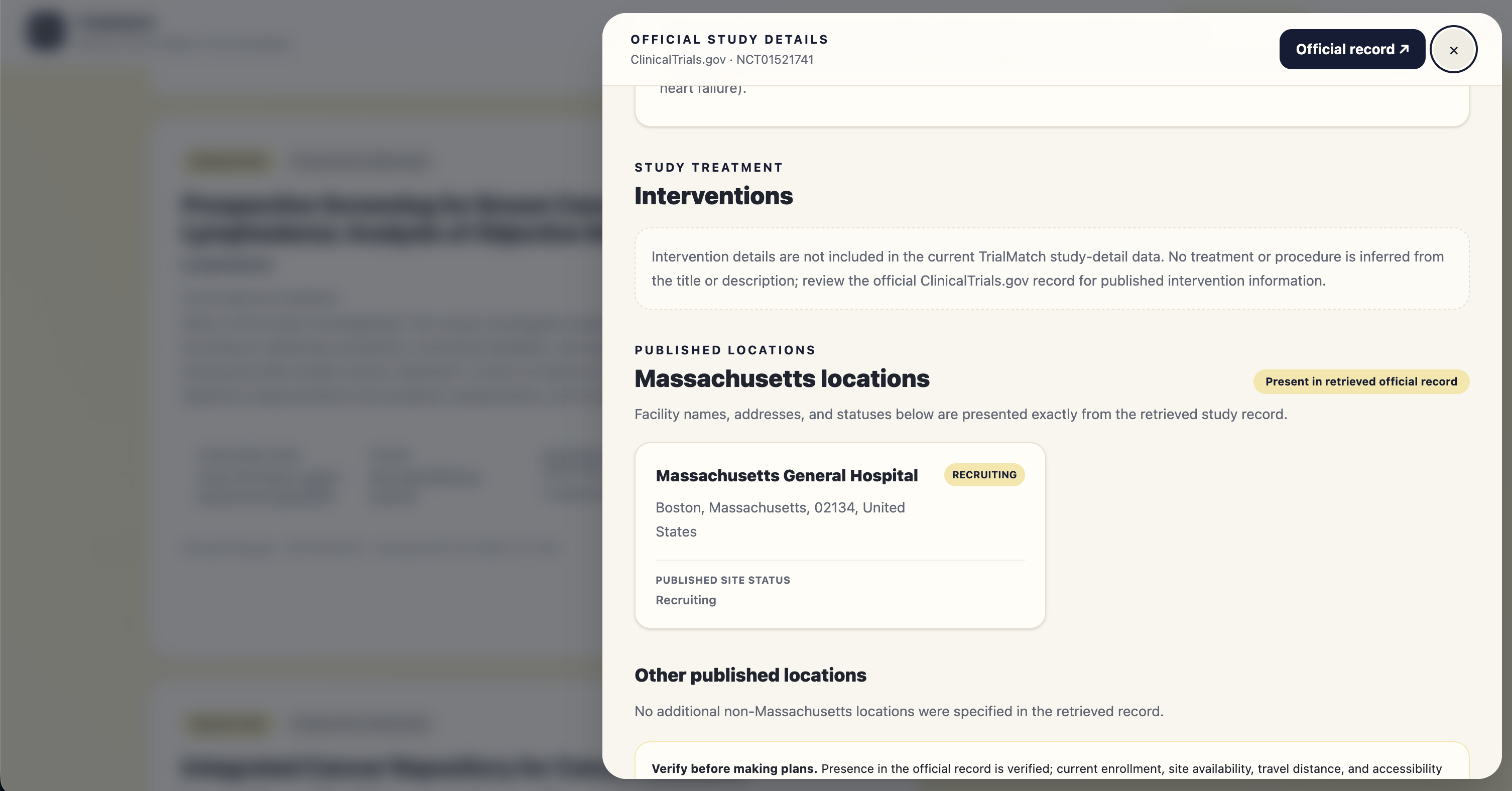
More important details regarding study, such as location
-
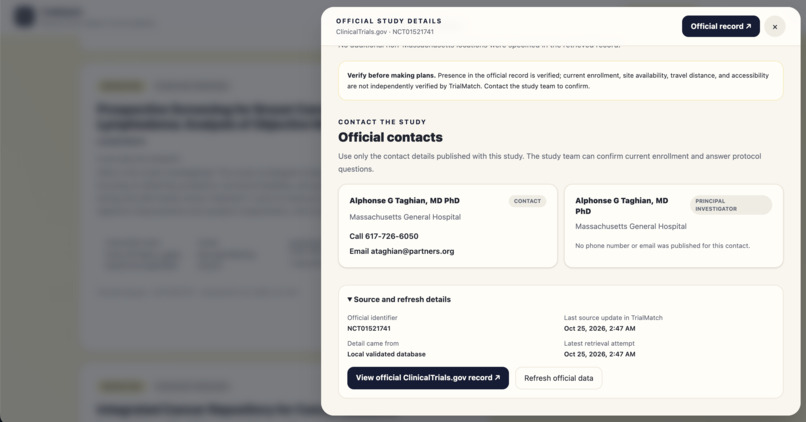
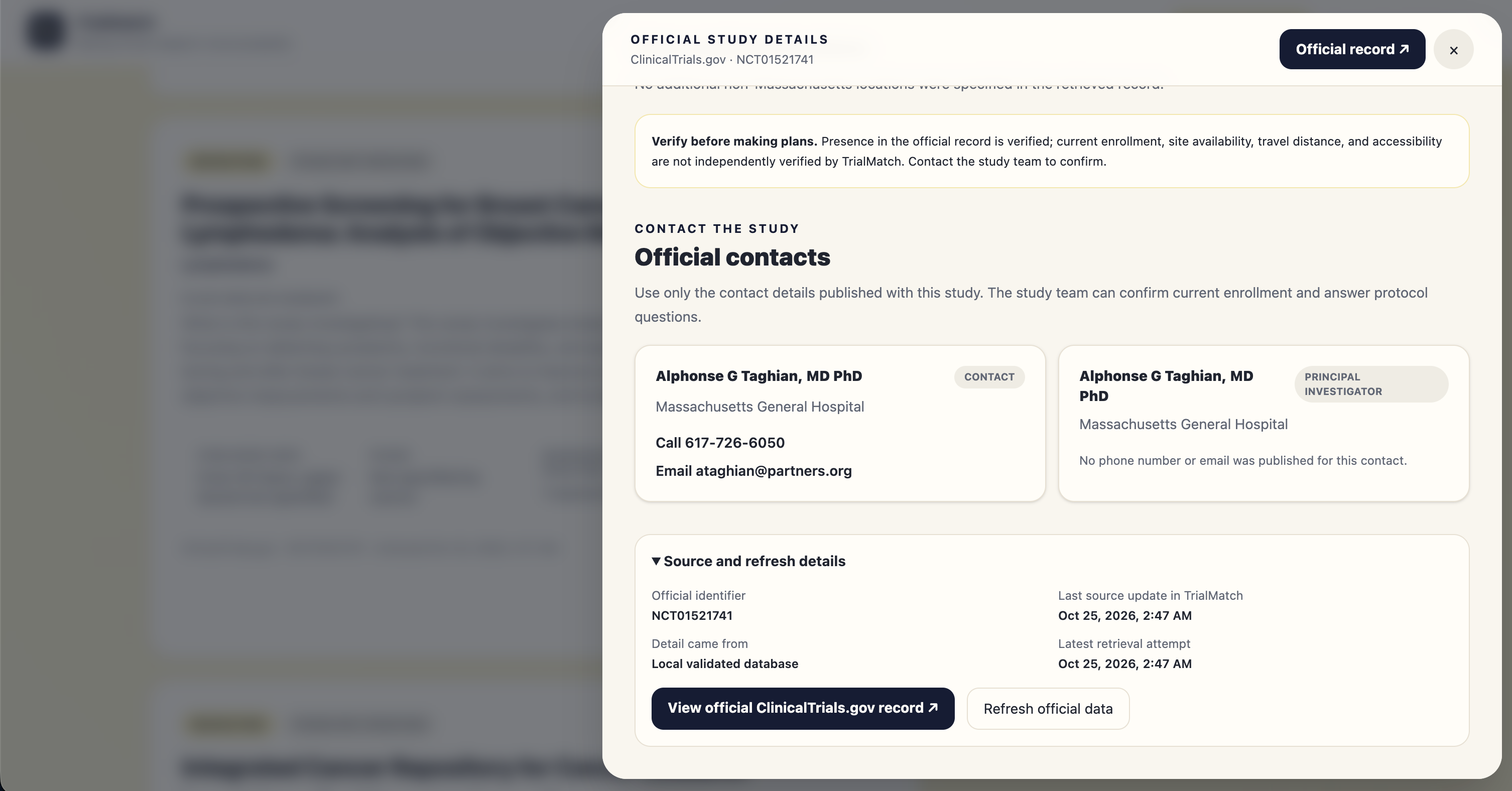
More important details regarding study, such as contact and original source
-
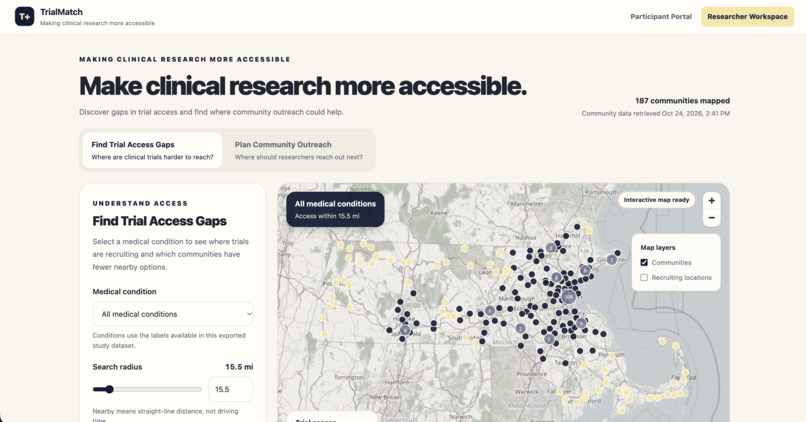
Researcher Workspace
-
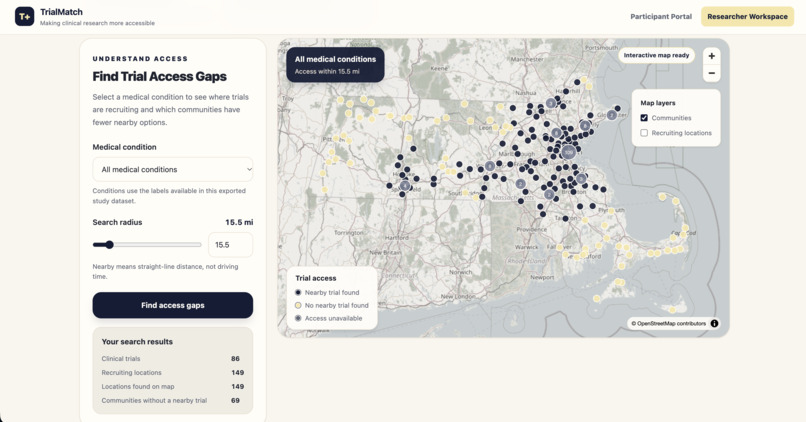
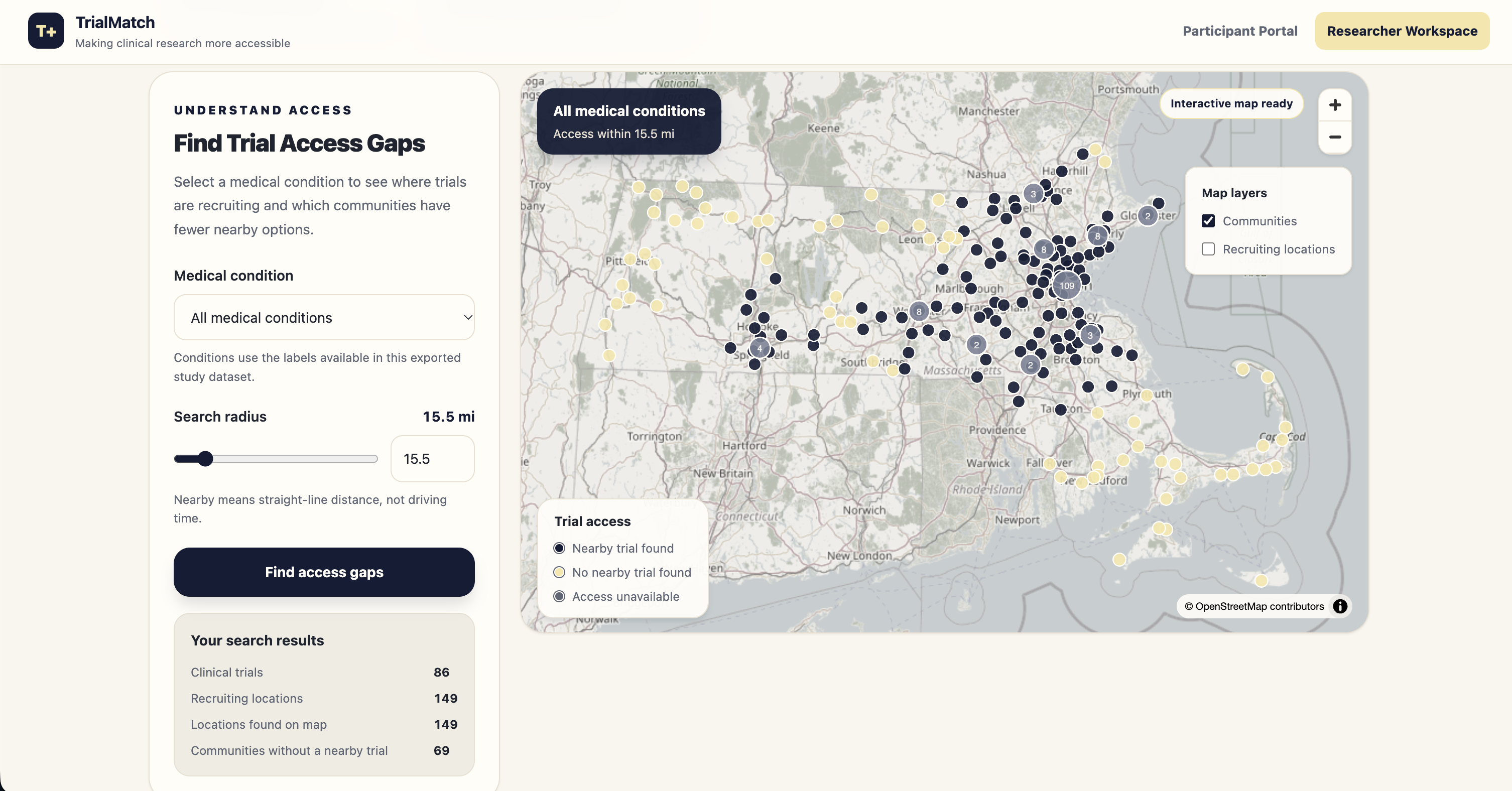
Finding access gaps
-
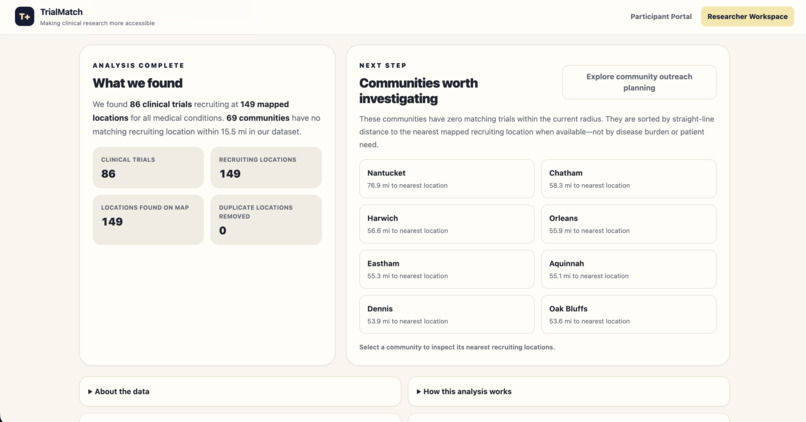
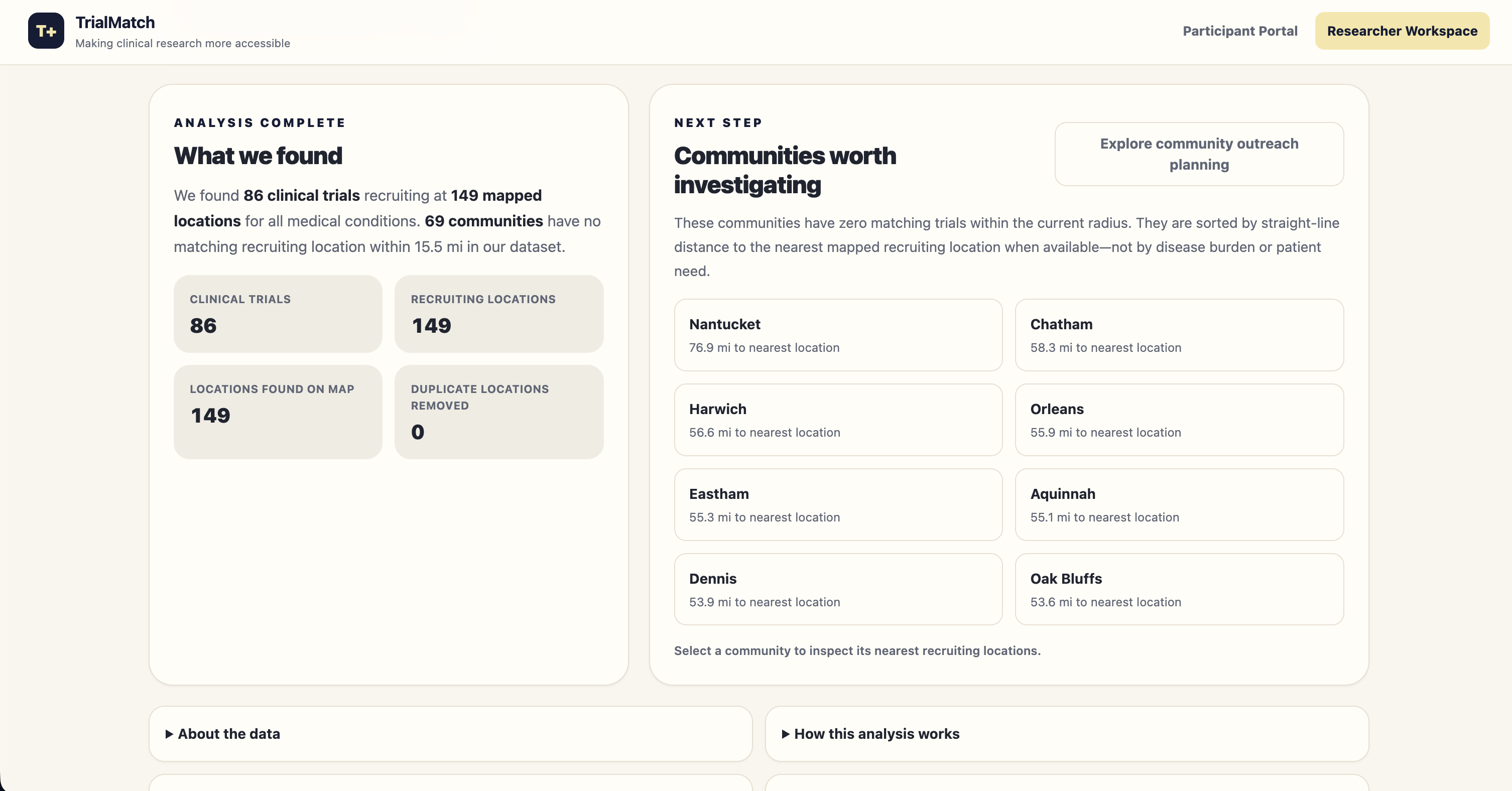
Analysis of gaps and communities worth investigating for clinical trials
-
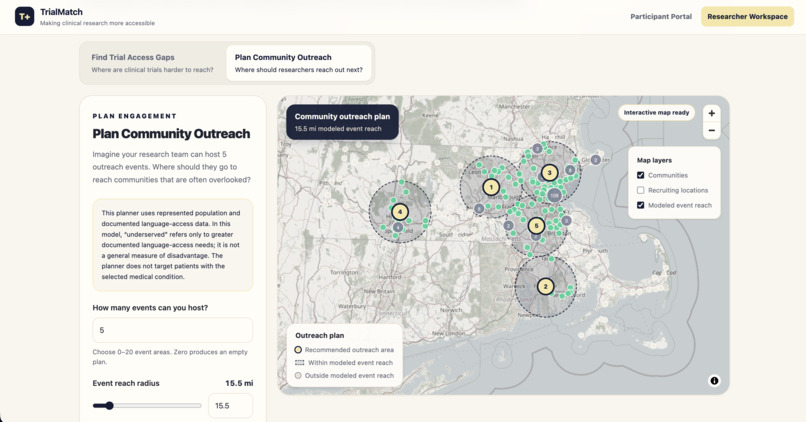
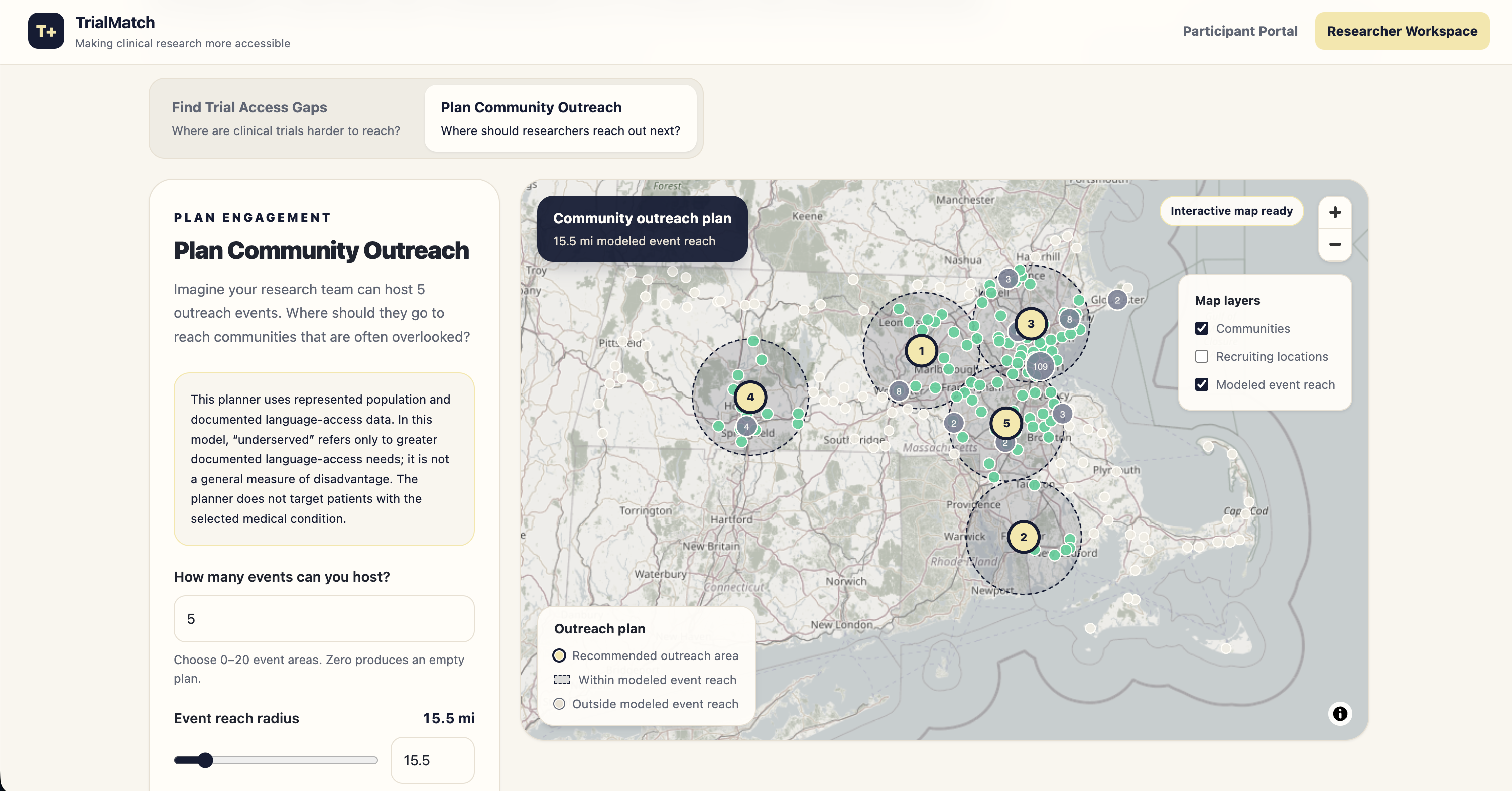
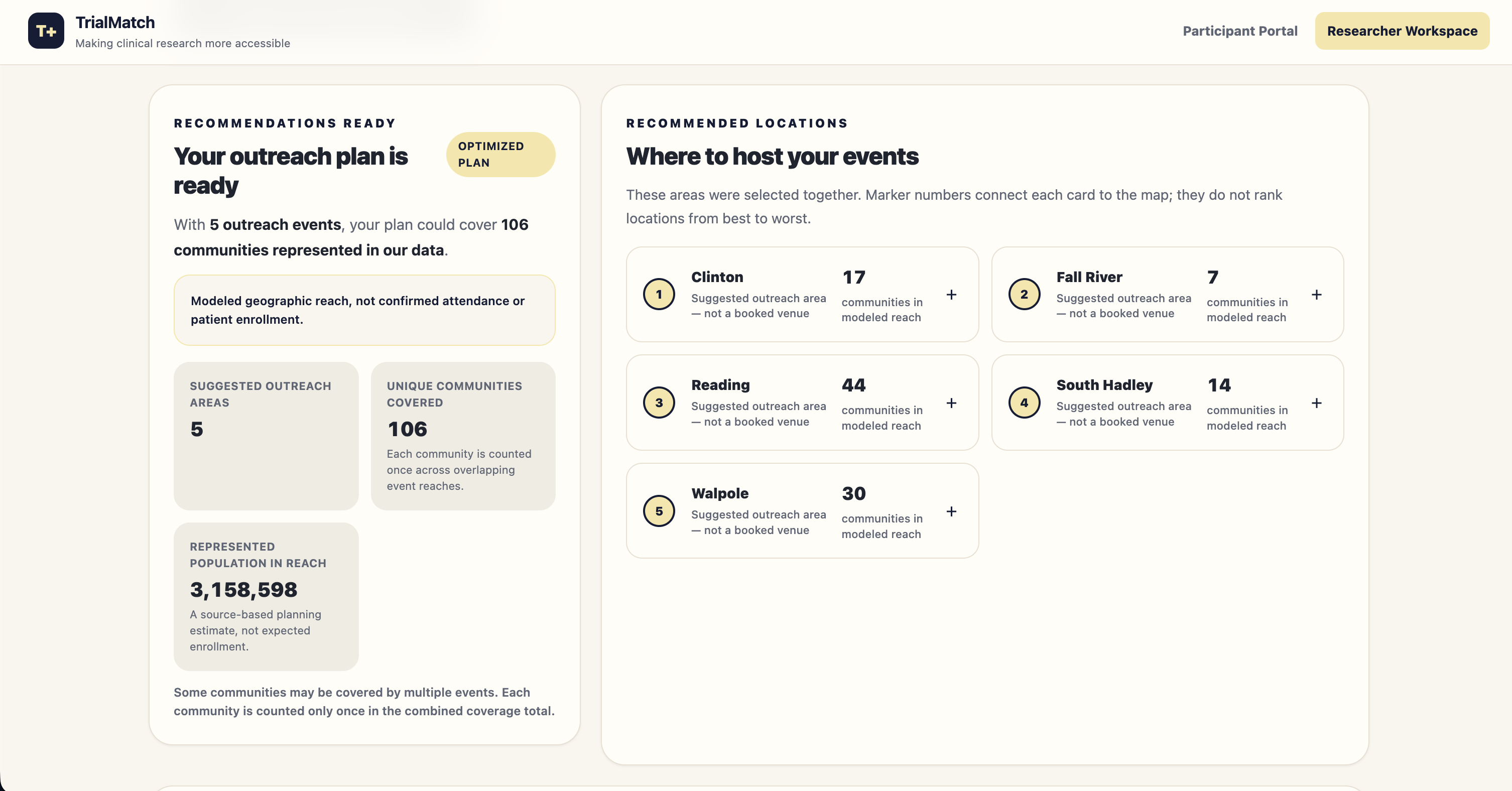
Planning community outreach as a researcher with a map to visualize the state better
-
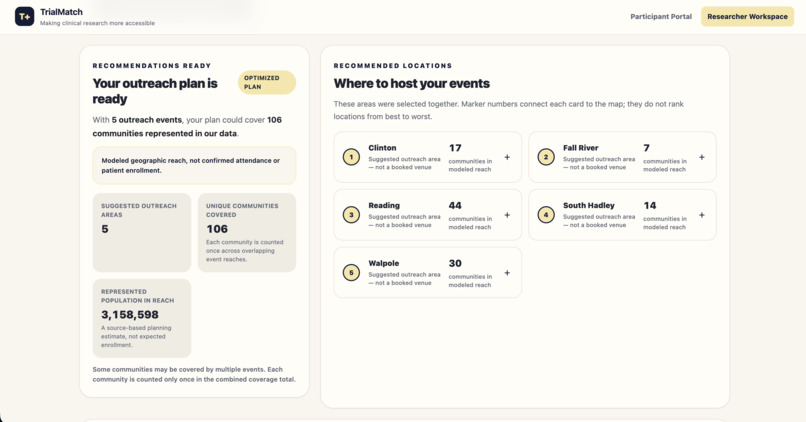
Outreach plan based on number of planned events and set priority for underserved communities
-
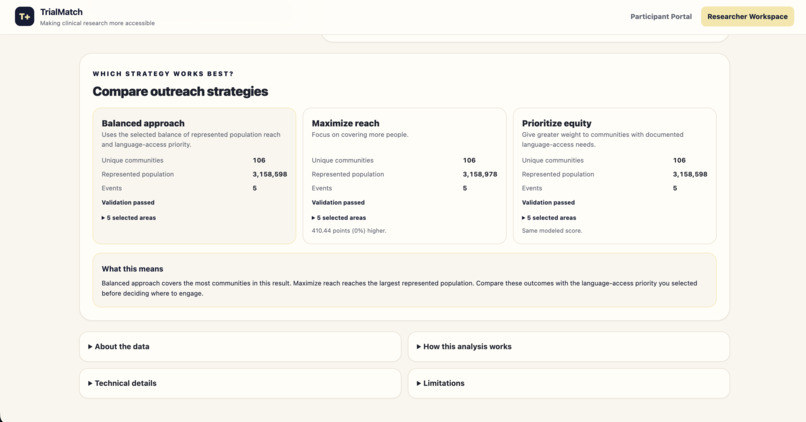
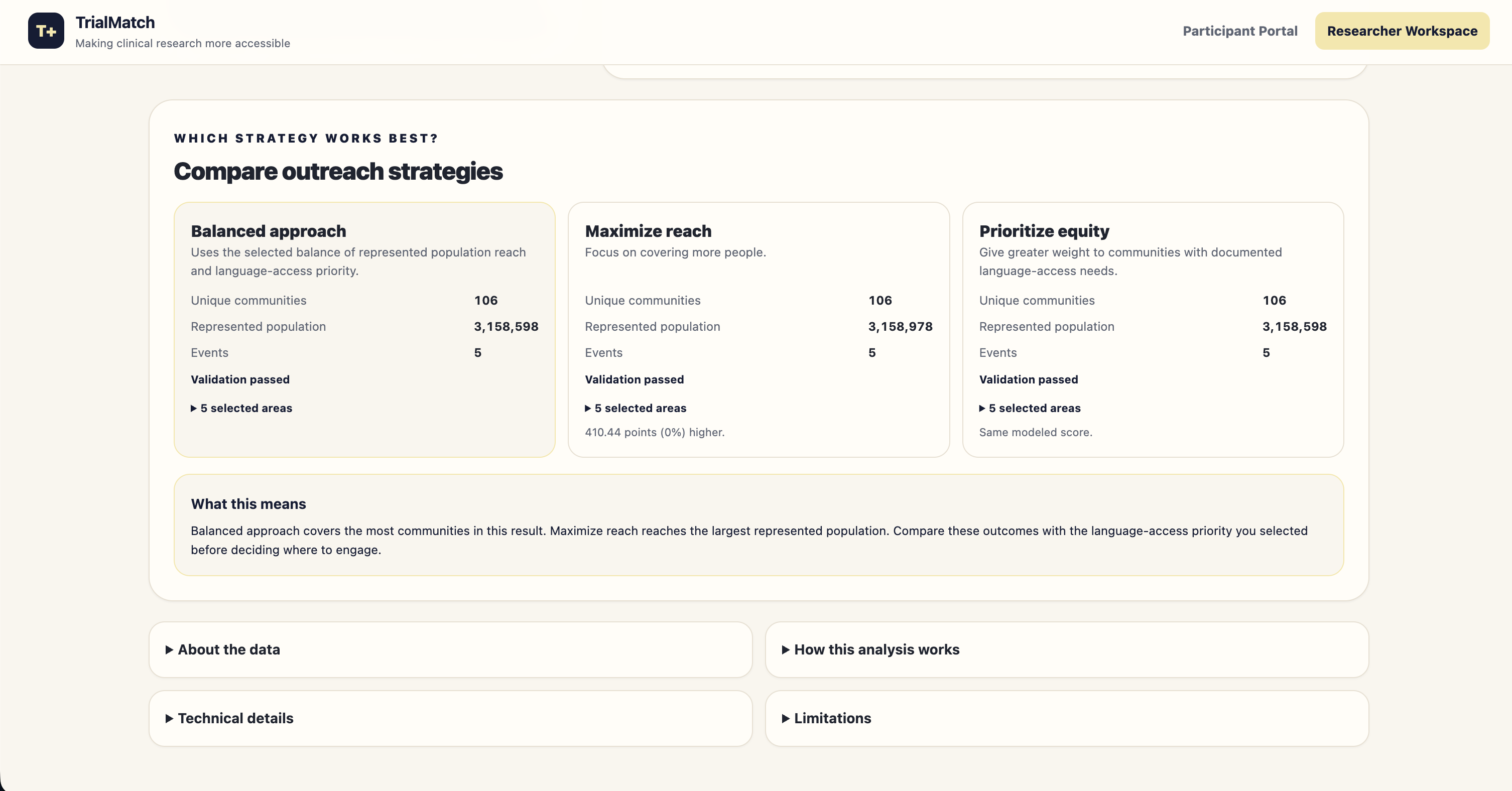
Compare which outreach strategies work best for a trial
Inspiration:
TrialMatch started with something deeply personal to our team.
Vidushi is a neuroscience researcher, and through her experience in research, she understands how important clinical trials are to advancing medicine and developing treatments that could change people's lives. This is a topic she holds especially close to her heart, and her passion for making research more accessible became the driving force behind our project.
As we discussed the challenges surrounding clinical research, one question kept coming up: What good is a potentially life-changing clinical trial if the people who need it most never get the opportunity to participate?
For patients, finding a relevant clinical trial can mean navigating complicated medical language, confusing eligibility requirements, and information scattered across different sources.
For researchers, the challenge extends beyond finding participants. It is also about understanding which communities are being overlooked and what barriers might prevent people from accessing research opportunities.
We realized that this wasn't simply a problem of making clinical trials easier to search. It was a much larger problem of equity, accessibility, and the disconnect between medical discoveries and the people they are meant to help.
With a neuroscience researcher on one side of our team and a computer science perspective on the other, we saw an opportunity to combine our strengths. We wanted to build something that brought together an understanding of clinical research with the power of software engineering, artificial intelligence, and data science.
That's how TrialMatch was born.
We didn't want to create just another clinical trial search engine. We wanted to build something meaningful: a platform that helps patients better understand their research opportunities while giving researchers the tools to recognize underserved communities and make more informed outreach decisions.
Because breakthroughs in medicine should not be limited by someone's ZIP code, their ability to understand medical jargon, or whether they happened to hear about a clinical trial.
For us, TrialMatch is about making sure that as medical research moves forward, fewer people are left behind.
What it does
TrialMatch is a clinical trial discovery and accessibility platform featuring two interconnected experiences: a Participant Portal and a Researcher Workspace.
Participant Portal: Making Clinical Trials Understandable The Participant Portal helps people explore clinical trials without needing a medical background. Users can search for studies based on their interests and medical conditions, browse relevant opportunities, and explore detailed information about individual trials.
One of our key features is AI-powered trial explanations. Instead of forcing patients to interpret complex clinical terminology, TrialMatch uses AI to translate study information into understandable language, helping users understand a trial's purpose, eligibility requirements, and what participation might involve.
Our goal is not to replace medical professionals or determine whether someone is clinically eligible. It is to make the first step toward research participation less intimidating.
Researcher Workspace: Understanding Who Research Is Missing Finding participants is only half the problem. Researchers also need to understand whether their recruitment strategies are reaching diverse communities. Our Researcher Workspace combines clinical trial information with geographic and community-level datasets to help researchers:
- Visualize clinical trial opportunities through an interactive map.
- Identify potentially underserved communities using geographic and demographic indicators.
- Explore access disparities between research locations and surrounding populations.
- Analyze geographic coverage to understand which communities may face barriers to participation.
- Explore outreach opportunities using data-driven geographic analysis and optimization.
By bringing clinical research data and community-level information into the same interface, TrialMatch helps researchers move beyond simply asking "Where are our trial sites?" toward asking "Who might we be failing to reach?"
Together, these experiences make TrialMatch more than a clinical trial search engine. It is a platform for connecting patient discovery, geographic accessibility, and research outreach.
How we built it
We built TrialMatch as a full-stack web application, combining modern frontend development, backend APIs, artificial intelligence, geospatial visualization, and mathematical optimization.
Frontend We used Next.js, React, and TypeScript to build the Participant Portal and Researcher Workspace.
Our design emphasizes clarity, accessibility, and interactivity. The participant experience focuses on making clinical trial information approachable, while the researcher experience provides a more analytical workspace for exploring geographic relationships and outreach opportunities.
We integrated MapLibre to create interactive geographic visualizations, enabling researchers to explore clinical trial locations alongside community-level information.
Backend and Data Our backend is built with Python and FastAPI, providing the API infrastructure for clinical trial search, data processing, and research accessibility analysis.
We incorporated datasets from the Hackachusetts healthcare challenges, including:
- ClinicalTrials.gov recruiting studies in Massachusetts, providing real-world clinical research opportunities.
- Massachusetts Environmental Justice community data, providing geographic indicators relevant to understanding historically underserved communities.
- CDC PLACES data, providing population-level public health indicators.
Combining these datasets allowed us to examine clinical research accessibility from multiple perspectives rather than relying exclusively on trial location data.
Artificial Intelligence
We integrated AI to address a specific problem: clinical trial descriptions are written for researchers, not necessarily for the patients trying to understand them.
Our AI explanation pipeline uses information about individual studies to generate more accessible descriptions of their purpose and participation requirements.
The system is intended to improve comprehension, not to make medical decisions or provide definitive eligibility assessments.
Geospatial Analysis and Optimization We used geographic data processing and SciPy-based optimization to support analysis of clinical trial accessibility and potential outreach opportunities.
Rather than simply displaying dots on a map, we wanted the Researcher Workspace to help users reason about where recruitment efforts could have greater geographic reach.
This combination of real research data, population-level indicators, interactive mapping, and optimization is central to TrialMatch's approach.
Development with Kiro We used Kiro IDE throughout development to accelerate implementation, debugging, and testing.
Kiro helped us move from a project specification into working frontend and backend components while maintaining consistency across two major product experiences.
We also used Git worktrees to develop different parts of the application in parallel, helping us divide responsibilities and move quickly within the hackathon's limited development window.
Our deployment architecture uses Vercel for the frontend and Render for the backend.
Challenges we ran into
1. Connecting Datasets That Were Never Designed to Work Together
One of our biggest challenges was combining clinical trial records with public health and geographic community datasets.
These sources contain different identifiers, geographic representations, and levels of detail. ClinicalTrials.gov describes research studies, while CDC PLACES and Environmental Justice datasets describe communities and population-level conditions.
We had to design a way to make these datasets useful together without incorrectly treating population statistics as individual patient information.
This was especially important because geographic proximity does not automatically mean clinical eligibility or genuine accessibility.
2. Making AI Explanations Work Across Different Studies Clinical trials vary enormously in structure, terminology, and completeness.
Some studies contain detailed eligibility criteria, while others provide limited descriptions or highly specialized medical language.
Building an AI explanation feature that could handle these differences was challenging. We worked on extracting relevant study information, handling inconsistent records, and improving how explanations were generated for different clinical trials.
This reinforced an important lesson: integrating an LLM is relatively straightforward; building a useful system around inconsistent real-world medical data is much harder.
3. Building Two Distinct Products in One Platform The Participant Portal and Researcher Workspace have very different users.
Patients need simplicity, understandable explanations, and an intuitive discovery experience.
Researchers need geographic context, analytical tools, and ways to explore complex relationships between multiple datasets.
Designing both experiences within one cohesive application required careful decisions about navigation, information hierarchy, and component design.
4. Making Interactive Maps Actually Useful Displaying trial sites on a map was the easy part.
The harder challenge was presenting multiple layers of geographic information without overwhelming users.
We had to work through map layout problems, overlapping controls, dropdown behavior, legends, and responsive sizing to make the interface practical rather than merely visually impressive.
Accomplishments that we're proud of
1. Building for both sides of clinical research. Instead of making another clinical trial directory, we developed a platform that considers both the people searching for trials and the researchers trying to reach them.
2. Bringing real-world datasets into one experience. We connected clinical study records with public health and community-level geographic data to create a broader view of research accessibility.
3. Making complex trial information more approachable. Our AI-powered explanations aim to reduce the knowledge barrier between medical research and potential participants.
4. Going beyond visualization with optimization. We incorporated mathematical optimization into our research accessibility workflow, creating a foundation for more informed geographic outreach planning.
5. Building a complete full-stack system within a hackathon. We developed two substantial product interfaces, a Python backend, geographic visualizations, AI integrations, and a deployment pipeline within a compressed timeframe.
Most importantly, we are proud that TrialMatch addresses a real problem. The objective is not simply to demonstrate technology, but to make clinical research more understandable and accessible.
What we learned
This project taught us that healthcare accessibility is not just a medical problem. It is also an information, geography, and systems problem.
A clinical trial can exist and still be effectively inaccessible to someone who cannot understand its requirements, does not know it exists, or faces practical barriers to reaching the study location.
We also learned how important it is to distinguish between correlation and actionable evidence when working with public health data.
A community with elevated disease prevalence does not automatically contain eligible participants for a particular clinical trial. Likewise, a community's geographic distance from a research location is only one component of accessibility.
From a technical perspective, we gained experience integrating heterogeneous datasets, building geospatial interfaces, applying optimization techniques, and designing AI workflows around real-world clinical records.
We also learned the importance of building AI features for specific user needs rather than adding AI simply because it is available.
Finally, developing TrialMatch under tight deadlines strengthened our ability to collaborate, prioritize essential functionality, and turn an ambitious concept into a working software project.
What's next for TrialMatch
We see TrialMatch as the foundation for a broader clinical research accessibility platform.
Our next steps include:
- More personalized trial discovery: Allow users to voluntarily provide relevant health information and receive more targeted trial suggestions, with appropriate privacy protections and clear eligibility disclaimers.
- Improved AI explanations: Expand coverage across more clinical trials and incorporate stronger source-grounding and medical information validation.
- Transportation accessibility analysis: Incorporate travel times, public transportation availability, and other practical barriers beyond straight-line geographic distance.
- Smarter outreach recommendations: Extend our optimization engine to help researchers evaluate potential outreach strategies under real-world resource constraints.
- Broader geographic coverage: Expand beyond Massachusetts to support clinical research accessibility across the United States.
- Researcher feedback and validation: Work with clinical research professionals and patient advocates to evaluate whether our insights reflect real recruitment challenges.
- Improved accessibility and multilingual support: Make trial discovery easier for individuals with different language needs and levels of health literacy.
Our long-term vision is to help shift clinical research from a system where patients must struggle to find opportunities toward one where research opportunities are easier to discover, understand, and access.
TrialMatch: Connecting clinical research with the communities it needs to reach.
Built With
- artificial-intelligence
- data-science
- fastapi
- git
- healthcare
- javascript
- kiro
- maplibre
- next.js
- openai-api
- python
- react
- render
- scipy
- tailwind-css
- typescript
- vercel

Log in or sign up for Devpost to join the conversation.