-
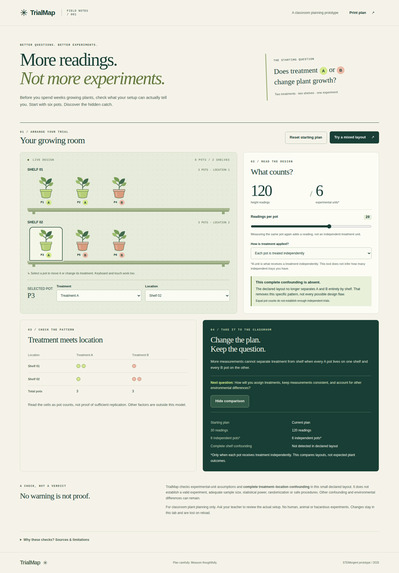
Compare a mixed layout with the starting plan. Clearing this warning is not a guarantee of experimental validity.
-
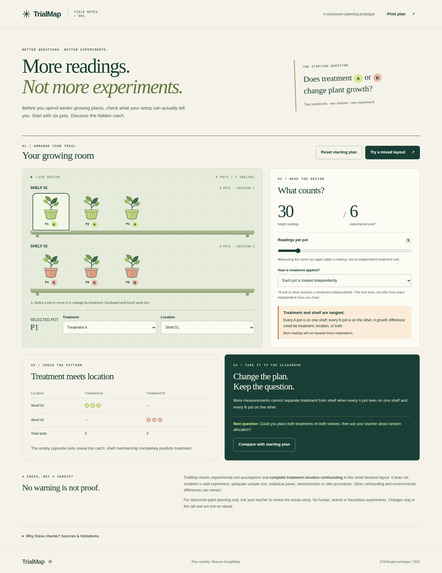
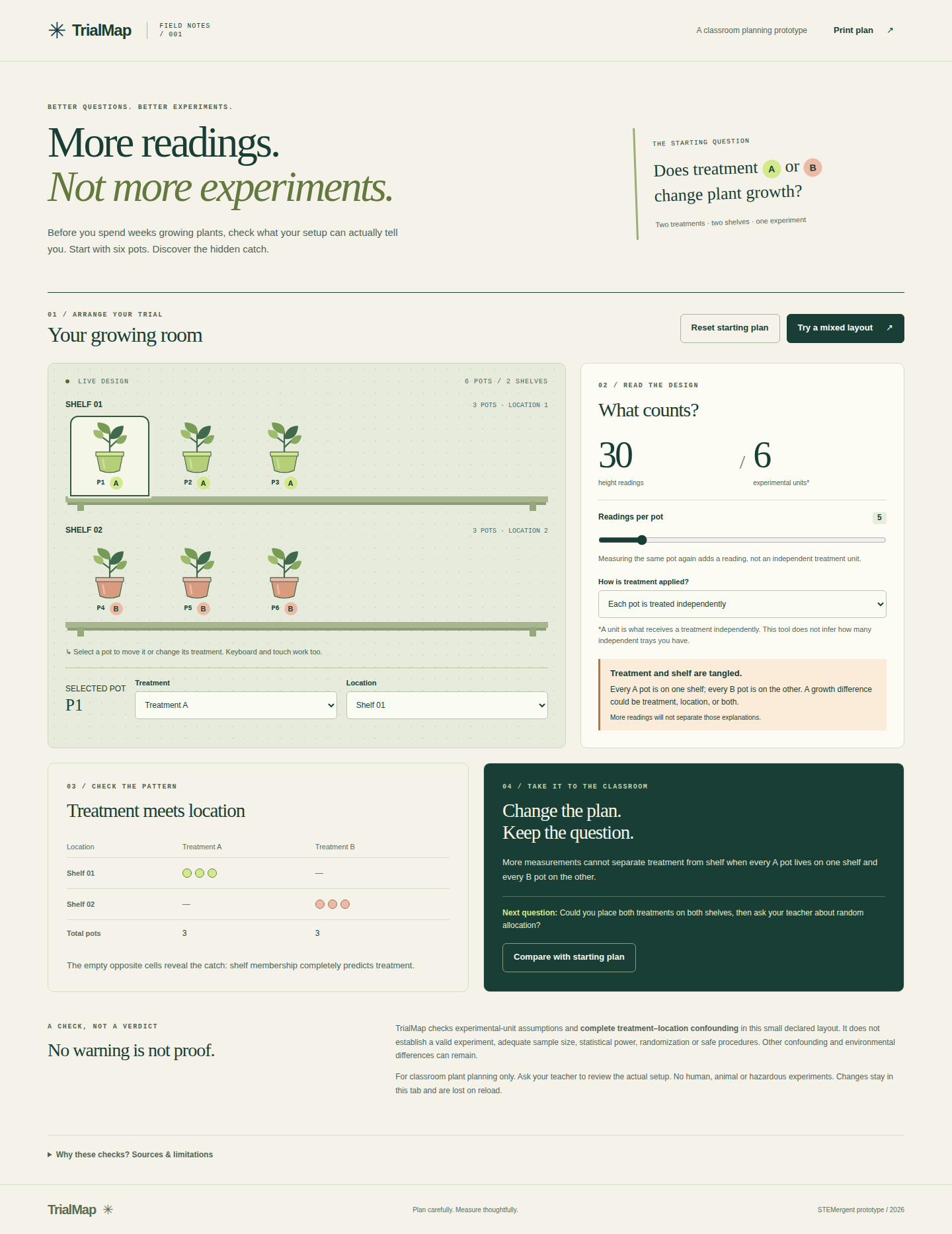
Starting plan: 30 readings, six declared independent treatment units, and treatments separated by shelf.
-
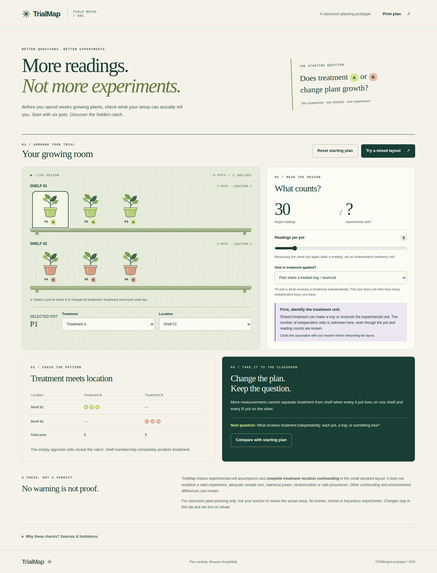
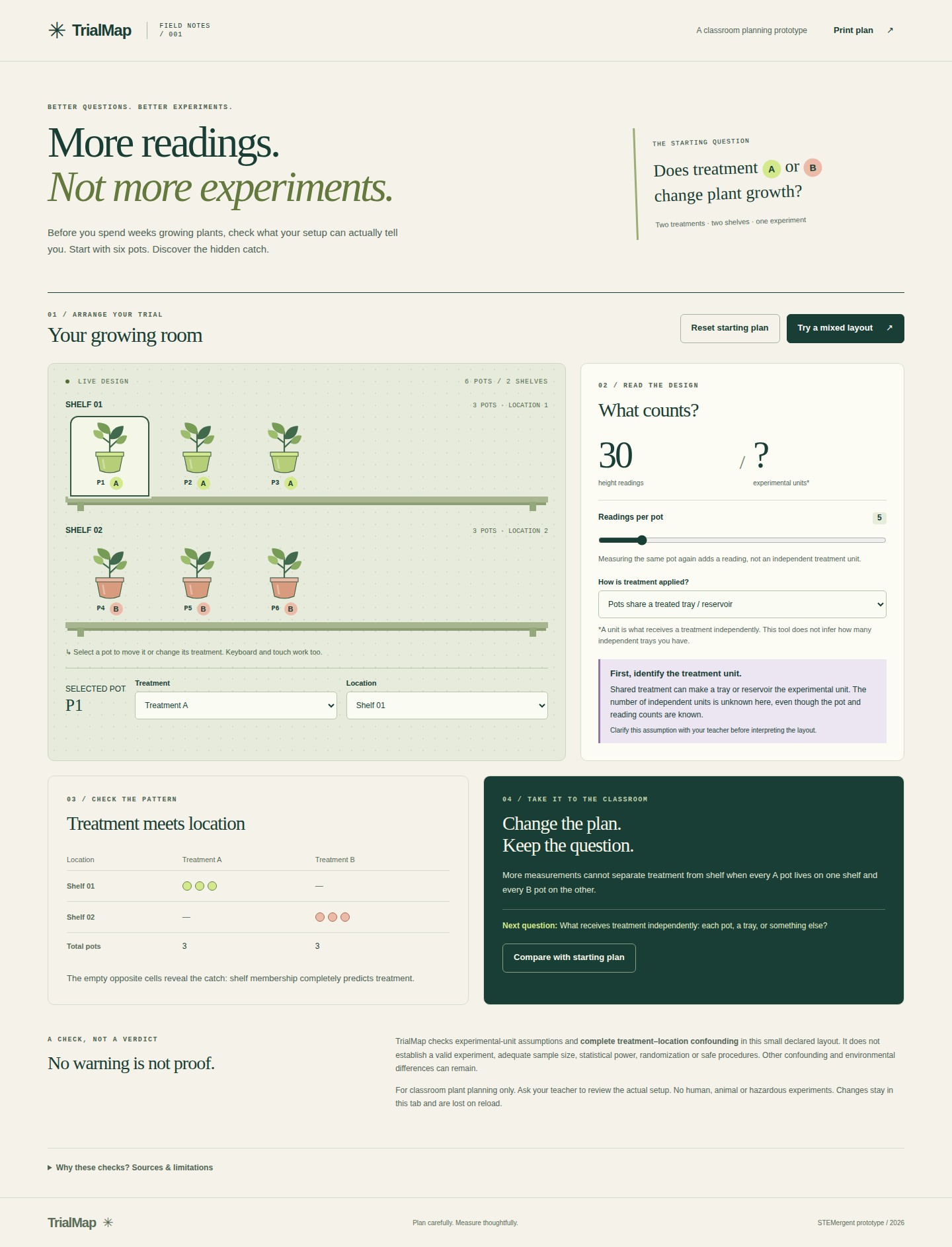
Shared treatment keeps the independent-unit count unknown, even after rearranging the pots.
The moment before an experiment goes wrong
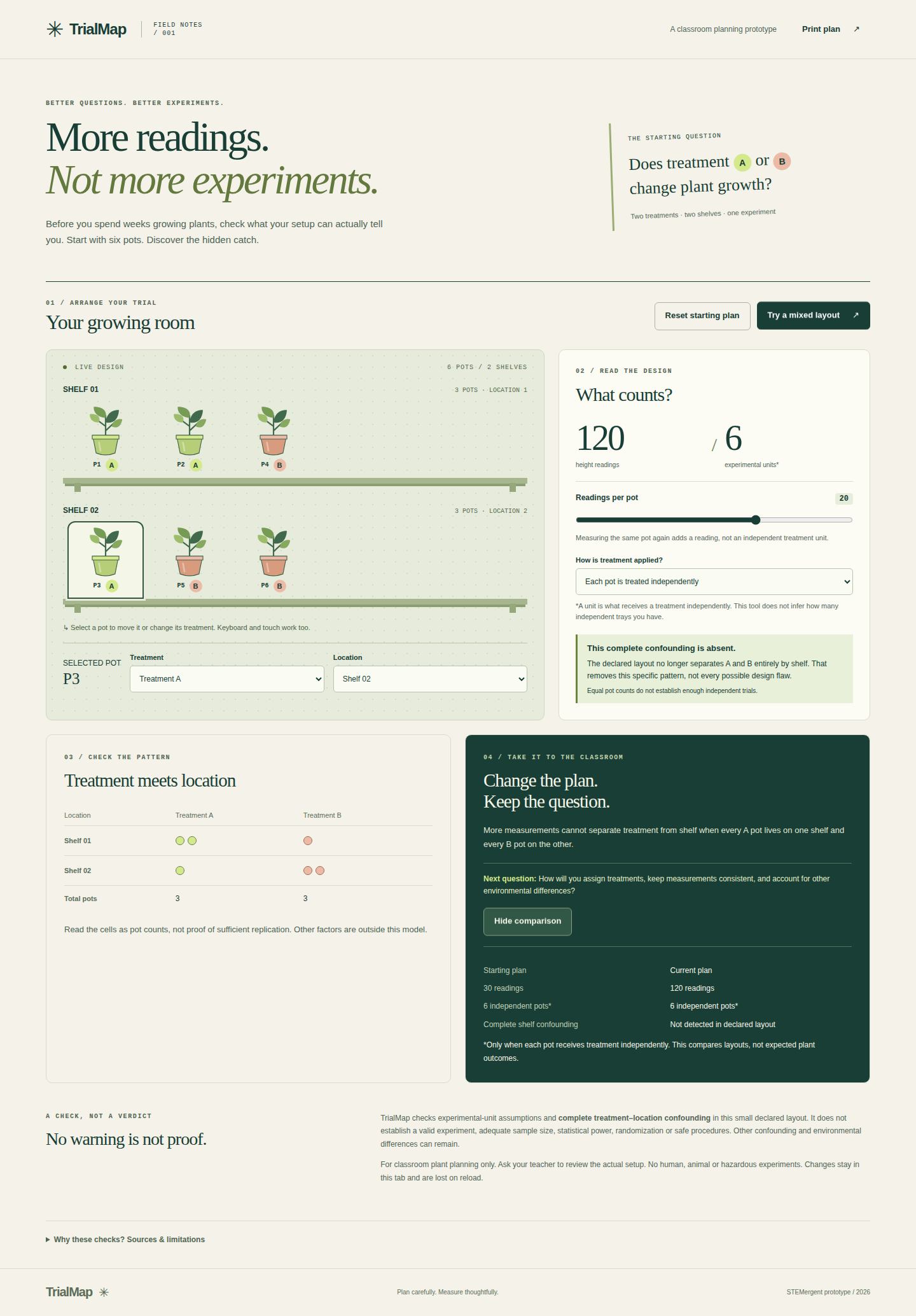
A student grows six plants, takes five height readings from each, and ends up with 30 measurements. But if each pot receives its treatment independently, there are still only six experimental units. If all treatment A pots sit on one shelf and all treatment B pots on another, treatment and location are completely linked.
TrialMap makes those two distinctions visible before anyone spends weeks growing plants. It is a working Hackathon Pathway prototype for STEMergent, built from a fresh baseline after the competition opened on October 31, 2026. Solo entrant: Sharon Basovich.
Try the decision, not just the interface
Open the live app with no account or installation.
- Start with six synthetic pots. The display separates 30 height readings from six declared independent treatment units.
- Increase readings per pot. The unit count stays the same and the shelf warning remains.
- Select a pot and move it, or choose Try a mixed layout. Putting both treatments on both shelves clears that specific complete-confounding warning.
- Choose shared treatment or an unknown treatment unit. TrialMap stops reporting a known unit count instead of assuming every pot is independent.
- Compare with the starting plan and print a discussion handout for a teacher.
The useful output is a concrete planning question: should we change where treatments are placed or clarify what is independently treated before collecting more readings?
How it works
The interface is a small, responsive growing-room workspace with native controls, keyboard/touch support, a treatment-by-shelf matrix, comparison view and print layout. Motion respects reduced-motion preferences. The same deterministic analysis drives the visual shelves, counts, warnings and handout.
A pure JavaScript model validates the declared plan, counts readings separately from treatment units, and checks whether the two treatments are completely separated by shelf. The UI deliberately stays at six pots, two treatments and two shelf locations. It does not use an AI model to judge the experiment.
The four-file app has no third-party runtime dependencies. Inputs stay in memory in the browser tab; there are no accounts, analytics, automatic uploads or saved student records. The host receives ordinary requests for the static app. Reloading discards changes, and printing uses the browser's chosen destination.
Evidence and limits
The scientific principle is established, not invented here. The NC3Rs Experimental Design Assistant explains experimental units; its animal-research examples were cautiously adapted to separately treated plant pots. NIST's discussion of blocking supports the importance of accounting for location. Society for Science provides the student-experiment context. NC3Rs EDA is an existing, much broader tool.
TrialMap is a bounded classroom explanation and planning prototype. A shared tray or reservoir may be the treatment unit; without that structure the unit count stays unknown. Clearing a warning does not establish validity, adequate sample size, statistical power, randomization, safety or the absence of other confounding. It is not intended for human, animal or hazardous experiments. There has been no student/teacher validation or demonstrated learning benefit yet.
Testing, challenges and learning
Fourteen domain tests include 5,460 enumerated layouts checked against an independent pairwise oracle. Six automated Chromium tests cover the main decision flow, shared/unknown assumptions, keyboard interaction, mobile layouts, accessibility scans and printing. Independent source and rendered reviews caught an accessible-label mismatch and truncated mobile controls; both were corrected before acceptance. Automated scans are not a WCAG certification or a substitute for manual assistive-technology testing.
The most important implementation lesson was to preserve uncertainty: rearranging pots must not silently turn an unknown treatment unit into a known one. The most useful next evaluation would be whether students and teachers can explain the before/after difference using the tool. That evaluation has not happened, and no outcome claim depends on it.
AI and third-party disclosure
This project was built with substantial OpenAI/Codex assistance for research, design, implementation, tests and review. The original code and inline vector artwork were created during the competition window; only problem and rules research preceded it. The scientific sources above informed the explanation. Node.js, Playwright, axe-core and GitHub Actions support development/testing; GitHub Pages hosts the static app. No generated scientific results, external dataset or runtime AI service is used.
Source and reproducible checks · Accepted application source snapshot

Log in or sign up for Devpost to join the conversation.