-
-
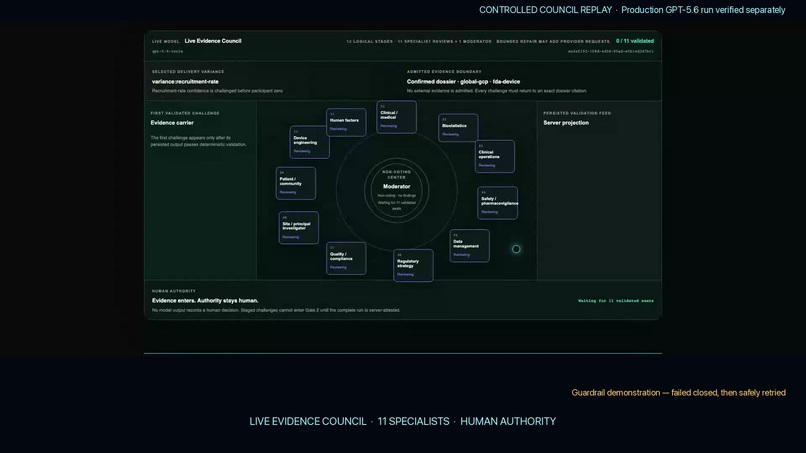
Evidence Council
-
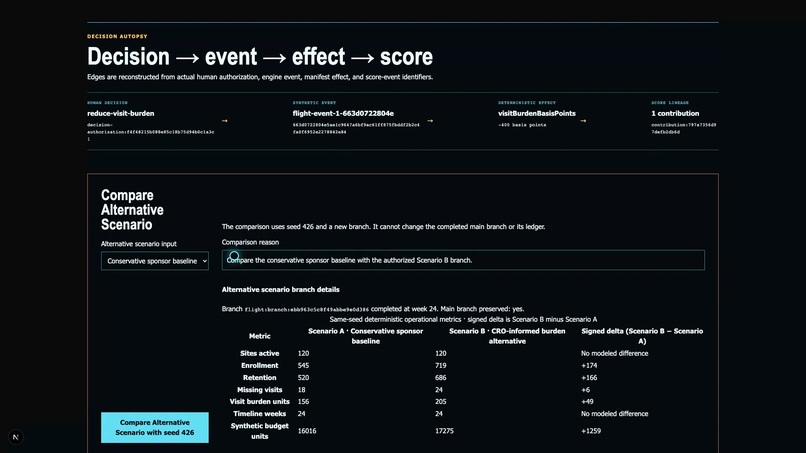
Deterministic scenario comparison
-
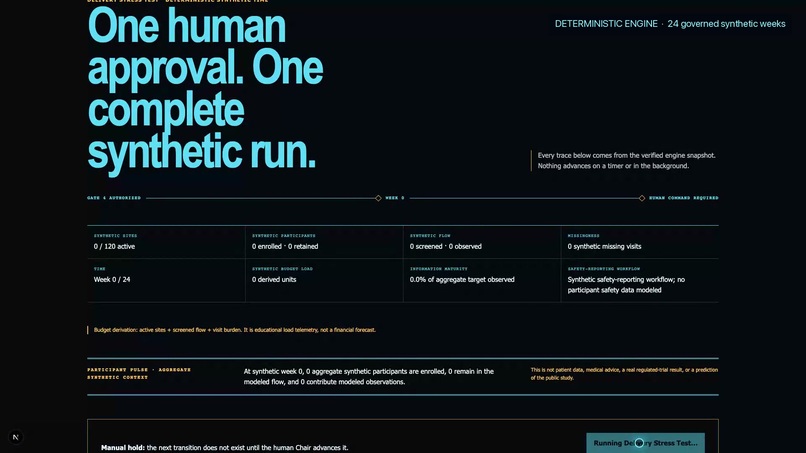
Human governed stress test
Inspiration
As a clinical trial biostatistician and AI/ML scientist, I have seen these failures firsthand. Teams often discover critical operational risks only after execution has started: assumptions are wrong, feasibility is overestimated, site readiness is misunderstood, and coordination issues appear under pressure.
When that happens, protocol amendments are expensive, timelines are extended, and quality suffers even before the first patient is enrolled. I built this because I wanted a practical way to surface those risks earlier, with evidence and structure, so teams can make better decisions before day one.
What it does
TRIAL//ZERO is a governed protocol-delivery rehearsal system built to test operational assumptions before a trial starts.
The idea is simple: a protocol is only as reliable as its assumptions. TRIAL//ZERO converts protocol context into a review workflow that maps those assumptions to concrete delivery risk.
In the Build Week prototype, the core flow is:
- Protocol dossier ingestion and scoping: case context is structured into a governed input runtime, then human users define the review scope and critical assumptions.
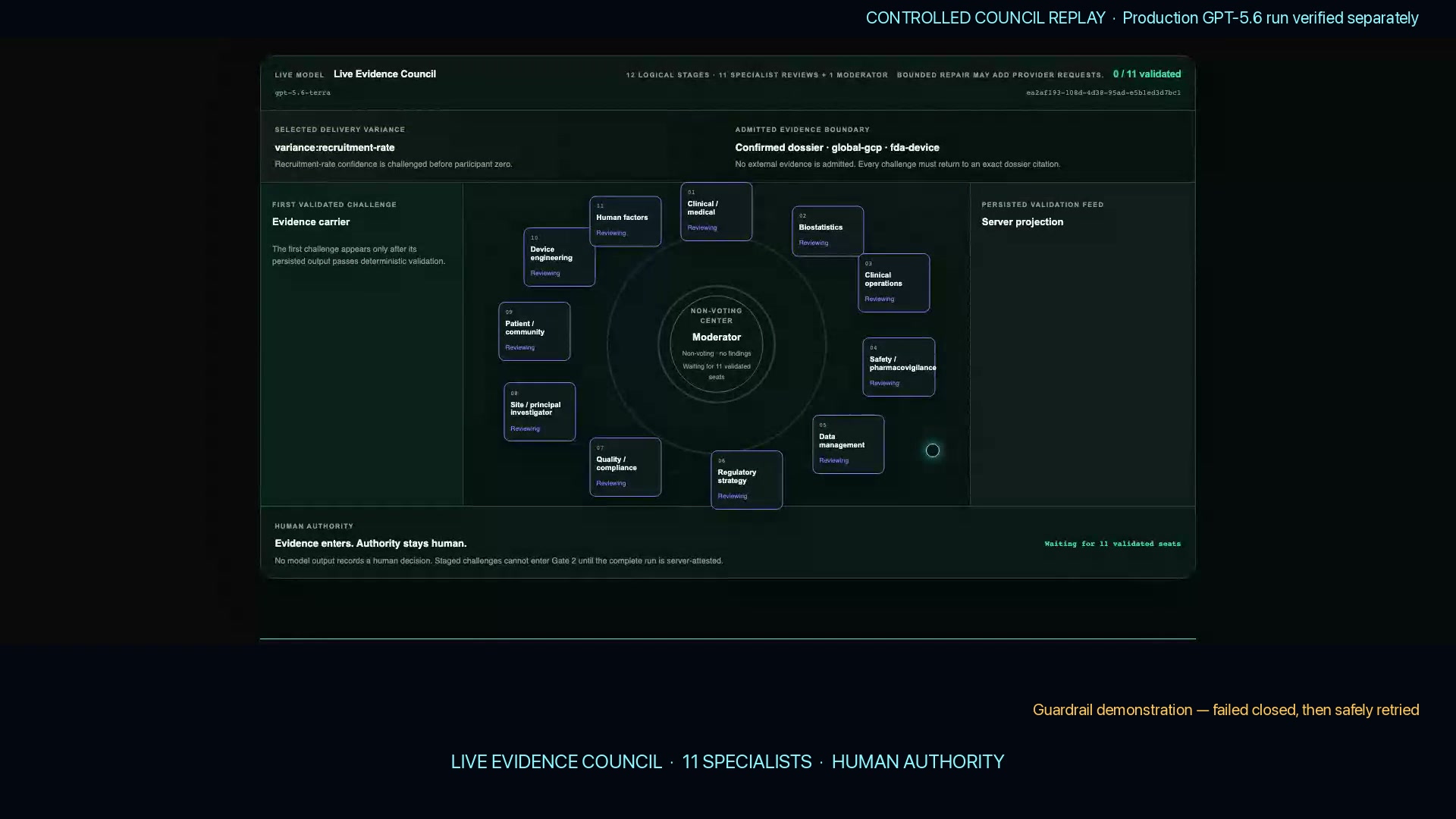
- 11-seat Evidence Council review: independent specialist perspectives (clinical, operations, statistics, safety, regulatory, and more) run in parallel against the same evidence-backed context.
- Cross-examination and variance-aware focus: findings are stress-tested across seats, while review attention can be focused on high-impact operational risk.
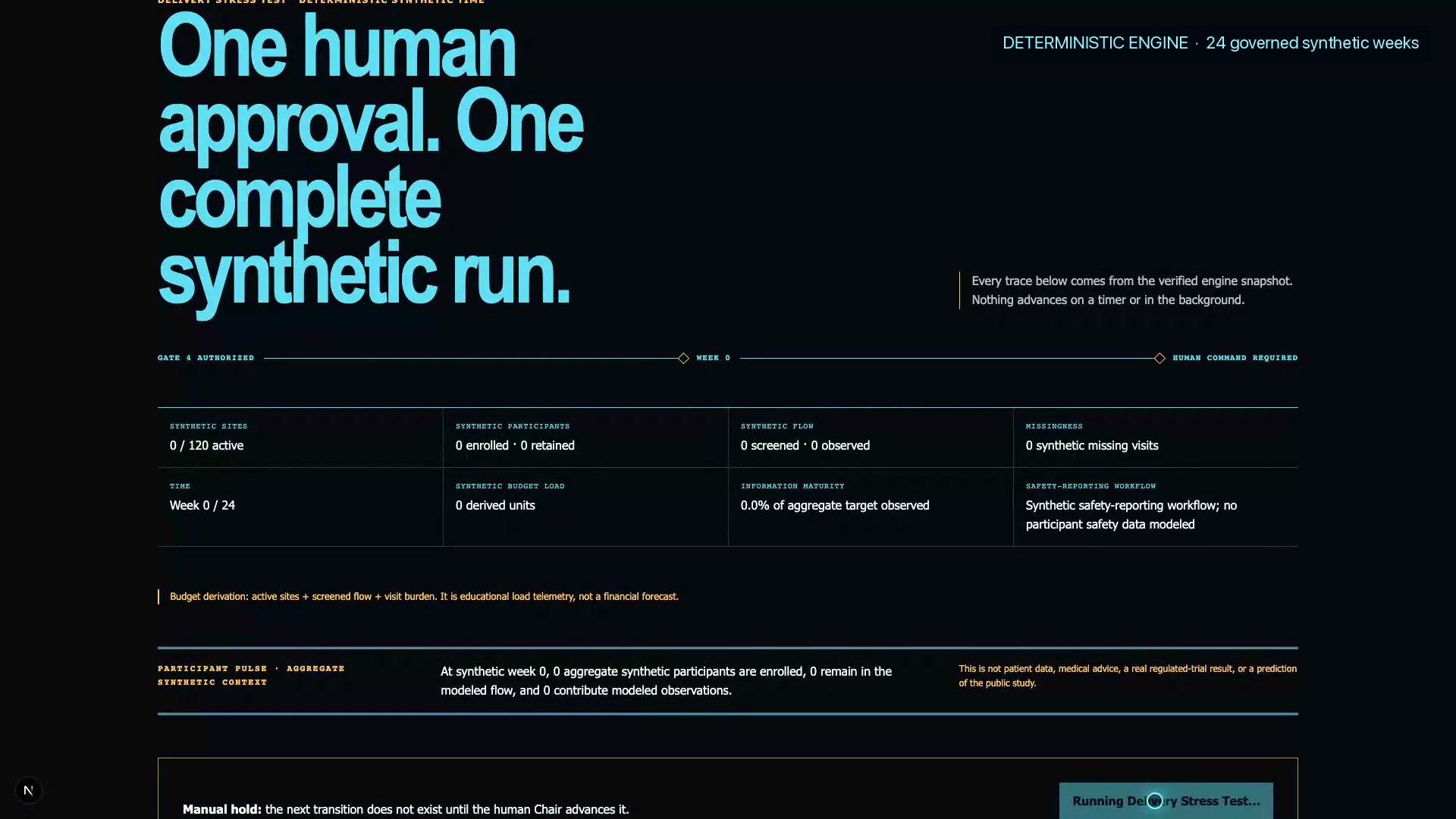
- Human-governed progression: explicit gates keep people in final control of acceptance, disposition, and readiness.
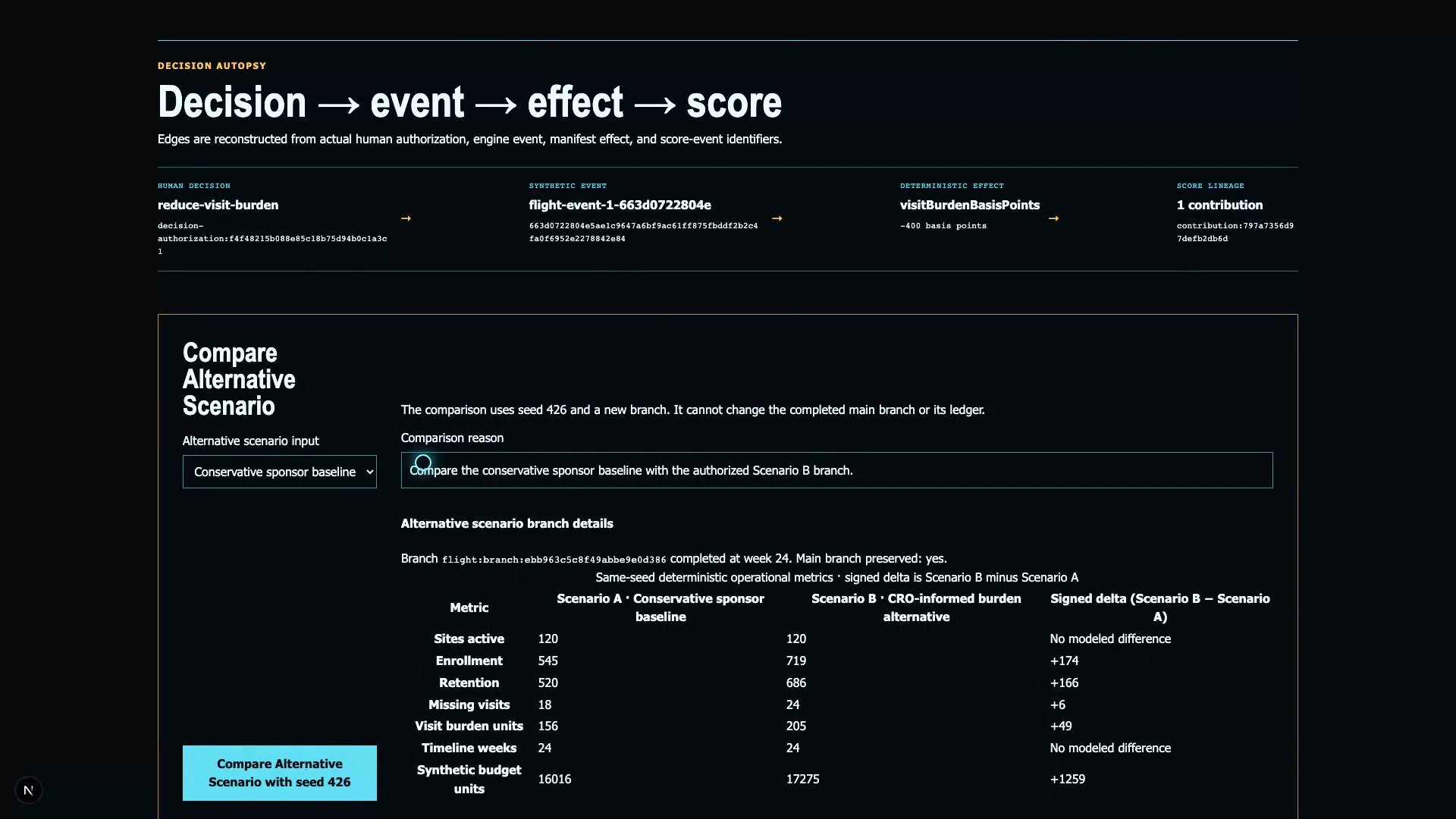
- Protocol Autopsy output: a final decision lineage that highlights findings, dissent, and how assumptions connect to risk.
The prototype is explicit about its boundaries: it is a synthetic, governance-first workflow demonstration, with deterministic fixtures for stable rehearsal and bounded AI assistance for review narration and interpretation.
How we built it
I built TRIAL//ZERO as a Next.js + TypeScript system with strict schemas and clear boundaries between what is deterministic and what is AI-assisted. The architecture focuses on reproducibility and traceability, because that is what makes a review credible.
Concretely, I implemented:
- typed core models for dossiers, evidence, findings, dissent, and run provenance;
- a multi-seat council runtime with independent review generation and explicit role identity;
- robust parse/validation/repair logic so malformed model outputs are handled safely;
- deterministic fixture paths for stable offline rehearsal and reliable tests;
- live review wiring for bounded GPT-5.6 use under governance constraints;
- persisted run state and stage events so a review can be audited from start to finish.
I also spent significant time on the governance surface: this should feel cinematic and useful without blurring the line between model support and human authority.
Challenges we ran into
The hard part was not building screens; it was controlling scope and authority.
Model output has to be useful without becoming the final decider. I had to enforce validation boundaries, deterministic checks, and role-level contracts so the workflow stays trustworthy and explainable.
The second challenge was clarity under complexity. A multi-agent review system can look like magic if not designed carefully. I needed the product to show what is evidence-grounded, what is human-confirmed, and where the final decisions are made.
The third challenge was making the system robust for judges: a strong build should not just run; it should prove itself with tests and predictable behavior across environments.
Accomplishments that we're proud of:
- Built a synchronized 11-seat council flow with explicit human authority at each critical stage.
- Added variance-aware review context so output stays relevant to the most consequential assumptions.
- Implemented repair-first validation to avoid silent failures and keep model output auditable.
- Delivered a complete, passing automated test path and successful production build.
- Preserved clear separation between synthetic rehearsal behavior and live-model-assisted logic.
- Created an explicit audit trail for review progression, provenance, and final findings.
What we learned
I learned that in this domain, the product win is governance clarity, not model cleverness.
The most useful AI systems do not replace expertise; they make it faster to test it. This project strengthened a principle I care about: structure and evidence, not fluency, is what creates trust.
What's next for TRIAL//ZERO
The next version is a sponsor-led protocol readiness companion for real planning teams:
- stronger collaborative handoff patterns,
- richer comparison and revision workflows,
- and deeper auditability for pre-launch decisions.
My goal is to keep the same constraint that defines the prototype: AI should increase decision quality while humans keep authority.
Built With
- gpt-5.6
- next.js
- node.js
- openai-api
- playwright
- react
- supabase
- tailwind-css
- typescript
- vitest
- zod

Log in or sign up for Devpost to join the conversation.