Inspiration
Clinical trial eligibility criteria are public, but hard to read: "a college reading level was found to be necessary to understand eligibility criteria text" (Kang et al., 2015, https://pmc.ncbi.nlm.nih.gov/articles/PMC4765646/). Awareness is low: "Of 3,772 US adults, 41.3% reported not knowing about clinical trials" (Yadav et al., 2022, https://pmc.ncbi.nlm.nih.gov/articles/PMC9595001/). Enrolment is a documented problem too: of 2579 eligible trials, "481 (19%) either terminated for failed accrual or completed with less than 85% expected enrolment" (Carlisle et al., 2015, https://pmc.ncbi.nlm.nih.gov/articles/PMC4516407/).
Trial Questions does not tell anyone whether they qualify. It turns each criterion into a question to bring to a doctor, with the original text beside it.
What it does
Search by condition, optionally add a location, and pick a recruiting study. Every lookup is a fresh ClinicalTrials.gov API v2 request; no trial record is cached or bundled.
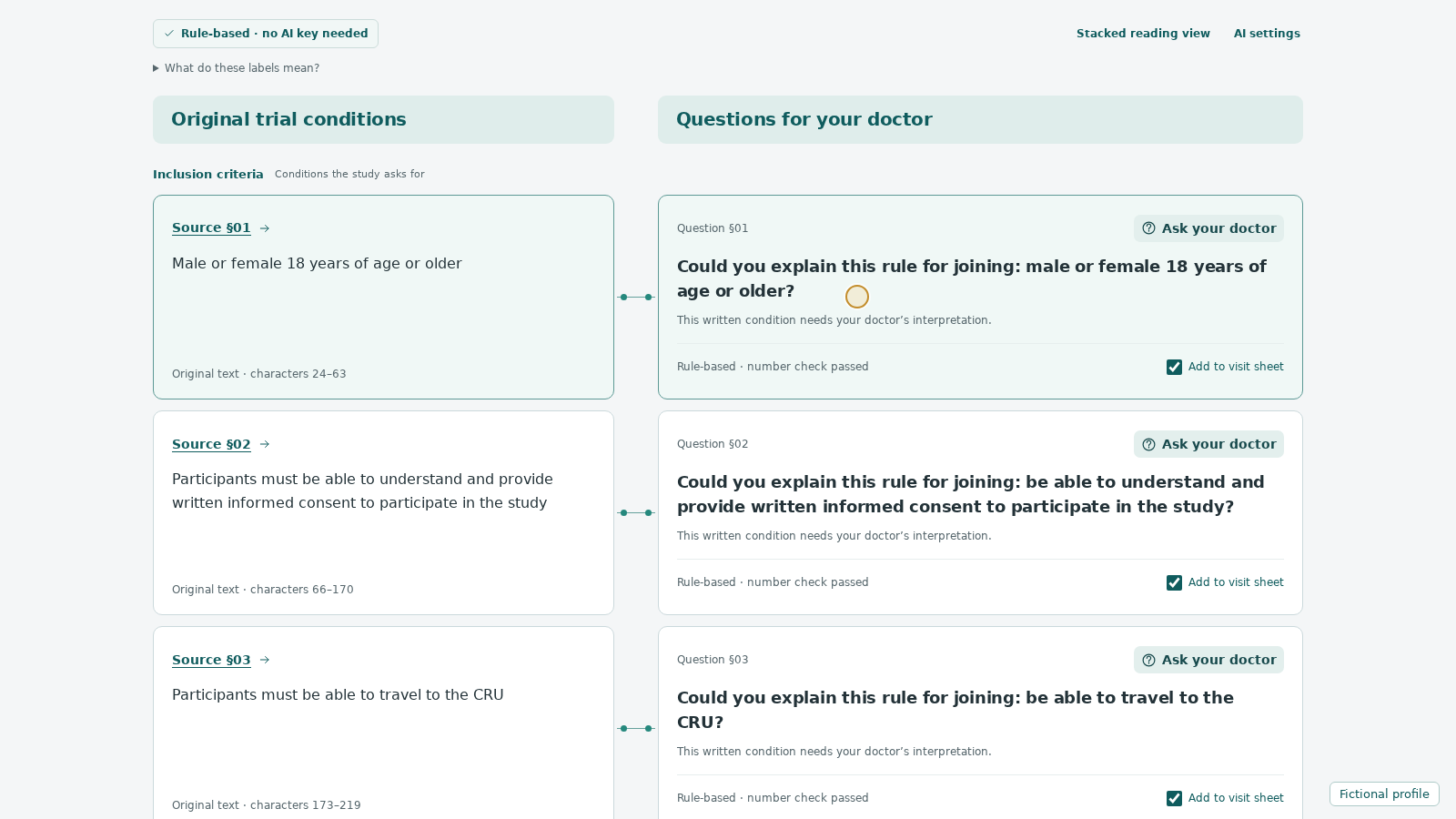
The eligibility text is split into inclusion and exclusion items, and nested items keep their parent context. Each original condition appears beside one question (or, when a check rejects the rewrite, beside its own original text) such as "Could you explain this rule for joining: …?", sharing a section number (§01, §02 …) and a source link; hovering one cell highlights the other. On a phone the pair stacks vertically, and a Stacked reading view does the same on desktop, with keyboard focus and reduced-motion support.
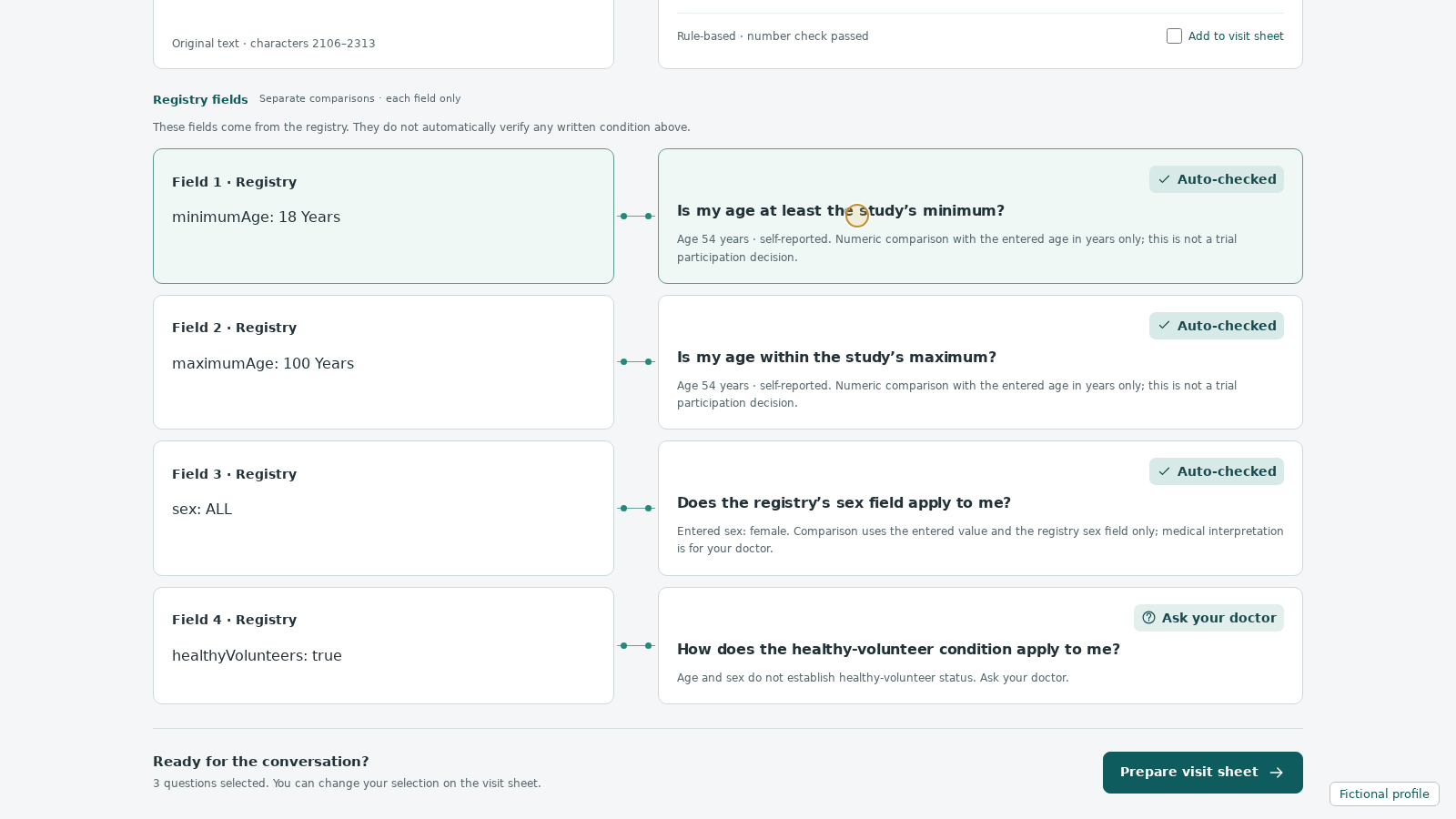
Optional age and sex stay on your device and are compared with three explicit registry fields, one at a time: minimum age, maximum age and sex. The fourth structured row, healthy volunteers, and every free-text criterion are always labelled "Ask your doctor".
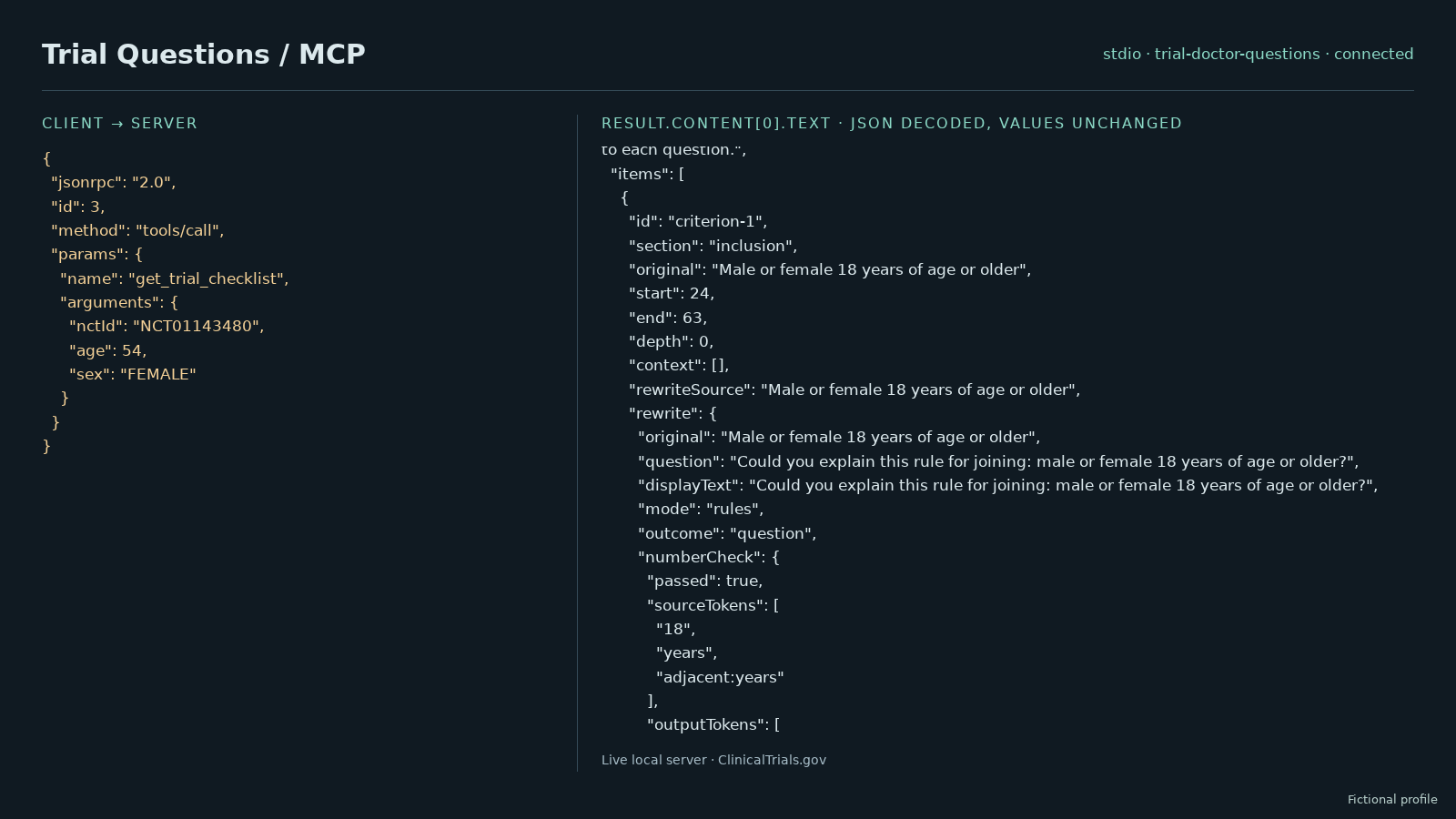
Selected questions go into a printable Visit sheet with notes. AI rewriting is optional: in AI settings you enter your own OpenAI-compatible endpoint, model and key, see the destination and click "Rewrite this trial with AI"; only public criterion text is sent. For AI agents, the same core runs as a Model Context Protocol (MCP) server over standard input/output (stdio) with two tools, search_trials and get_trial_checklist, and makes no LLM calls.
How I built it
I entered alone. Two independent AI brainstorming runs produced 14 candidate ideas; an AI agent scored them against the four judging criteria and against roughly 150 public gallery submissions to avoid crowded categories, and I chose this project from its recommendations. I also chose the interface from four AI-generated mockups that varied layout rather than colour, the one-page PDF handout from three layouts, and the demo narration voice from four samples.
AI coding agents wrote the code. OpenAI Codex (GPT-6 Astra, via the Codex CLI) wrote the TypeScript core, tests, evaluation scripts, React interface and recording scripts. Claude Code (Claude Opus 5.5) planned the work, wrote the briefs, reviewed every change, ran the tests, fixed defects it found and published the repository. GPT-6 Pro drafted this submission text, which was then checked against the repository and the cited sources and reviewed by four other AI models. The demo voice is Gemini text-to-speech.
Challenges I ran into
Nested criteria: a child bullet can depend on a parent's "at least one of" or a shared limit, so each item keeps its parent context, and the text sent to rewriting joins parent and child.
Offsets: every item's original is an exact slice of the registry text, so the interface can show its character range (for example "characters 24–63") and the evaluation can check it.
Numbers: the rule path and the optional AI path run the same lexical check: digits, units, operators, written numbers and Roman numerals must appear unchanged and in order. A claim gate rejects rewrites with common eligibility claims and requires exactly one question. The checks are lexical, not medical.
Accomplishments that I'm proud of
Live evaluation with no LLM: 50 recruiting records across five conditions, 856 free-text items (203 nested), 0 slice/offset mismatches. With a synthetic profile (age 45, FEMALE), 127 of 200 structured rows (63.50%) were compared automatically (four rows per record; the healthy-volunteers row is never compared). The number check rejected 33 of 856 proposed rule questions (3.86%); all gates together produced 70 fallbacks, each showing the original instead of a question.
Optional AI path, measured with Gemini 3.5 Flash-Lite on 195 sampled items: 148 (75.9%) passed the gates; 42 were rejected for numbers, 3 for eligibility claims, 2 for not being exactly one question; 0 errors. For those 148 items the mean Flesch–Kincaid grade was 12.47 for the original and 10.39 for the question.
What I learned
Rules alone barely change readability: for the 786 items where the rule question passed the gates, the mean grade was 14.26 for the original and 13.91 for the question. What held up is traceability: every question is tied to an exact span, structured fields are compared one at a time, and the gates reject changed numbers and common eligibility claims. Flesch–Kincaid is a heuristic; it does not measure understanding.
What's next
Clinician review of medical meaning, usability testing, unusual free-text formats, paid providers on the AI path, and printer checks. None of that has happened yet: no user study, no clinician review, no patient testing, no partnership with any organisation.
This tool does not decide whether you can join a trial. Bring these questions to your doctor.
