-
-
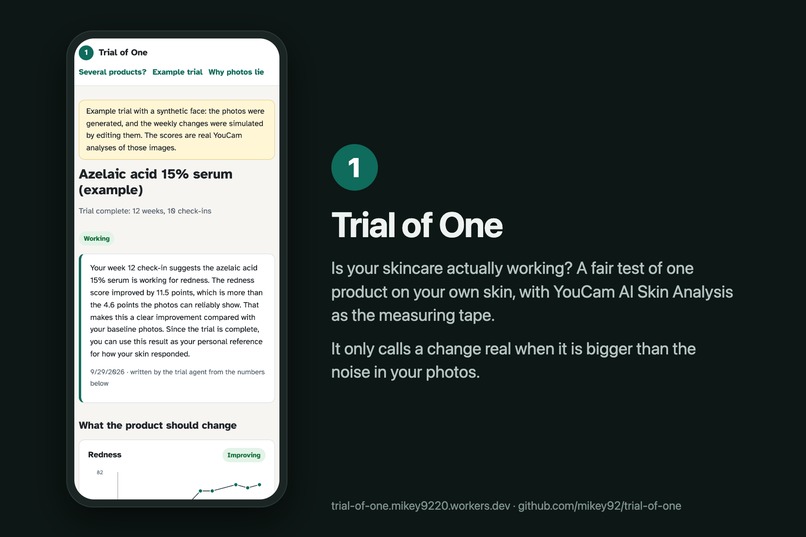
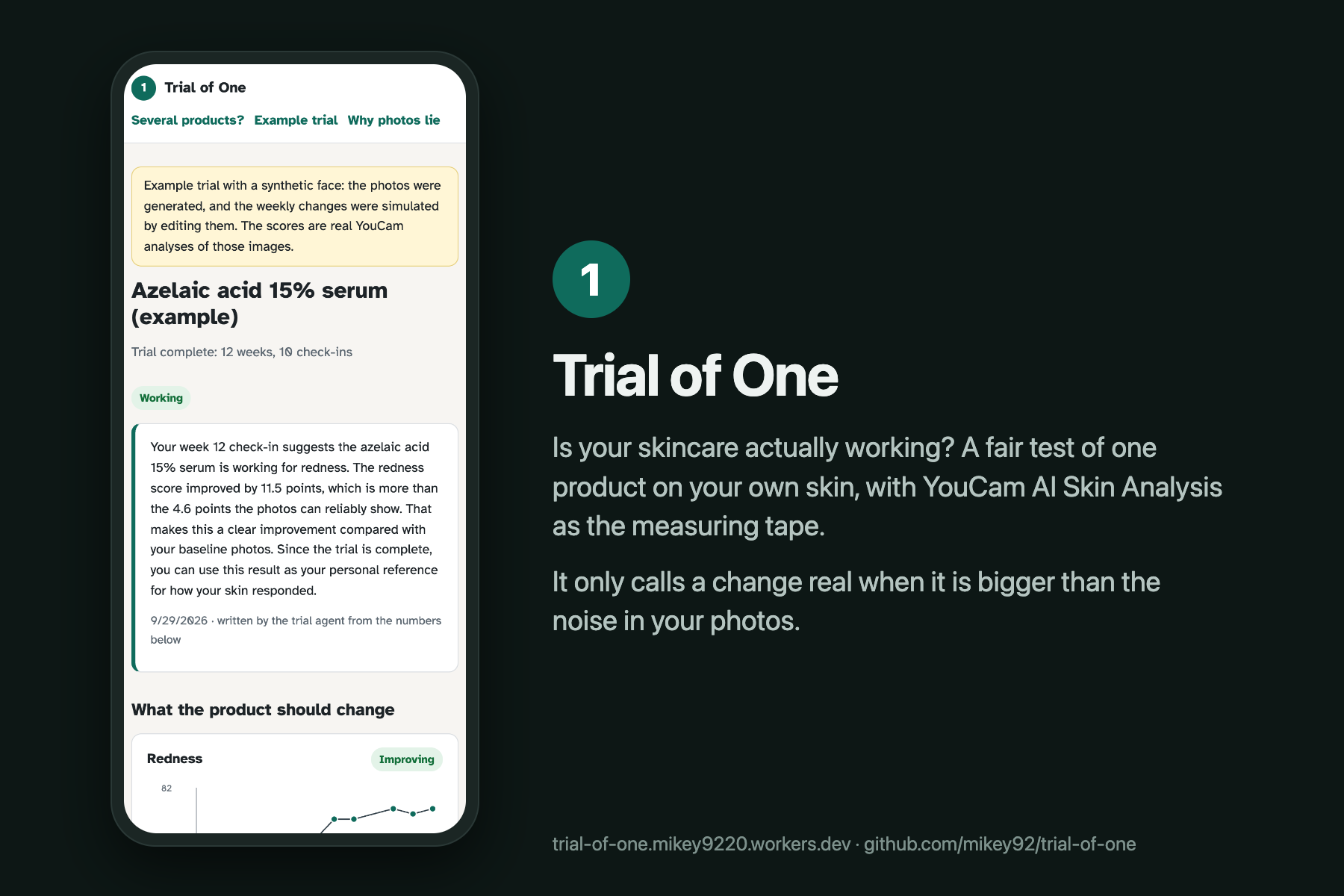
Trial of One: a fair test of one skincare product, measured with YouCam AI Skin Analysis
-
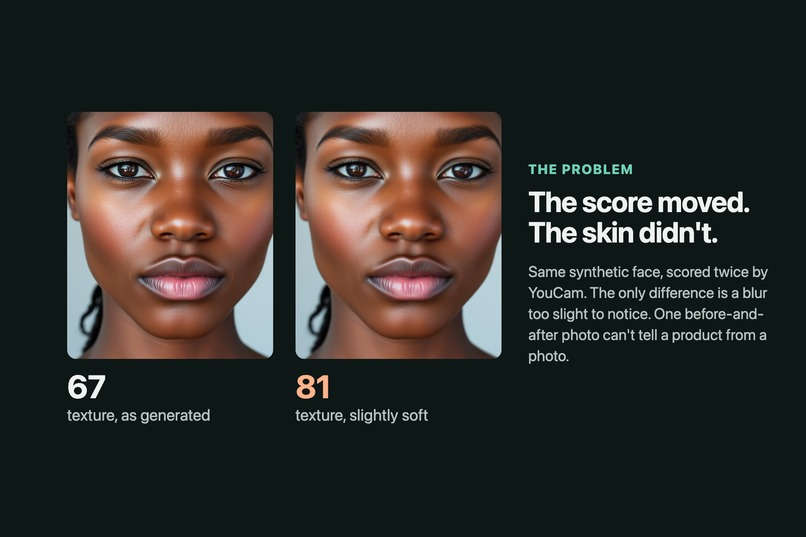
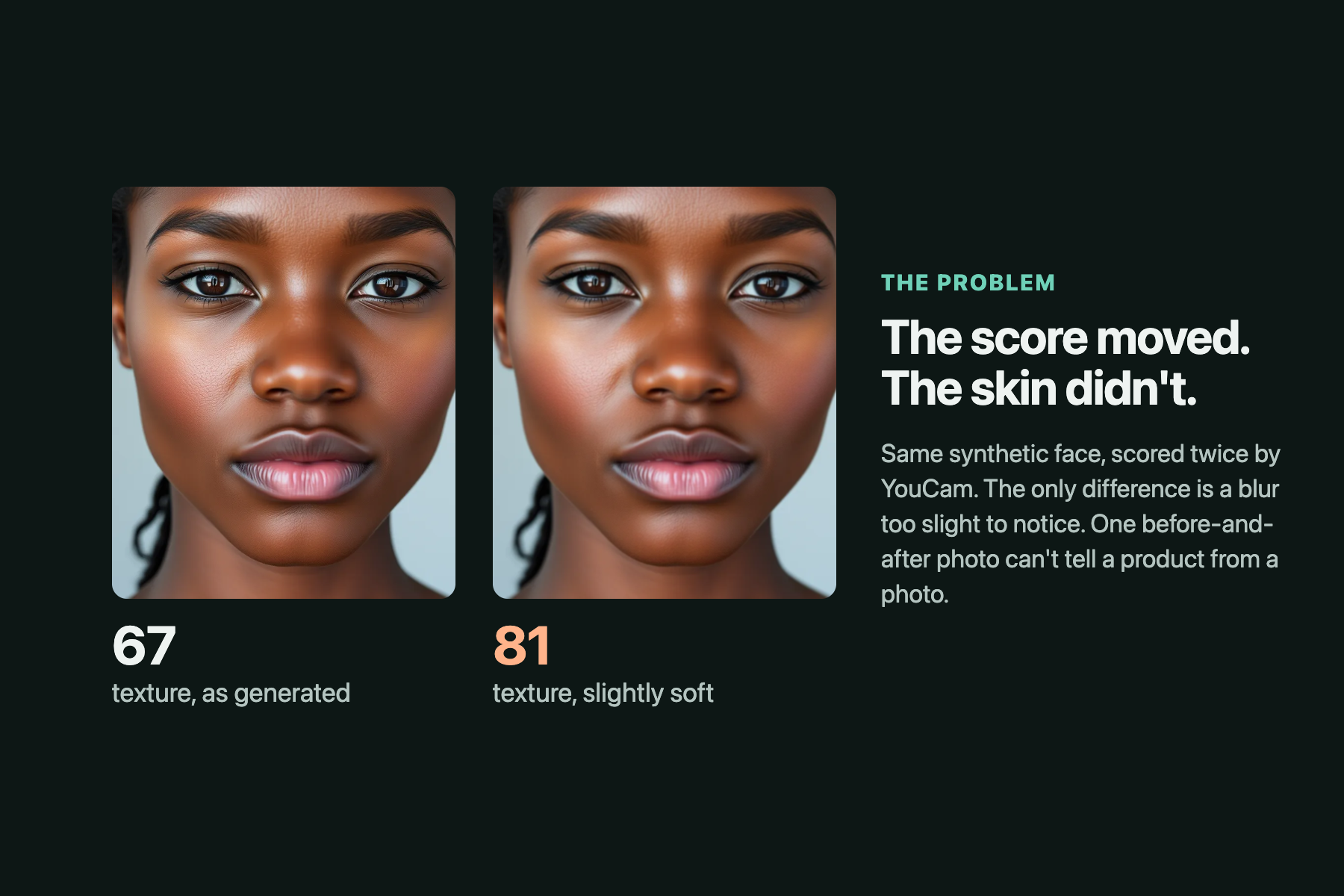
Same synthetic face, scored twice by YouCam: a blur too slight to notice moved texture from 67 to 81
-
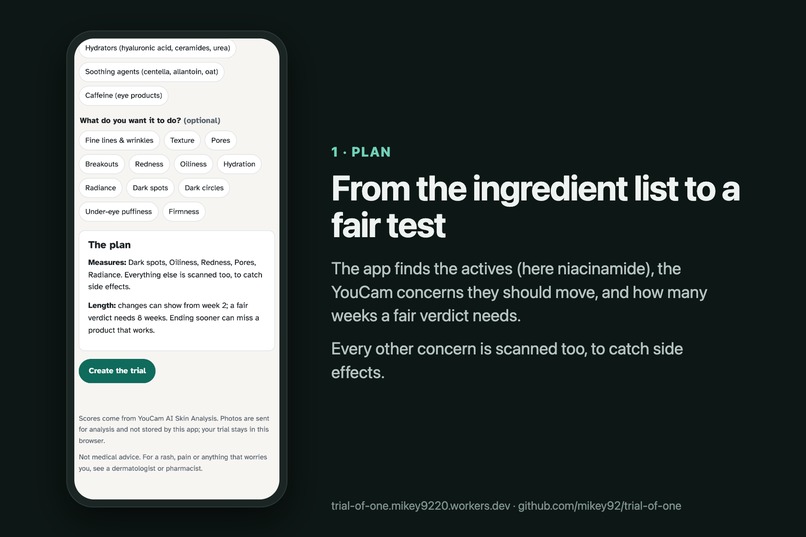
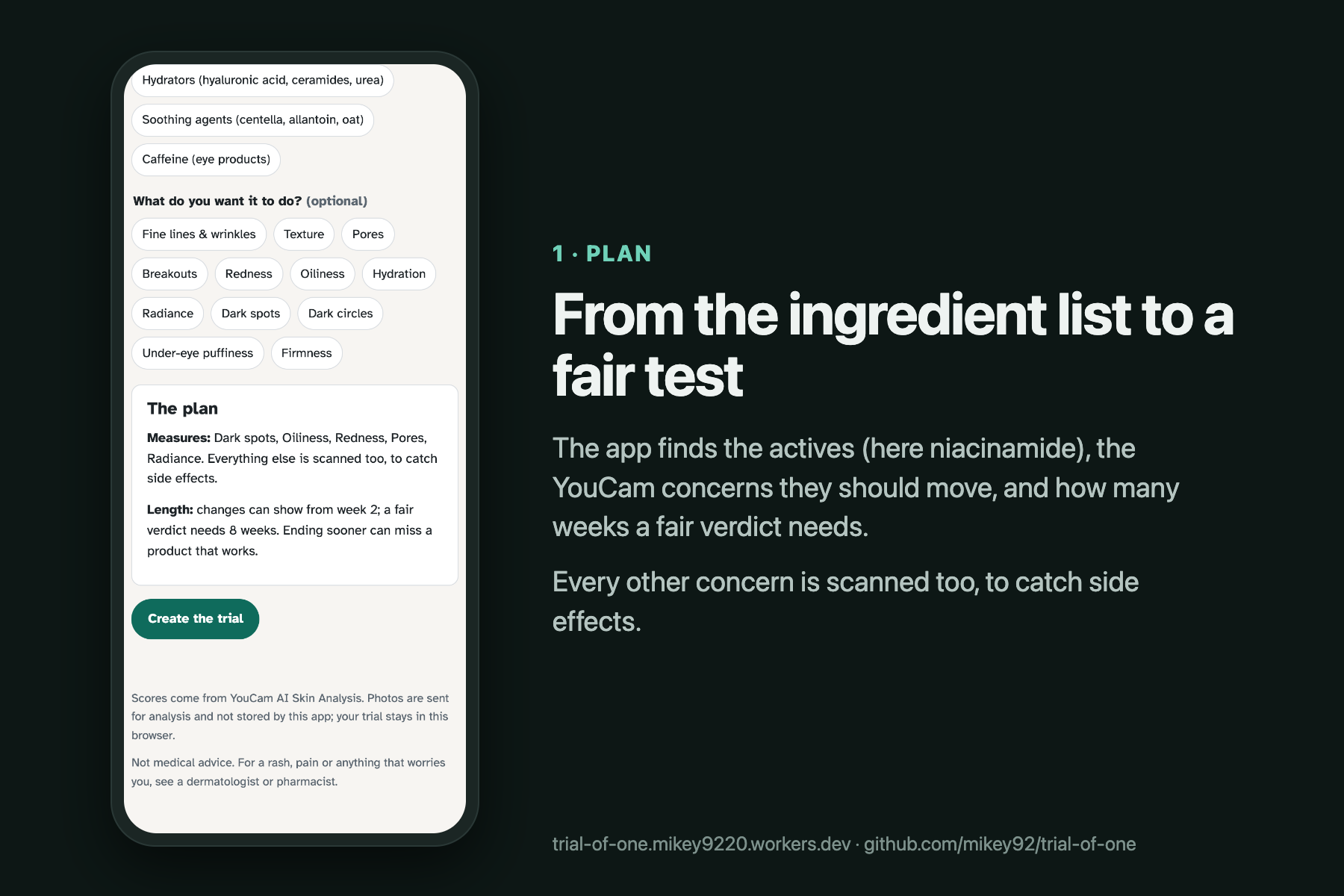
1 · Plan: the actives in the ingredient list, the YouCam concerns they should move, and how long a fair test takes
-
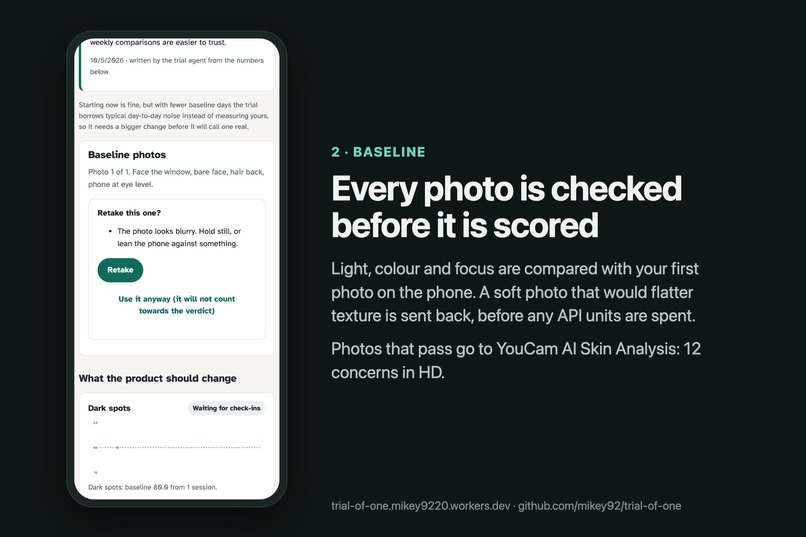
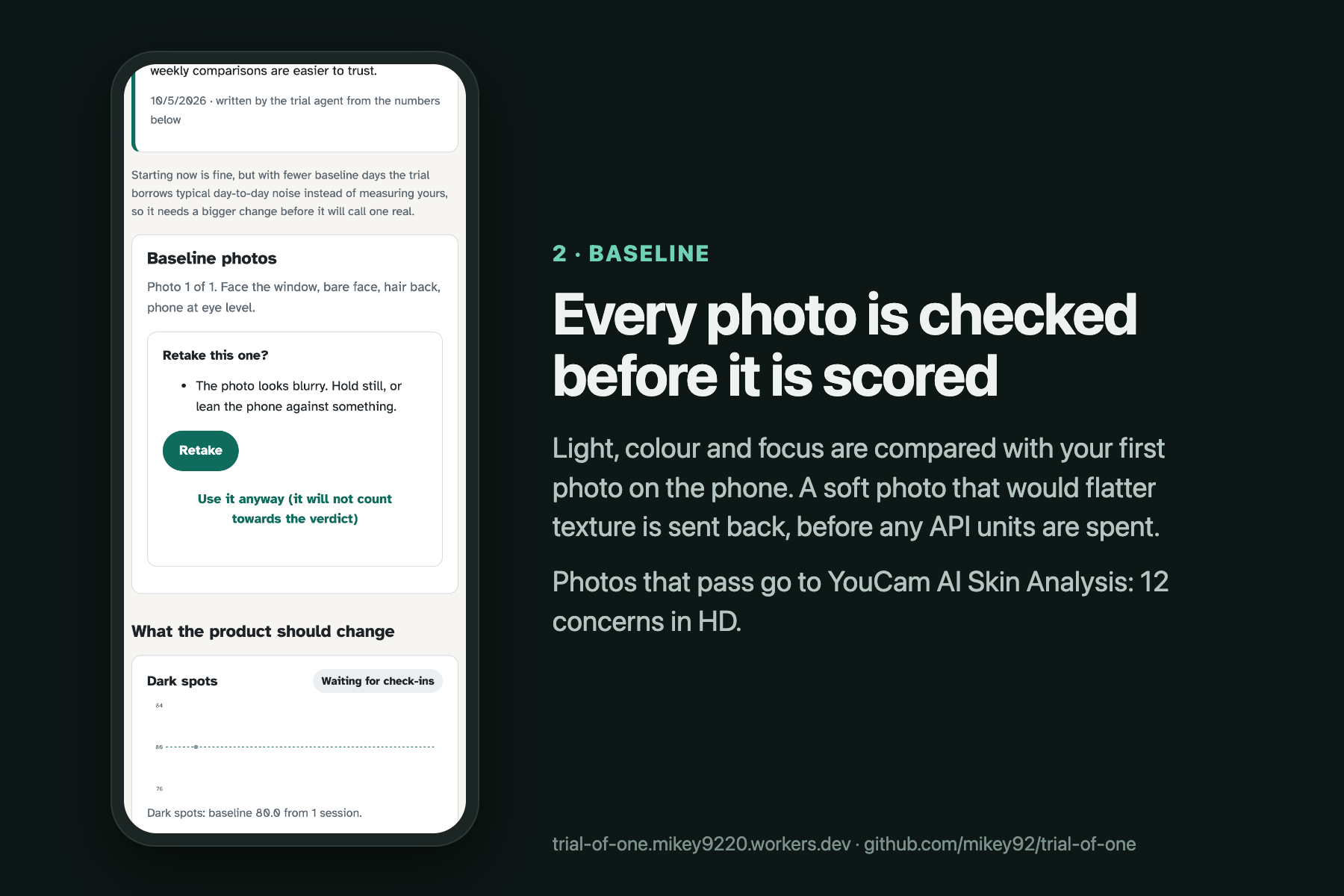
2 · Baseline: a soft photo is sent back on the phone, before any API units are spent
-
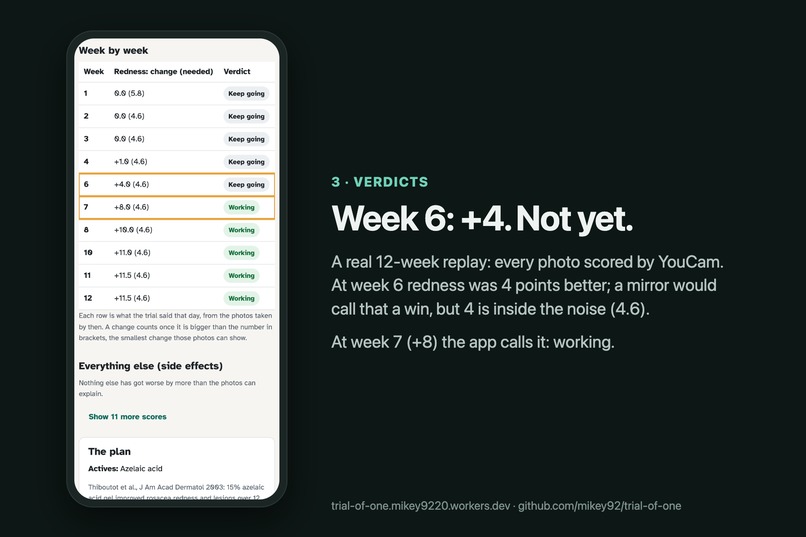
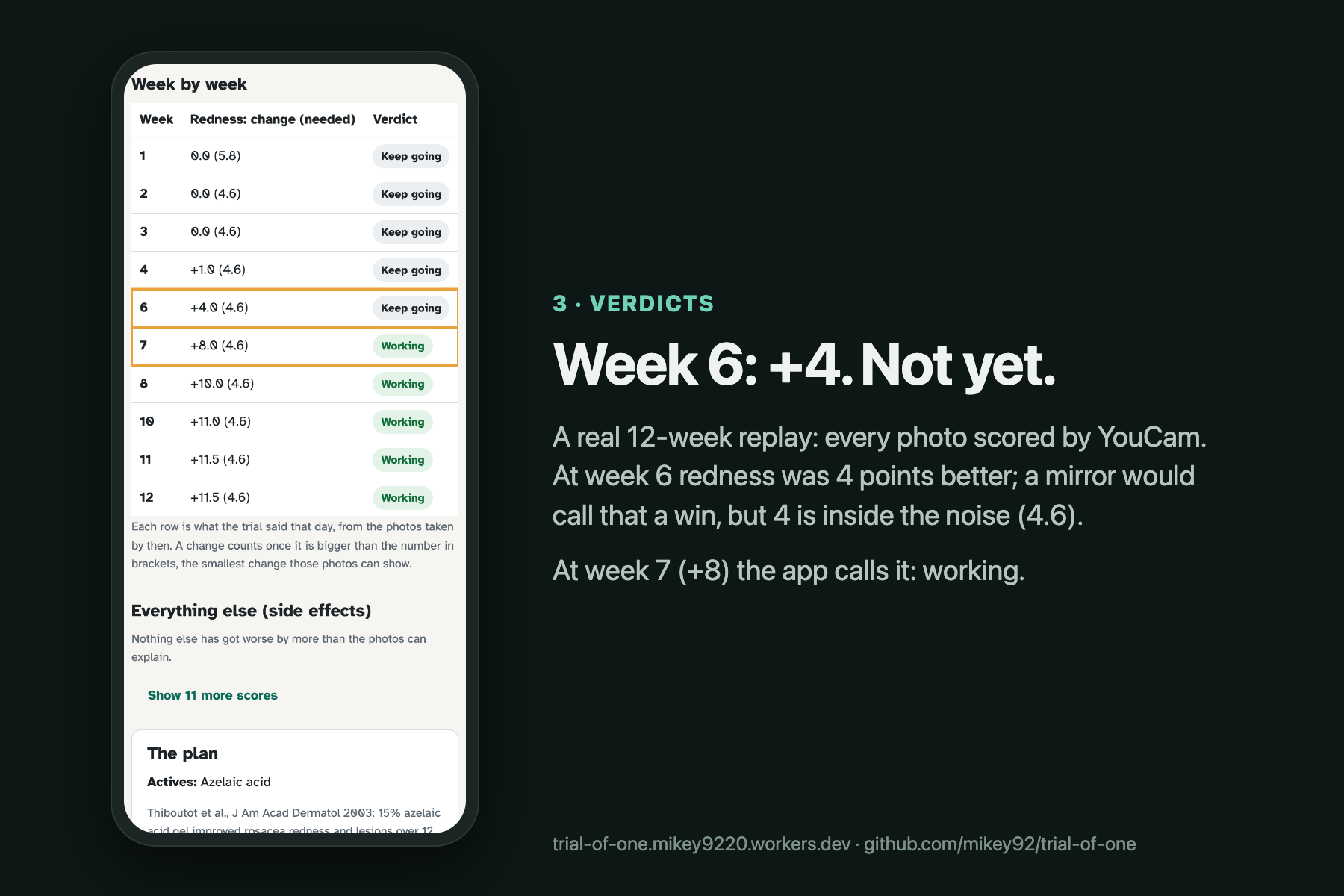
3 · Verdicts: at week 6 redness was +4, inside the noise; at week 7 (+8) the app calls it working
-
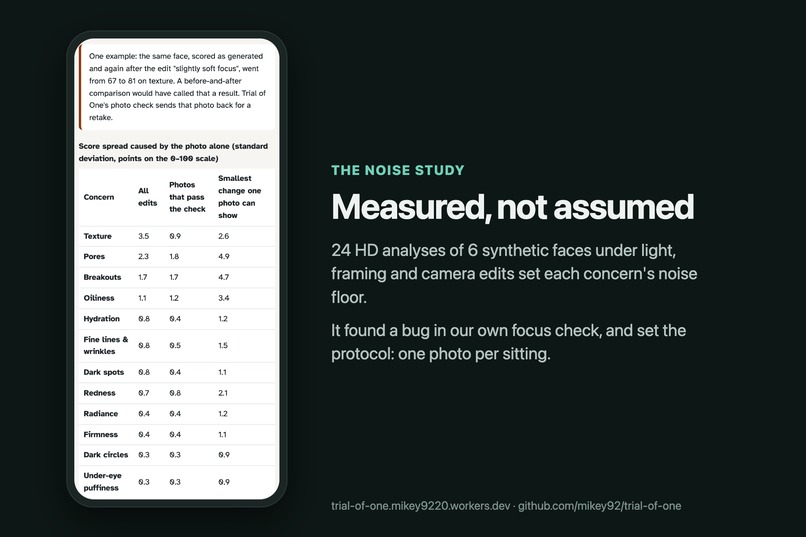
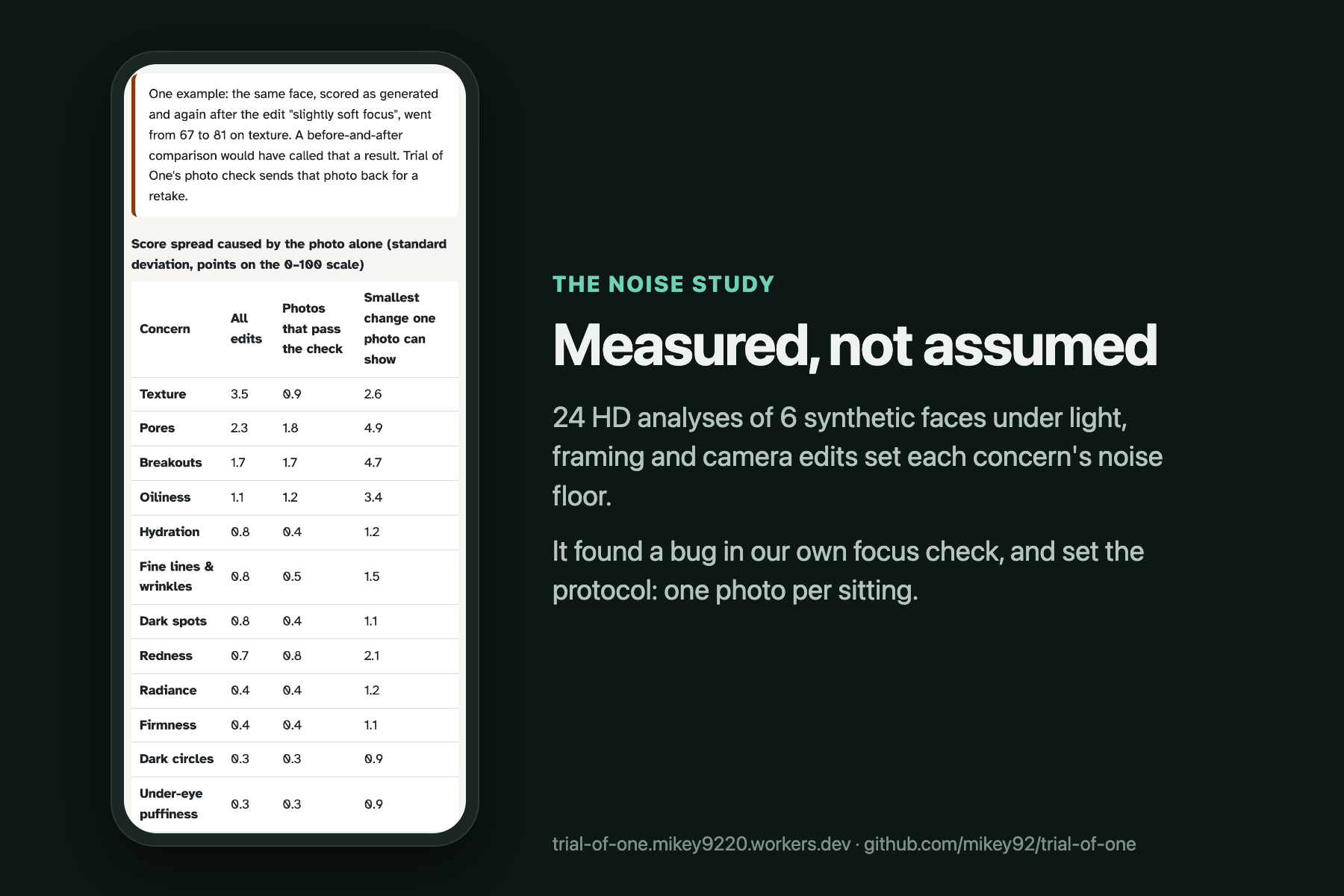
The noise study: 24 HD analyses of 6 synthetic faces set each concern's noise floor
-
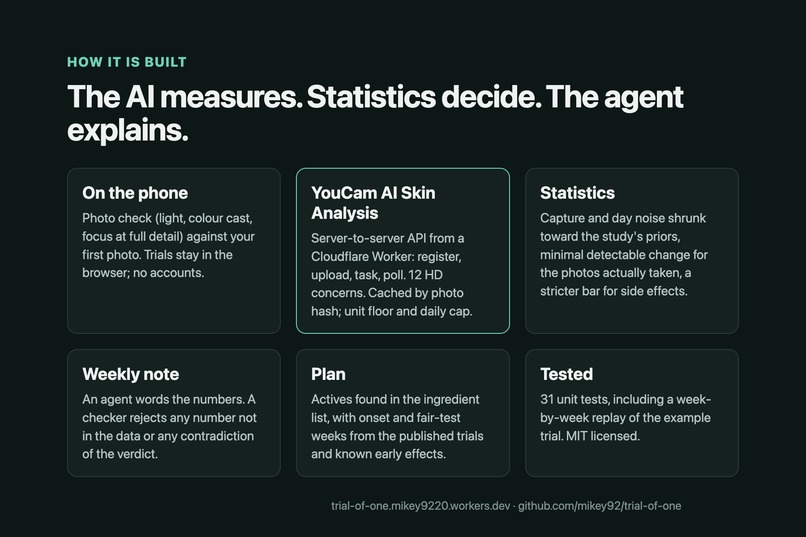
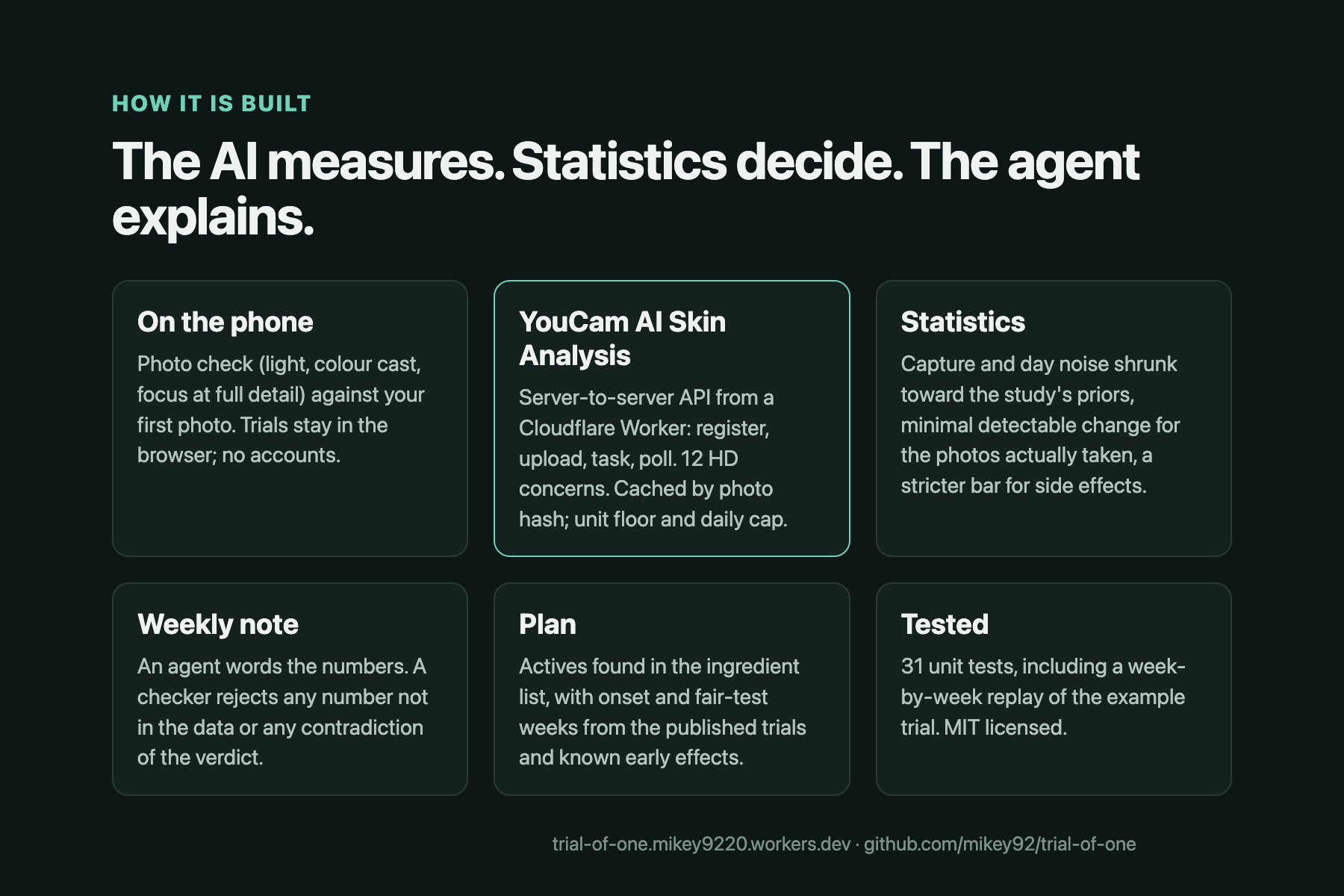
How it is built: the AI measures, statistics decide, the agent explains
Inspiration
The YouCam brief describes the moment exactly: someone standing in front of a mirror, deciding whether a product is working. We kept running into the same problem from the other side: the mirror is a terrible instrument. Light from a different window, a bad night's sleep, a phone held a bit lower, last week's breakout: each moves what you see more than most actives move skin in a month. So people quit products that needed eight more weeks, keep paying for ones that do nothing, or start three new things at once and never learn which one helped.
An AI skin score fixes the eye, not the photo. So we measured how much YouCam's scores move when only the photo changes (the noise study below), and that number became the core of the app: it decides how big a change has to be before Trial of One calls it real, and what to do next while it isn't.
What it does
- Plans the trial. Paste a product's ingredient list. Trial of One finds the actives, picks the YouCam concerns they are meant to move, and sets how long a fair test takes, from four weeks for a hydrator to 24 for a retinoid, citing the trials behind the numbers. It knows the expected early effects (retinoid redness and dryness in weeks 1–6) so they are not mistaken for failure.
- Measures your noise. One photo on each of three days before the first use gives the person's own day-to-day noise; how much a score moves between photos of the same skin comes from our noise study.
- Guards every photo. Before upload, each photo is checked on the device for exposure, colour cast and focus against the first baseline photo. A photo that would not compare is retaken, not scored.
- Calls a change only when it is real. For each target concern, the change from baseline is compared with the 95% minimal detectable change for exactly the photos taken. Verdicts: working, too early (fair from a date), not working for you, expected early dip, or stop and check.
- Writes the weekly note. An agent turns the numbers into a short, plain note: what changed, how sure, what to do next. It cannot change a verdict or invent a number (see below).
- Untangles routines. List everything you want to start; the planner flags clashes (retinoid with acids, benzoyl peroxide with vitamin C), duplicate actives, and orders the products into back-to-back trials by your priorities.
How we built it
- YouCam AI Skin Analysis (HD), twelve concerns per photo, called server-side from a Cloudflare Worker (file registration → pre-signed upload → task → polling) so the key never reaches the browser. Results are cached by photo hash so a photo never costs a second unit. YouCam prices an analysis by tier and concern count, so the Worker reads the unit balance before each new analysis and stops at a floor, with a daily cap on top.
- Statistics in TypeScript, shared by the app and the tests: pooled within-session variance for capture noise, between-session variance for day noise, both shrunk towards the study's population values when a person has few baseline photos; minimal detectable change from the exact numbers of sessions and photos; Theil–Sen trends that one bad photo cannot drag.
- Agent: a language model writes the weekly note from the structured results. A checker rejects any note containing a number not in the input, or contradicting the verdict, and falls back to a deterministic template. The model can explain; it cannot decide.
- Privacy: photos are analysed and dropped; trials live in the browser's IndexedDB. No accounts.
- No real faces: the study and the example trial use six synthetic faces, three from FLUX.1 schnell and three from an OpenAI image model.
The noise study
Six synthetic faces, each scored as generated and after three edits a phone photo can have from one week to the next (light, framing, camera), rotated across faces: 24 HD analyses. The skin never changes, so whatever moves is the photo. We ran the app's own photo check on every edited photo.
- Focus matters most. A blur too slight to notice on a phone screen raised texture by 8.7 points on average and by 14 on one face (67 → 81). A before-and-after comparison would have called that a result.
- It found a bug in our check. We measured sharpness on a 256 px copy, where the blurred photos kept 85% of their sharpness. At up to 1024 px inside the face oval they keep 9–20%, every other edit 87–112%, so the check now sends them back. Texture noise falls from 3.5 to 0.9 points.
- Light and framing within the check's limits move most scores by a point or less; pores and breakouts move most (spread 1.8 and 1.7 points), so a trial needs the largest change on those.
- One photo per sitting. With noise this small, a second photo would shrink the smallest detectable change by at most 7% and double the units a trial spends, so the protocol takes one.
- The scores follow the skin. Fading only the cheek flush on one face moved redness from 66 to 82 while the other eleven scores stayed within a point.
The per-concern spreads are the prior every trial starts from, and the study reruns from the repo without spending a unit.
The example trial
The demo is a real 12-week replay: a synthetic face whose cheek flush fades from week 4, realistic photo-to-photo variation, two missed weeks, and 13 real YouCam analyses. Redness went 66 → 78. At week 6 it was up 4 points, which a mirror would call a win; the app said "too early" because 4 is inside the noise (4.6). At week 7 (+8) it said "working". The other eleven scores stayed within their noise, so no side effect was raised.
Challenges
- A trial only works if the photos compare, so most of the engineering went into the photo, not the model: the on-device light and focus checks, the session design, and the noise model.
- Deciding when not to give an answer. "Too early, fair from (a date)" is the most common verdict in the first weeks, and the most useful one.
- A budget of 1,000 analysis units. Every analysis is priced by tier and concern count (20 units for 12 HD concerns), so the study was designed to fit: three rotated edits per face instead of all eight, cached results, and a dry run that prints the units a script would spend.
Accomplishments that we're proud of
- The noise study changed the product three times: it found a bug in our own focus check, it set the protocol (one photo per sitting), and it sets every trial's noise floor.
- The example trial is made of real YouCam scores, and a test replays it week by week, so the verdicts in the demo are the ones the code gives.
- The weekly note can explain but never overrule the statistics.
What we learned
- YouCam's scores are repeatable: the same photo, sent again through the live app, came back identical on all twelve concerns. So all of the noise a trial has to see through comes from the photo, which is exactly why the photo protocol is worth engineering.
- Colour-based concerns (redness, dark circles, radiance) barely move with capture changes; texture-based ones (texture, pores, breakouts) react to focus and compression. A trial needs different evidence for each.
Try it
https://trial-of-one.mikey9220.workers.dev: the finished example trial (#/demo) and the noise study (#/study) need nothing. To score your own photos, plan a trial and take or upload a frontal photo with at least 1080 px on the short side. Each analysis spends the hackathon's API units, so new scans are capped per day.
What's next
- Use the YouCam Camera Kit's live quality checks during capture.
- Let brands run the same protocol for product sampling: a 30-day trial kit with a sample size, ending in an honest verdict instead of a coupon.
- Pool anonymous, opt-in trial outcomes by active and skin type to show real-world effect sizes.
Built With
- claude-code
- cloudflare-workers
- flux
- numpy
- openai
- perfect-corp
- pillow
- python
- react
- typescript
- vite
- vitest
- workers-kv
- youcam-api

Log in or sign up for Devpost to join the conversation.