-
-
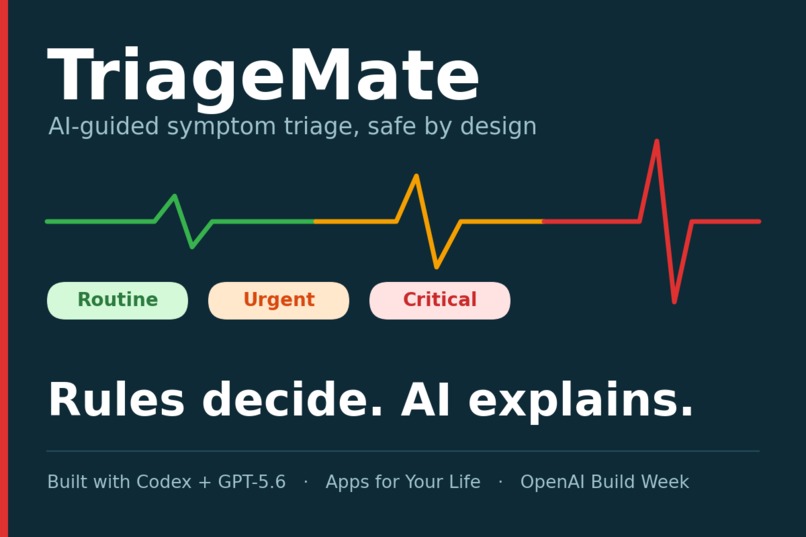
Rules decide urgency, GPT-5.6 explains it — symptom triage that's safe by design.
-
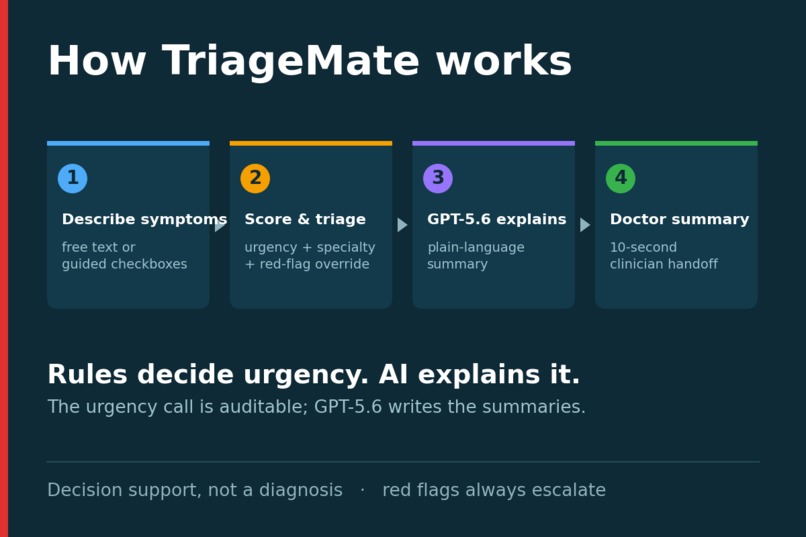
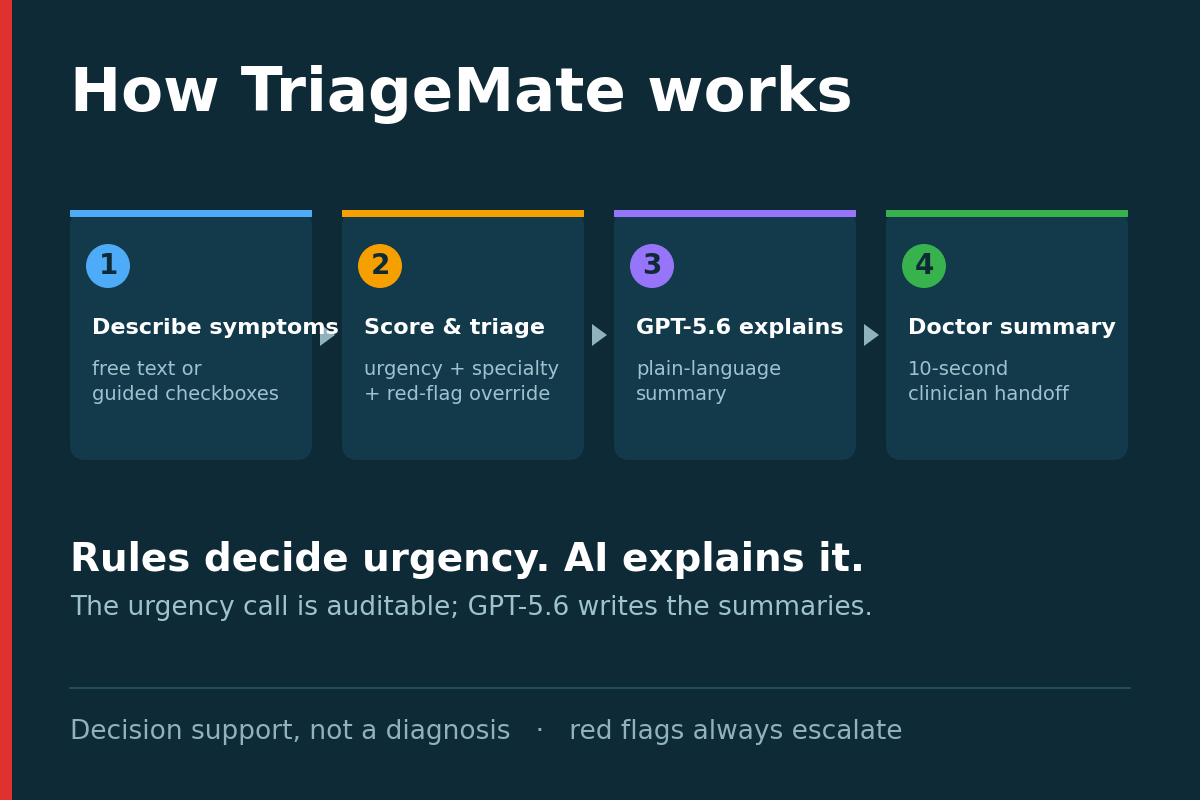
Describe symptoms → rules triage with a red-flag override → GPT-5.6 writes the patient explanation and doctor summary.
Inspiration My grandfather ran charity clinics — some days he'd see a hundred and fifty patients. In villages, in the mountains, on islands, across much of India and the world, there's one doctor for far too many people. That's the problem TriageMate is built for: not another symptom-checker for people who already have good healthcare, but a force multiplier for the doctor who's overwhelmed — helping them safely see more people, without ever replacing the human who makes the call. The everyday version is the same problem, smaller: people panic-search their symptoms or wait too long, and a doctor spends the first minutes of every visit reconstructing what the patient already knows. We wanted a calm, safe first step — one that tells a person how urgent their symptoms are and hands their doctor a clear summary, without ever pretending to be a doctor. What it does You describe how you're feeling in plain language. TriageMate turns that into a triage decision and a doctor-ready handoff, in four steps: Intake. You enter your symptoms (free text or guided checkboxes), how long, how severe, plus any medications and past history. Triage + case. A transparent rules engine scores the most likely conditions, assigns an urgency level — Routine, Urgent, or Critical — and routes you to the right specialty. Emergency red-flag patterns (like chest pain radiating to the arm) override everything and escalate instantly. Explanation. GPT-5.6 turns the structured result into a short, plain-language explanation you can actually understand. Doctor-ready output. GPT-5.6 also produces a concise clinician summary — the probable issues to consider, the urgency, and any medication or allergy that affects what's safe to prescribe — so your doctor can skim it in ten seconds. The idea that makes it different: rules decide, AI explains We never let a language model decide whether a chest-pain patient is urgent. A deterministic weighted score plus a red-flag override makes that call — and it's fully explainable: when a judge (or a clinician) asks "why Critical?", we point at the scores. GPT-5.6 does the two things it's genuinely great at: understanding messy free-text symptoms, and writing clear summaries for both the patient and the doctor. That split is the whole safety story — the intelligence is auditable, and the AI is on explanation duty, not diagnosis duty. How we built it Built with Codex + GPT-5.6. The engine and interface run on Salesforce (Apex for the rules engine and orchestration, a Lightning Web Component for the intake and results). GPT-5.6 is called to generate the patient explanation and the clinician summary. The clinical knowledge base is demo-grade but real in structure: 83 symptoms, 61 conditions, 280 weighted symptom-condition mappings, 16 specialties, and 12 emergency red-flag conditions. Safety and responsibility TriageMate is decision support, not diagnosis. Every output is labelled "for clinician review," a licensed clinician must confirm, red-flag patterns escalate to Emergency immediately, and mental-health crisis patterns route to a human rather than auto-closing. The urgency decision is deterministic on purpose, so it can be inspected and trusted. Impact TriageMate is a force multiplier for healthcare where doctors are scarce. In a medical camp or on a telehealth line, a health worker runs intake on a tablet; the engine triages the queue so the sickest are seen first, red flags jump to the front, and every patient arrives at the doctor with a ready-made summary — turning minutes of history-taking into seconds. One doctor safely handles more people, and the human always makes the final call. It keeps people out of the ER for routine issues, catches the emergencies they'd otherwise sleep on, and gives already-stretched clinicians a head start on every visit. The same engine generalizes far beyond this demo — any symptom-to-specialty knowledge base plugs straight in, in any language, anywhere there aren't enough doctors. Challenges we ran into Getting the rules-versus-AI boundary exactly right took discipline — it's tempting to let the model do everything, and the whole point is that it shouldn't. Building a clean, weighted knowledge base and proving the scoring was correct end-to-end (chest pain must always come out Critical → Emergency) was where most of the real engineering went. What's next This is the screening-and-triage slice of a bigger vision: add record summarization for returning patients, automated post-visit follow-up, and clinician validation of the mapping before any real-world pilot. More conditions, more languages, and a patient-facing "share to your doctor" link.
Built With
- apex
- gpt-5.6
- healthcare
- javascript
- lightning-web-components
- openai
- rest-api
- salesforce
- that's-the-"built-with"-field-?-the-tech-tags-for-your-project.-type-each-one-and-press-enter-(they-become-individual-tags;-up-to-25).-here's-what-to-enter-for-triagemate:-codex


Log in or sign up for Devpost to join the conversation.