-
-
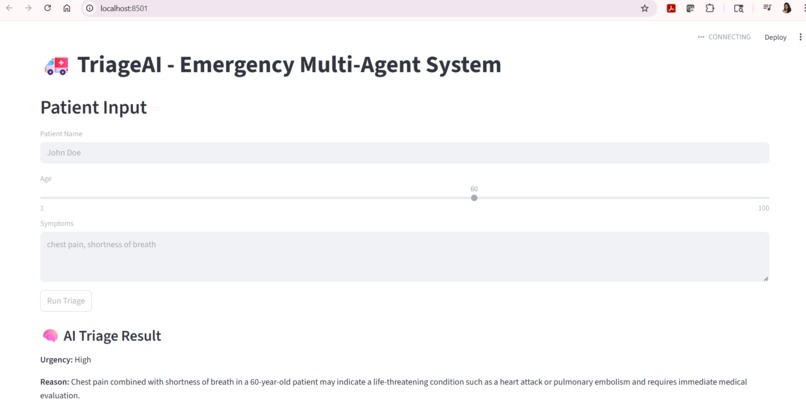
Streamlit
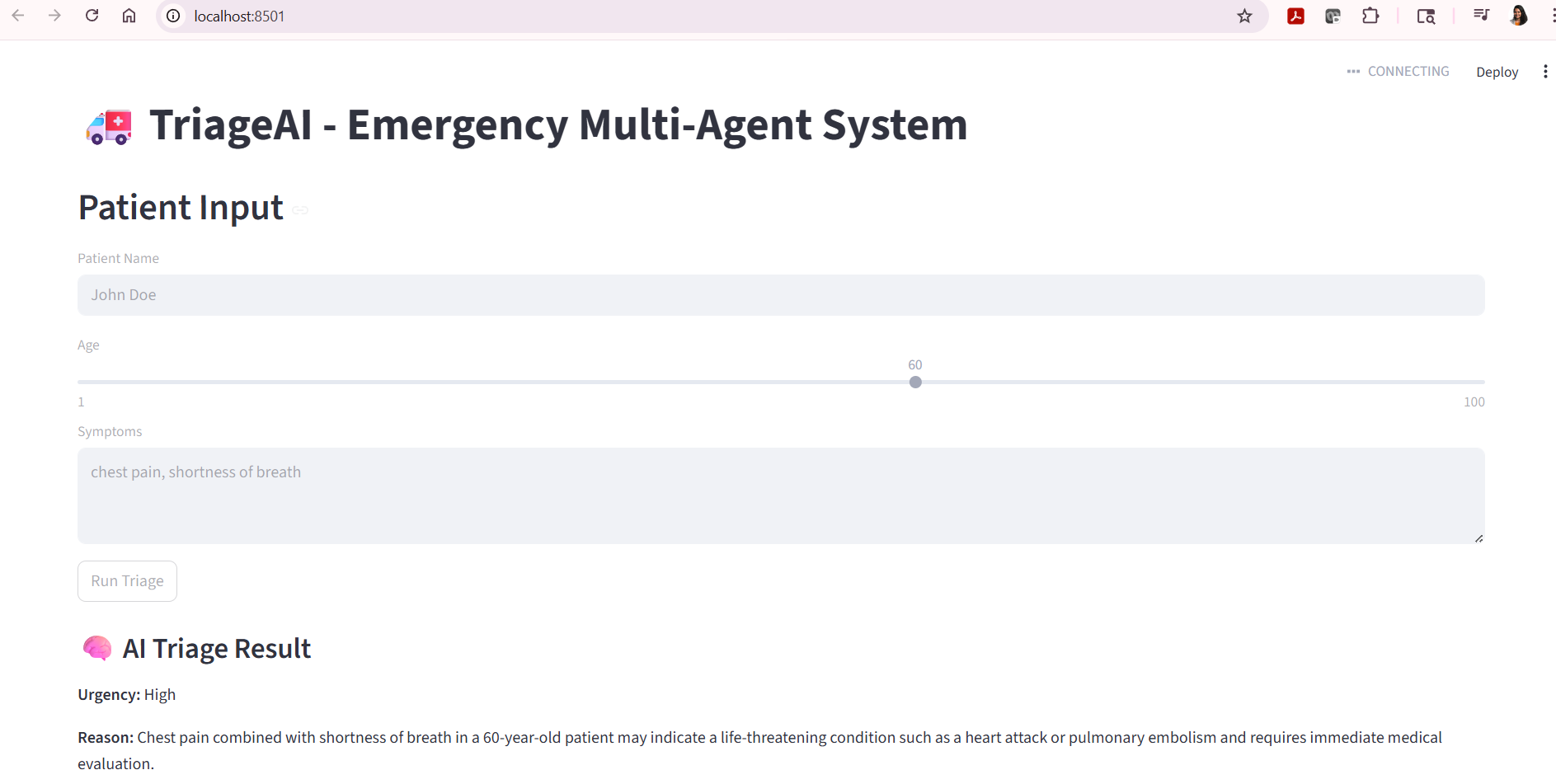
TriageAI: A Multi-Agent Emergency Triage System
Inspiration
Emergency departments around the world face overwhelming patient volumes, often leading to delayed triage and critical decision-making bottlenecks. In high-pressure situations, even small delays can significantly impact patient outcomes.
We were inspired by the idea of combining Generative AI with multi-agent systems to simulate how a real hospital coordinates care—rapidly, intelligently, and collaboratively. The goal was to build a system that not only classifies urgency but also acts on it, just like a real emergency response team.
What We Learned
This project pushed us to explore the intersection of:
- Generative AI for reasoning under uncertainty
- Agent-to-Agent (A2A) communication architectures
- Healthcare system constraints (privacy, safety, feasibility)
We learned that traditional rule-based systems are limited in handling complex symptom combinations. By contrast, LLMs can infer nuanced relationships between symptoms and urgency levels.
We also discovered how modular agent design improves scalability: [ System = \sum_{i=1}^{n} Agent_i ] Each agent performs a specialized role, making the system more flexible and extensible.
How We Built It
TriageAI is built as a multi-agent system integrated into the Prompt Opinion platform.
Core Components
Triage Agent (LLM-powered)
Uses Generative AI to classify urgency based on symptoms.Bed Allocation Agent
Simulates hospital resource availability.Specialist Agent
Assigns appropriate medical professionals based on urgency.Notification Agent (LLM-powered)
Generates human-friendly, reassuring patient communication.
Architecture
Agents communicate through a shared messaging layer (A2A simulation), enabling coordinated decision-making.
[ Decision = f(Symptoms, Context, Agent_Interactions) ]
Tech Stack
- Python
- Streamlit (interactive dashboard)
- OpenAI API (LLM reasoning)
- Docker (containerized environment)
- Synthetic healthcare data (no PHI)
Challenges We Faced
1. Reliable AI Output
Ensuring the LLM returned structured JSON outputs was challenging. We solved this with prompt engineering and fallback parsing.
2. Multi-Agent Coordination
Designing clean communication between agents required building a lightweight agent bus system to simulate A2A interactions.
3. Healthcare Constraints
We had to strictly avoid real patient data while still demonstrating realistic scenarios using synthetic datasets.
4. Balancing Simplicity vs. Impact
We needed a system simple enough for a hackathon, yet powerful enough to demonstrate real-world potential.
What’s Next
- Integration with real hospital systems (EHR APIs)
- Voice-based triage using speech-to-text
- Predictive analytics for hospital capacity planning
Why It Matters
TriageAI demonstrates how Generative AI + multi-agent systems can transform emergency care:
- Faster triage decisions
- Better resource allocation
- Improved patient communication
Ultimately, our vision is to augment healthcare professionals with intelligent systems that help save lives.
