Inspiration
What it does
How we built it
Challenges we ran into
Accomplishments that we're proud of
What we learned
What's next for Triage Compass
Inspiration
In most software teams a new bug lands in a shared backlog and waits for the one person who remembers everything. They search for duplicates by hand (or do not), guess the owning team, and assign it to whoever they last saw fixing something similar. When they guess wrong the bug bounces between teams for days, duplicates get fixed twice, and regressions are treated as brand-new problems because nobody connected them to the original fix. The evidence to do this well already exists in Jira and in the Teamwork Graph: similar issues, who fixed them, which teams those people are in. Nobody puts it in front of the person triaging.
What it does
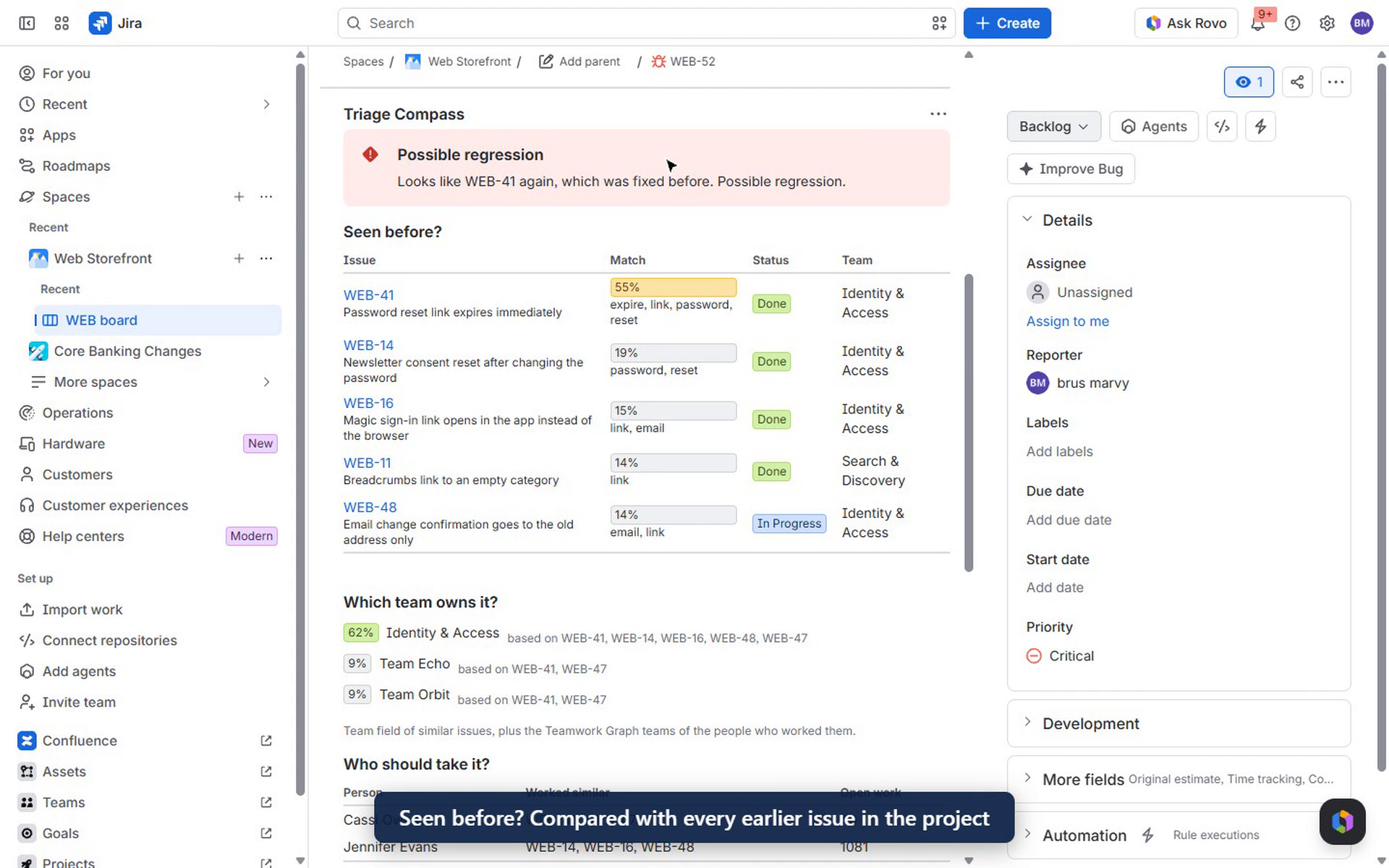
- Seen before? For every issue, Triage Compass compares the summary and description with the earlier issues in the project and shows the closest ones with a similarity score and the words they share. It distinguishes an open duplicate from a possible regression (the closest match is already Done) from a possible match worth a look, or a genuinely new problem.
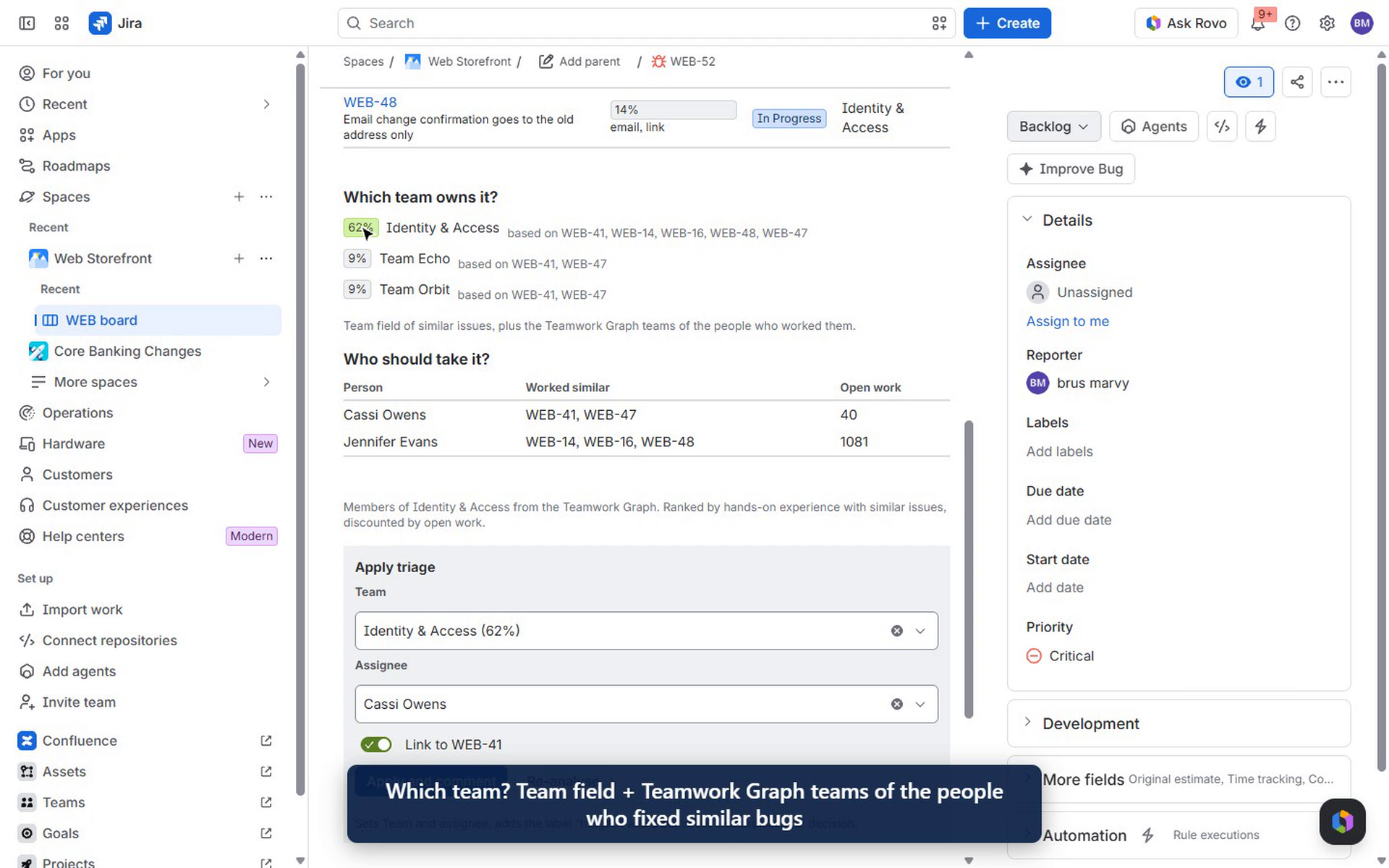
- Which team owns it? It votes for the owning team using the Jira Team field of the similar issues and the Teamwork Graph: the Atlassian teams that the people who worked those issues belong to (
atlassianUserInTeams). Each team shows its share of the evidence and the exact issues it is based on. - Who should take it? The members of the winning team come straight from the Teamwork Graph (
atlassianTeamMembers). Each person is shown with the similar issues they have worked on and their current open work; the ranking is experience discounted by workload, so the expert who is buried under 25 tickets is not automatically the pick. - Linked work. For the issue and its closest matches the app asks the Teamwork Graph for linked pull requests, deployments and goals, so "how was this fixed last time?" is one glance away when the data exists.
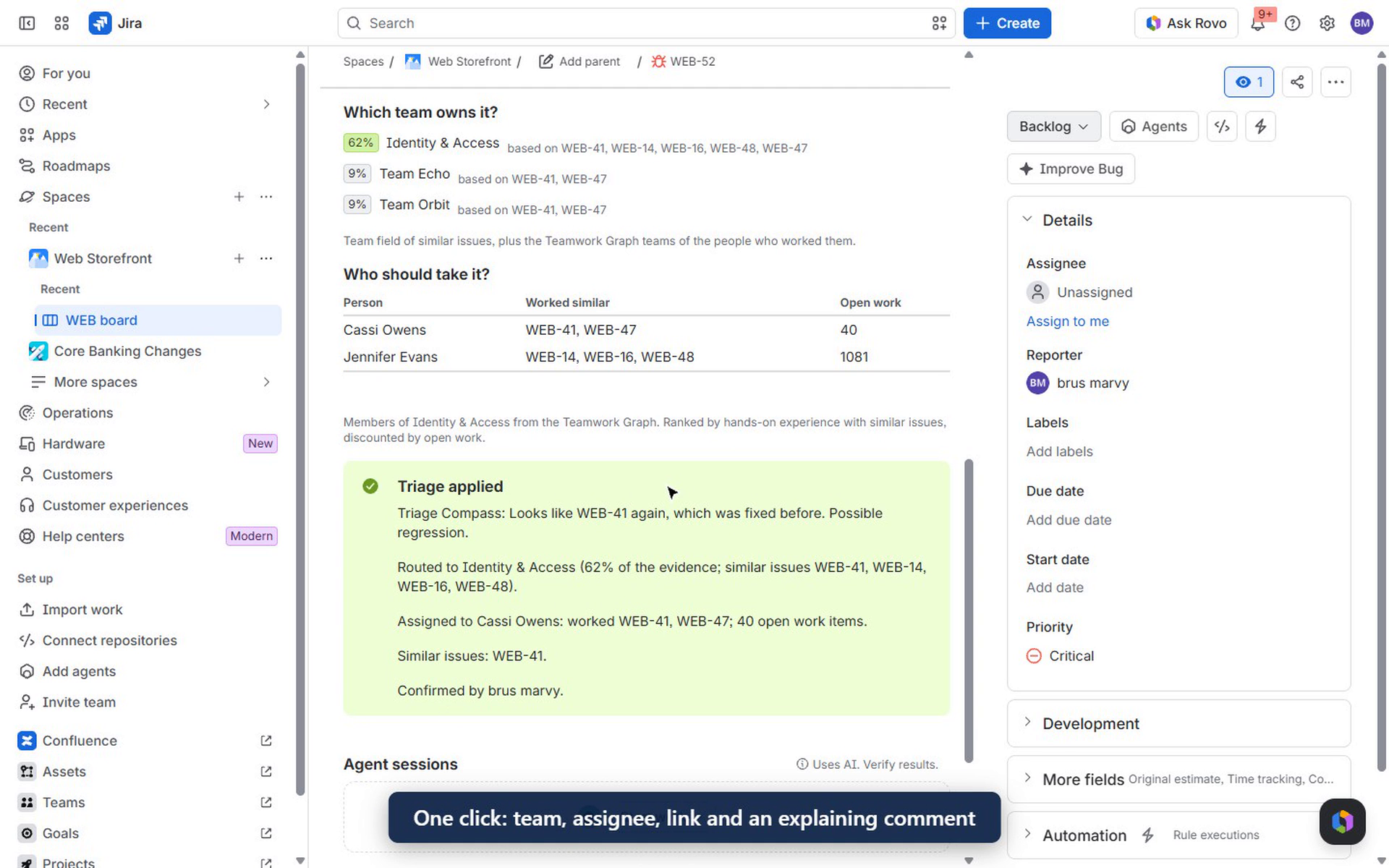
- Apply with one click, and explain it. A person confirms. The app sets Team and assignee, adds the label
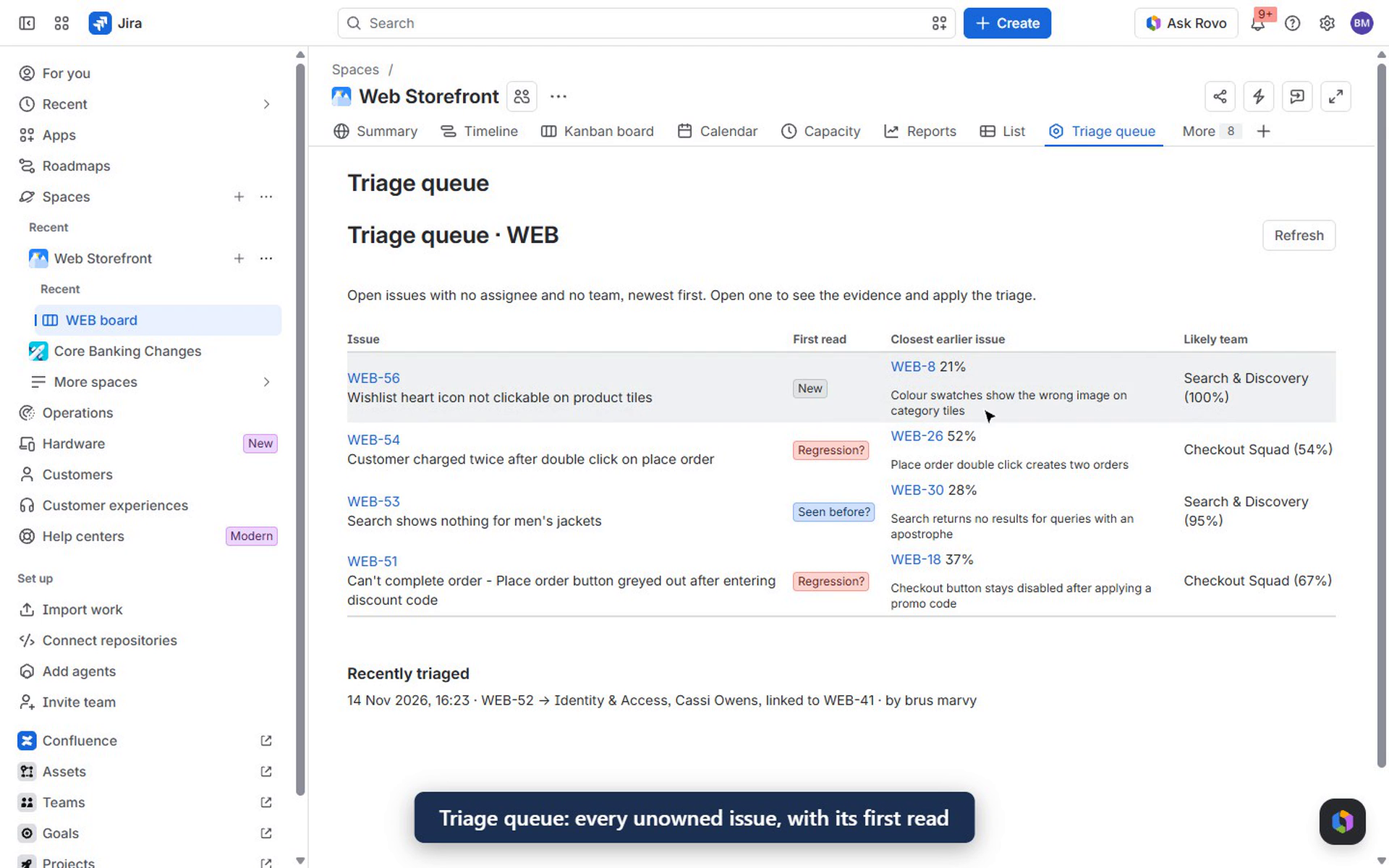
triaged, links the duplicate (or the earlier issue for a regression), and writes a comment that explains the decision and who confirmed it. Every decision is kept in a triage log. - Triage queue (project page). Every open issue with no assignee and no team, newest first, each with its first read (duplicate, regression, seen before, new), its closest earlier issue and its likely team.
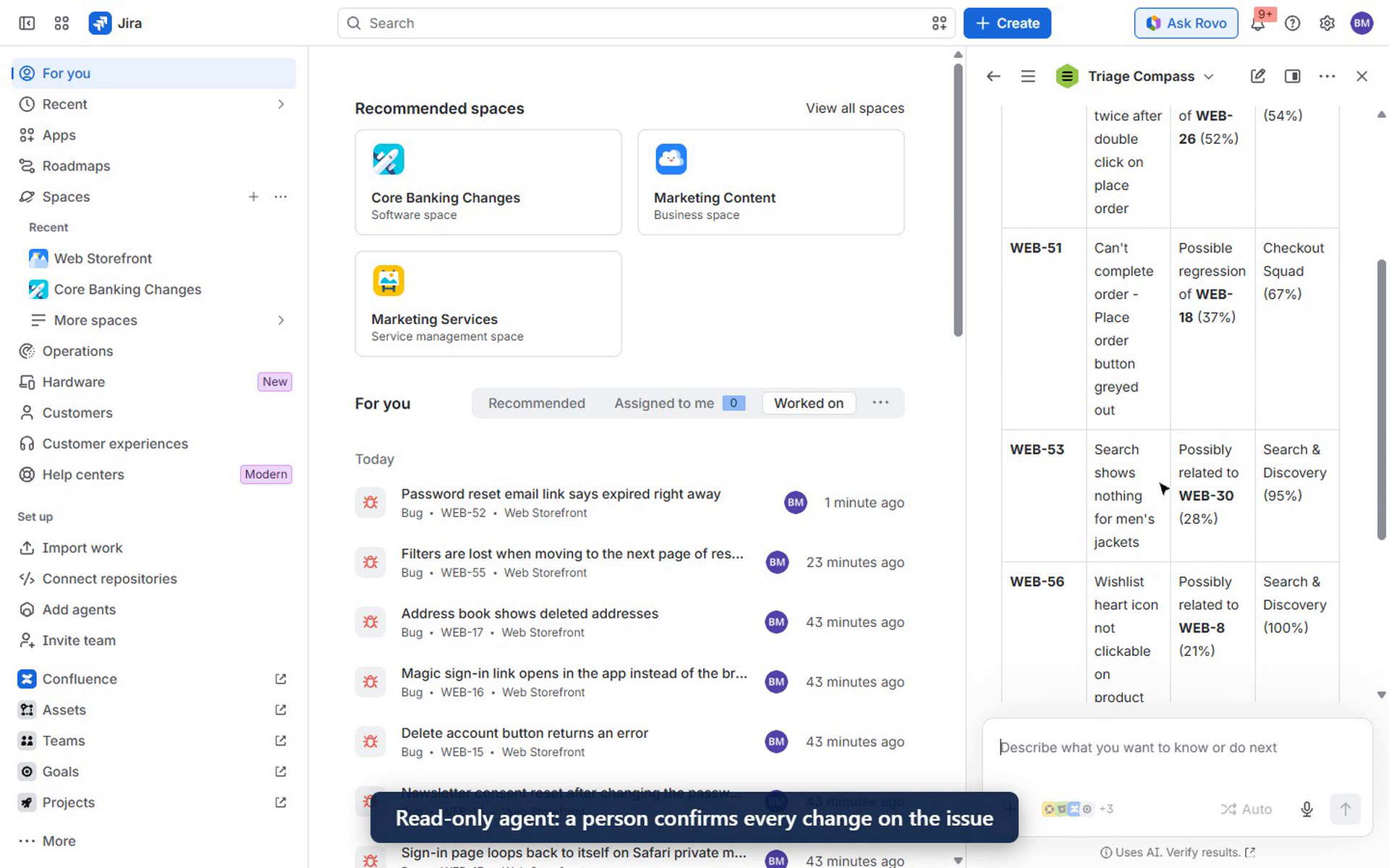
- Rovo agent "Triage Compass" answers "What needs triage in WEB?", "Is WEB-55 a duplicate?", "Who should fix WEB-51?" from three read-only actions. The same tools (
analyze-issue,triage-queue,triage-log) are exposed over MCP (rovo:mcp) so a coding agent can triage with the user's own permissions.
How we built it
- Forge only, Runs on Atlassian: no egress, no remote backend, no external model. Modules:
jira:issuePanelandjira:projectPage(UI Kit),rovo:agent,rovo:mcp, threeactionmodules, Forge KVS for the triage log. - Teamwork Graph API through
api.asUser().requestTeamworkGraph()with curated queries only:atlassianUserInTeams,atlassianTeamMembers,jiraWorkItemLinkedExternalPullRequests,jiraWorkItemLinkedExternalDeployments,jiraWorkItemGoals. Per-object scopes (read:graph:team:atlassian,read:graph:user:atlassian,read:graph:issue:jira,read:graph:pull-request:external,read:graph:deployment:external,read:graph:goal:atlassian,read:graph:issue-status:jira). Results are permission-filtered for the viewer. - Similarity is a small pure module (
src/triage.js, 11 unit tests on a real fixture): TF-IDF cosine over summary (double weight) and description, with stop words, light stemming and a bug-report synonym table ("greyed out" = disabled, "discount" = promo, "charged twice" = duplicate charge, "men's" = men). Thresholds (35% duplicate, 25% possible) were calibrated on the demo data, and the tests pin them. - Team voting gives the Team field full weight and splits half a vote across the Teamwork Graph teams of each similar issue's assignee, because people sit in several teams.
- Workload uses Jira's approximate-count API; the corpus is the 300 most recently updated issues in the project, so one analysis is a handful of calls and stays fast.
Challenges we ran into
- Teamwork Graph failures look like success. An unnamed query, a missing scope or a rate limit can come back as HTTP 200 with errors or an empty list. Every call is named
triagecompass_<operation>, is treated as successful only with data and no errors, retries transient errors with backoff, and the panel says how many graph calls returned nothing instead of silently showing "no team". - Raw Cypher is not available to new apps, so the design had to fit the curated queries. It turned out they cover triage well: teams of a person, members of a team, and work linked to an issue.
- Graph freshness. Team membership changes reach the graph with a delay, so the Jira Team field stays a first-class signal and the UI always shows which evidence a suggestion is based on.
- Keeping it a suggestion: the agent is read-only, writes happen only after a person confirms in the panel, and the comment records who confirmed.
Accomplishments that we're proud of
On the demo project, the six new bugs were matched as intended with no configuration: the reset-link bug found its fixed twin at 55% and was flagged as a regression, routed to Identity & Access and assigned to the person who fixed the original; "filters lost on page 2" was linked as a duplicate of the open pagination bug; "men's jackets" pointed at the apostrophe search bug as a possible match; the wishlist bug was correctly called new.
What we learned
Triage is mostly a memory problem, and the Teamwork Graph is organizational memory. Combining a cheap, explainable text match with who-worked-on-what from the graph beats asking a language model to guess, and it can always show its working.
What's next
- Learn per-project synonyms from accepted and rejected suggestions.
- Run automatically on issue creation with a "suggested triage" comment for teams that want it.
- Use more of the graph: the components and code areas behind linked pull requests, and on-call schedules for urgent bugs.
Built With
- forge
- graphql
- javascript
- jira
- mcp
- node.js
- rovo
- teamwork-graph
- ui-kit
