-
-
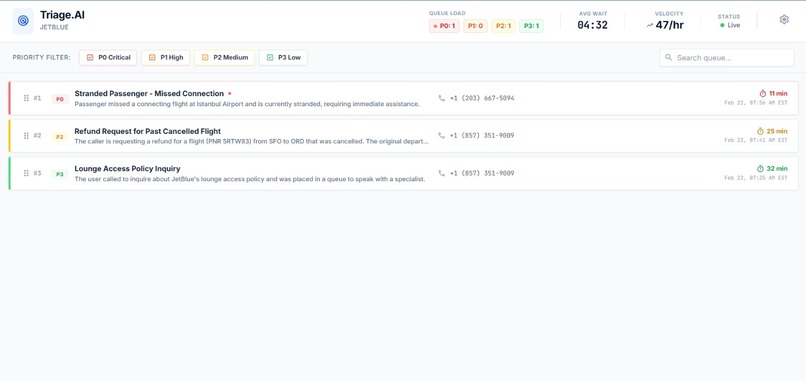
Dashboard
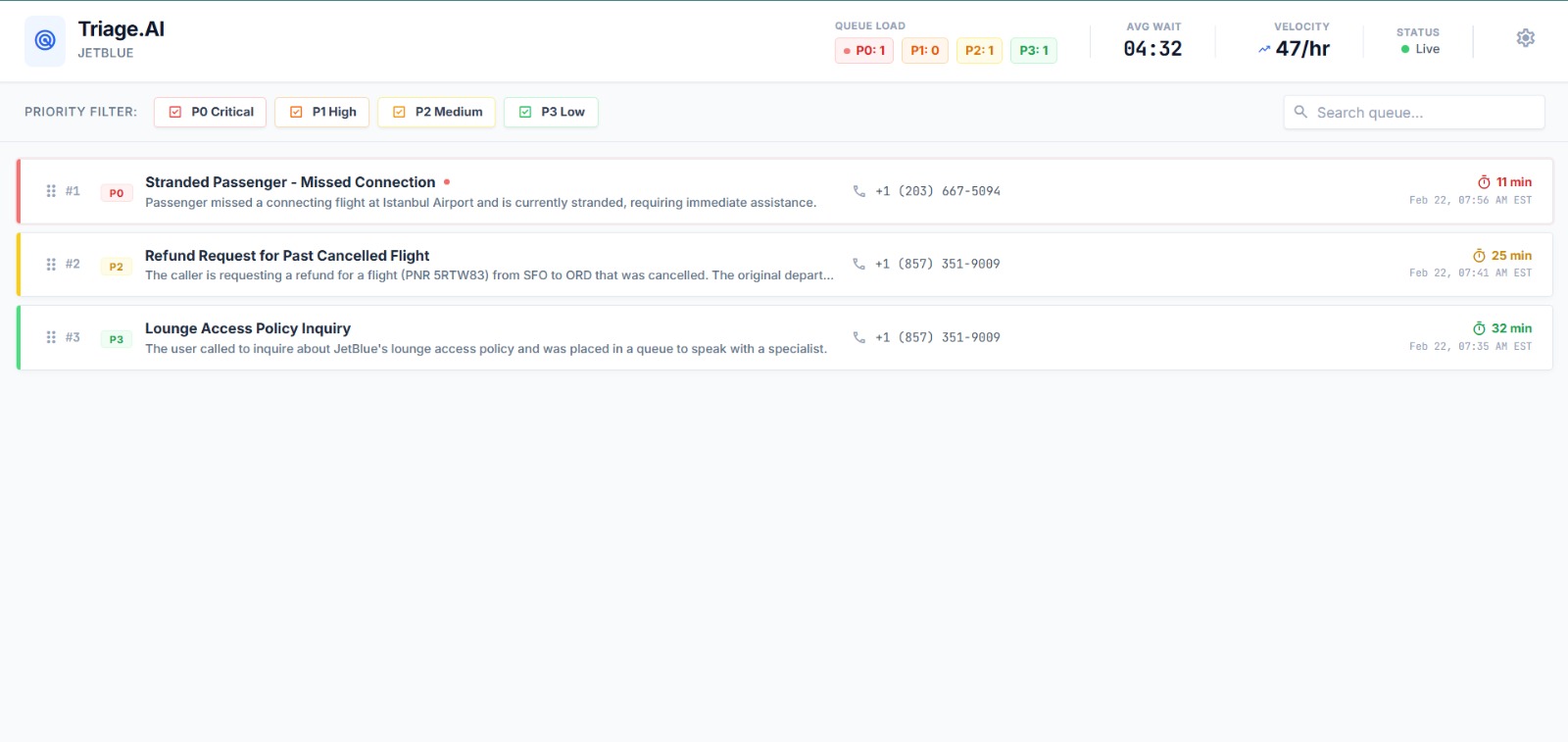
Triage.AI
Inspiration
We've all been stuck on hold after a cancelled flight, listening to the same loop of hold music for two hours. The frustrating part isn't the wait itself. It's knowing that someone with a simple baggage question is getting helped while you're stranded at the gate with no options. We spoke with other travelers and heard the same thing over and over: "I just wish they knew how urgent my situation was." Traditional phone systems treat every caller the same. We wanted to fix that.
What It Does
Triage.AI is an AI-powered call triage system for airlines. When a customer calls, an AI voice agent picks up immediately. No hold music, no phone tree. The agent has a natural conversation, understands the situation, and classifies the call by urgency: P0 (critical, like a stranded passenger) down to P3 (low, like a baggage policy question). Critical calls jump to the top of the queue. Human agents see every call on a real-time dashboard sorted by priority and work through them in order. Every caller gets answered instantly. Every agent knows who to help first.
How We Built It
Four components. Twilio receives incoming calls and routes them to an ElevenLabs conversational AI agent via native integration no audio middleware needed. When the call ends, ElevenLabs sends a summary to our FastAPI backend. FastAPI passes the summary to Gemini Flash for priority classification, saves the result to MongoDB Atlas, and pushes it to a React dashboard via WebSocket. The call card appears in real-time in the correct queue position. The entire backend is under 200 lines of code.
Challenges We Ran Into
Priority classification was the hardest part. Stressed callers don't speak in neat categories. "I'm stuck and I don't know what to do" could be P0 or P2 depending on context. We iterated on the Gemini prompt with few-shot examples and explicit decision criteria to handle ambiguity. On the voice side, getting the ElevenLabs agent to ask the right questions without sounding like an interrogation took multiple rounds of prompt tuning. The agent needs to be conversational and adaptive while still extracting enough information for accurate classification.
Accomplishments That We're Proud Of
The system works end to end. You call the number, an AI answers, has a real conversation, and within seconds of hanging up, the classified call appears on the dashboard in the right priority position. We're also proud of the architecture decision to use ElevenLabs' native Twilio integration. What could have been hundreds of lines of audio streaming code became a configuration step, letting us focus on the triage logic and dashboard instead.
What We Learned
Triage is the bottleneck, not the actual support. Airlines already have trained agents. The problem is those agents waste time on low-priority calls while critical ones wait. An AI that just sorts the queue without replacing the human delivers most of the value with a fraction of the complexity.
What's Next for Triage.AI
The architecture is industry-agnostic. Only the priority definitions and voice prompts are airline-specific. We plan to expand into healthcare clinics, insurance, and telecom. On the product side: multi-agent dashboards, call status tracking, analytics, and eventually full self-service resolution for low-priority calls where the AI handles everything without a human callback.


Log in or sign up for Devpost to join the conversation.