The problem
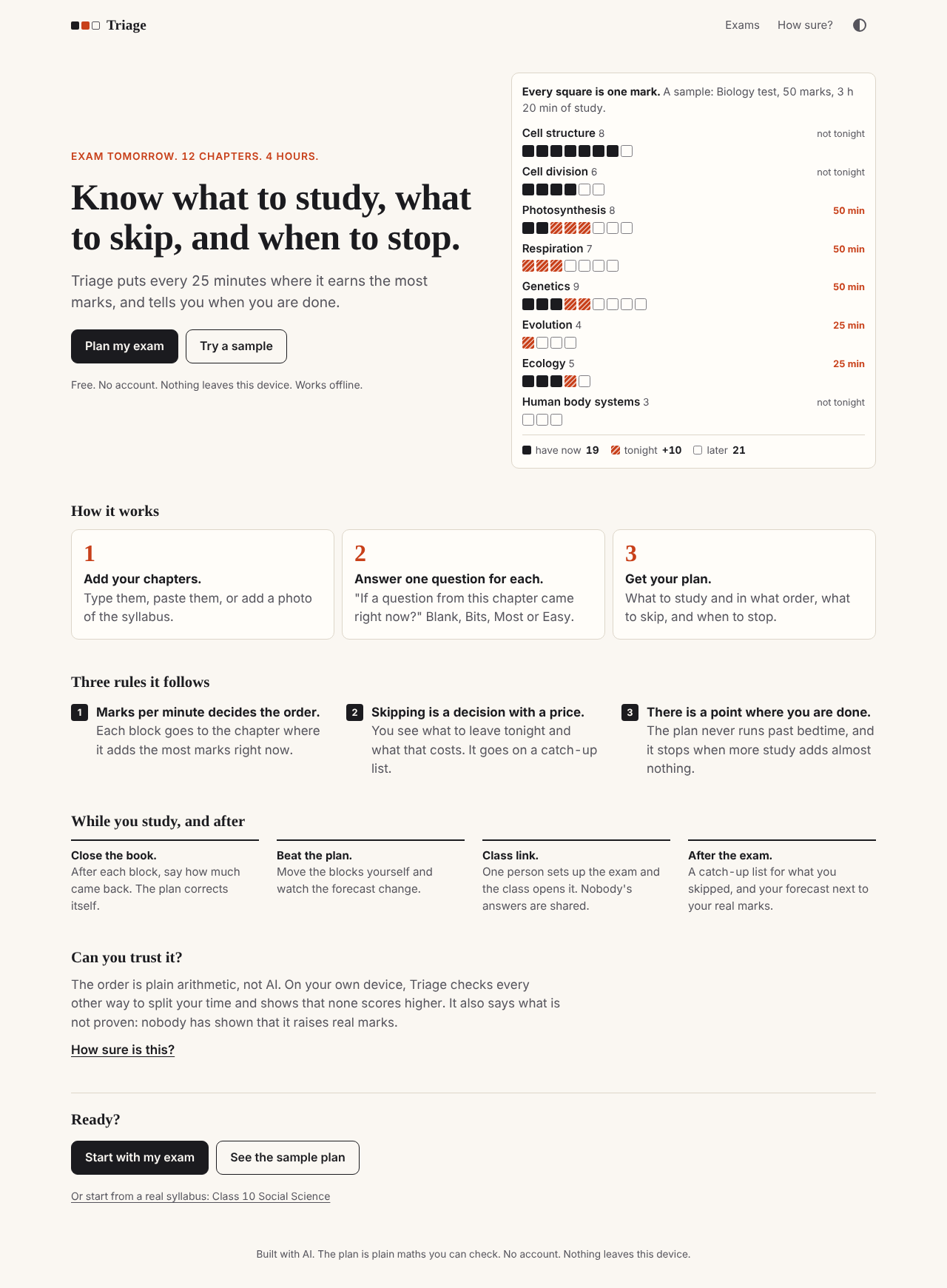
It is the night before an exam. You have 12 chapters and 4 hours. Most students do the same thing: open chapter 1, go in book order, run out of time around chapter 4, cut sleep to make up for it, and walk in tired with the last chapters never opened.
That is three mistakes: the wrong order, no rule for when to stop, and sleep paid as the price. This entry comes from a real exam week: five Class 10 exams between 3 and 12 October.
What it does
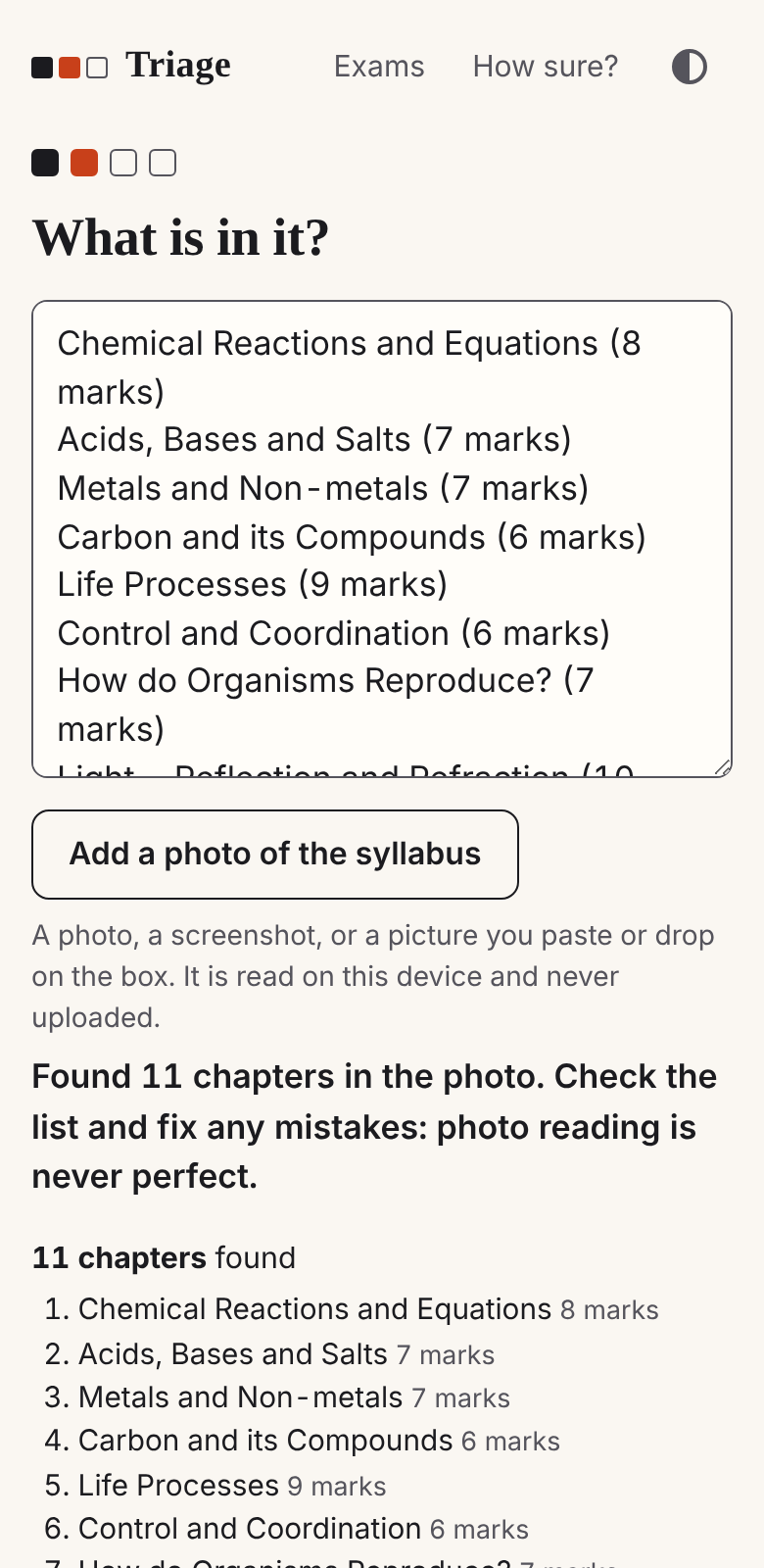
You add your chapters (type them, paste them, or add a photo of the syllabus, which is read on your own device). For each chapter you answer one question: "If a question from this chapter came right now?" Blank, Bits, Most or Easy. You say when you can study and when you wake up. Triage then follows three rules.
- Marks per minute decides the order. Each 25-minute block goes to the chapter where it adds the most marks right now.
- Skipping is a decision with a price. You see what to leave tonight and what each skip costs. Skipped chapters go on a catch-up list.
- There is a point where you are done. The plan never runs past bedtime (sleep is never planned under 6 hours), and it stops when another block would add almost nothing.
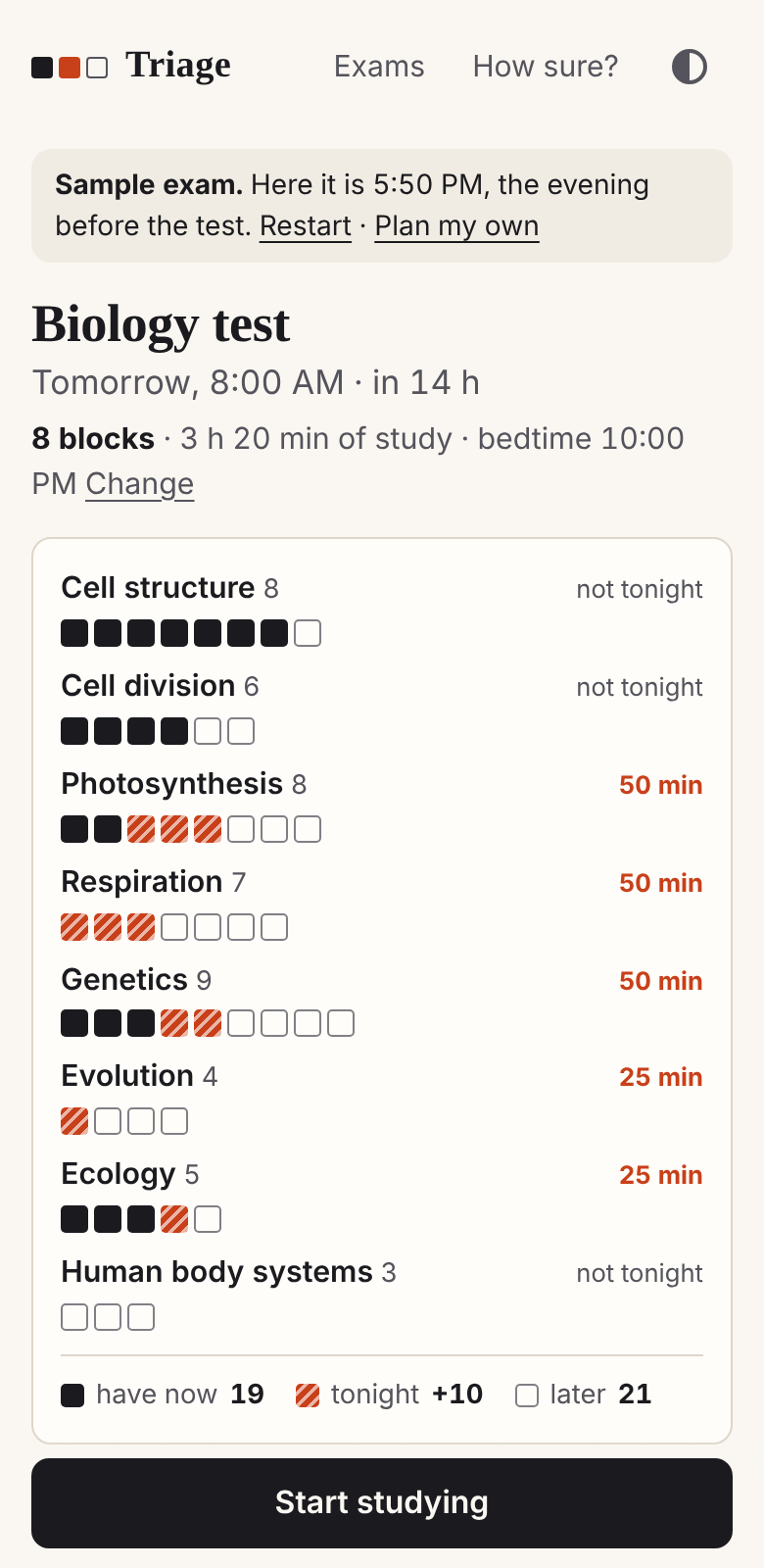
The Marks Map shows the whole plan in one picture. Every square is one mark of the paper: solid squares are marks you have now, striped squares are marks tonight's plan can win, outlined squares are left for later.
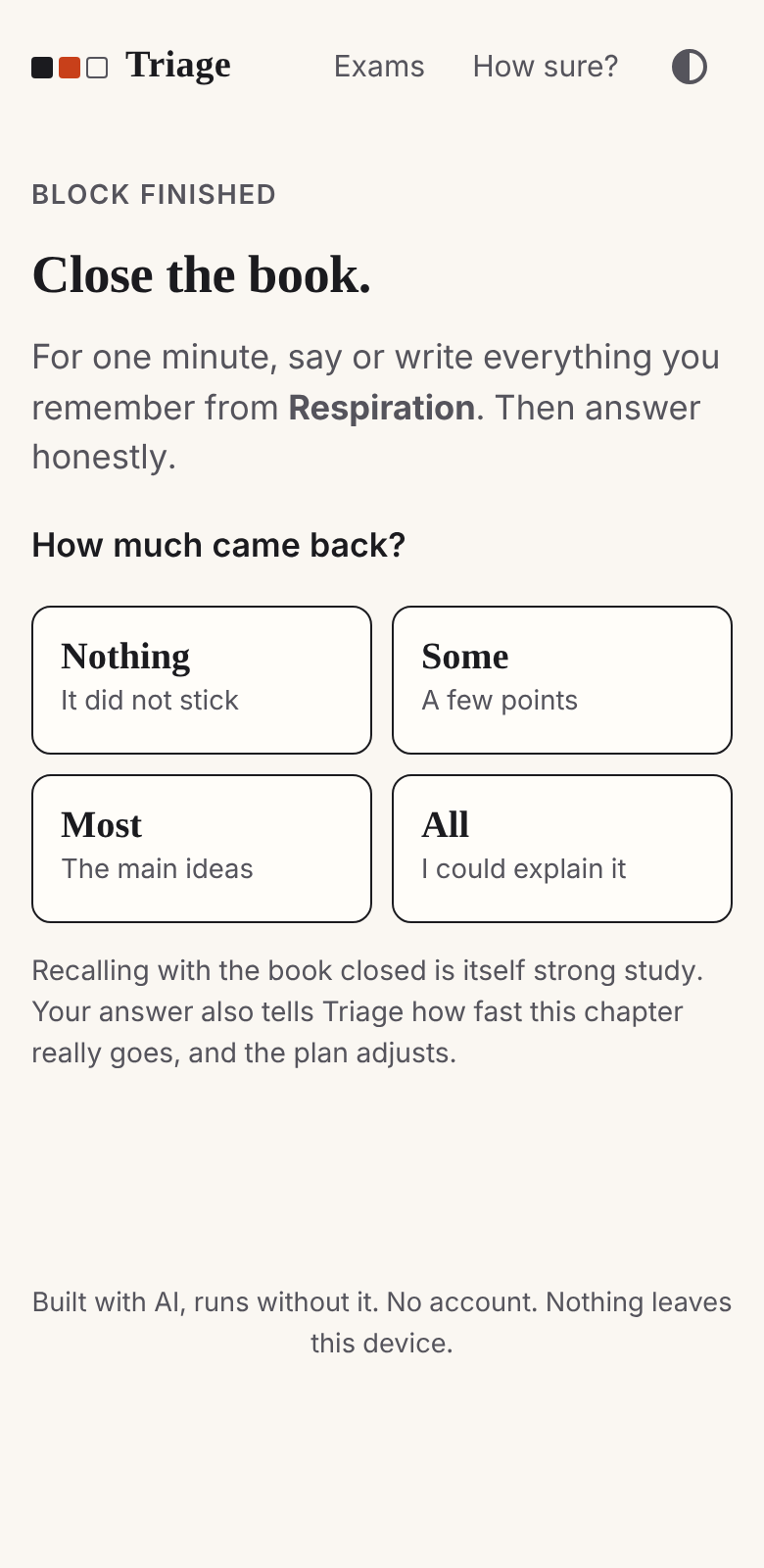
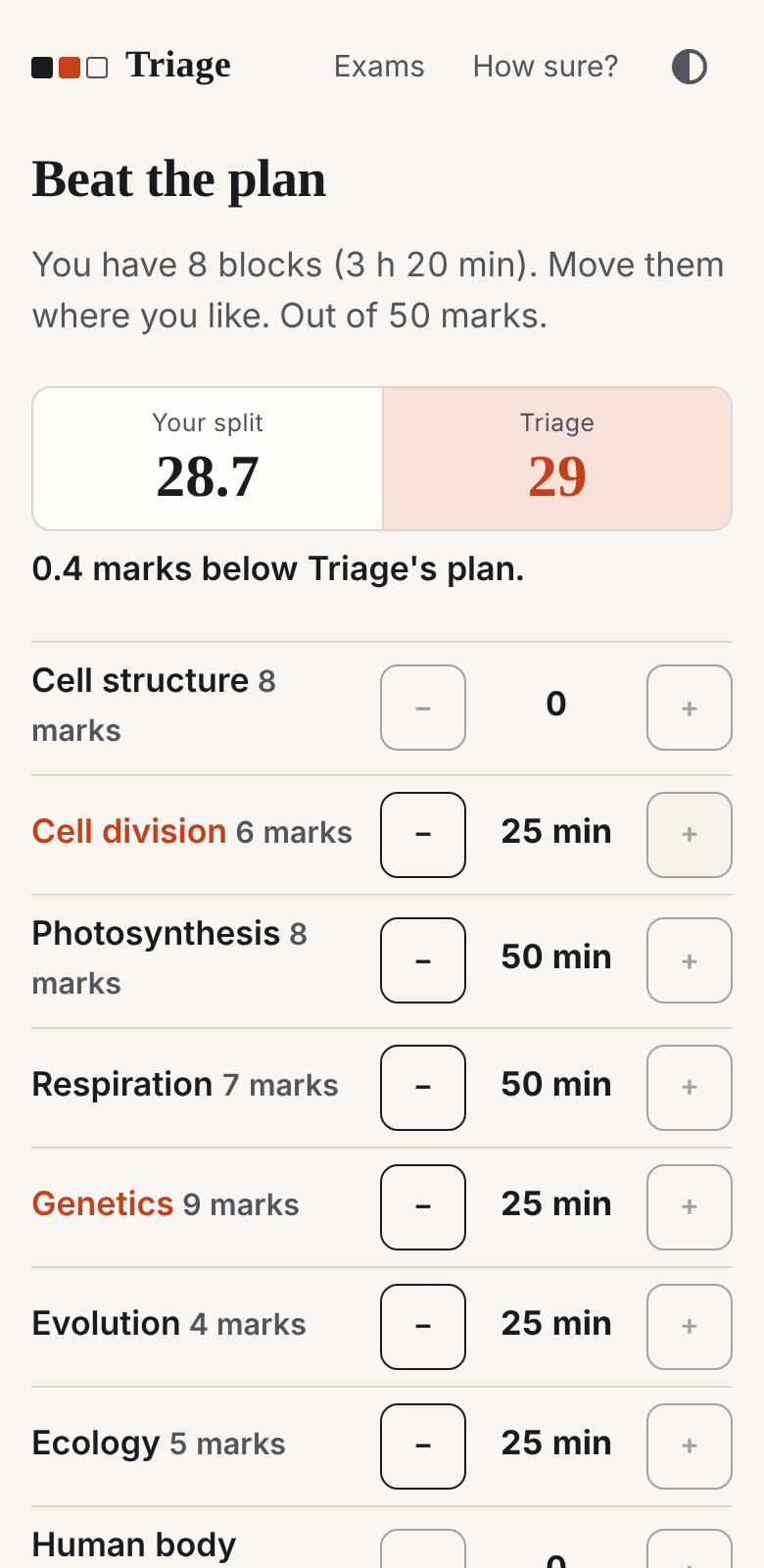
While you study: after each block you close the book and say how much came back, and the plan corrects itself. You can try to beat the plan by moving the blocks yourself. A class link carries the chapter list (never anyone's answers) so one person sets up the exam for the class. After the exam there is a catch-up list, and your forecast is shown next to your real marks.
No account, no server, no tracking. It works offline after the first visit.
How it decides
Studying has diminishing returns: the first 25 minutes on a chapter you never opened teach you more than the fourth 25 minutes on one you already know. Each chapter gets one curve for that. Triage hands out the evening one block at a time, always to the chapter where that block earns the most marks. The whole method is about 300 lines of arithmetic in one file, and the "Why?" under every row shows the numbers.
What is proven and what is not
- Proven, inside the app's own model: no other way of splitting the same time scores higher. The tests compare the plan with every possible split on more than 500 random exams, and the "How sure?" screen re-checks it live for your own exam, on your device.
- Simulated: when the student's answers are off by a level and the real study speed is wrong by up to twice in either direction, the plan still beat book order in 99.2% of 3,000 simulated exams.
- Not proven: that real students gain real marks. Nobody has shown that. So every forecast is a range labelled as an estimate, and the app compares its forecast with your real marks afterwards. It has not yet been used for a real exam.
How it was built
A plain website: HTML, CSS and JavaScript. No framework, no build step, no server. A security policy in the page blocks it from contacting any other site.
Reading a photo: the picture is first cleaned with plain arithmetic (straightened, shadows evened out, table lines removed), then Tesseract, an open-source text reader, turns it into text in the browser, and the student checks the result. It reads printed English only. It was tested on seven made-up pictures, not on a range of real photos.
Tests: 116 unit tests, 39 browser tests, and a simulation of what happens when students misjudge themselves. Tested in Chromium only (Chrome and Edge), across eight time zones and screen widths from 320 to 2560 px. Not tested in Safari or Firefox.
What went wrong
The day before the deadline, the app was put through a review of everything that could lose. It found real bugs. The worst: the stop rule ended the plan when the next block added less than 1% of the paper. That looked right on the 8-chapter sample. With a long syllabus every block is a small share of the paper, so a student with 35 chapters, all rated "Blank", was told "You are done" before starting. It is fixed (0.5%, never an empty plan, and a fair comparison with book order) and tested. The review also found a skip link that jumped to the wrong page, a class link that broke on refresh, and an end-of-block sound that would not have played in Safari.
AI-use disclosure
This project was built with heavy use of AI.
- Claude (Anthropic), used in Cowork, proposed the idea when Jaz asked for one, using Jaz's own exam week as the problem. It wrote the engine, the rest of the code, the tests, the documentation and this write-up, and ran the review on 4 October.
- Jaz asked for a project that could win and let Claude choose the idea. He chose to enter solo, set the rule that sleep is never planned under 6 hours, and asked for the weak spots of the idea to be closed, for a photo of the syllabus to work as input, for a start page, and for the final review. He set up the repository and published the site.
- Inside the app, no AI makes the plan: it is plain arithmetic that can be checked. One optional feature, reading a photo of the syllabus, uses Tesseract, which contains a small trained neural network. It runs in the browser on the student's own device and uploads nothing.
- Earlier work: Jaz's personal assistant project "Taz OS" (1 to 2 October 2026) had a simple exam-eve list that led to this idea. The repository's
prototype/folder holds the first sketch of the engine.
Lessons from the build
These were written by Claude, from what happened during the build. They are not Jaz's own reflections.
- A rule tuned on one sample is not a rule. The stop rule passed every test on a 50-mark, 8-chapter exam and gave useless advice on a 35-chapter one.
- "Proven best" only means best under the model. The inputs are a student's guesses, so the honest output is a range, a correction after every block, and a comparison with real marks.
- Keeping AI out of the decision made the plan checkable. The one place a trained model is used, reading a photo, is at the edge, where the student sees and corrects its output.
What's next
Planning a whole exam week across several exams. A QR code for the class link. More languages. And the first real test: using it for a real exam and recording the forecast against the real marks.
Built With
- claude
- css3
- html5
- javascript
- node.js
- playwright
- service-worker
- tesseract.js

Log in or sign up for Devpost to join the conversation.