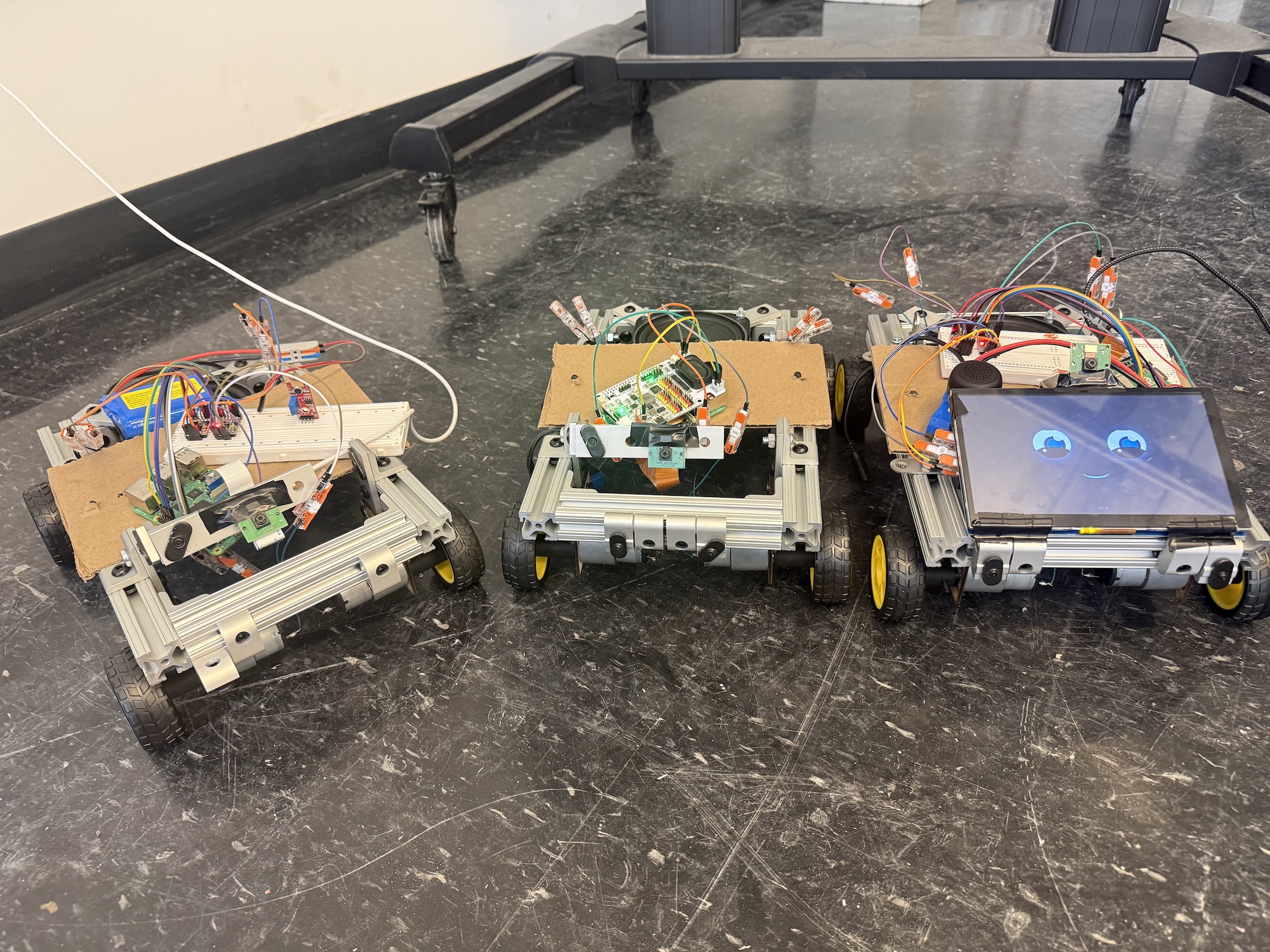
Triad
Inspiration
Most robots today are lonely thinkers. Even when they look impressive, they usually rely on teleoperation, scripted behaviors, or a single centralized brain telling them what to do. That’s not how intelligence works in nature — ants, bees, humans, and even neurons solve problems collectively.
Triad was inspired by a simple question:
What happens when autonomy isn’t confined to one robot, but shared across many?
We wanted to explore collective intelligence in physical form — not simulations, not chatbots, but real robots that perceive the world, talk to each other, negotiate decisions, and act together without human intervention.
What it does
Triad is a swarm of three fully autonomous robots running OpenClaw agents. Each robot has wheels, motors, a camera, microphone, and speaker, allowing it to move, see, hear, and speak.
Individually, each robot can:
- Perceive its environment using computer vision
- Speak and listen using real-time speech synthesis and transcription
- Reason about what it sees and hears
- Decide when to move, what to say, and how to act
Collectively, the robots:
- Communicate with each other in natural language
- Share observations and intent
- Coordinate tasks and movement
- Behave as a single distributed intelligence, rather than three independent assistants
There is no remote control and no hardcoded choreography. The OpenClaw agents themselves generate motor commands, speech, and coordination strategies in real time.
How we built it
Each robot runs an OpenClaw agent as its control loop. The agent integrates:
- Perception: live camera input processed through Gemini’s image understanding to produce structured observations
- Reasoning: a Gemini-powered large language model acting as the primary decision-maker
- Communication: ElevenLabs agents with tools for real-time speech synthesis and audio interaction
- Action: motor commands generated directly by the agent and sent to the robot’s drivetrain
The robots communicate over a shared messaging layer, exchanging observations, plans, and decisions. There is no central controller; coordination emerges from agent-to-agent negotiation.
In effect, each robot runs its own intelligence loop, but the system behaves like a swarm:
[ \text{Collective Behavior} \neq \sum \text{Individual Behaviors} ]
Challenges we ran into
- Latency: coordinating vision, speech, reasoning, and motor control in real time pushed the limits of responsiveness.
- Embodied reasoning: translating high-level language decisions into safe, physical actions is far harder in the real world than in simulation.
- Coordination without collapse: preventing robots from speaking over each other, duplicating effort, or pursuing conflicting goals.
- Debugging autonomy: emergent behavior doesn’t fail cleanly — sometimes the system behaves “correctly,” just not desirably.
Accomplishments that we're proud of
- Built fully autonomous robots — no teleoperation, no scripted demos
- Achieved real-time multi-agent coordination in physical hardware
- Integrated perception, speech, reasoning, and actuation into a single agent loop
- Demonstrated collective intelligence as an embodied system, not a simulation
What we learned
- Autonomy is less about smarter models and more about tight perception–reasoning–action loops
- Multi-agent systems behave more like ecosystems than traditional software
- Embodiment exposes weaknesses immediately — but also makes progress real
- Coordination is a harder and more interesting problem than intelligence in isolation
Track alignment
Seeed Studio Interactive Signage Track
Triad reimagines signage as alive, embodied, and social. Instead of static displays, our robots act as mobile, speaking, and singing information agents. They can respond to people, coordinate with each other, and physically move through a space — turning information into an interactive, expressive presence rather than something fixed on a wall.
Triad explores what happens when signage doesn’t just display information, but perceives, reacts, and collaborates.
Communication Track
At its core, Triad is a communication system — not just between humans and machines, but between machines themselves. The robots use natural language to negotiate tasks, share observations, and coordinate behavior, forming a decentralized mesh of embodied agents.
This project explores new forms of communication:
- Agent-to-agent language-based coordination
- Human–swarm interaction through speech and presence
- Distributed communication without a central controller
Generative AI (Gemini & ElevenLabs)
Triad relies on generative AI as its core control layer:
- Gemini powers perception and reasoning, enabling robots to interpret visual input and make real-time decisions
- ElevenLabs enables expressive speech, allowing robots to speak, sing, and interact naturally with humans and each other
These models are not used as assistants or interfaces, but as active controllers embedded in physical agents.
What's next for Triad
Triad is a prototype for collective robotics intelligence. Next steps include:
- Scaling beyond three robots
- Structured task negotiation and role assignment
- Persistent memory and learning across interactions
- Deeper human–swarm collaboration
Long term, we see systems like Triad enabling groups of robots that assist humans with complex, real-world tasks — not as tools to be commanded, but as collaborators that think, speak, and act together.

Log in or sign up for Devpost to join the conversation.