-
-
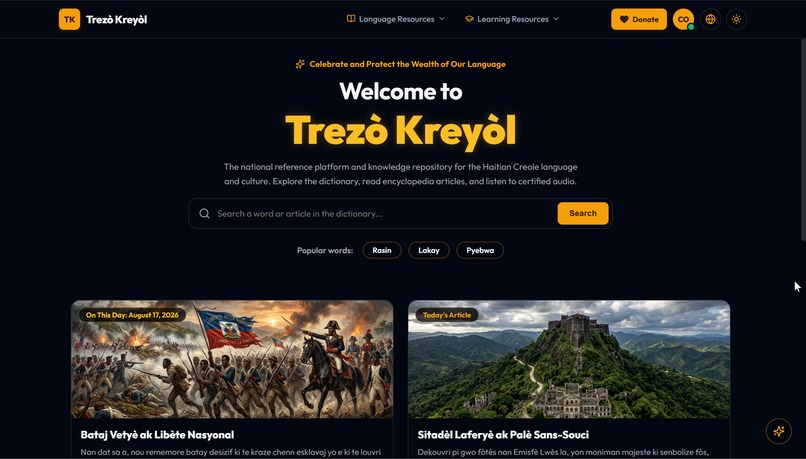
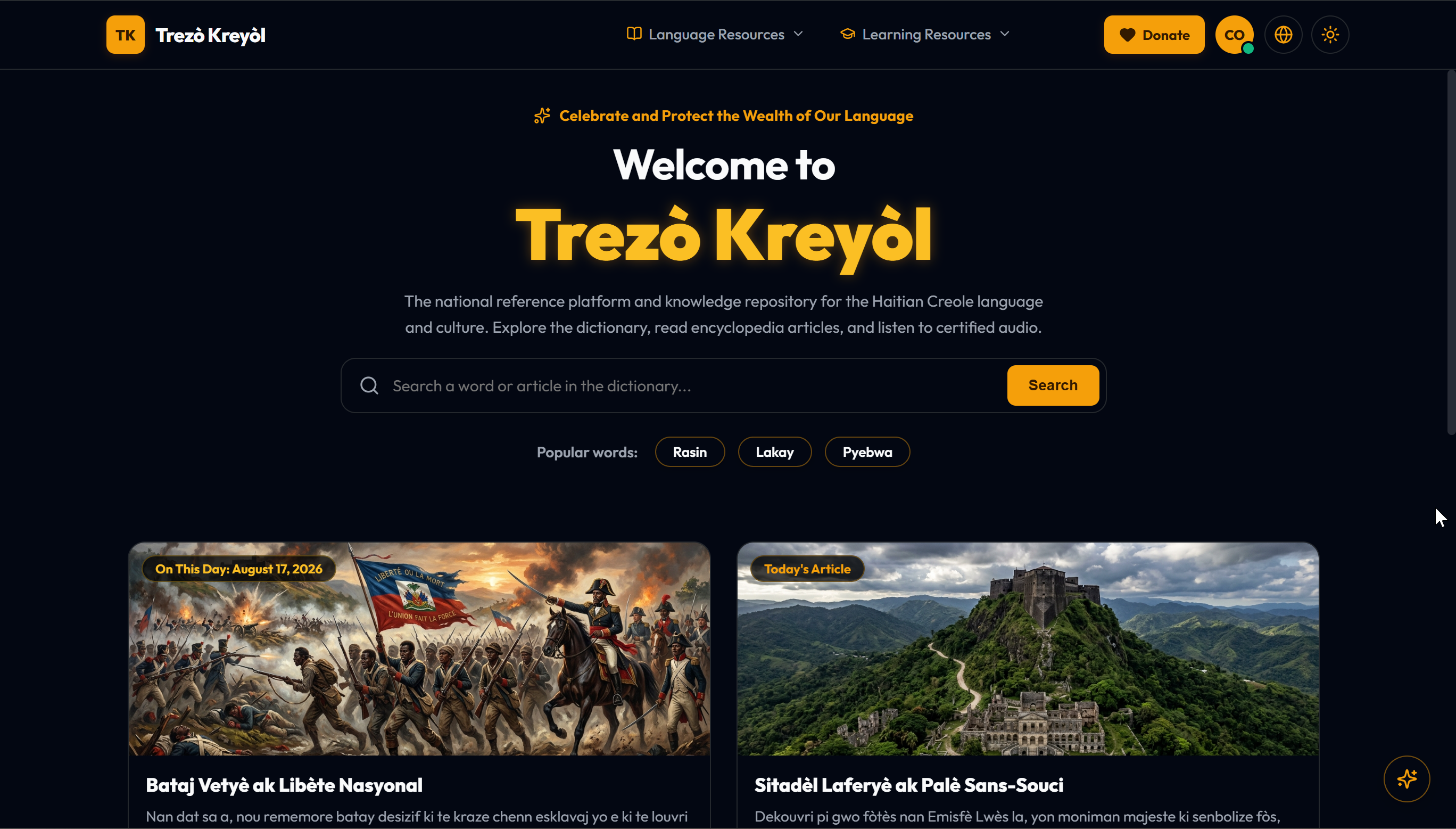
Public Web homepage
-
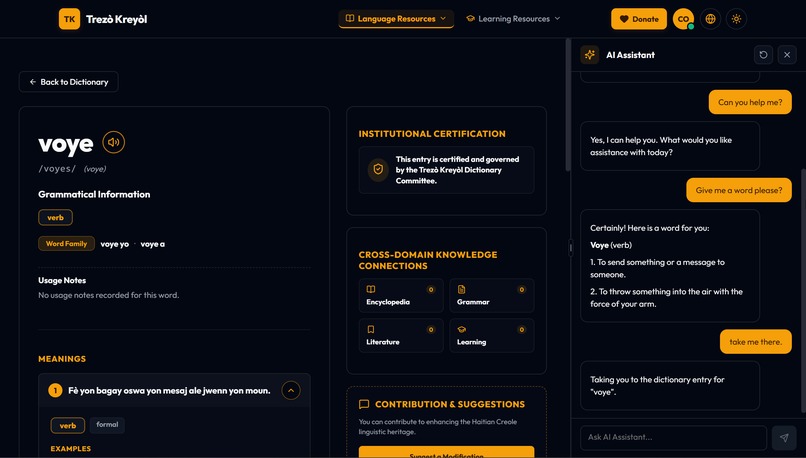
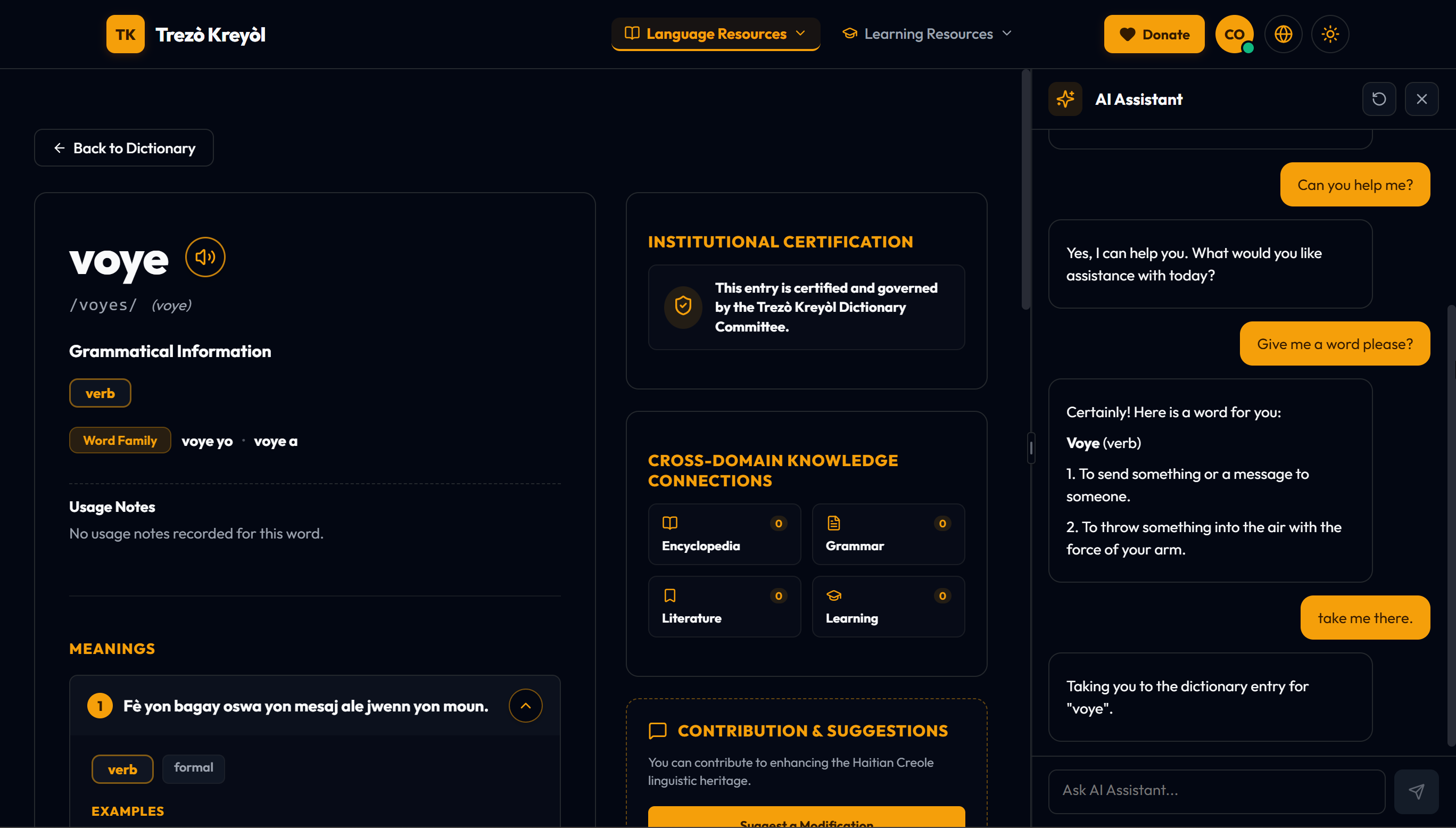
Dictionary AI discovery
-
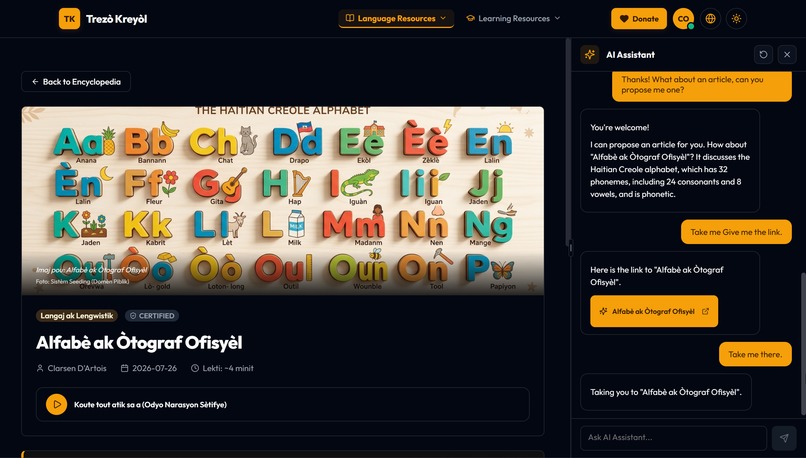
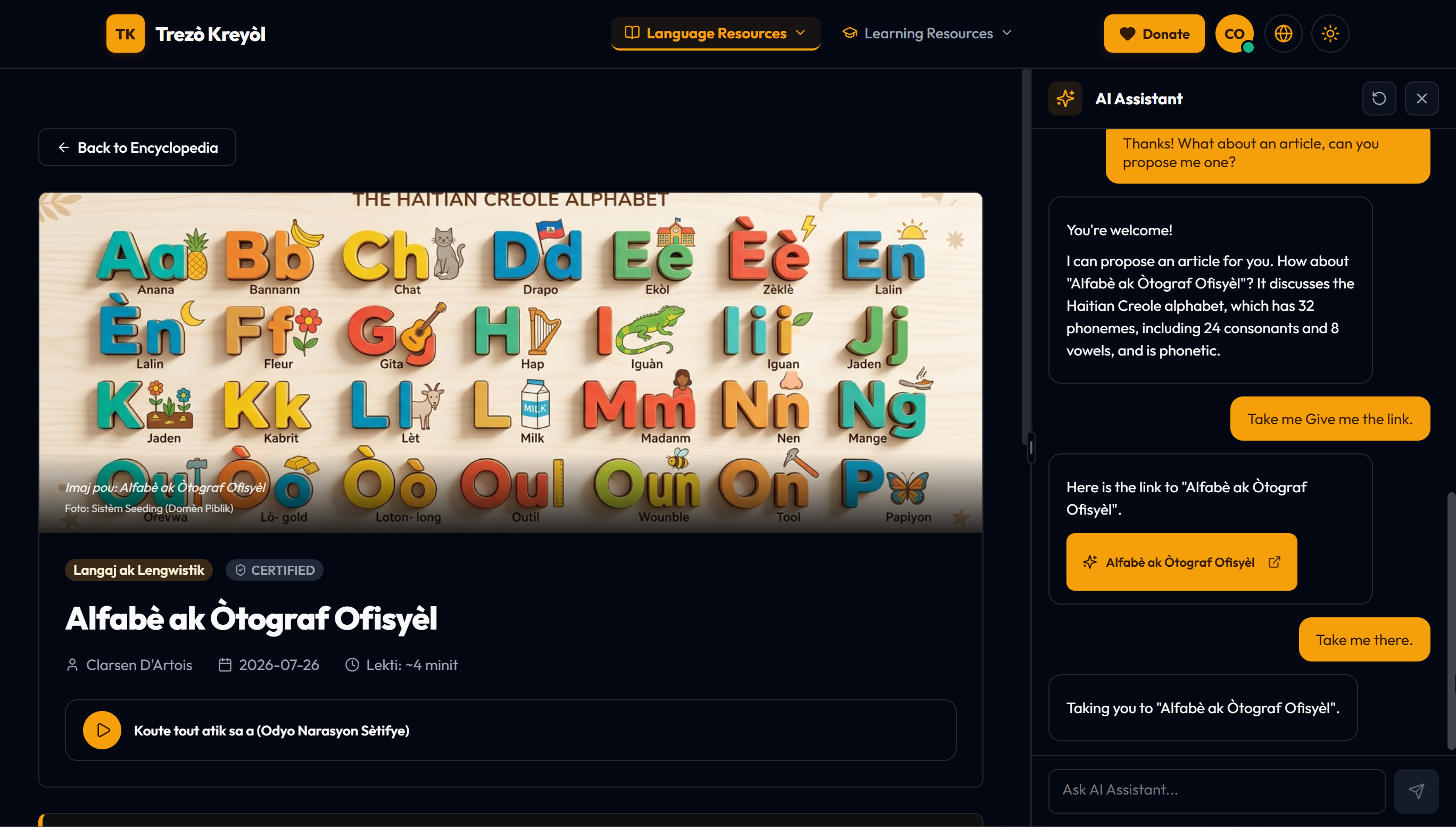
Knowledge domain — Encyclopedia
-
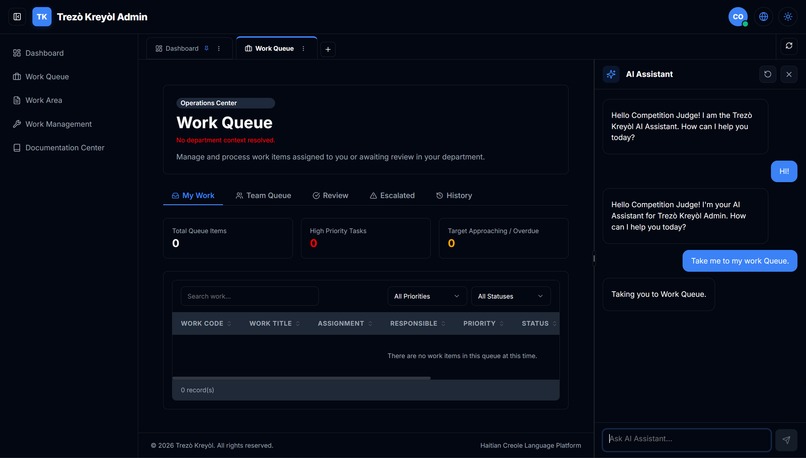
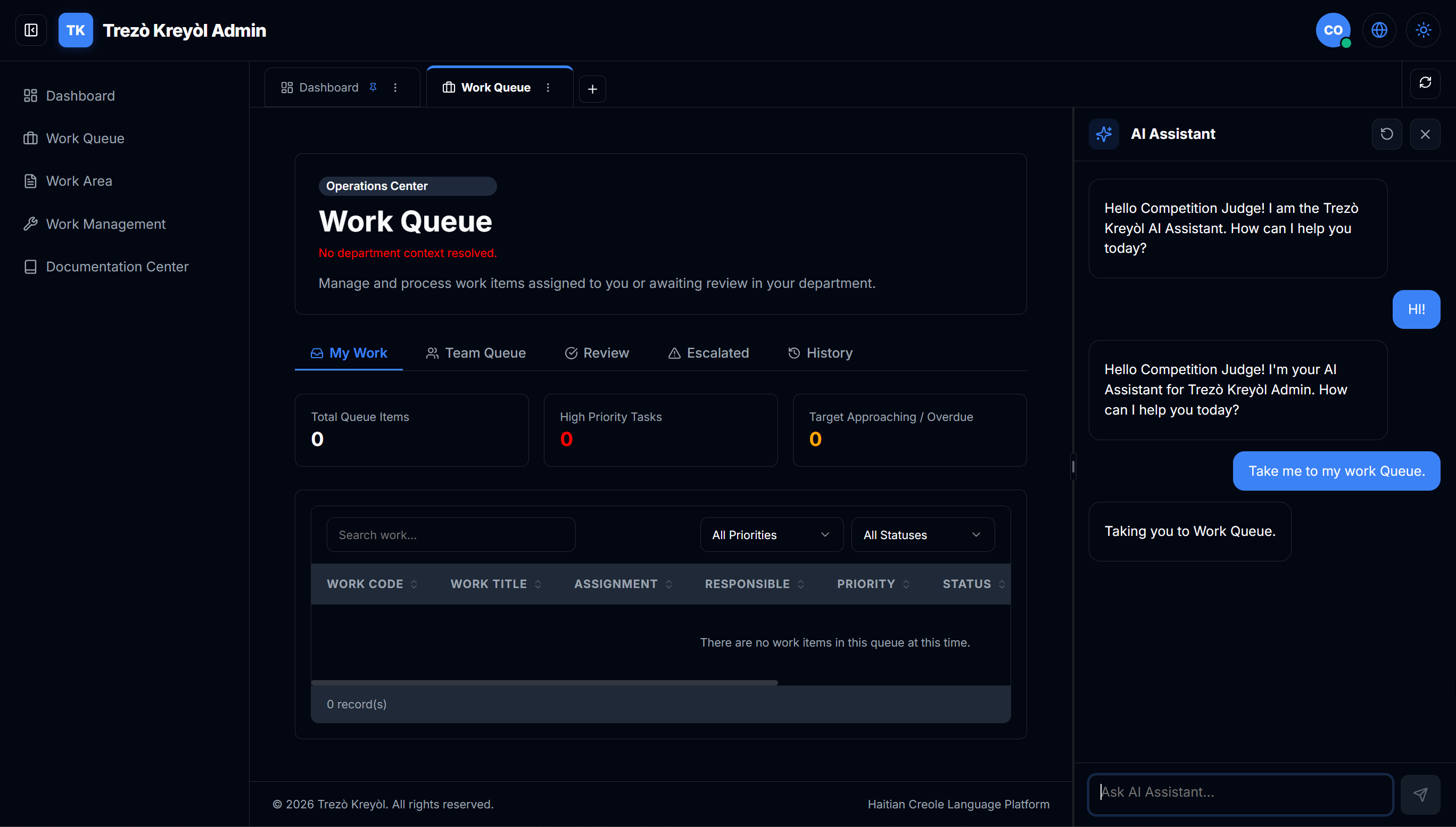
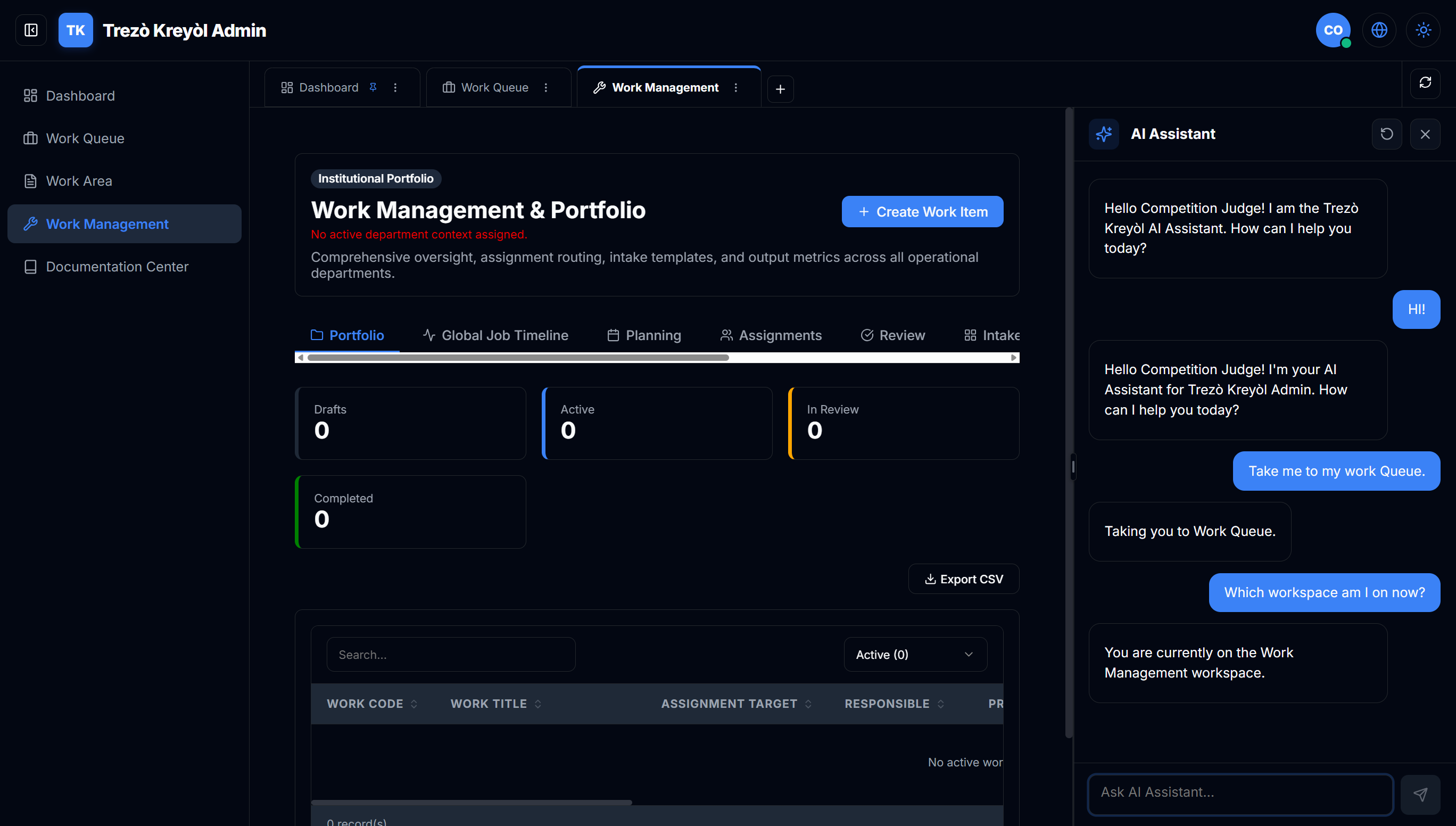
Admin operations
-
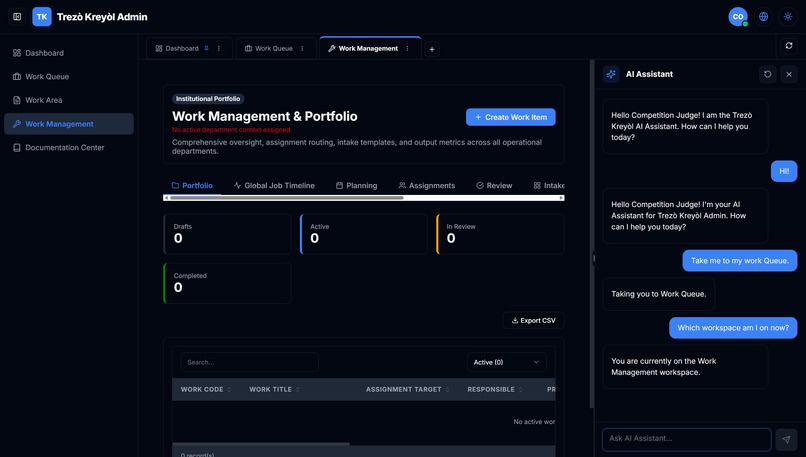
AI institutional workflow
💡 Inspiration
Haitian Creole is spoken by millions of people and is central to Haitian identity, history, education, and culture, yet it remains deeply underrepresented in high-quality digital systems and modern AI experiences.
I created Trezò Kreyòl ("Creole Treasure") to help change that.
The project began as an effort to organize and preserve Haitian Creole knowledge through structured resources such as a dictionary, grammar, literature, educational content, cultural articles, and interactive learning experiences. As the platform grew, I realized that simply storing information was not enough.
People should be able to interact with that knowledge naturally.
At the same time, the people responsible for maintaining such a platform—researchers, contributors, staff, editors, and administrators—need intelligent tools of their own.
That led to the current vision for Trezò Kreyòl: an AI-native cultural and educational institution, where Gemini connects people to trusted Haitian Creole knowledge while also helping the institution organize and operate the work required to preserve it.
🌍 What Trezò Kreyòl Does
Trezò Kreyòl combines a public knowledge platform with an institutional administration system.
The public platform brings together structured Haitian Creole resources including:
- dictionary and lexical knowledge
- grammar
- literature
- cultural and educational articles
- learning resources and interactive experiences
Gemini provides a conversational layer over this ecosystem.
Instead of behaving like a generic chatbot, the assistant is designed to understand where the user is in the platform, discover information from authoritative application data, explain available resources, answer multilingual questions, and direct users to canonical content within Trezò Kreyòl.
For example, a visitor can ask about a word, article, or cultural topic and the system can ground discovery in Trezò Kreyòl's own data and provide the corresponding platform resource rather than inventing an entry.
The experience also understands the distinction between anonymous and authenticated users, allowing the platform to provide useful guidance while maintaining clear public and institutional boundaries.
🤖 One AI Kernel, Two Surfaces
A central architectural principle of Trezò Kreyòl is that AI should understand where it is operating and what it is allowed to know or do.
We therefore designed one backend AI kernel serving two deliberately separated experiences.
Public Web
On the public platform, Gemini acts as an intelligent guide to Trezò Kreyòl.
It can help users discover and understand public knowledge, navigate platform resources, interact across supported languages, and find canonical content backed by the platform's data.
The public assistant remains inside the public information boundary regardless of a user's institutional role.
Admin
The Admin platform represents the institutional side of Trezò Kreyòl.
Here, the AI is being developed as a context-aware coworker, not an autonomous decision-maker. The architecture provides awareness of the active administrative surface, workspace context, authenticated identity, role, and authorization boundaries.
Its purpose is to assist staff with understanding institutional information and workflows while preserving human authority.
The governing principle is simple:
AI can read, explain, suggest, assist, insert, or propose—but humans remain responsible for consequential institutional decisions such as approval and publication.
This human-in-the-loop model is fundamental to the project.
⚙️ How We Built It
Trezò Kreyòl is engineered as a modular monorepo with deliberately separated Web, Admin, API, shared contracts, UI, and AI responsibilities.
The platform uses technologies including:
- Gemini API for language understanding and reasoning
- Python / FastAPI for backend services and the AI kernel
- PostgreSQL for authoritative structured institutional and linguistic data
- Next.js / React / TypeScript for the Web and Admin applications
- Firebase Authentication for identity and authentication flows
- Turborepo and pnpm workspaces for monorepo organization
- Google Cloud infrastructure for deployment environments
A major engineering focus has been grounding and context.
Rather than asking the model to guess whether platform content exists, the architecture is designed around query-first access to authoritative application data. The AI receives structured runtime context describing its active surface and relevant application state, while backend boundaries determine what information can be accessed.
This allows Gemini to function as part of the application architecture rather than as an isolated chat window placed on top of it.
🧠 What I Learned
One of the biggest lessons from building Trezò Kreyòl is that integrating an LLM is relatively easy; building an AI system that can be trusted inside a real application is much harder.
The difficult questions became architectural:
How does the AI know where the user is?
How does it know whether a user is anonymous or authenticated?
How does it distinguish public knowledge from institutional information?
How do we prevent it from inventing database entities or application routes?
How should permissions affect what the assistant can discover?
How can the same intelligence serve two very different interfaces without collapsing their security boundaries?
And how do we preserve human authority while still making the AI genuinely useful?
Answering those questions transformed the project from a conversational feature into a broader AI-native application architecture.
🛠️ Challenges
Building Trezò Kreyòl has required solving challenges across language technology, data architecture, authentication, authorization, AI grounding, localization, institutional workflow design, and user experience.
Haitian Creole itself presents an important challenge: it is a comparatively low-resource language in today's AI ecosystem. The platform therefore cannot depend solely on what a general-purpose model happens to know. Trezò Kreyòl is building structured, authoritative knowledge that the AI can use as its institutional source of truth.
Another major challenge has been maintaining reliable behavior while rapidly integrating AI across an already substantial platform. This pushed the project toward stronger contracts, centralized context, reusable registries, automated testing, strict Web/Admin boundaries, and human-controlled AI actions rather than one-off patches.
🚀 What's Next
The immediate goal is to continue strengthening the end-to-end AI-assisted experience across both surfaces.
On the public side, this means richer semantic discovery across Haitian Creole dictionary, literature, educational, and cultural resources.
On the institutional side, the goal is to deepen the AI coworker experience so authorized staff can receive contextual assistance throughout their workspaces while administrators retain control over assignments, review, approval, and publication.
Longer term, Trezò Kreyòl can expand into adaptive language learning, pronunciation and voice experiences, culturally grounded educational interactions, and richer tools for researchers, educators, contributors, and Haitian Creole learners.
The larger mission remains unchanged:
use modern technology not merely to digitize Haitian Creole knowledge, but to create an intelligent, sustainable ecosystem in which that knowledge can be preserved, explored, taught, expanded, and passed forward.
Built With
- fastapi
- firebase
- firebase-authentication
- gemini-api
- google-cloud
- next.js
- pnpm
- postgresql
- python
- react
- tailwind-css
- turborepo
- typescript


Log in or sign up for Devpost to join the conversation.