-
-
Trenvise AI

Trenvise AI — About the Project
Inspiration
Trenvise was inspired by a simple but costly observation:
most companies don’t fail because they lack data — they fail because they can’t turn data into clear decisions.
In marketing, teams see clicks, impressions, and conversions.
In finance, teams see revenue, costs, and margins.
Customer feedback lives in surveys, reviews, and social comments.
Yet these signals are rarely connected. As a result, companies miss trends, market to the wrong customers, overspend on weak channels, and slowly lose profit without knowing why. Seeing how even large brands and well-funded teams make these mistakes motivated us to build Trenvise, an AI that focuses on decision-making instead of dashboards.
What We Learned
Building Trenvise reinforced several key lessons:
- Data alone is not insight. Metrics without context create confusion rather than clarity.
- Explainability matters. Users trust recommendations only when they understand how results were derived.
- Marketing and finance must be analyzed together. Optimizing clicks without considering profit leads to bad decisions.
- Simplicity beats complexity. Clear logic and transparent calculations are more valuable than black-box models.
We also learned how challenging it is to design AI that behaves like a consultant — asking the right questions, prioritizing actions, and communicating clearly to both technical and non-technical users.
How We Built Trenvise
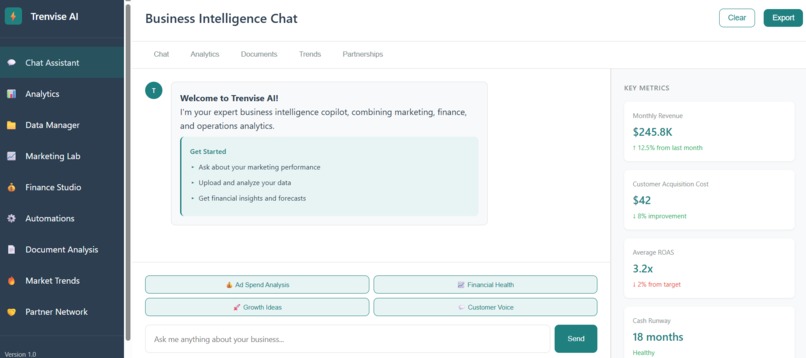
Trenvise was built as a decision-intelligence assistant with a structured reasoning flow:
Data Ingestion
Users upload marketing performance data, financial summaries, and customer feedback (CSV or text).
The system validates, cleans, and normalizes the data.Analytical Layer
- Marketing analysis computes metrics such as: [ \text{CAC} = \frac{\text{Total Marketing Spend}}{\text{New Customers}} ] [ \text{ROAS} = \frac{\text{Revenue from Campaign}}{\text{Campaign Spend}} ]
- Financial analysis examines revenue trends, margins, and cost structure.
- Sentiment analysis extracts themes and trends from customer feedback.
AI Reasoning & Recommendations
A system prompt defines Trenvise’s role as a marketing analyst, financial advisor, and strategy partner.
The AI synthesizes insights across domains and outputs:- A restated business goal
- Key insights
- Prioritized, concrete actions
- Metrics to monitor
- A restated business goal
User Experience
We designed Trenvise to be approachable, offering:- Plain-English explanations for non-technical users
- Transparent “show-the-math” logic for advanced users
- Plain-English explanations for non-technical users
Challenges We Faced
One major challenge was avoiding hallucinated precision.
Rather than inventing exact forecasts, we clearly labeled estimates and focused on directional impact.
Another challenge was connecting metrics meaningfully. Marketing metrics like CTR or impressions do not matter unless linked to financial outcomes such as profit or lifetime value. Building this linkage required careful logic and restraint.
Finally, balancing depth and simplicity was difficult. We wanted Trenvise to feel expert-level without overwhelming users, which led to a structured, consistent output format and simplified language.
Conclusion
Trenvise is not a chatbot or another analytics dashboard.
It is an AI decision assistant designed to help businesses understand what is happening, why it matters, and what to do next — across marketing, finance, and analytics.
By turning trends into advice and advice into action, Trenvise helps teams make smarter, more confident decisions.
Built With
- analytics
- cfa/cpa-aligned
- chatgpt-(openai)
- cloud-deployment-services
- fastapi
- financial
- gemini-(google-ai)
- llm-apis
- marketing
- numpy
- pandas
- plotly
- postgresql
- python
- scikit-learn
- streamlit

Log in or sign up for Devpost to join the conversation.