Inspiration
The fashion industry loses billions annually to trend misalignment - brands design collections months in advance, only to find they missed what consumers actually want. Independent designers face the same cycle: manually scrolling Instagram, guessing at trends, hoping their collections land. What if a single platform could analyze real-time global fashion trends, generate brand-compliant product imagery, dress AI fashion models in those products, produce manufacturing-ready tech packs as professional PDFs, and create ad-ready video - all from one dashboard? The "aha" moment was the runway video: upload your brand, and AI shows you your future collection on a runway.
What it does
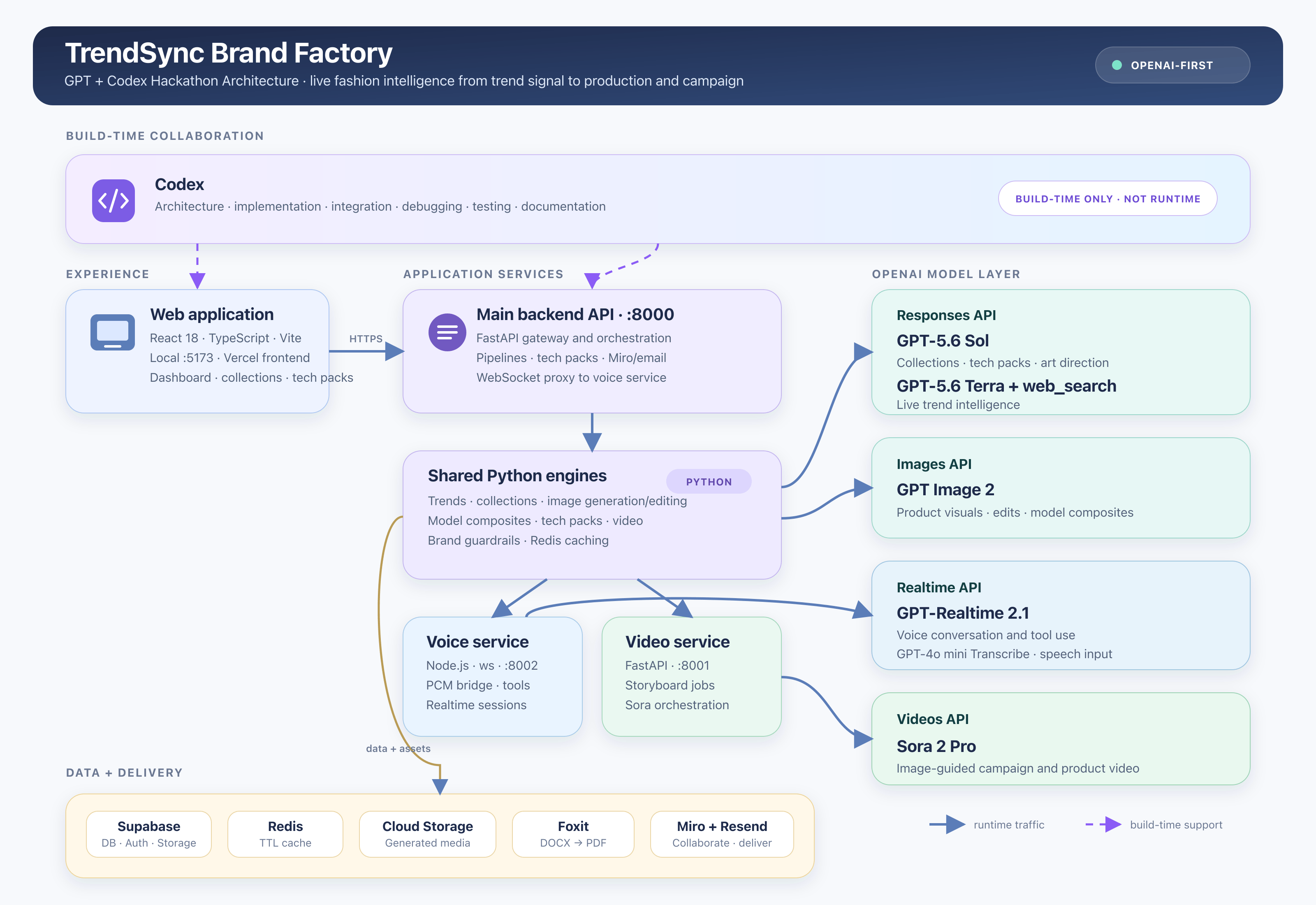
TrendSync Brand Factory is an end-to-end AI fashion design platform where every capability is wired to the OpenAI model that does it best:
- Trend Intelligence Engine - OpenAI Responses API with the hosted web_search tool analyzes real-time fashion trends across 6 global markets (LA, NYC, London, Tokyo, Paris, Seoul) - colors, silhouettes, materials, themes, celebrity influence - from live web data, cached in Redis with 24h TTL.
- AI Collection Generator - GPT-5.6 SOL takes trend insights + brand guidelines through two-phase generation (plan the collection, then expand each product into 200-300 word image prompts) with validation and automated repair.
- GPT Image generation and surgical editing - GPT-5.6 SOL writes art direction; gpt-image-2 renders and edits products. A surgical-vs-global classifier decides whether "change off-white to black" recolors one region or shifts the whole palette - covered by a regression test suite.
- Company Models catalog + composites - 12 AI-generated fashion models (gpt-image-1.5) across diverse demographics; gpt-image-2 multi-image editing dresses a chosen model in your garment while preserving face, pose, and skin tone.
- Lux, an Agents SDK design companion - built on the OpenAI Agents SDK (Python) with 7 typed tools: image analysis, surgical editing, brand-compliance adjustment, trend fetching, validation, variation, save-design.
- Voice Design Companion - a Node.js microservice bridging the browser to OpenAI Realtime over WebSocket with raw binary PCM frames (no JSON+base64 overhead). The voice agent shares all design tools and adds ad-video generation, page navigation, and one-shot collection generation.
- Tech packs + Foxit PDF pipeline - GPT-5.6 TERRA produces manufacturing specs (fabrics, measurements, construction, QC, packaging), persisted to Supabase as the single source of truth; python-docx builds styled DOCX and Foxit PDF Services converts, compresses, and merges them into tech packs and multi-product lookbooks.
- Ad Video Generator (Sora 2) - GPT-5.6 TERRA plans a 5-scene storyboard (hook, hero, detail, lifestyle, CTA), then sora-2-pro renders each image-guided scene into a cinematic ad. The same pipeline makes single-product social clips.
- Brand Guardian - a rule-based compliance engine (pure math, no AI): Euclidean RGB distance against the brand palette, camera/lighting range checks, negative-prompt scanning, with a transparent scoring formula per product.
- Extras - Miro board export for production review, login auditing with real-time email alerts, and a demo account for instant judging.
How I built it
React + TypeScript + Vite frontend; Python backend services plus a Node.js voice microservice; Supabase for auth/data/storage; Redis for trend caching; OpenAI Responses API, Agents SDK, Realtime, gpt-image-2/1.5, and Sora 2 for the AI layer; Foxit PDF Services for the document layer; deployed on Vercel.
Challenges I ran into
- Surgical image edits: distinguishing "recolor only the sole" from "rebrand the whole palette" required a dedicated classifier that understands preservation language, AI-rephrased instructions, and short voice phrasings.
- Long structured outputs: two-phase collection generation with truncated-JSON repair and up to 3 retries to guarantee structurally complete collections.
- Voice latency: switching the Realtime bridge to raw binary PCM WebSocket frames eliminated JSON+base64 overhead; Whisper language pinning stopped transcription drift.
- PDF trust: tech packs are saved to the database BEFORE PDF generation is allowed, so the PDF always matches what the designer approved - never a re-hallucinated variation.
Accomplishments that I'm proud of
- A complete loop: "what is trending right now?" to manufacturer-ready PDF and a cinematic ad video, in one dashboard.
- Model composites that preserve identity - face, pose, skin tone - while swapping garments.
- A voice companion that can drive the whole platform, including generating an ad video by asking for it.
- Professional deliverables: styled tech packs and merged lookbooks that look agency-made.
What I learned
- Route each job to the model that does it best; orchestration beats one-model-does-everything.
- Deterministic guards (Brand Guardian, single-source-of-truth tech packs) are what make AI output trustworthy enough for manufacturing.
- Real-time web search grounding beats stale trend datasets.
What's next for TrendSync Brand Factory
Runway video for full collections, marketplace integrations, collaborative team workspaces, and manufacturer handoff APIs.
Built With
- foxit
- node.js
- openai
- python
- react
- redis
- sora
- supabase
- typescript
- vite

Log in or sign up for Devpost to join the conversation.