-
-
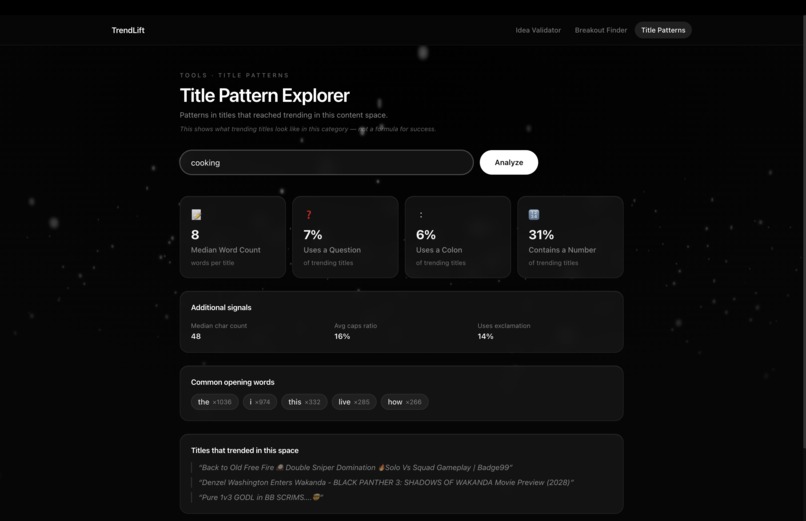
Title Patterns
-
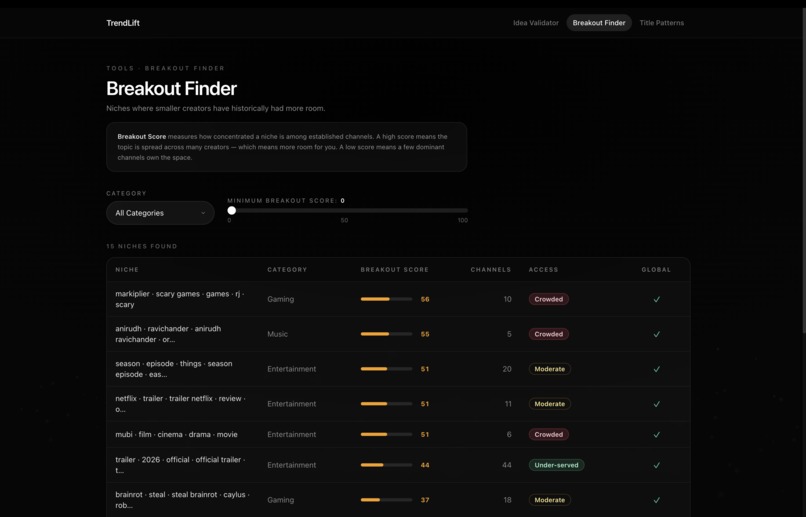
Breakout Finder
-
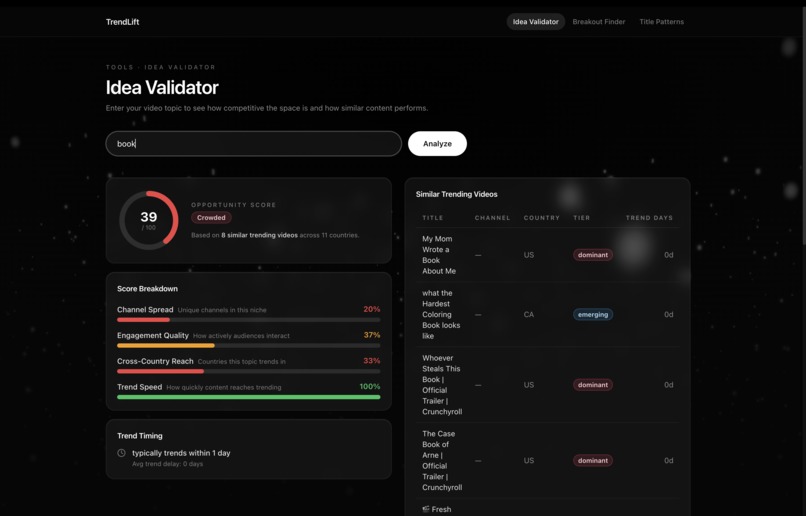
Idea Validator
-
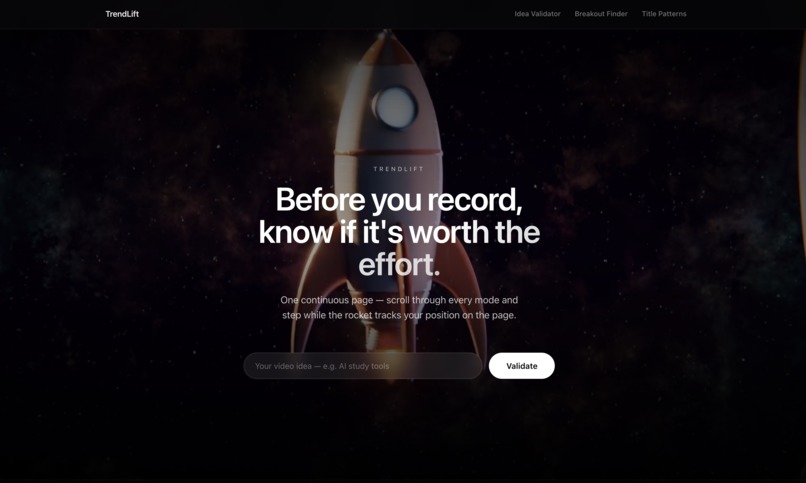
Home Page
TrendLift — Before You Hit Record, Know If It’s Worth Making
Inspiration
TrendLift started with a simple observation: small creators usually do not fail because they lack effort. They fail because they make high-effort videos in the wrong niche, with the wrong packaging, at the wrong time.
Today’s creator economy is incredibly competitive. Large creators have teams, editors, analysts, audience history, and intuition built from years of experience. Small creators usually have none of that. They are forced to guess:
- Is this topic already too crowded?
- Do smaller creators actually have room in this niche?
- Are successful videos in this space local, or do they travel across markets?
- What do titles in this category actually look like when they trend?
We wanted to build a tool that gives smaller creators some of that strategic advantage before they spend hours filming and editing.
That idea became TrendLift.
Our central product belief was:
Virality is not fully predictable, but wasted effort is reducible.
So instead of trying to build a fake “go viral” machine, we built a creator decision-support tool.
What We Learned
The biggest thing we learned is that “what is popular” is not the same as “what is accessible.”
At first, it was tempting to treat YouTube trending data like a leaderboard problem:
- highest views,
- biggest categories,
- most engaged videos.
But that approach is not actually useful for a small creator.
A niche can be highly popular and still be a terrible place for a new creator if it is dominated by a small number of established channels. On the other hand, a niche that looks smaller on the surface can be much more promising if success is distributed across many creators.
That led us to a more useful framing:
The real question is not:
“What content performs well?”
The better question is:
“Where does a smaller creator actually have room to compete?”
We also learned that cross-country data adds a major strategic advantage. Looking at one market alone can make a niche seem narrow or saturated. But when we examined patterns across multiple countries, we could start to see which ideas were:
- globally portable,
- locally concentrated,
- or more open to broader creator participation.
That changed the project from a dashboard into a product.
What TrendLift Does
TrendLift is a creator intelligence web app built for small YouTube creators.
It has three core features:
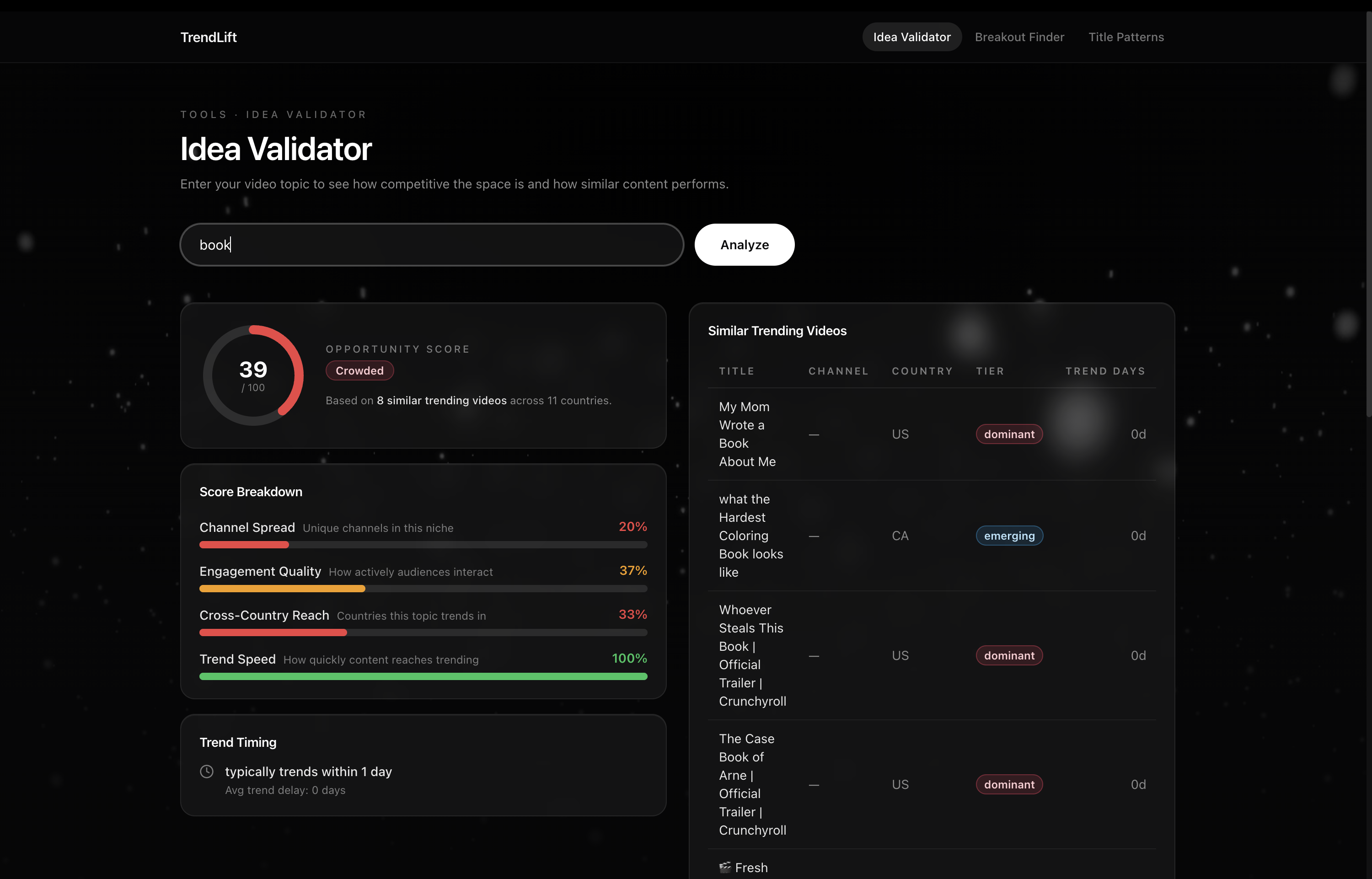
1. Idea Validator
A creator enters a topic or idea and gets a data-backed read on whether the niche looks:
- crowded,
- moderate,
- or under-served.
This helps answer the most important pre-production question:
Should I spend time making this video at all?
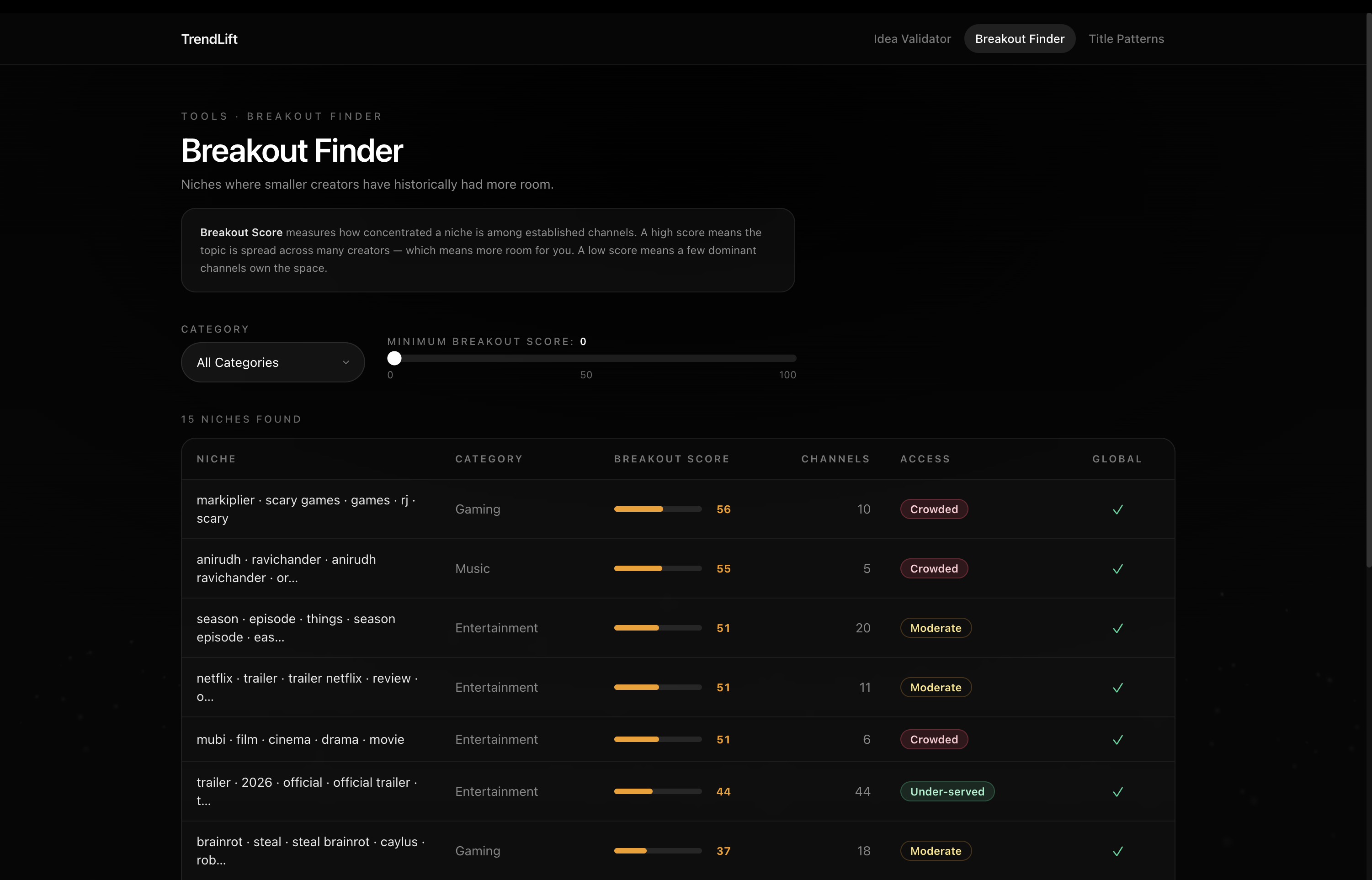
2. Breakout Finder
This is the most distinctive part of the product.
Instead of simply showing what is popular, Breakout Finder highlights niches where:
- channel concentration is lower,
- smaller-footprint creators are present,
- and breakout room appears stronger.
This shifts the product from trend browsing to competitive positioning.
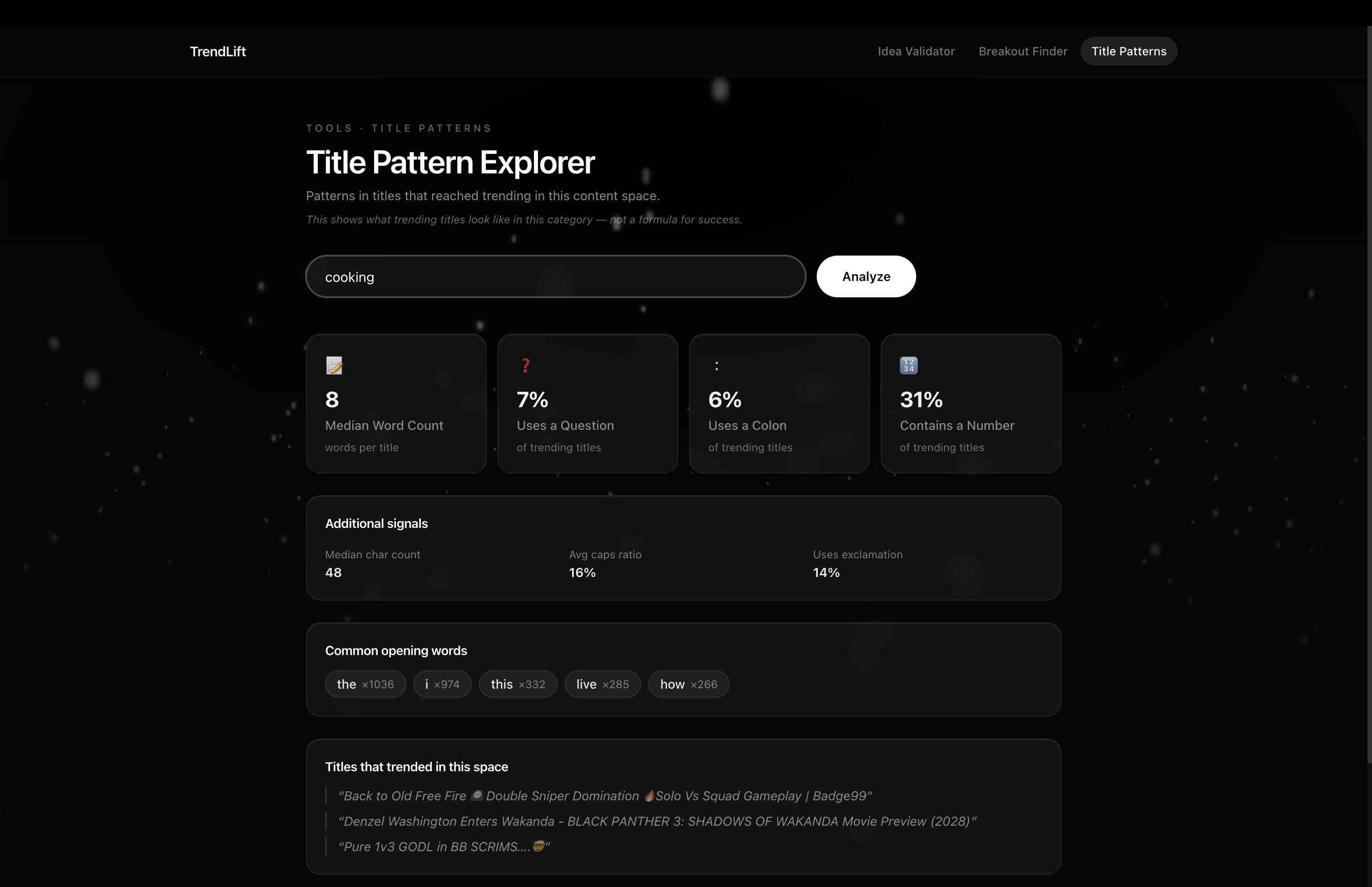
3. Title Patterns
This feature shows what titles tend to look like in successfully trending content in a given space.
It helps creators improve packaging by surfacing patterns like:
- title length,
- common opening words,
- punctuation usage,
- and structural conventions.
We deliberately framed this as pattern awareness, not formulaic title copying.
The Dataset and Why It Matters
Our product is built on a 2026 YouTube trending dataset spanning 11 countries and containing over 100,000 trending video records across country-specific snapshots.
Each row includes metadata such as:
video_idtitlechannel_titleviewslikescommentspublish_timecategory_idtagschannel_iddescription
The raw data was split by country, so one of our first tasks was to unify it into a consistent dataset and add country manually from filename.
This dataset gave us a major advantage over simpler creator tools because it let us analyze:
- cross-country spread,
- niche concentration,
- creator footprint,
- and packaging patterns
instead of only raw popularity.
That distinction is the heart of TrendLift.
How We Built It
We built TrendLift in layers, starting from the data pipeline and ending with the user-facing web app.
1. Data Cleaning and Unification
We merged all country-specific CSV files into one consistent table.
That required:
- standardizing schemas,
- parsing dates,
- cleaning missing values,
- removing duplicates,
- and adding
countryfrom the original filename.
This gave us one usable analysis base.
2. Feature Engineering
We then transformed the raw metadata into creator-relevant signals.
Some of the key features included:
- likes ratio
$$ \text{likes_ratio} = \frac{\text{likes}}{\text{views}} $$
- comments ratio
$$ \text{comments_ratio} = \frac{\text{comments}}{\text{views}} $$
- engagement score
$$ \text{engagement_score} = 0.6 \cdot \text{likes_ratio} + 0.4 \cdot \text{comments_ratio} $$
- trend delay: how long it took a video to appear in trending after publication
- country count: in how many countries a video appeared
- channel footprint: how often a channel appeared across the dataset
- title pattern features: punctuation, word count, capitalization, numbers, etc.
These features helped convert raw video data into something meaningful for creators.
3. Topic Structuring with NLP
To make free-form user queries useful, we built a text pipeline using:
titletags
We used TF-IDF vectorization and clustering to group similar videos into topic spaces.
That gave us:
- a way to compare new user ideas to existing trending content,
- a way to summarize “niches,”
- and a way to power our Idea Validator and Title Pattern Explorer.
4. Breakout Logic
Breakout Finder required a stronger idea than simple popularity.
So we measured how concentrated each niche was among channels. In spirit, the more evenly spread a niche is across creators, the more “accessible” it is likely to be.
Conceptually, this is related to concentration logic like:
$$ \text{Accessibility} \propto 1 - \text{Concentration} $$
The implementation combined:
- unique channel spread,
- low-footprint creator presence,
- engagement quality,
- and cross-country behavior
into a niche-level breakout score.
5. Backend and Frontend
We built:
- a FastAPI backend to serve the scoring and analysis endpoints
- a React + Vite frontend for the interactive product
The final product flow is simple:
- enter a topic,
- analyze opportunity,
- inspect breakout niches,
- understand title patterns.
We focused on making the interface feel clear and lightweight rather than overly technical.
Challenges We Faced
1. The Data Looked Simpler Than It Really Was
At first glance, it seemed like a standard CSV analytics project. In reality, the pipeline was more fragile than expected.
We had to deal with:
- country-split files,
- multilingual content,
- schema inconsistencies,
- derived features,
- and downstream artifact synchronization.
One of the biggest lessons was that artifact consistency matters. A frontend can look finished, but if the processed files, clustering outputs, and saved model artifacts do not align, the whole product breaks.
2. “Working Locally” Does Not Mean “Deployment Ready”
A major challenge was deployment.
We ran into issues involving:
- missing Python dependencies,
- package import paths,
- missing model artifacts on the backend,
- Git LFS pointer files being mistaken for real CSVs,
- and environment variables not matching between local and production builds.
This was especially frustrating because the app had worked locally earlier. But once deployment started, we discovered that some files in the pipeline were stale, mismatched, or not actually present in the cloud environment.
That forced us to debug the project from the data layer upward, not just from the UI downward.
3. The Frontend Was Pointing to Localhost in Production
One of the final blockers was that our Vercel frontend was still calling:
http://localhost:8000
instead of the live Render backend URL.
That problem came from an environment variable naming mismatch. It was a small issue, but one with a huge effect: the product loaded visually, but none of the data appeared.
Fixing that was a reminder that in full-stack work, the smallest wiring issue can make the whole app look broken.
What Makes TrendLift Special
What makes TrendLift different is that it does not just say:
“Here are trending videos.”
It tries to answer:
“Where does a smaller creator actually have a chance?”
That is a much more practical and human question.
Our product is built around reducing wasted effort:
- don’t film the wrong idea,
- don’t enter a niche blindly,
- don’t rely purely on intuition for packaging,
- and don’t assume popular means accessible.
TrendLift gives creators a structured way to evaluate ideas before production.
What We’re Proud Of
We are proud that this became more than a dataset project.
It became:
- a clear product for a specific user,
- grounded in real data,
- with interpretable logic,
- and a usable interface.
We are also proud that the project evolved. It started as a broad exploration of virality, but through the data and the build process, it became a sharper and more honest product:
not “how to go viral,”
but “how to make smarter creative bets.”
That shift made the project better.
Future Work
If we had more time, the next steps would be:
1. Better Creator Profiling
Right now, creator “size” is inferred from dataset footprint. With subscriber or channel-history data, this could become more accurate.
2. Stronger Semantic Matching
We used a practical text pipeline for the hackathon. Future versions could use multilingual embeddings for better topic understanding across countries.
3. Time-Series Trend Modeling
The current data supports cross-sectional insight well, but we would love to incorporate more repeated trending cycles over time for true persistence and momentum modeling.
4. Personal Creator Workspace
A future version could let creators:
- save ideas,
- compare multiple concepts,
- and track which kinds of niches best match their goals.
Final Reflection
TrendLift was inspired by the gap between effort and strategy in the creator economy.
A lot of talented people are putting in real work, but they are doing it in spaces where they never had a strong chance to begin with.
We wanted to build a tool that helps fix that.
Not by pretending we can predict the internet perfectly, but by giving creators a more informed starting point.
And that is the core of TrendLift:
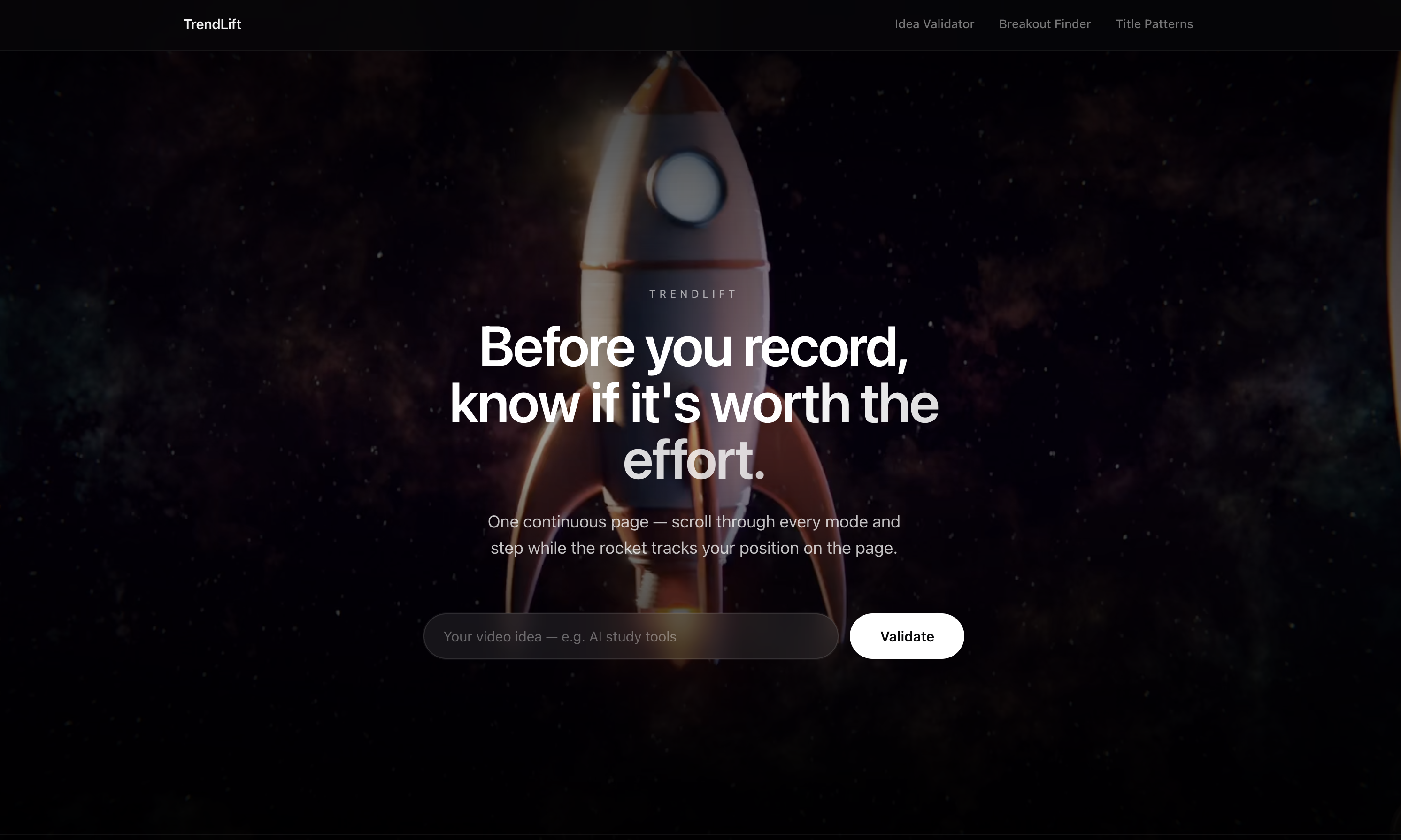
Before you hit record, know if it’s worth making.
Built With
Frontend: React, Vite, JavaScript, Tailwind CSS, Axios, React Router
Backend: FastAPI, Uvicorn, Python
Data & ML: Pandas, NumPy, scikit-learn, SciPy, joblib
Deployment: Render, Vercel, GitHub, Git LFS
Built With
- axios
- custom-scripts
- fastapi
- git-lfs
- github
- javascript
- joblib
- numpy
- pandas
- python
- react
- react-router
- render
- scikit-learn
- scipy
- tailwind-css
- uvicorn
- vercel
- vite

Log in or sign up for Devpost to join the conversation.