Inspiration
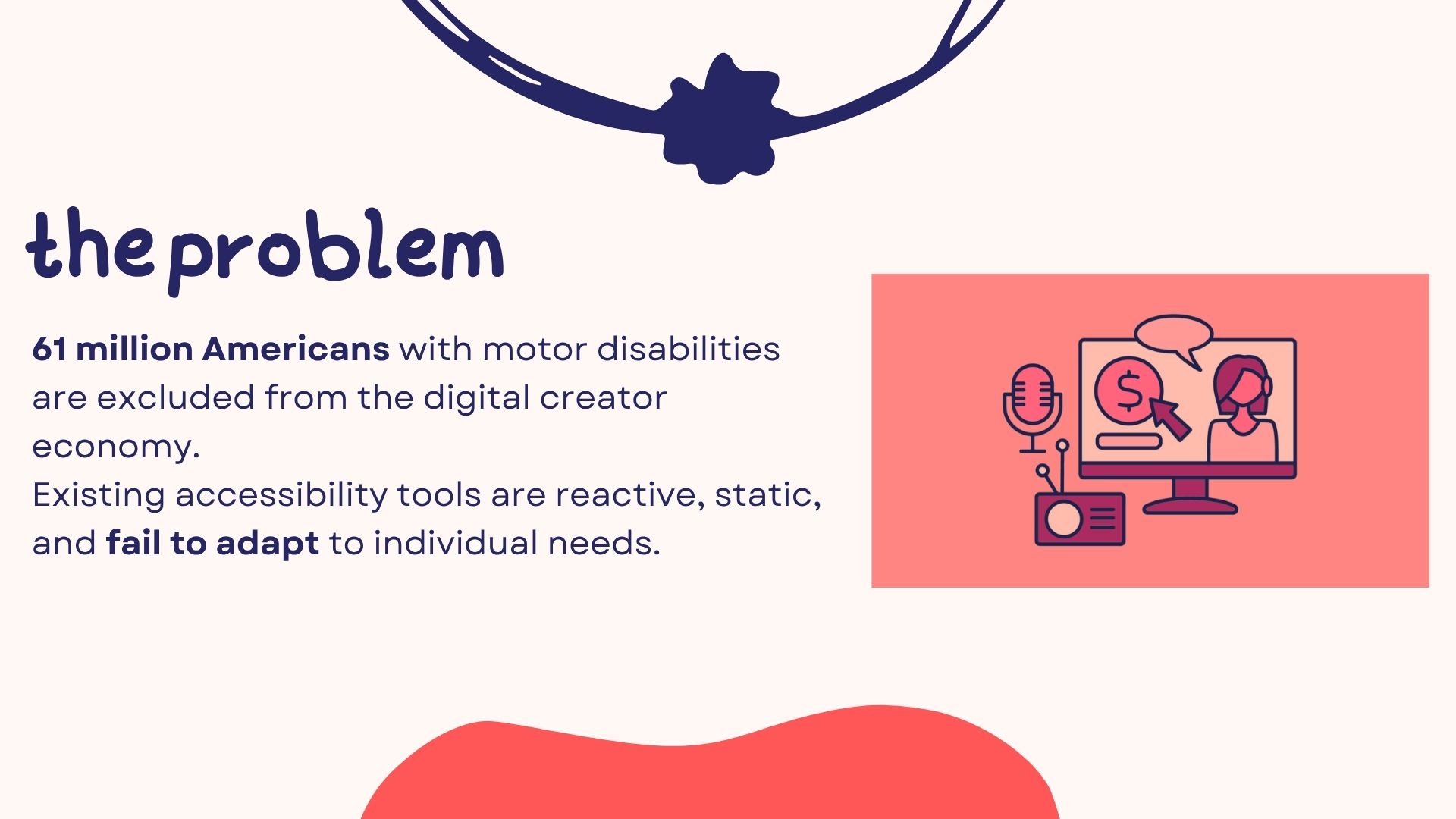
Millions of people living with movement disorders like Parkinson’s disease struggle with tremors that impact daily activities and independence. We wanted to build a solution that doesn’t just track tremors, but helps people and caregivers understand them in real time and act on that information. TremorSense was inspired by the need for accessible, non-invasive, and intelligent monitoring tools that improve quality of life.
What it does
TremorSense is an AI-powered browser extension that detects and analyzes tremors using real-time sensor data. It identifies abnormal motion patterns, tracks tremor intensity over time, and provides AI analytic insights and a chatbot !!!!! that can help users, caregivers, or clinicians make informed decisions. The system also responds to erratic hand motion by enlarging buttons and highlighting interactable elements. Lastly, the browser extension features a creator hub with tools for senior citizens to learn how to engage in the digital economy.
How we built it
Our program was built using JavaScript, HTML, CSS, and Python on VS Code and Cursor. We utilized Hermes AI for our intelligent movement assistance to recognize involuntary misclicks, ClaudeAI to streamline the coding process, and Hex API for the Tremor Analytics and data visualization.
Challenges we ran into
As a team of mostly rookies, there were a number of challenges that we faced, the most significant being distinguishing between intentional mouse movements and involuntary tremors. Further, we struggled with buttons enlarging at the wrong time. We ended up resolving this issue by adding specific checks to prevent sidebar elements from scaling at the wrong time and implementing a shrink-back quality on successful clicks to make sure that interactables returned to their normal size.
Accomplishments that we're proud of
We're proud of the fact that we made an extremely accessible tool that will be able to help senior citizens independently and efficiently interact with technology in both the physical and mental sense. Where senior citizens once struggled to be able to control their mouse and understand how to get involved in the digital creator economy, we have created a tool that has solved both. Additionally, we were particularly proud of our successful production of an easily navigable UI and integration of various AI models, especially Hermes AI for the sake of detecting involuntary motions, magnetically drawing the mouse to interactable elements, and enlarging buttons after enough misclicks had been detected.
What we learned
This hackathon showed us what it takes to design technology with real impact. One of our biggest takeaways was the importance of user-centered design when it came to front-end. Technically, we gained hands-on experience integrating multiple AI tools into a cohesive system. As a team of mostly beginners, we also learned the value of collaboration under pressure and communication when splitting up feature development.
What's next for TremorSense
Next, we plan to integrate voice-based search functionalities in the browser in order to allow seniors with more aggressive mobility disorders an easier method of navigating the internet. We're also looking into integrating a full back-end in order to store large amounts of user misclick data in order to improve the performance of our integrated AI models.
Built With
- claude
- css
- cursor
- hermes
- hex
- html
- javascript
- python
- visual-studio

Log in or sign up for Devpost to join the conversation.