Inspiration
Have you ever found several new or pre-owned products online but could not tell which one was actually worth buying? The information is usually scattered across listing screenshots, seller messages, product pages, brochures, voice notes, and marketplace research. Price matters, but so do condition, fit, style, missing proof, and whether the seller's claims can be trusted.
I built TriWear to turn that fragmented research into one clear, evidence-backed purchase decision.
What it does
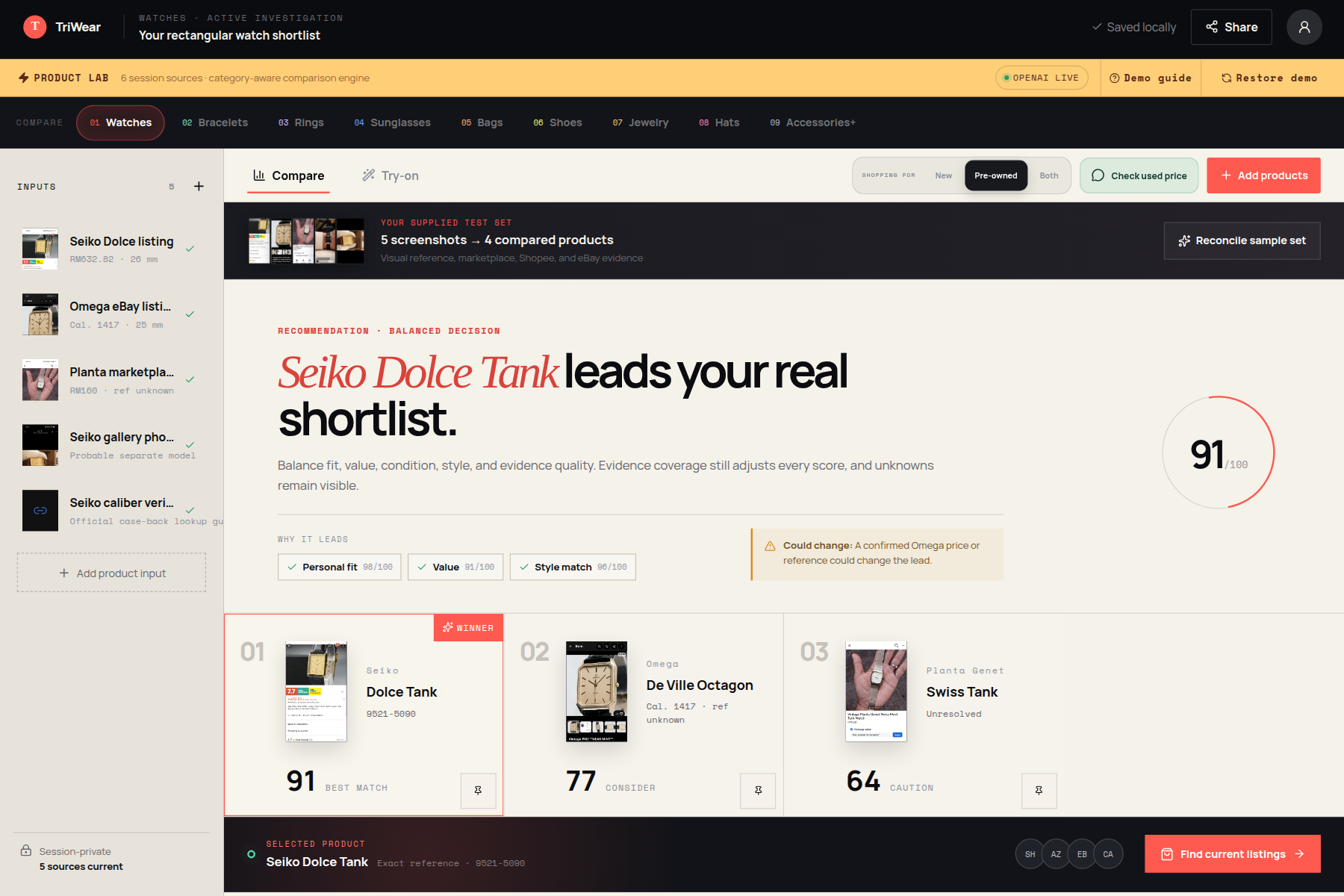
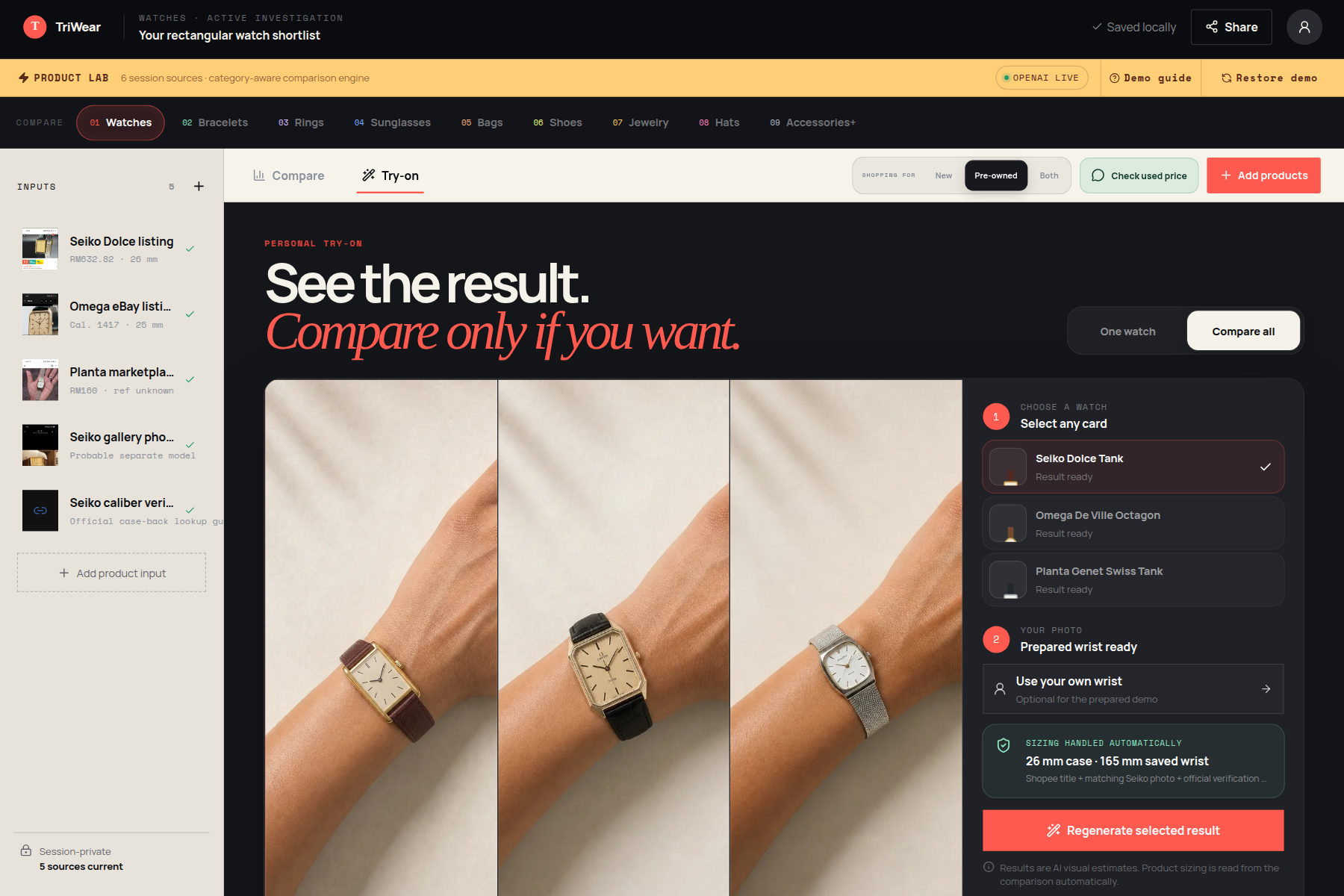
TriWear is an AI purchase-intelligence workspace for watches, sunglasses, bags, bracelets, rings, shoes, jewelry, hats, and selected wearable accessories.
Users can upload product photos, listing screenshots, PDFs, URLs, notes, and audio. TriWear then:
- Extracts category-specific facts from every source
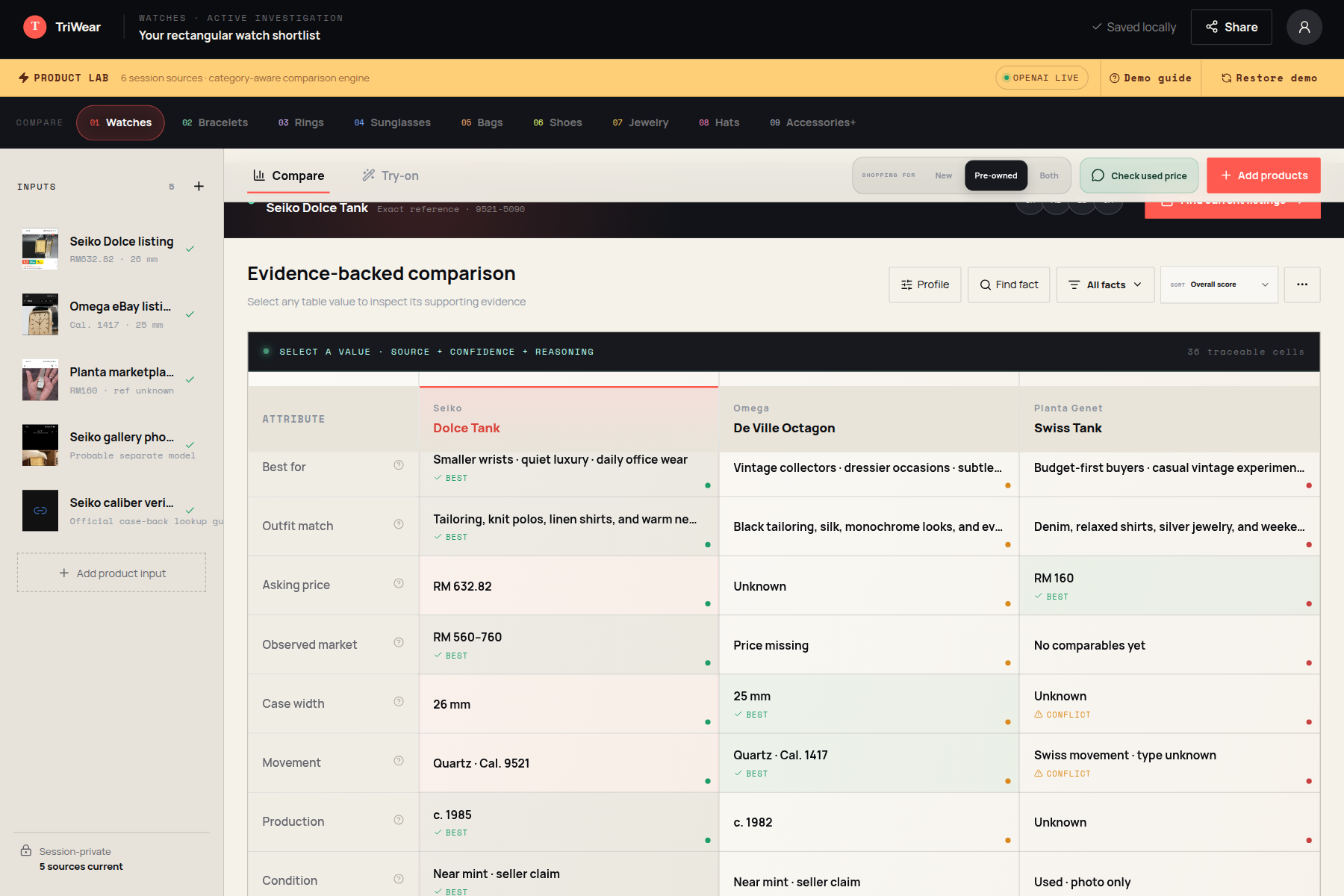
- Compares products in a traceable result matrix
- Preserves contradictions, missing information, and confidence levels
- Re-ranks products around what matters most to the shopper
- Explains why one candidate leads
- Requests only the relevant body photo for a personalized try-on
- Uses supported product dimensions automatically
- Connects the selected product to marketplace searches
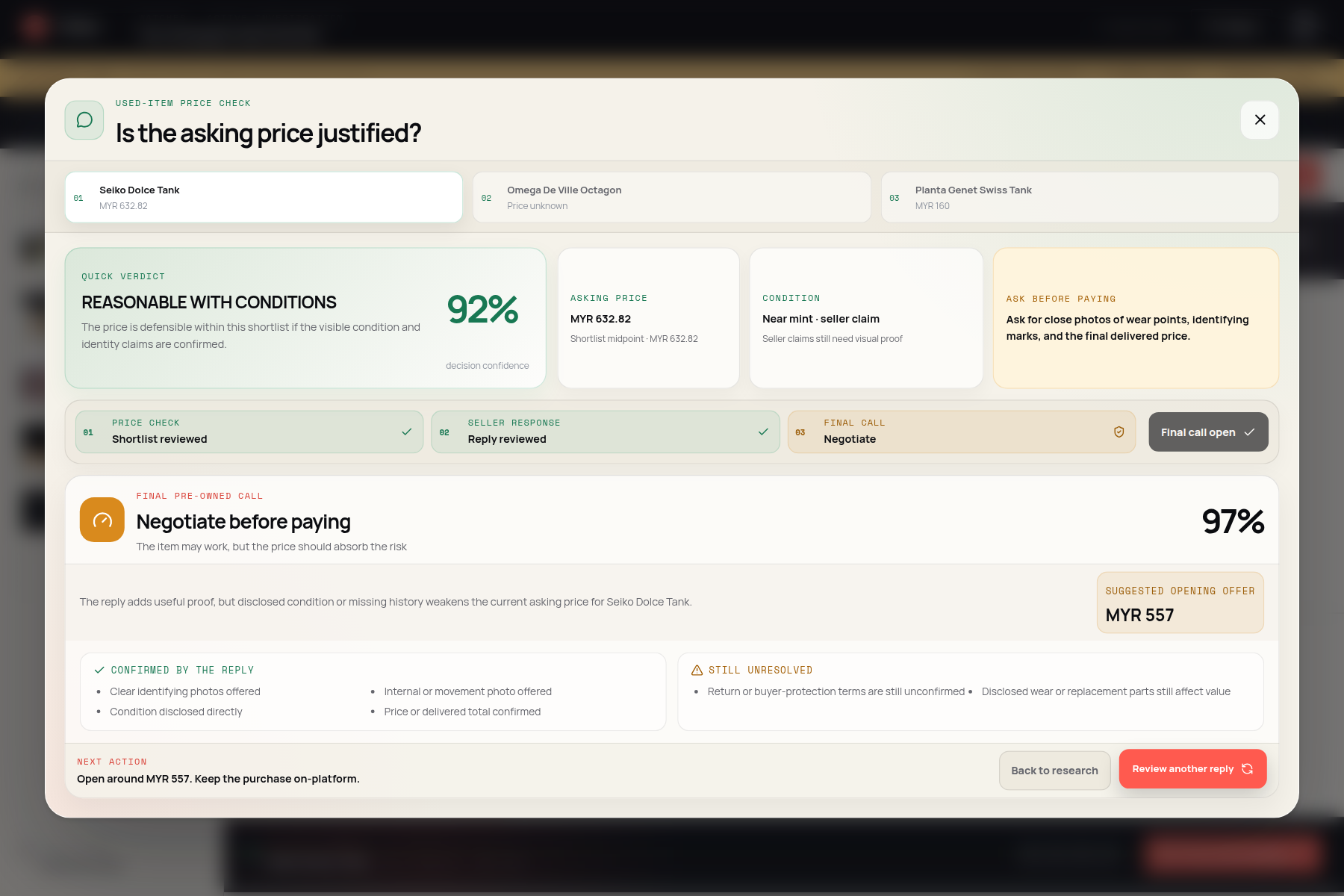
For pre-owned products, TriWear unlocks an additional purchase-safety workflow. It investigates whether the asking price is justified, suggests questions for the seller, reviews the seller's response, identifies what is confirmed or unresolved, and recommends whether to buy, negotiate, or walk away.
How I built it
TriWear is built with Next.js, React, and TypeScript and deployed on Vercel.
GPT-5.6 provides the structured reasoning layer. It converts mixed multimodal evidence into category-aware product facts, confidence-adjusted comparisons, missing-proof requests, price research, and explainable recommendations. GPT-4o Transcribe processes seller voice notes, while GPT Image supports personalized product try-ons.
Codex was my primary engineering collaborator throughout the project. With Codex, I translated the initial technical and visual specifications into the application architecture, implemented the OpenAI routes, created all nine category adapters, developed the evidence and pre-owned purchase flows, built the interactive frontend, generated synthetic demo assets, and created the automated testing and submission-video workflows.
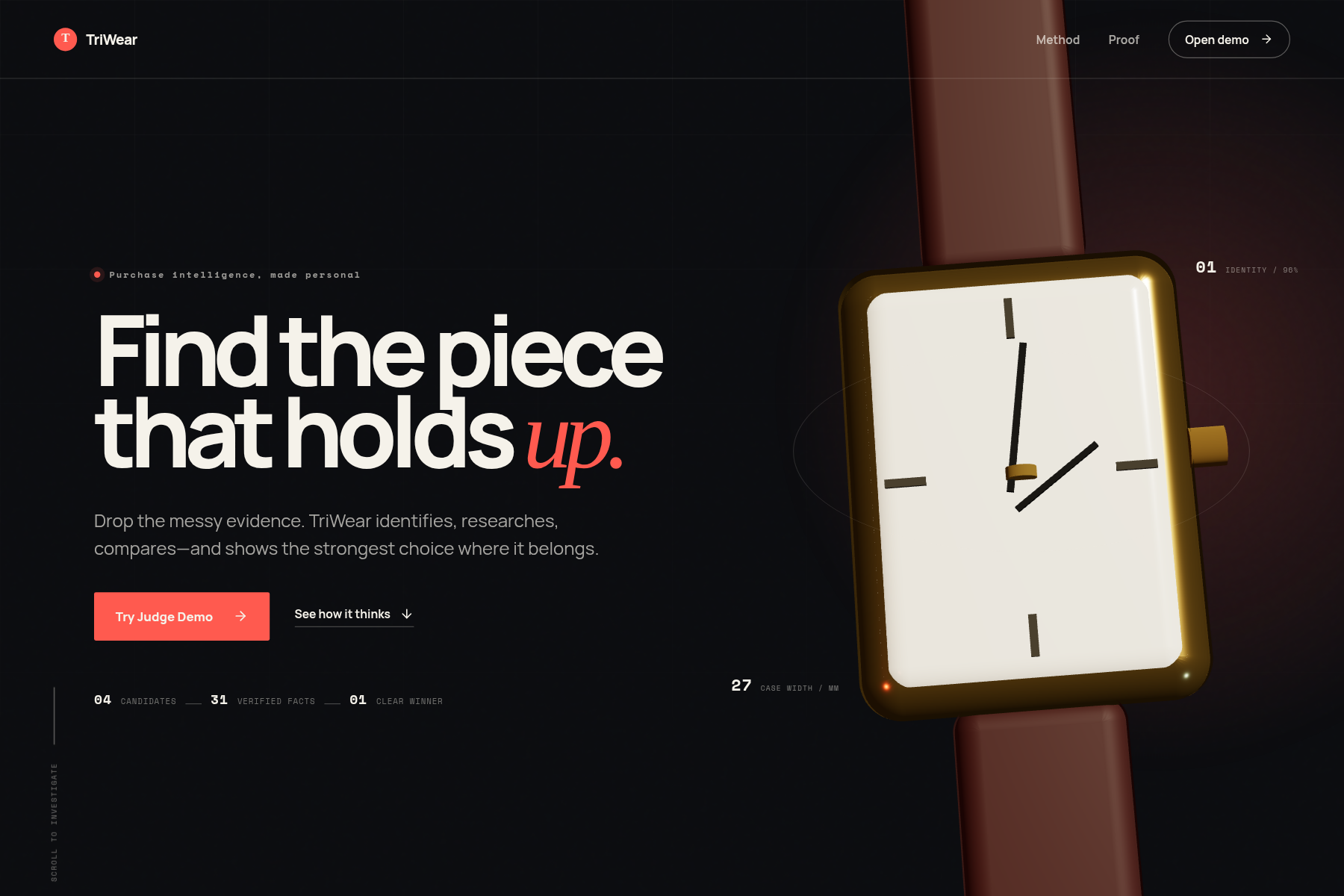
Three.js, React Three Fiber, and Framer Motion power the interactive landing experience and product animations. Remotion was used to assemble the final demonstration video. Zod validates model responses, while IndexedDB and browser-local state keep private body and outfit uploads on the user's device.
The deployed OpenAI credentials remain securely inside Vercel server routes. Judges never receive or enter the OpenAI API key.
Challenges
The biggest challenge was preventing a polished AI recommendation from hiding weak evidence. TriWear separates seller claims, researched facts, visual estimates, conflicts, corrections, verified information, and unknowns instead of collapsing everything into an unexplained score.
Another challenge was supporting nine different product categories without overwhelming the user. Each category needs different specifications, fit criteria, body-photo instructions, price logic, and try-on behavior. I created a shared comparison workflow with category-specific adapters so the interface remains familiar while the intelligence changes underneath it.
I also had to balance live AI capabilities with demo reliability. TriWear uses the same validated result contract for live and cached results, allowing the essential judging flow to remain available if a provider request is temporarily unavailable.
What I learned
I learned that uncertainty can be a useful product feature. Showing what could change a recommendation—and what the shopper should ask next—is often more helpful than pretending the first ranking is final.
I also learned that virtual try-on is most useful when it is connected to supported dimensions, personal styling context, and a broader purchase decision rather than presented as an isolated image-generation feature.
Accomplishments
- One comparison workflow supports nine wearable-product categories
- Every important result can expose its source and confidence
- New and pre-owned modes reveal only the relevant tools
- Seller responses lead to a concrete Buy, Negotiate, or Walk Away decision
- Judges can test live AI without an account or personal API key
- Private body and outfit uploads are excluded from shared comparison links
- The application has automated unit, contract, desktop, mobile, and production-build verification
What's next
Next steps include encrypted user accounts, regional price history, retailer and marketplace feeds, collaborative shortlists, background research jobs, price-drop alerts, and broader evaluation of try-on and fit accuracy.
Built With
- codex
- framer-motion
- gpt-5.6
- next.js
- openai
- react
- remotion
- three.js
- typescript
- vercel

Log in or sign up for Devpost to join the conversation.