-
-

From one photo to done. An autonomous AI agent that detects, appraises, lists, and negotiates — you just approve.
-
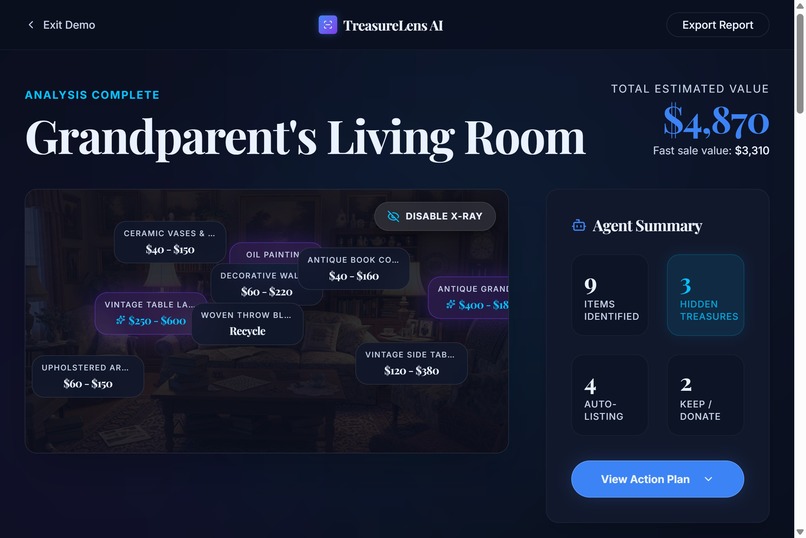
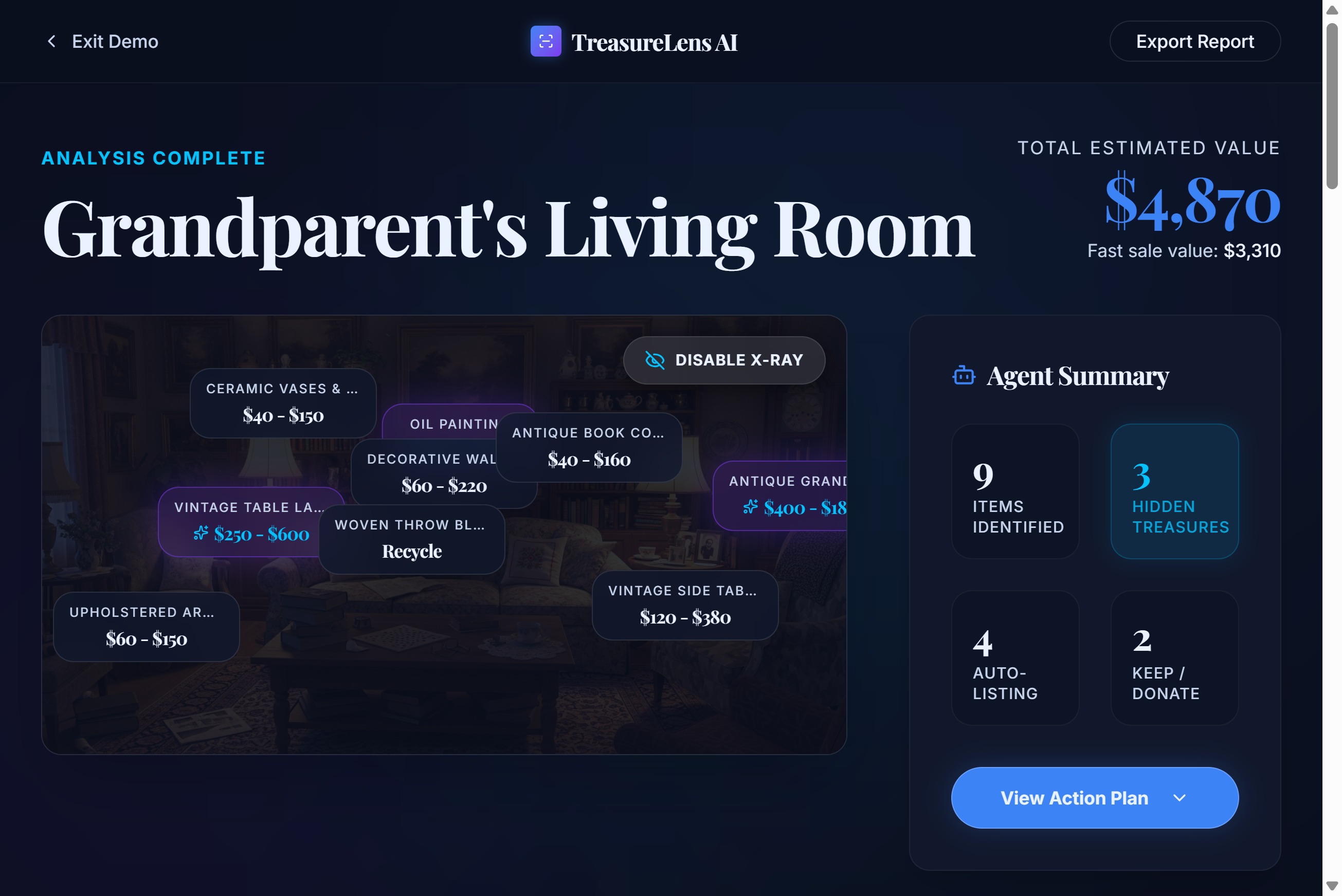
Value X-Ray: $4,870 across 9 items in one room, with hidden treasures (lamp, oil painting, grandfather clock) flagged to appraise first.
-

AI drafts the listing, picks the best marketplace, and cross-posts on your approval. Nothing goes live without your OK.
-
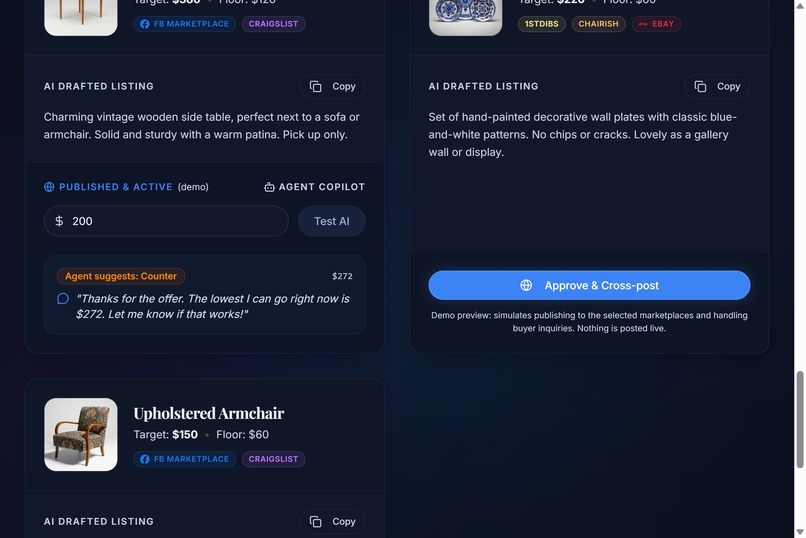
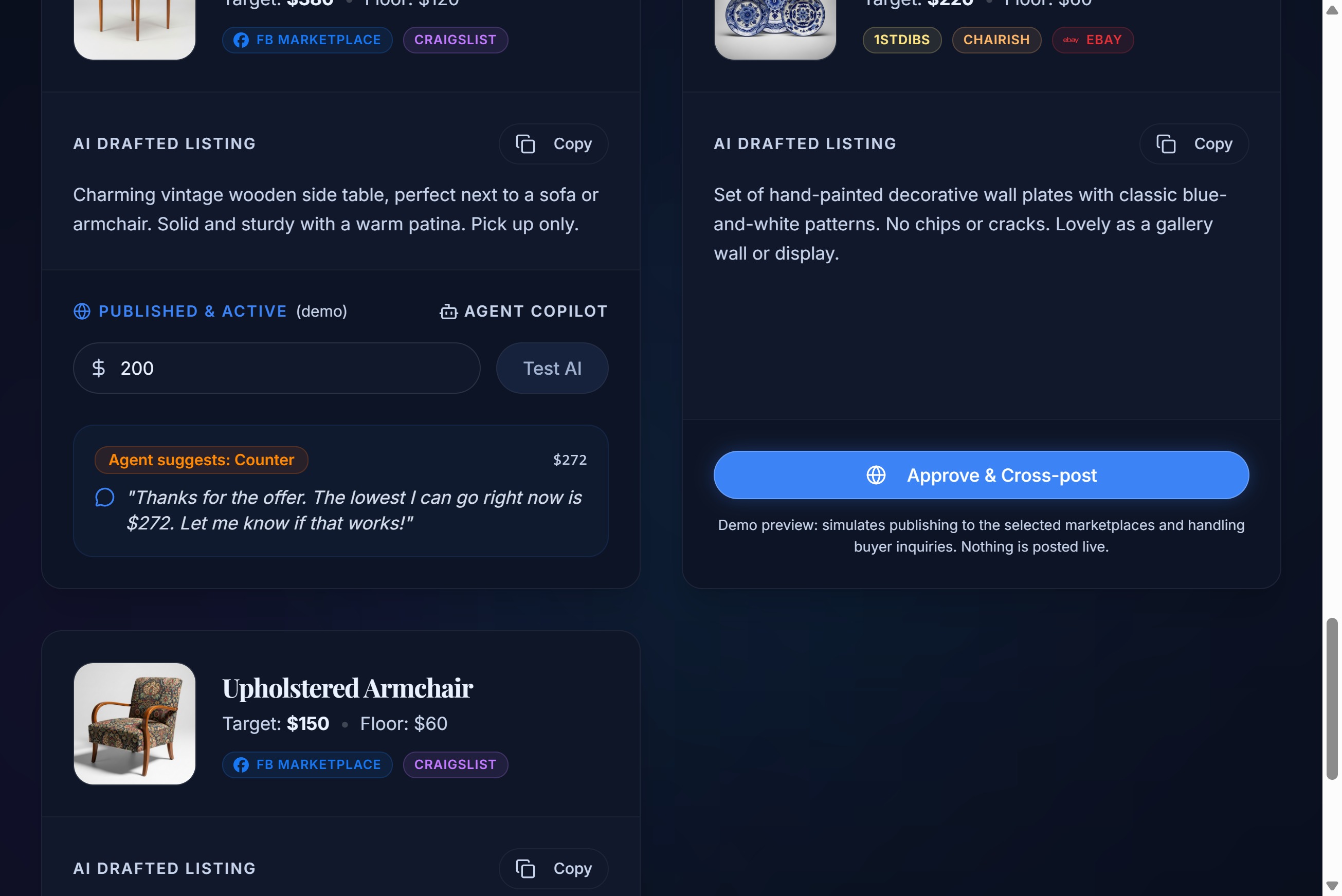
Negotiation copilot: a $200 lowball gets a smart $272 counter against your floor — accept, counter, or decline math, not vibes.


🏠 Inspiration
Helping clear out a grandparent's house, we kept hitting the same wall: "Is this worth anything?" We almost donated a lamp worth hundreds. The hard part of downsizing isn't selling — it's knowing what's valuable before it's gone. We wanted to put an AI estate-sale expert in everyone's pocket.
💡 What it does
From a single room photo, TreasureLens AI:
- Detects every item and estimates total room value ($4,870 across 9 items in our sample)
- Value X-Ray — darkens the room and overlays live price tags on every object
- Hidden Treasure detection — flags heirlooms to appraise before selling, so nothing is under-sold
- Liquidation Plan — routes each item to Sell / Bundle / Appraise / Donate / Recycle / Keep
- Auto-drafted listings with title, price, floor, and best-fit marketplace
- Negotiation copilot — accept / counter / decline against your floor price
- Human approval gate on every listing and offer
For downsizers, estate executors, and anyone clearing a garage or attic. The question it answers isn't "how do I list this?" — it's "what is this whole room worth, and what should I do with it?"
🛠️ How we built it
We modeled the agent as a five-stage pipeline, each stage a swappable module behind one shared interface:
| Stage | Output | In this demo |
|---|---|---|
| 1. Vision | items, brand, condition, confidence | sample data |
| 2. Valuation | price range + confidence | sample data |
| 3. Recommendation | Sell / Bundle / Appraise / Donate / Recycle / Keep | sample data |
| 4. Listing | marketplace copy + pricing | runs live in-browser |
| 5. Negotiation | accept / counter / decline | runs live in-browser |
Stages 4–5 run for real via a ResaleAgent interface (draftListing() + negotiate()) in src/lib/agent.ts, with a fully offline implementation. Stages 1–3 use prepared outputs so the demo is fast and reliable — a live vision model (GPT-4o, Gemini) and real sold-price data drop in with no UI changes.
Valuations use an explainable model, not a black box:
value = base_range × brand × condition × demand × completeness
Each item ships with a value range and confidence score. Low-confidence items are gated to "Appraise First" instead of guessed at.
Stack: React + Vite + TypeScript + Tailwind + Framer Motion on our "Electric Slate" design system, built with Claude Code as our AI pair-programmer.
Built responsibly: approval-first, privacy-aware image handling, and honest ranges with confidence so heirlooms aren't under-sold.
🧗 Challenges we ran into
- Making a scripted demo feel live — animation timing, the climbing value counter, and the X-Ray reveal all had to land in seconds
- Designing five swappable stages so a real model slots in without a rewrite
- Keeping valuations honest with ranges + confidence instead of fake-precise numbers
🏆 Accomplishments that we're proud of
- End-to-end flow that reads as a real agent: photo → detection → valuation → plan → listings → negotiation
- Working Value X-Ray and real negotiation math (accept / counter / decline)
- Judge-ready interface with a consistent design system
📚 What we learned
- Decision-making was the hard part, not listing creation. The product is stronger as a resale advisor than a listing generator.
- The human-in-the-loop approval gate is a feature, not a limitation.
- Designing swappable stages early makes "sample data now, real model later" a real path, not a promise.
🚀 What's next for TreasureLens AI
- Live vision model + real sold-price data (eBay sold listings) behind the existing five stages
- Real marketplace cross-posting (Facebook, eBay, OfferUp, Poshmark)
- Buyer-message integration with approved negotiation rules and pickup coordination
© 2026 Enrica Garrino. TreasureLens AI — original concept, design, and source code. All rights reserved.
Built With
- claude-code
- react
- typescript
- vite


Log in or sign up for Devpost to join the conversation.