-
-
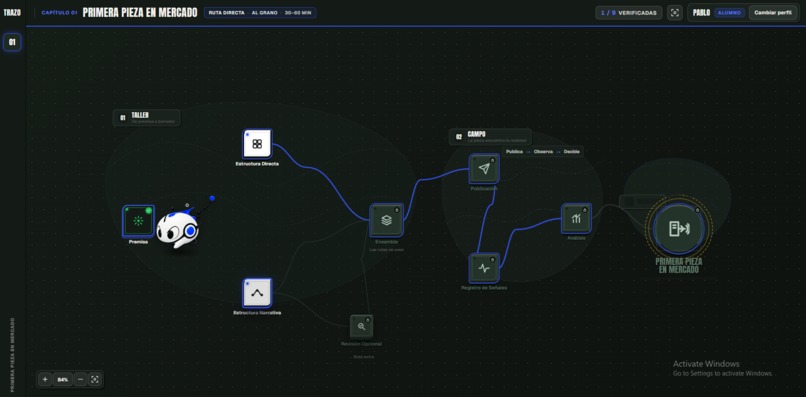
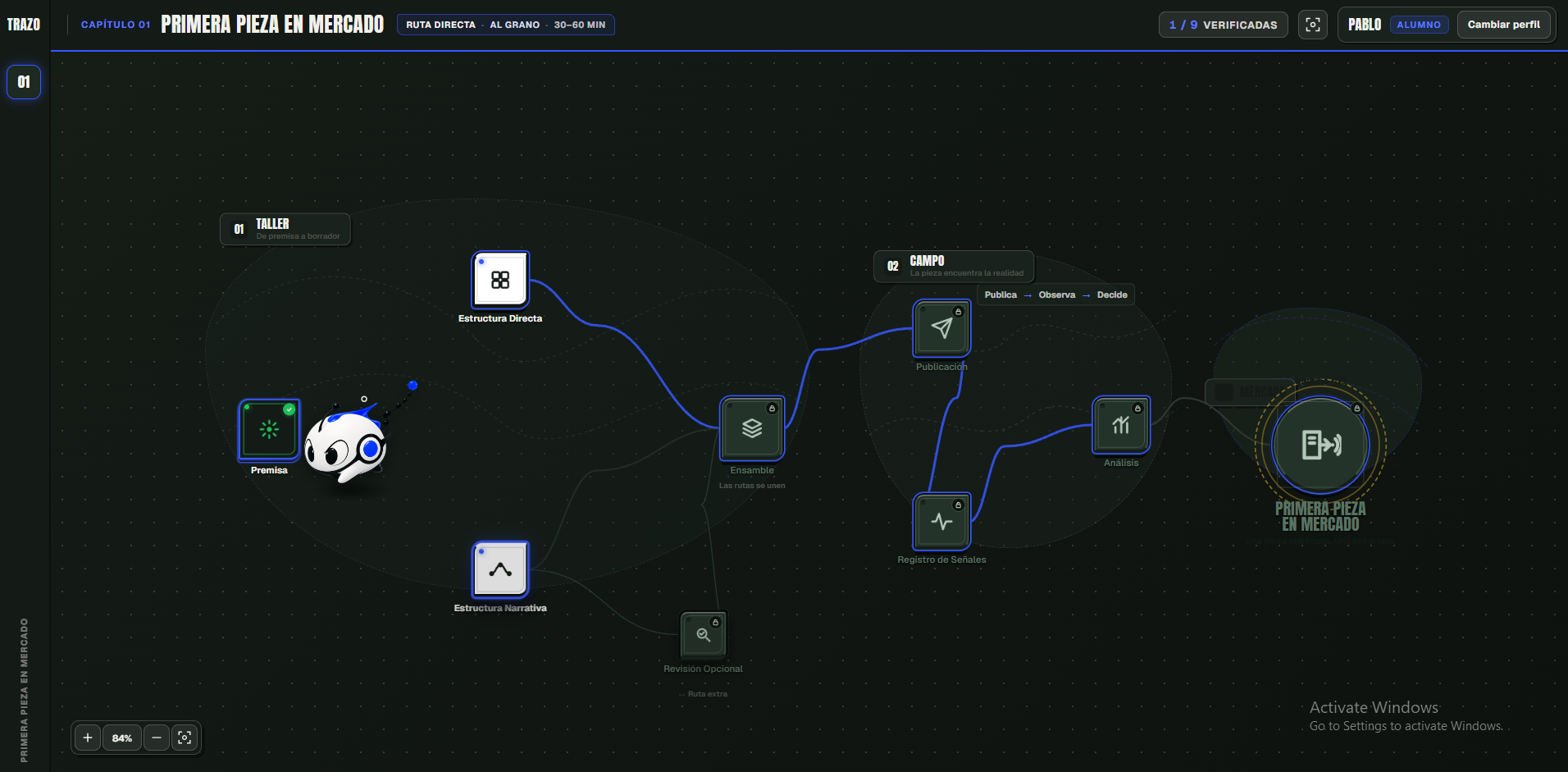
Interactive 2.5D Quest Map: Directed Acyclic Graph (DAG) with dynamic branching corridors and real-time companion navigation.
Inspiration
As a student, I’ve enrolled in countless online courses, and I always hit the exact same wall.
Sitting in front of a screen watching dozens of hours of passive video lectures felt monotonous and exhausting. You watch someone explain a concept for 40 minutes, nod along, but when it’s time to actually build something in the real world, you realize you haven't developed real mastery. You get stuck, self-doubt creeps in, and like most people, you end up abandoning the course.
Frustrated by this recurring cycle, I started researching why online education felt so fundamentally broken. That’s when I came across a landmark study by researchers from Harvard and MIT published in Science: over 96% of students abandon online courses.
That statistic proved that the problem wasn't a lack of student discipline or willpower—it was the format itself. Passive video consumption doesn't teach execution. As learners, we don't need more hours of video; we need to take action, get our hands dirty, make mistakes, and receive rigorous, instant feedback.
I asked myself: What if instead of a boring video playlist, learning was structured as an interactive quest map? What if every student was paired with an autonomous AI companion that doesn't just flatter them, but strictly evaluates their real-world deliverables and proactively rescues them the moment they hit friction?
That personal conviction inspired me to build TRAZO.
What it does
TRAZO is an autonomous agentic learning engine that transforms static educational curriculum into an interactive 2.5D dynamic quest map.
First, learning is mapped as a Directed Acyclic Graph where every node represents an executable, real-world deliverable rather than a video lecture.
Second, our companion Trazz, powered by Google Gemini 3.7 Flash on Vertex AI, evaluates student submissions against rigorous creator rubrics and issues deterministic JSON verdicts.
Third, when a student achieves a PASS on a foundational mission, such as defining a target business premise, the backend materializes an immutable deliverable. This artifact is automatically injected into downstream evaluation prompts as a hard constraint.
Fourth, Trazz follows a strictly non-sycophantic feedback policy. If a deliverable is inconsistent or incomplete, the system issues a REWORK verdict, rejects progression, and delivers clear feedback detailing the exact failed criteria.
Fifth, if a learner struggles with two consecutive REWORK verdicts on the same mission, TRAZO background autonomy engine intervenes without the student asking for help, generating tailored adaptive guidance to unblock them.
Finally, course creators can access a dedicated calibration cockpit to test Gemini against synthetic and real-world edge cases with cryptographic SHA-256 rubric versioning.
How we built it
TRAZO was engineered from the ground up on the Google Cloud AI Stack. Google Vertex AI with Gemini 3.7 Flash handles semantic evaluation and proactive coaching. We configured thinking budgets for structured extraction, achieving blazingly fast sub-2.5-second evaluation latency.
The official Google GenAI SDK is utilized across the backend for strict structured JSON schema outputs and multi-turn bounded context management.
A deterministic state machine maintains architectural integrity: Gemini interprets nuance and qualitative evidence, but our deterministic Node.js backend authoritatively owns state transitions. A non-PASS result can never advance the progression graph.
Google Cloud Firestore serves as the authoritative source of truth for learner profiles, mission state transitions, and progression artifacts.
Google Cloud Run hosts the containerized production backend in us-central1 with automated scaling and zero cold-start latency.
The frontend is built with React 19, TypeScript, and a custom design system featuring fluid SVG corridor animations.
Challenges we ran into
First, we had to enforce deterministic state authority over probabilistic model outputs. Large language models can occasionally hallucinate progress or be overly lenient. We designed a fail-closed schema validator that discards malformed model outputs and requires explicit criterion satisfaction before advancing state.
Second, early evaluation calls with variable reasoning took over 10 seconds. By optimizing our prompt architecture and configuring Gemini 3.7 Flash thinking budgets, we brought total round-trip evaluation time down to approximately 2 seconds.
Third, automatic browser translation tools like Google Translate mutate raw DOM text nodes and initially caused reconciliation crashes in React during multi-step setups. We engineered custom DOM reconciler interceptors in the frontend to make the entire interface completely resilient to real-time browser translations.
Accomplishments that we're proud of
We are proud to have passed 222 automated unit and integration tests validating our domain policies, state machine invariants, and Gemini rubric evaluators.
We achieved true proactive agency, where Trazz intervenes autonomously upon detecting friction after two consecutive reworks without needing manual user prompts.
We successfully deployed a production-ready, highly responsive service running entirely on Google Cloud Run connected to Vertex AI and Firestore.
What we learned
We learned how to combine the Google GenAI SDK with structured schema constraints to turn probabilistic model responses into reliable, deterministic evaluation engines.
We discovered how to design educational interfaces that motivate learners through active deliverable verification rather than passive video consumption.
We also reinforced the critical importance of isolating state authority in the backend so AI companions can explore nuances without risking progression data integrity.
What's next for TRAZO
Next, we plan to implement Gemini Live Multimodal Voice Coaching to add bidirectional real-time audio interaction with Trazz for live pitch practice, verbal roleplays, and interactive voice assistance.
We also aim to build a global creator marketplace allowing educators and companies worldwide to convert their methodologies into autonomous quest maps with few-shot calibration.
Built With
- cloud-build
- cloud-firestore
- cloud-run
- docker
- gemini-3.7-flash
- google-cloud
- google-genai-sdk
- node.js
- playwright
- react
- typescript
- vertex-ai


Log in or sign up for Devpost to join the conversation.