Inspiration
At the end of lunch, extra portions are easy to count. The harder decision comes before service, when a kitchen lead has to choose how much to cook. A busy day can make extra portions feel essential, even if that same batch leaves food behind on most other days. TrayShift gives campus dining teams a way to make that decision with their service records.
What it does
Enter the demand for the same dish across comparable services, your usual batch size, and an average portion weight. TrayShift suggests a batch size, replays both plans against recent services, and shows extra portions, unfilled requests, and the difference in overproduction by weight. The per-service CSV gives the team a record to discuss before changing the prep plan.
Demo walkthrough
- Open the live demo at
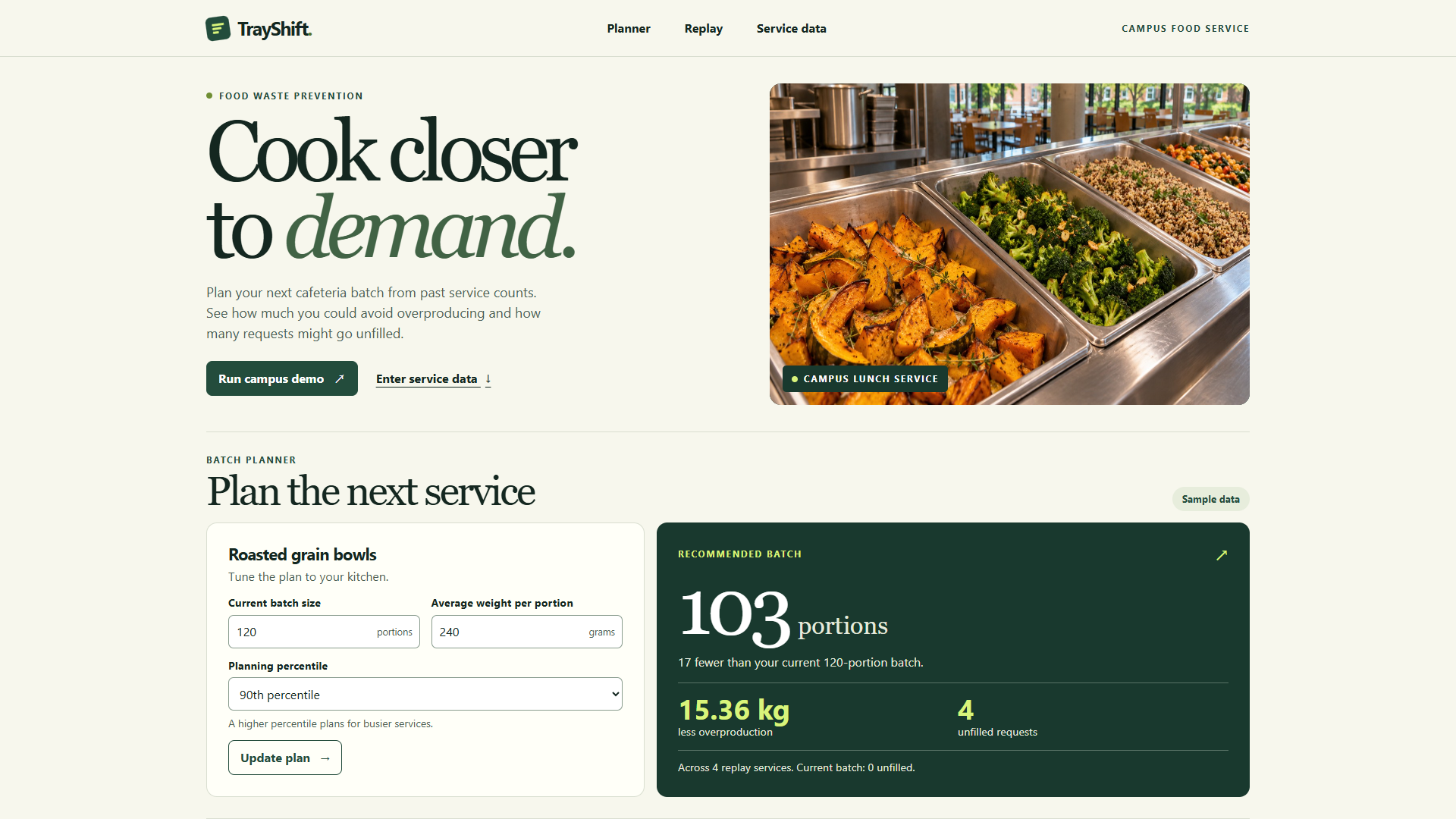
https://trayshift.pages.dev/and select Run campus demo. - Read the recommendation of 103 portions against the usual 120. Across four fictional services, extra portions fall from 83 to 19, a difference of 64 portions or 15.36 kg, with four projected unfilled requests versus zero.
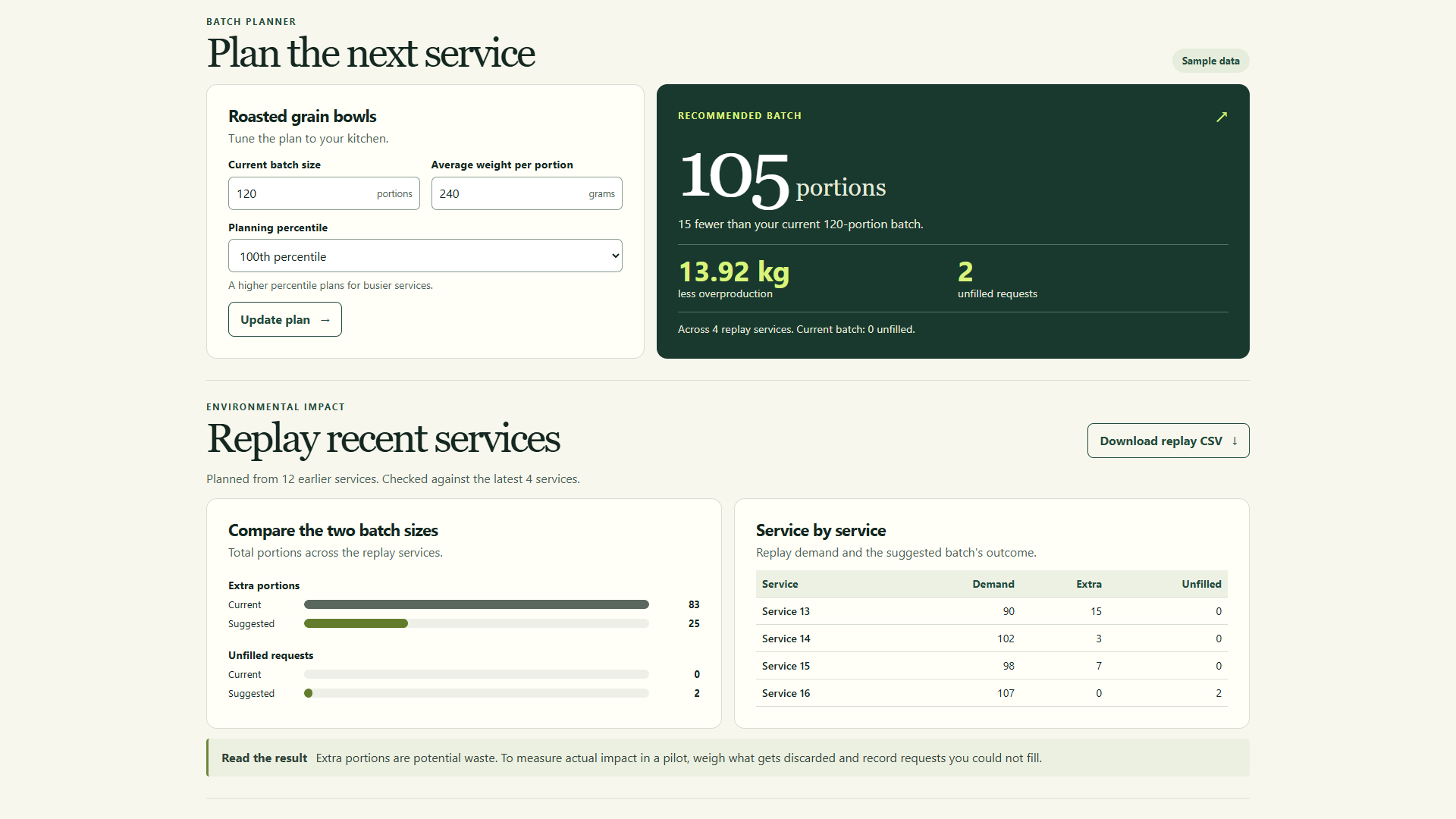
- Choose the 100th percentile and select Update plan. The batch rises to 105 portions and the replay shows two unfilled requests and 13.92 kg less overproduction.
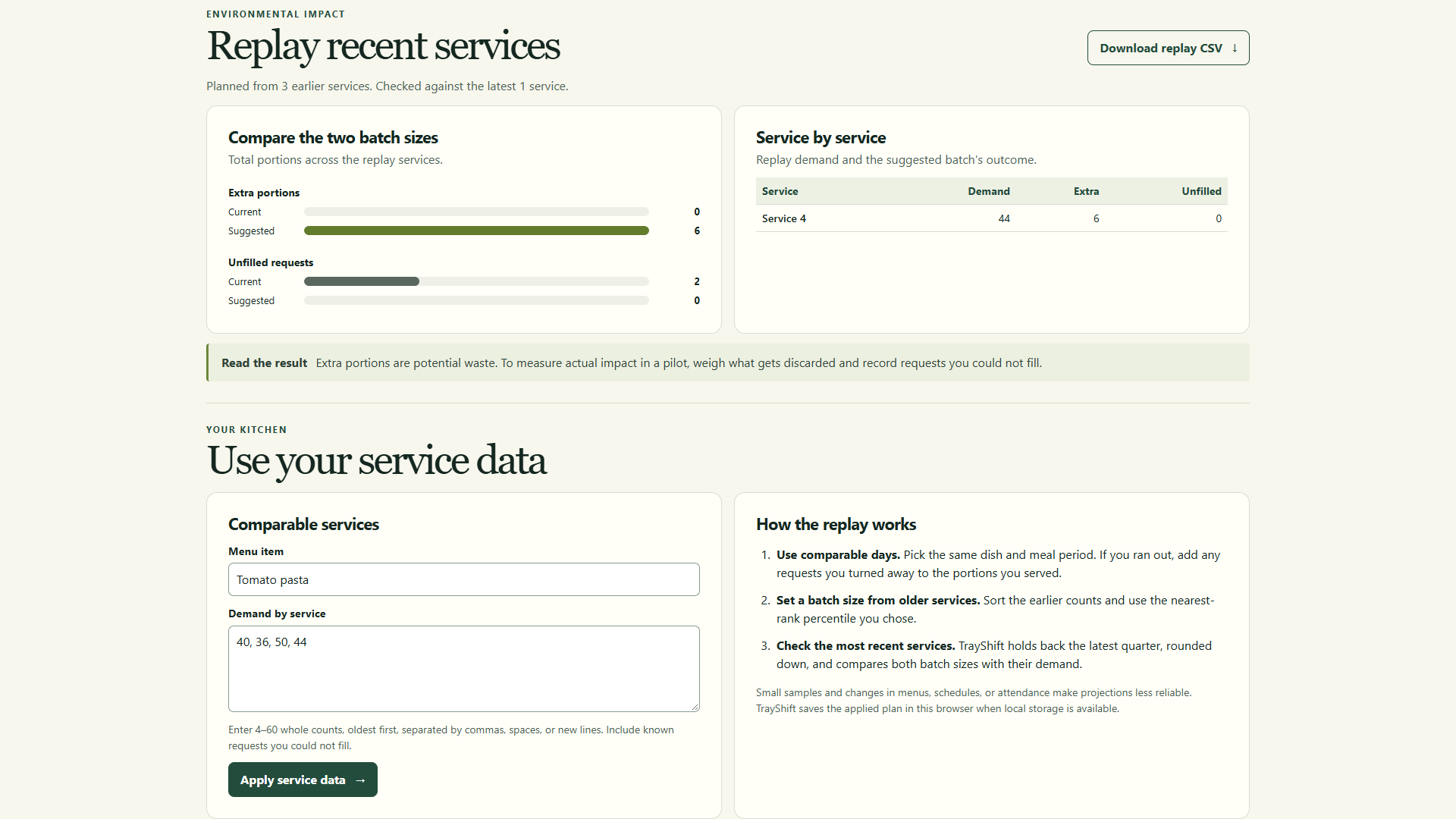
- Open Replay for the service-by-service breakdown and use Download replay CSV. Open Service data to replace the example with counts from your own kitchen.
How we built it
TrayShift is a static HTML, CSS and JavaScript app. It reserves the latest quarter of service counts for evaluation and chooses a nearest-rank percentile from earlier counts. It then compares both batch sizes against each of the reserved services. The browser handles user input, persistence, and CSV export. Playwright tests the production build at desktop and mobile sizes.
Challenges we ran into
Portions served can understate demand when the kitchen runs out. The data entry instructions ask teams to include known requests they could not fill. The suggested batch is also evaluated on recent services that were held back from the calculation.
Accomplishments that we're proud of
The demo makes the trade-off visible in one click. A kitchen lead can see how an adjustment changes both portions left over and requests missed, then export the underlying comparison for a shift meeting.
What we learned
The cost of underproduction belongs beside the estimate of overproduction. An extra portion may still be used later, so the replay expresses potential waste in portions and weight. Actual food waste needs a scale and an agreed measurement process.
What's next for TrayShift
Run a pilot on one recurring campus meal. Record demand, unfilled requests, and the weight of food discarded at the end of service. Compare results across several comparable service days and review the percentile with the kitchen lead.
AI disclosure
OpenAI Codex, an AI coding agent, wrote the code and copy under human direction during the event period. OpenAI ImageGen generated the illustrative cafeteria photograph. The demo uses fictional data, and the app uses deterministic calculations at runtime.
Required extras
- Track or category — Food / Waste is the project focus. No formal track is listed publicly. If a category selector appears, choose the closest matching option. 送件時依畫面。
- Team — Individual entrant. Keep the solo entrant as the only team member on Devpost.
- Try it out —
https://trayshift.pages.dev/ - Source code —
https://github.com/ryan930704/trayshift. Build instructions are inapp/README.md. The project is MIT-licensed. - Walkthrough and images — Use the Demo walkthrough above and the three PNGs in
shots/. A separate file upload or video URL is not identified as mandatory in the public event rules. 送件時依畫面。 - Organizer-specific prompts or attestations — 送件時依畫面。
Built With
- css
- html
- javascript
- node.js
- playwright
