-
-
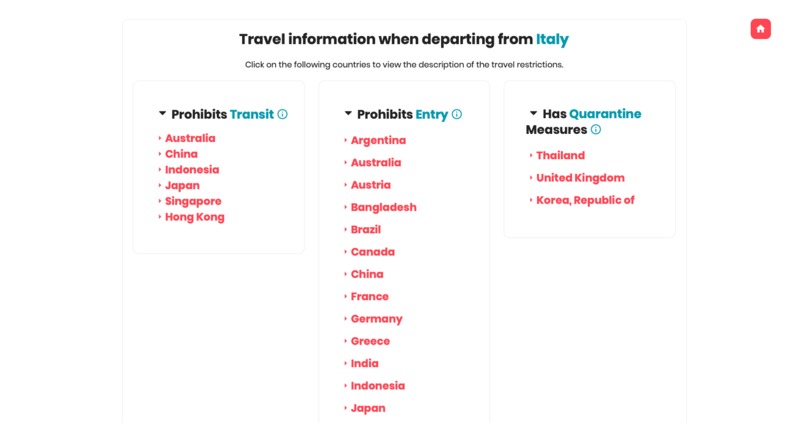
Travel restrictions faced when traveling from Italy
-
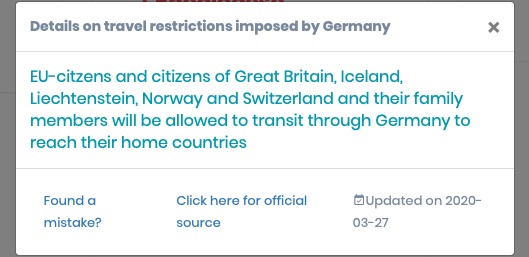
Details of travel restrictions imposed by Germany on Italy
Inspiration
Initially, as the COVID-19 situation started to heat up in China and subsequently Asia, many had their travel plans tossed up as governments imposed new tourist and border restrictions on a daily basis. After COVID-19 was declared a global pandemic, countries all around the world started to close their borders, with many going into lockdown. Friends and families were faced with the difficult task of finding their way home, as available travel routes diminished by the day and online travel resources struggled to keep up.
Our team was inspired to create travelnogo as we could not find any single online resource that could on one hand keep up with the amount of new information that was released, and on the other hand was concise and end-user friendly. It troubled us greatly that travel companies online were not reflecting these new changes on their website, as their itinerary still included stopovers in countries that have gone into lockdown, or flight routes that were no longer open.
In this climate of uncertainty and panic, we created this website in hopes to provide some clarity with regards to the current travel restrictions across the globe. We do so by reflecting up-to-date and accurate information on our site in a minimalistic and user-friendly way. Our site and its creators acknowledge that all non-essential travel should be avoided at this point of time, therefore our current purpose is to help stranded overseas travellers, foreign workers, and international students find their way home.
Even though the end is not yet in sight, we believe that there is great potential for this site to provide eager travellers the information they need when travel restrictions begin to lift.
What it does
Travelnogo is an online community that aims to help people across the globe navigate through confusing travel restrictions amid the COVID-19 pandemic. Through vetted crowdsourcing information, we developed a network of updated travel restrictions that allows users to easily identify travel restrictions which apply to them.
How we built it
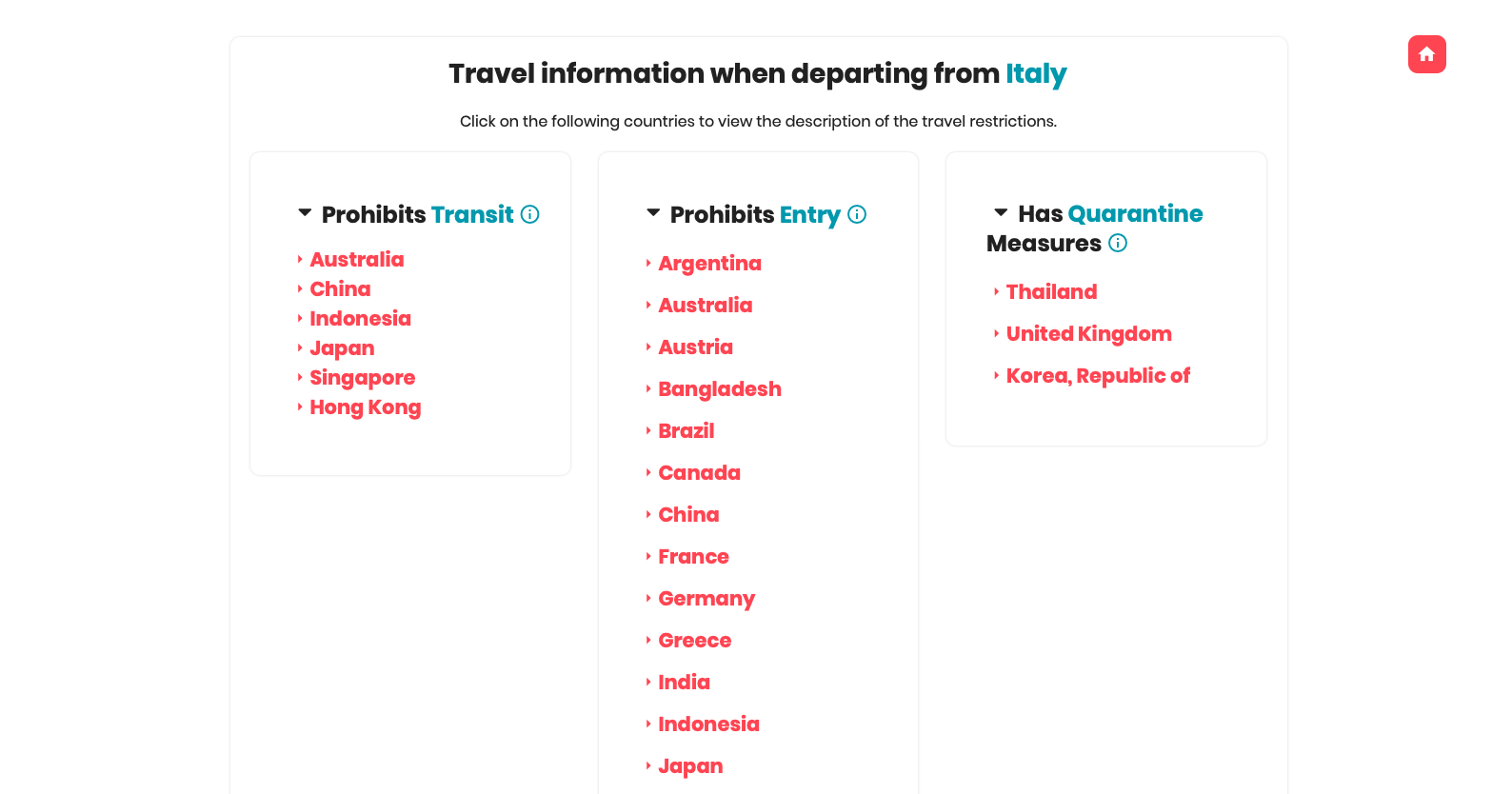
The key issue we were trying to solve is the lack of clear and concise information on the travel restrictions one will face when departing from a certain country. Using a web crawling algorithm we are able to retrieve reliable information to model the global travel situation into a graph with countries as the nodes and travel restrictions as the edges. We derived an exhaustive list of countries in which an individual individual is 1) unable to transit through 2) unable to enter as a tourist, and 3) will face quarantine measures upon entry by querying the incoming edges on the country in our relational database. We then presented this information in a concise manner on our minimalistic, easy-to-use website.
Challenges we faced
To date, information retrieval remains our biggest challenge. Numerous government agencies were slow to update their official website regarding the latest travel restrictions or had ambiguous information on the restrictions. We had to resort to searching for alternatives sources of information through various online news and media outlets, subjecting these information through thorough corroboration with official sources, to get the latest and most accurate information.
Our accomplishments
We are proud that we were able to develop and launch our platform within a week. Upon its launch, travelnogo was able to engage more than a thousand users within the first 48 hours.
What we've learned
In a global pandemic where government agencies are scrambling to implement policy changes as quickly as possible, the lack of concise and accurate information regarding the situation can render significant distress to society. People want to be in the know, and we believe that accurate and updated information should be made easily available on the internet. However this is also a climate where "fake news" are spreading through social media platforms and chat groups like wildfire, and the internet remains a double edged sword that could create more distress and panic than clarity for the public. Hence, in such a time of crisis, it is imperative that online platforms of information prioritise the delivery of clear, concise and accurate to its users.


Log in or sign up for Devpost to join the conversation.