-
-
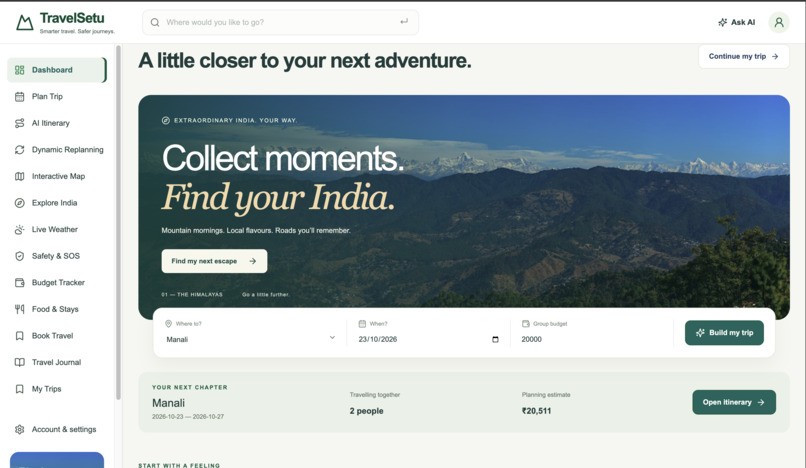
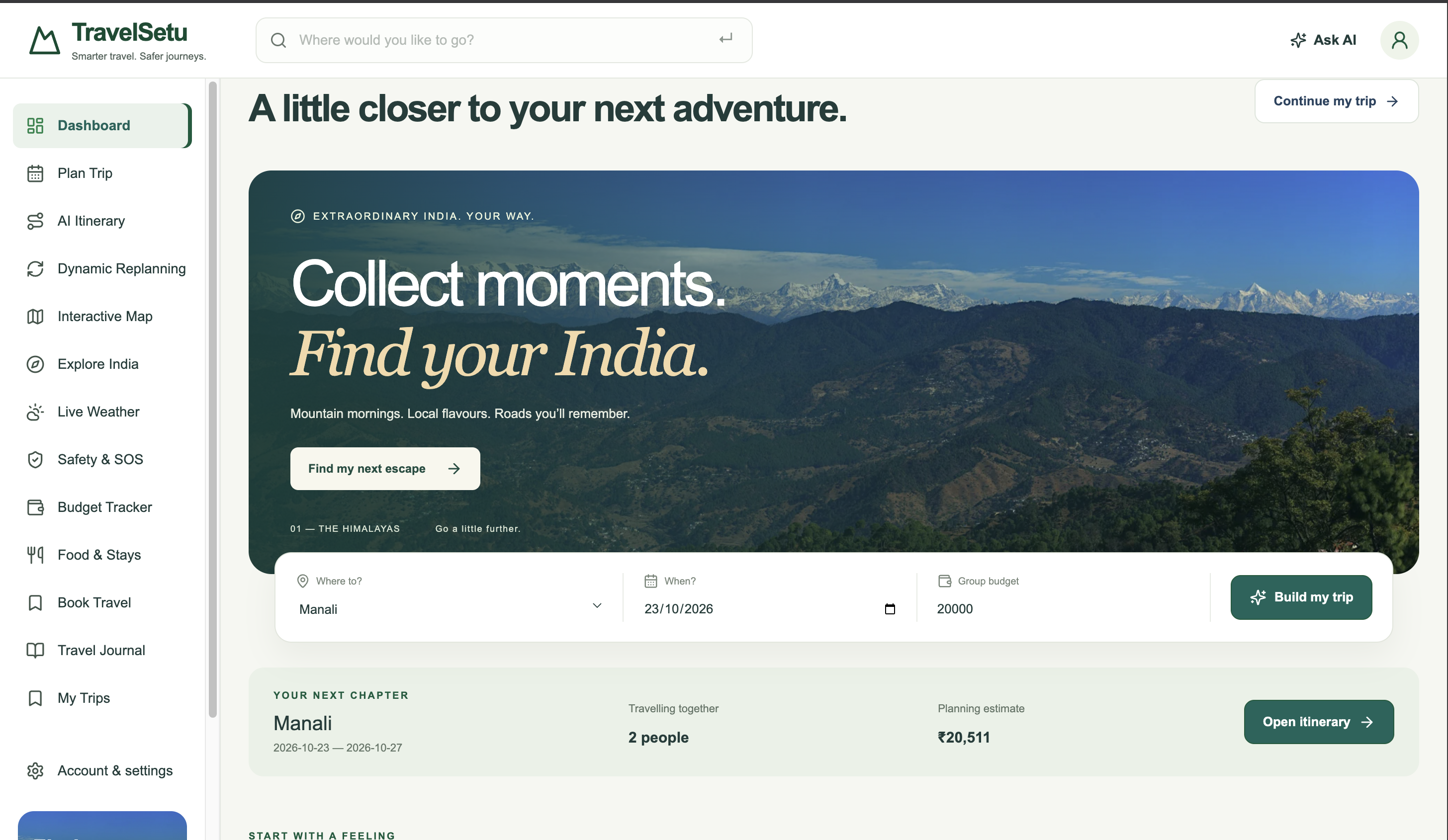
DashBoard
💡 Inspiration
Planning a trip in dynamic, high-altitude regions like Uttarakhand or Himachal Pradesh is notoriously stressful. A traveler typically juggles 8+ disconnected apps—Maps, weather apps, hotel aggregators, food portals, and note-taking spreadsheets.
However, static travel plans fail the moment reality strikes: sudden mountain landslides, unseasonal cloudbursts, local religious processions, or unscheduled venue closures leave travelers stranded roadside in panic. Moreover, traditional search engines and booking aggregators prioritize high-SEO commercial chains, diverting critical revenue away from local homestays, rural guides, and authentic regional dhabas.
We asked ourselves: Why should travelers act as logistics project managers during their own vacations? We built Travel Setu to shift the paradigm from searching for trips to an autonomous, auto-healing travel copilot.
🚀 What it does
Travel Setu is an intelligent travel optimization and dynamic execution platform tailored for the Himalayan belt and regional tourism circuits:
- 1-Click Personalization & Constraint Matching: Generates complete day-by-day itineraries tailored to dietary constraints (Pure Veg, Jain, Sattvic), physical pace, crowd tolerance, and travel style.
- Deterministic Budget Enforcement: Uses mathematical allocation algorithms to guarantee that total expenses remain strictly under the user's defined financial ceiling ($\text{Total Cost} \le \text{Budget}$), complete with an automatic emergency cash reserve.
- Real-Time "Auto-Healing" Itinerary: When a sudden road closure, weather alert, or venue shutdown is detected, Travel Setu reconstructs downstream schedules in one tap—swapping blocked spots with open, low-crowd alternatives and local dhabas within a safe radius.
- Direct Grassroots Tourism Pipeline: Promotes verified rural homestays, local guide collectives, and regional food culture without demanding high middleman commissions.
- Offline-First Safety & SOS: Features instant one-tap emergency geolocation sharing to nearby local medical facilities and police outposts, backed by cached offline itineraries.
🛠️ How we built it
We architected Travel Setu with a modern, decoupled web stack focused on rapid execution and offline resilience:
- Frontend: Built with React and TypeScript powered by Vite and styled using Tailwind CSS for a clean, mobile-first responsive experience. Interactive maps and geographic routing are rendered using Leaflet / Mapbox GL.
- Backend & Database: Orchestrated using Node.js with Supabase (PostgreSQL) for secure authentication, relational database modeling, and real-time state synchronization.
- Optimization & Routing Logic: Implemented deterministic algorithms for budget allocation (Multi-Choice Knapsack model) and route sequencing (Traveling Salesperson Problem with scenic scoring weights) to ensure math calculations are strictly independent of LLM hallucinations.
- AI Reasoning Layer: Integrated frontier LLMs (via Gemini / OpenAI APIs) to handle conversational natural language adjustments, contextual narrative generation, and review sentiment summarization on top of verified structured data.
🧗 Challenges we faced
- Unreliable Remote Data Feeds: Official real-time APIs for remote mountain road conditions and monument timings are often nonexistent or updated late. We resolved this by building a multi-tier data confidence model that cross-verifies official bulletins with geo-fenced community reports.
- Separating Math from Probabilistic AI: Generative language models frequently hallucinate prices and time calculations. We had to enforce a strict boundary where all budget balancing and distance calculations happen deterministically in code, using AI solely for human-like reasoning and explanations.
- Offline Reliability: Network dropouts are frequent in mountain valleys. Implementing client-side caching (PWA/local storage sync) was essential to keep itineraries and emergency contacts accessible without active cellular coverage.
🏆 Accomplishments that we're proud of
- Successfully built an end-to-end working prototype that can simulate an active roadblock and recalculate an afternoon schedule, route, and budget delta in under 2 seconds.
- Created a platform architecture that actively redistributes footfall to lesser-known local businesses rather than funneling tourists into already congested hotspots.
- Developed an intuitive UI that eliminates decision fatigue for budget travelers and families.
📚 What we learned
- Real travel problems in India are execution problems, not discovery problems. People don’t lack information; they lack the ability to adapt when conditions change unexpectedly.
- How to implement spatial geospatial querying with PostGIS and integrate offline caching strategies in modern web applications.
- How to structure hybrid data architectures combining authoritative government advisories with crowdsourced verification.
🔮 What's next for Travel Setu
- Piloting Regional Datasets: Partnering with regional homestay associations and tourism boards across Uttarakhand and Himachal Pradesh.
- Offline Mesh Alerts: Exploring Bluetooth/Wi-Fi Direct peer-to-peer relay protocols for tourists to share route updates in complete cellular dead zones.
- B2G Tourism Authority Telemetry: Providing municipal tourism bodies with anonymized real-time footfall density heatmaps to mitigate over-tourism at vulnerable ecological checkpoints.
Built With
- css
- express.js
- google-gemin
- google-maps
- html5
- javascript
- node.js
- react
- tailwind


Log in or sign up for Devpost to join the conversation.