-
-
Travel Master
-
Travel Master
Inspiration
Travel Master was born from a simple idea: planning a trip should feel as personalized as the trip itself.
Travel Master is a multi-agent system composed of five specialized agents that work together to build a customized travel experience:
- Flight Agent — finds flight options based on the user's needs.
- Stay Agent — recommends accommodation options.
- Activity Agent — discovers activities and experiences at the destination.
- Dining Agent — finds restaurants and dining experiences.
- Advice Agent — provides personalized travel recommendations and practical advice.
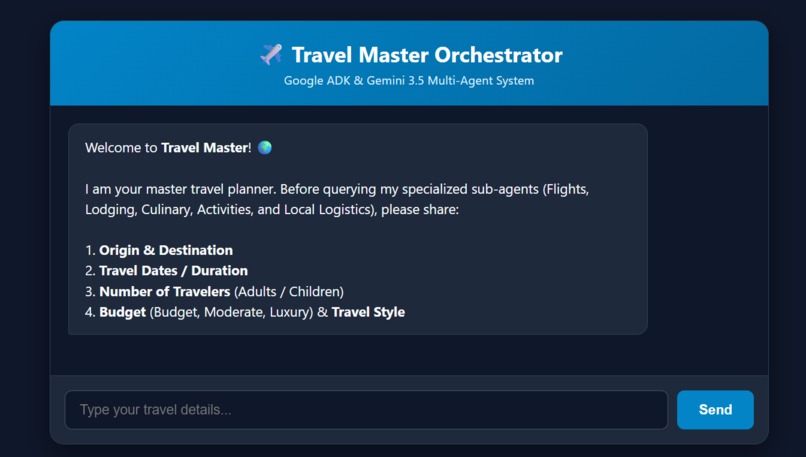
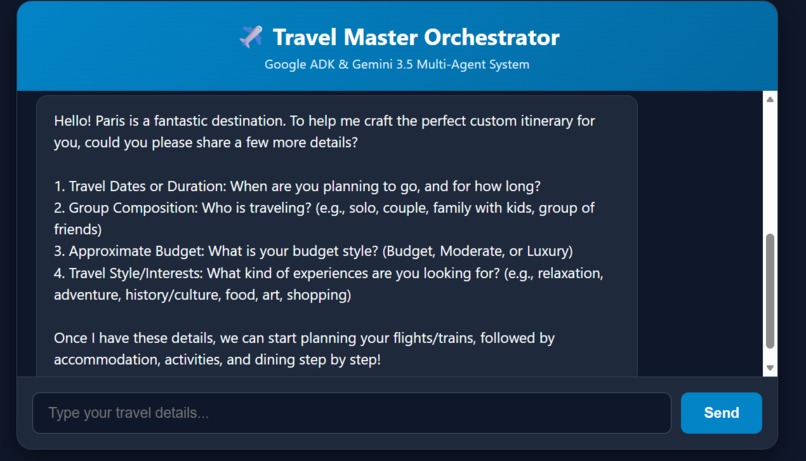
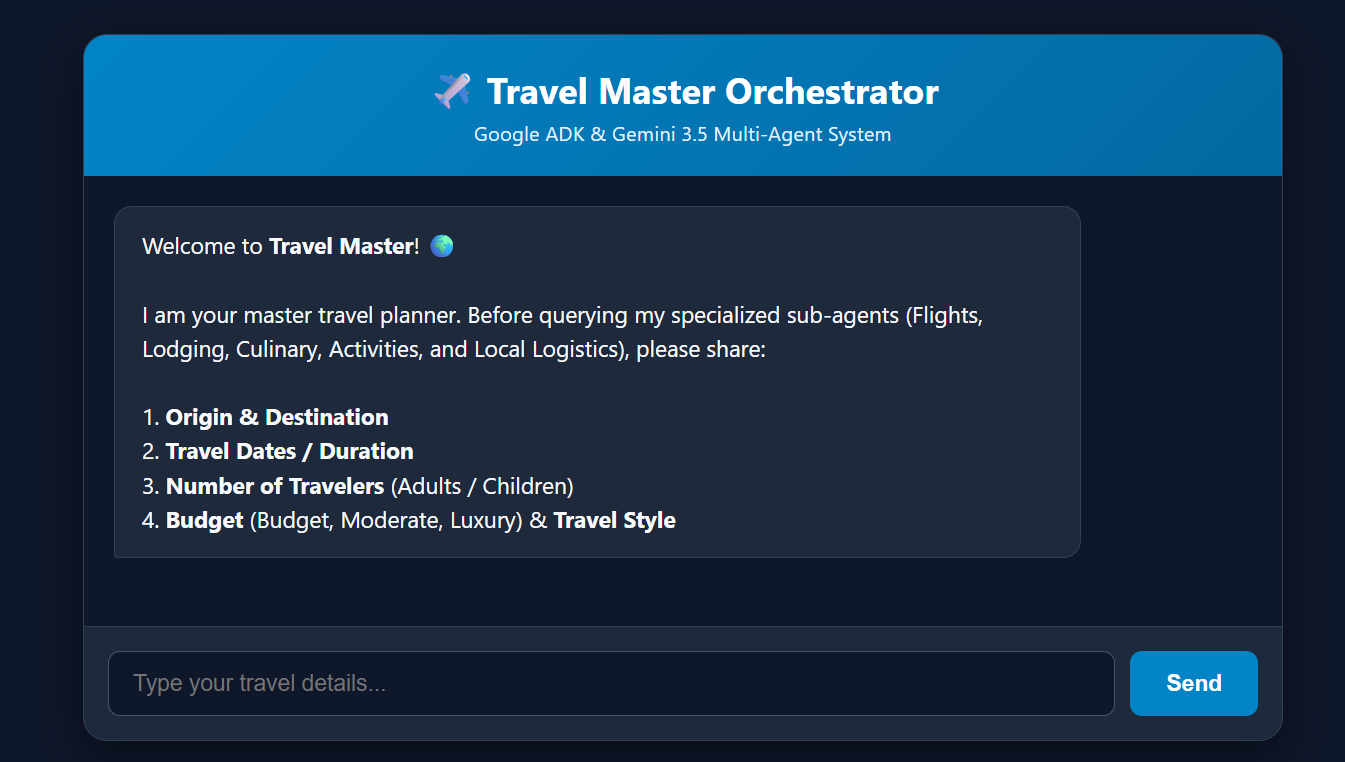
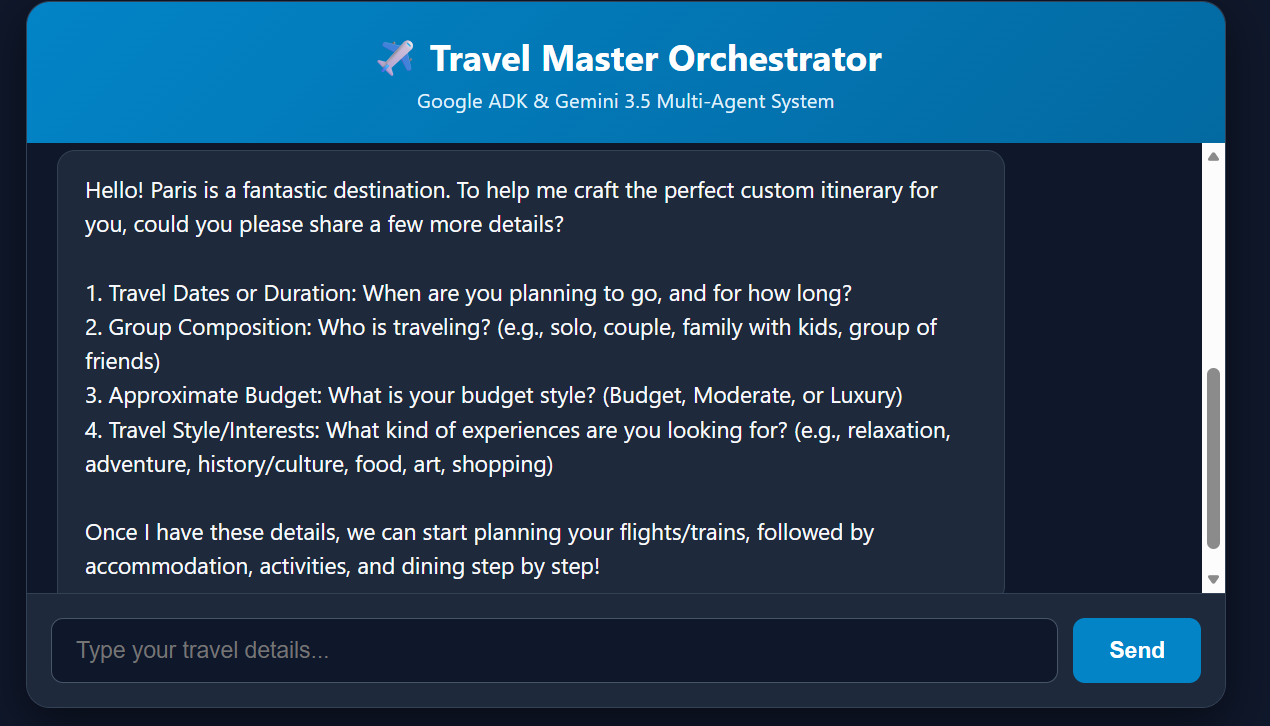
At the center of the system is a Master Orchestrator. Instead of asking users to provide everything at once, the orchestrator conducts a structured conversation to understand their trip type, destination, budget, and preferences.
It then sequentially delegates tasks to the specialized agents and presents the available options to the user step by step. Every decision made by the user is incorporated into the next stage of the process, allowing Travel Master to progressively build an itinerary around their choices.
Finally, the orchestrator brings everything together and generates a complete, personalized travel itinerary.
How We Built It
Travel Master is built using Google ADK (Agent Development Kit) and a system of five specialized sub-agents.
Each agent has a specific responsibility and can use web search tools to retrieve real-time information and recommendations.
The architecture is centered around the Master Orchestrator, which:
- Conducts a structured interview with the user.
- Builds a profile based on their preferences and constraints.
- Determines which specialized agent should handle each task.
- Delegates tasks sequentially to the appropriate sub-agents.
- Presents results and options to the user.
- Collects the user's decisions.
- Synthesizes all the selected information into the final itinerary.
This architecture allows each agent to focus on a specific domain while the orchestrator maintains the overall conversational state and user experience.
Challenges We Ran Into
One of our biggest challenges was managing the dynamic flow of the Master Orchestrator.
Coordinating five autonomous agents while ensuring that each one stayed within its own responsibility was more complex than simply connecting multiple agents together. We needed to prevent agents from overriding each other's tasks, jumping ahead in the workflow, or disrupting the conversation.
A significant part of the engineering process involved designing and fine-tuning the root orchestrator's system prompt so it could reliably control delegation, sequencing, and decision-making across the entire workflow.
Accomplishments That We're Proud Of
We successfully developed a multi-agent travel system with five autonomous decision-making agents, each specialized in a different part of the travel-planning process.
We are particularly proud of creating a system capable of:
- Coordinating multiple specialized agents through a single orchestrator.
- Retrieving real-time information from the web.
- Maintaining a structured conversational flow.
- Incorporating user decisions throughout the planning process.
- Synthesizing multiple agent outputs into one coherent travel itinerary.
What We Learned
Building Travel Master gave us a much deeper understanding of the Google ADK ecosystem and how agent-based applications can be orchestrated.
We explored different ADK tools and learned how they can simplify the development of complex agent workflows compared with manually managing multiple API calls and interactions.
One of our biggest takeaways was that a well-designed agent architecture can make complex workflows more modular, easier to manage, and more scalable.
We also learned that the quality of the orchestrator is critical: when multiple agents collaborate, defining clear responsibilities and boundaries is just as important as the capabilities of the individual agents themselves.
What's Next for Travel Master Agent
We see Travel Master as the foundation for a more complete AI-powered travel companion.
Our next steps are:
- Google Maps integration for optimized route planning and travel-time estimation.
- Travel reminders for flights, reservations, activities, and important trip events.
- Persistent tracking dashboard to manage reservations, flights, tickets, and activities in one place.
- Improved personalization through richer user preferences and travel history.
- More intelligent itinerary optimization based on time, distance, budget, and user priorities.
Our goal is to move from simply planning a trip to helping users manage the entire travel experience from planning to execution.

Log in or sign up for Devpost to join the conversation.