-
-
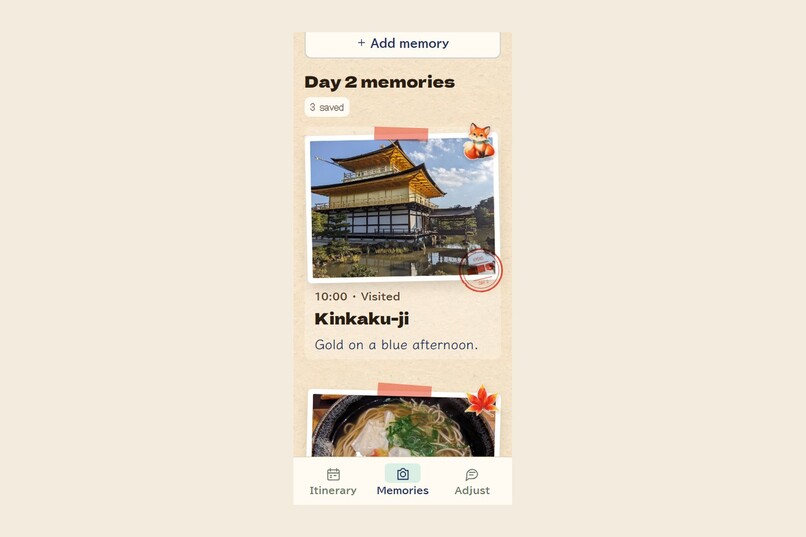
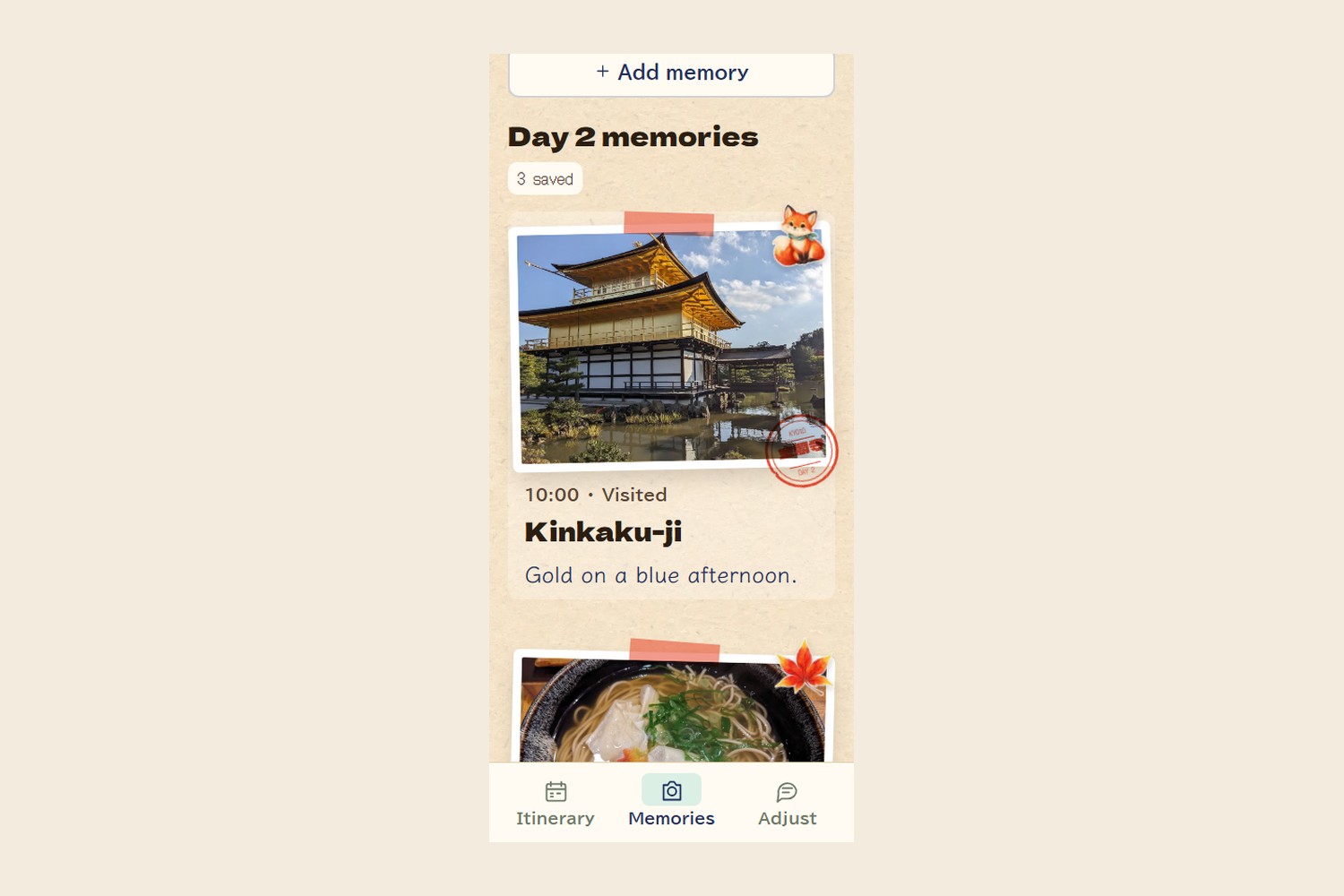
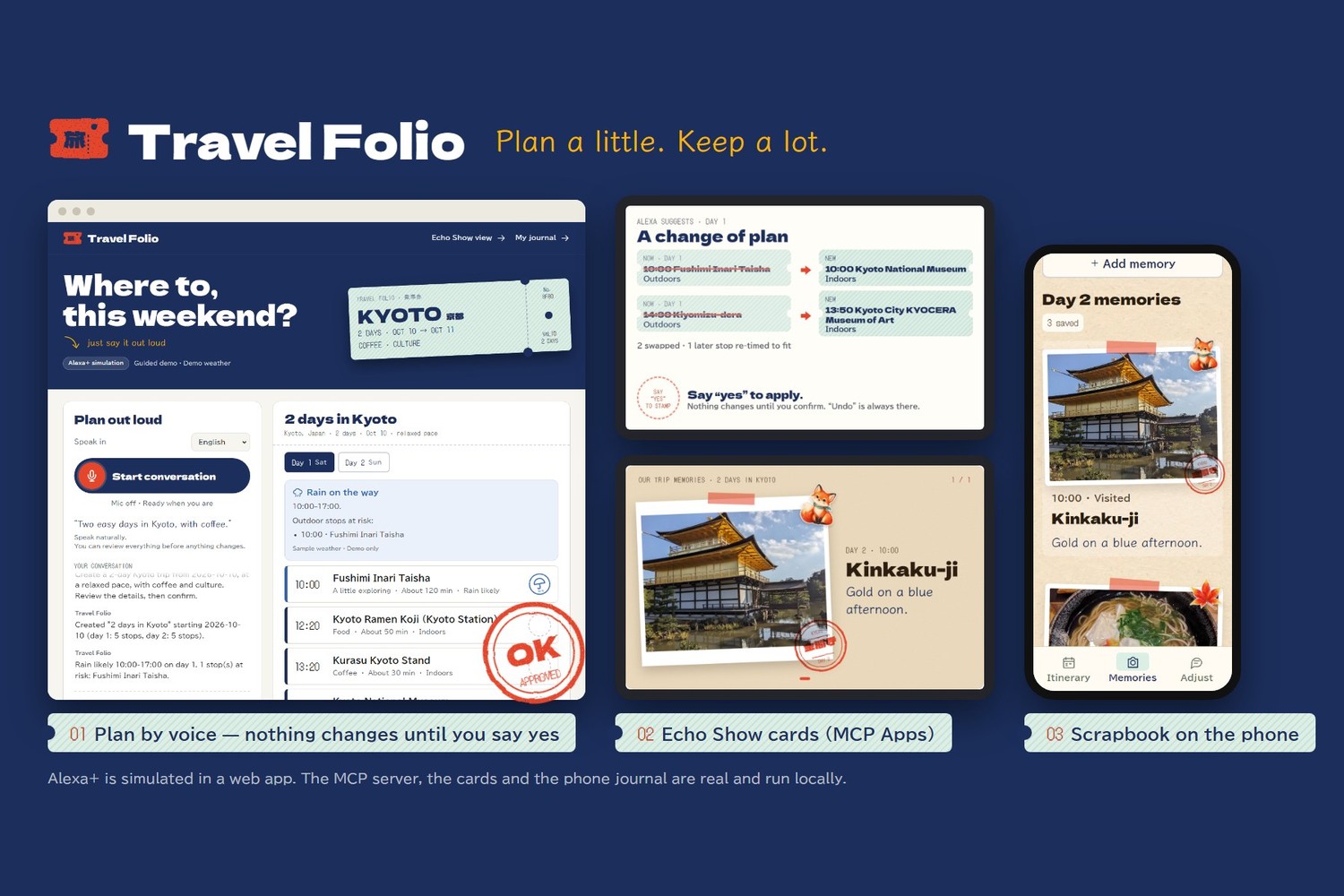
The phone journal turns the trip into a stamp-book scrapbook that can be saved or printed.
-
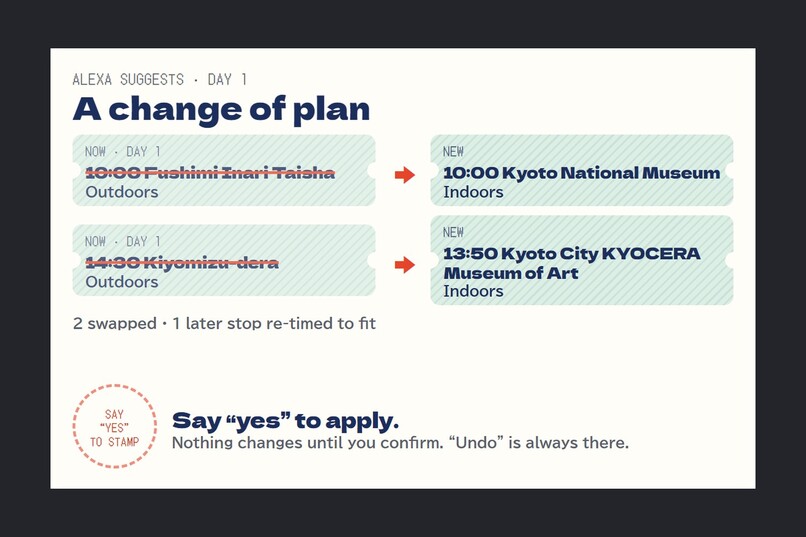
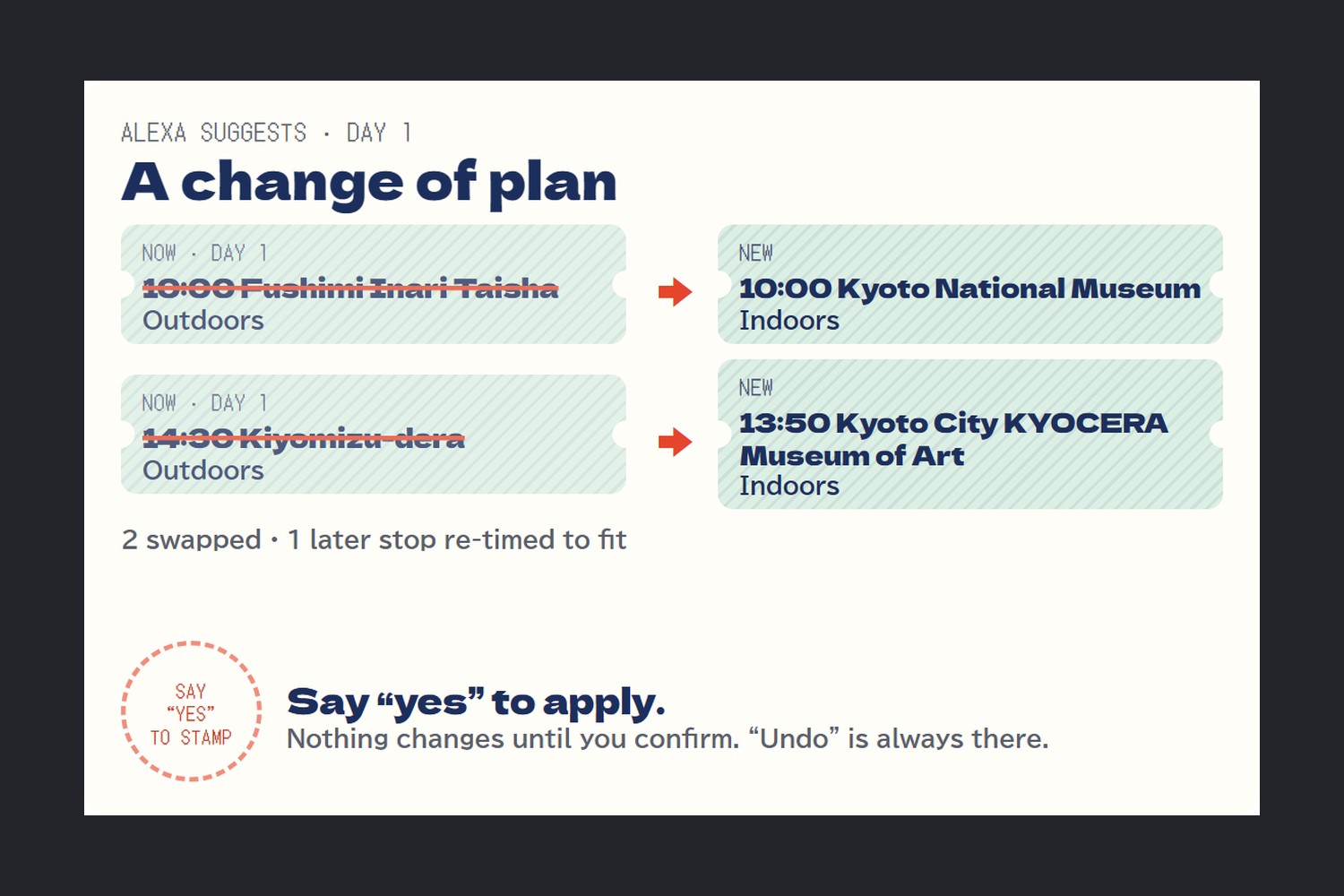
Echo Show proposal card shows the before-and-after change and waits for a clear yes before applying it.
-
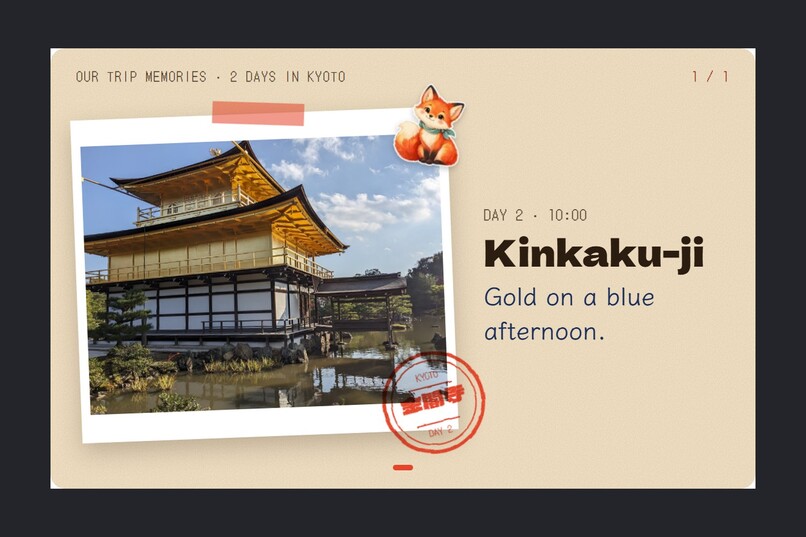
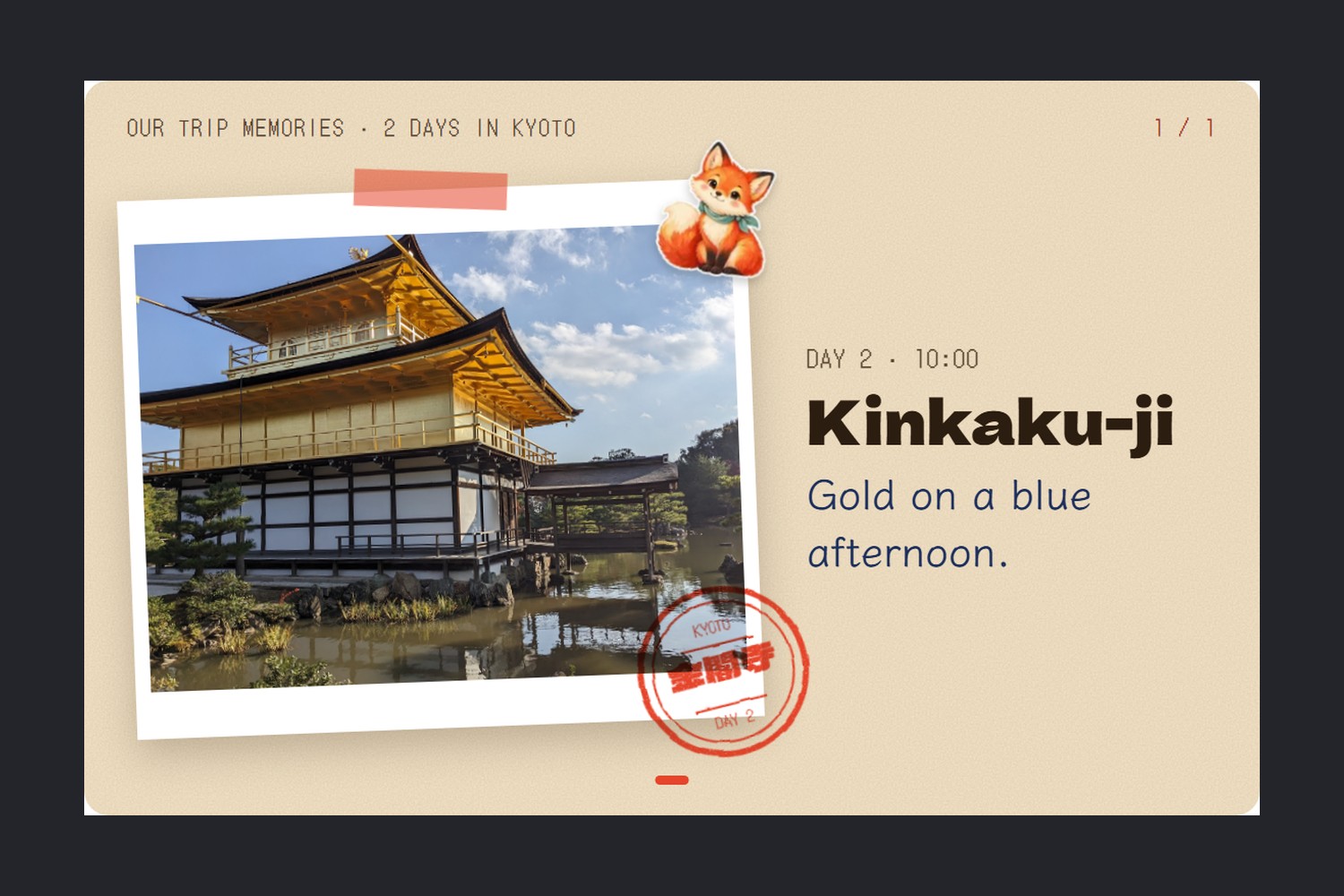
Shared memories return to the Echo Show as a family slideshow with photos, captions, stickers, and stamps.
-
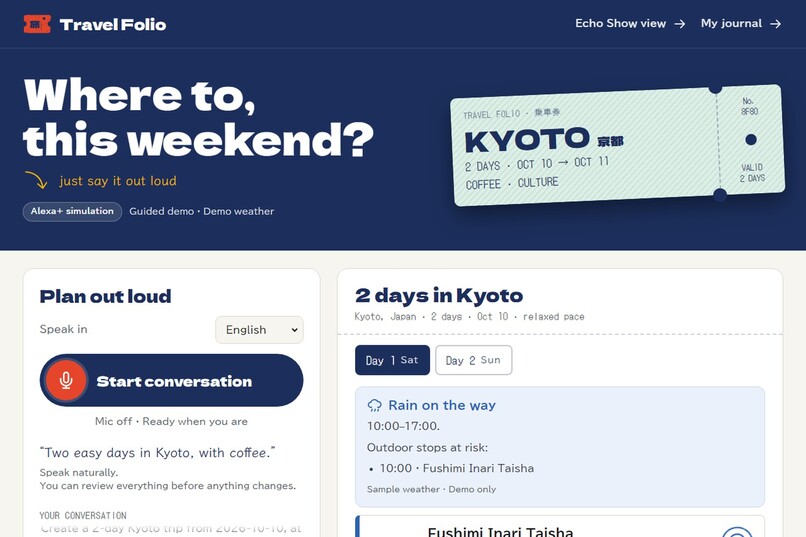
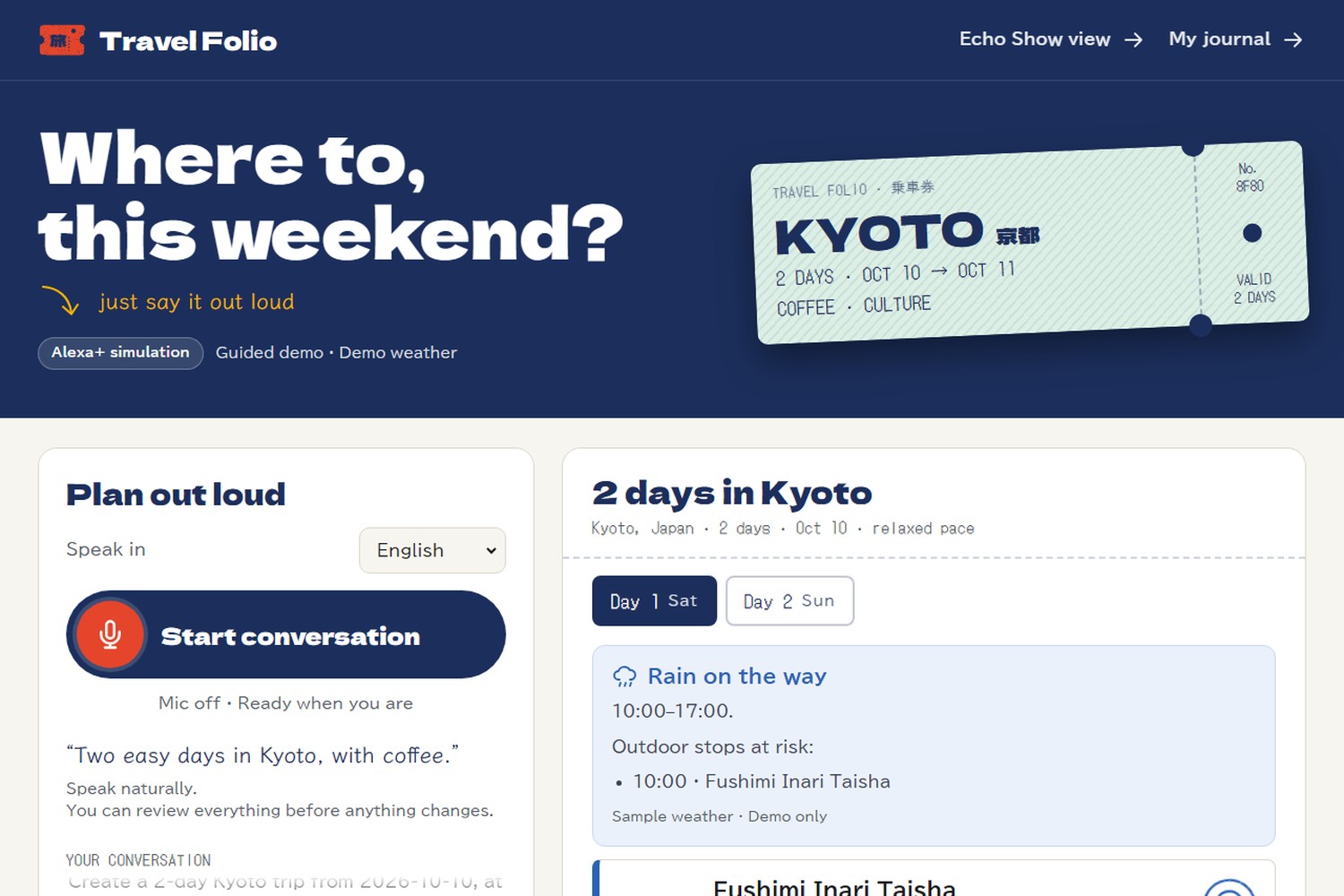
The home screen starts a voice-first Kyoto trip plan and shows the itinerary before anything is confirmed.
-
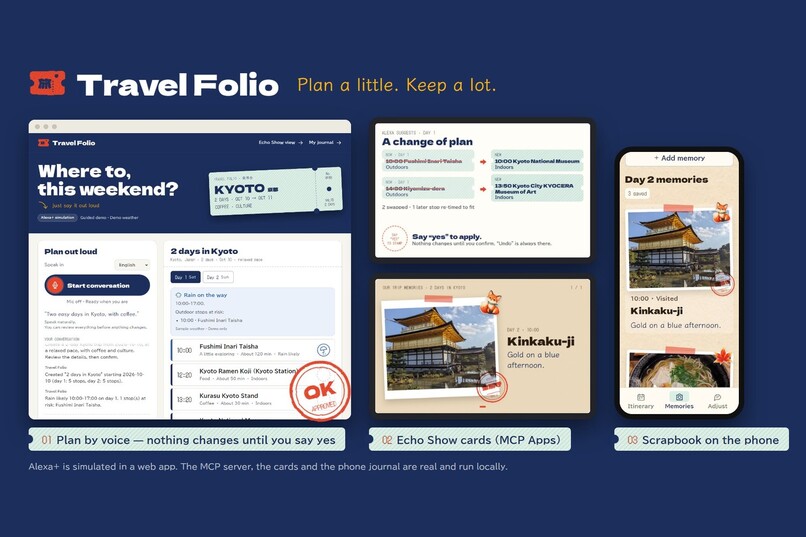
Travel Folio connects home planning, Echo Show cards, phone journaling, and printable scrapbook memories.
Inspiration
Planning a trip with a voice assistant is already possible. What gets lost is everything after: the photos end up scattered in a camera roll, the little detours are forgotten, and the trip that started around the kitchen screen never comes back to it.
We wanted an Alexa+ companion for the whole journey: plan together at home, keep a scrapbook on the road, and bring the memories back to the kitchen screen so the family can relive them. And it has to stay trustworthy: it suggests, the person decides.
What it does
What is real and what is simulated. This demo simulates how Travel Folio's MCP responses would appear on an Alexa device: the Alexa+ developer toolkit is not available to hackathon participants, so there is no real Alexa or Echo connection. The MCP server, its tool calls, the MCP Apps cards, the phone journal and the memory sharing are real and run locally.
In one line: voice-first travel planning with explicit consent — plan, disruption, suggested replacement, visible diff, your confirmation, and finally a scrapbook you relive together.
- A scrapbook, not just an itinerary. On the phone, every stop can hold a photo, a few words and up to three of 32 travel stickers. Unplanned detours become pages too ("An unplanned detour"). Each day turns into a light-kraft scrapbook page with station-style stamps, printable as an A4 booklet or saved as one offline HTML file.
- A design you can hold. Plan = a ticket, trip = a stamp rally, memories = a stamp book. Saying yes to a change stamps it "OK" on the Echo Show; visited stops get a 済 (done) stamp; every memory gets a station stamp with the place's Japanese name.
- Relive it together on Echo Show. Back home, choose "Show memories on Echo Show" on the phone. Alexa greets you ("3 memories from your phone just arrived. Shall I show them?") and plays them as a polaroid-style slideshow on the kitchen screen. Nothing leaves the phone until you choose to share it, and private notes never do.
- Plan by talking. "Plan two easy days in Kyoto, with coffee." Travel Folio builds an itinerary from a curated list of real places and reads back a proposal. Nothing is created until you say yes to that exact proposal. English and Japanese.
- Remembers you and speaks first. Come back tomorrow (even after a restart) and it greets you with what matters: "Welcome back. Your 2-day Kyoto trip starts tomorrow. The forecast shows rain from 10:00 to 17:00, which affects Fushimi Inari. Shall I look for indoor alternatives? Nothing changes until you confirm."
- Weather-aware changes with a before/after. Rainy outdoor stops are swapped for nearby indoor places, later stops are re-timed, and the card shows exactly what moves. Visited and fixed stops are never touched. Undo is always one sentence away.
- Echo Show cards with MCP Apps. Itinerary, rain risk, proposals and results render as interactive MCP Apps views styled with the Alexa+ visual foundations (768x480 canvas, one root zoom per device), with "Try saying…" hints for the next step.
- Take it to your phone. "Take it to my phone" shows a QR code. The phone journal imports the itinerary and pairs with this home. Failed saves never lose an edit.
How we built it
- Self-hosted MCP server (official MCP TypeScript SDK, spec 2025-11-25, Streamable
HTTP): 12 tools (
preview_trip,create_trip,get_itinerary,get_next_stop,check_weather,list_places,propose_change,apply_change,undo_last_change,mark_visited,send_to_phone,show_memories), resources for the current trip and each day, and amorning_briefingprompt. Tools carry annotations;apply_changeasks the human through MCP elicitation when the client supports it. - MCP Apps (
io.modelcontextprotocol/ui, 2026-01-26): eight tools link a hashedui://view. It is a single self-contained bundle with inlined fonts and an empty CSP allowlist. Our simulated Echo Show is a small MCP Apps host: it loads the view through a cross-origin sandbox proxy, as the spec requires of web hosts. - Alexa+ simulation: a home web app that is the conversation surface (voice via the browser's speech APIs, or text), and an Echo Show 8 view that mirrors the same session. Every trip action is a real MCP call from an SDK client to the server.
- Conversation: a guided intent engine by default (no cloud account needed to judge the demo). An opt-in Amazon Bedrock mode uses the Converse API with tool use; the model's tool allowlist cannot apply, undo or confirm anything. Verified live with Amazon Nova 2 Lite through the Japan inference profile (requests stay in Tokyo/Osaka).
- Weather: Open-Meteo hourly precipitation, or a clearly labelled sample forecast for a reproducible demo. Unknown data is reported as unknown, never as "dry".
- State: each home plan is saved per browser and restored through MCP on return; the phone journal persists in IndexedDB with rescue copies.
- Quality: 98 automated tests (real HTTP/MCP journeys, the MCP Apps handshake run against the real view script, voice-controller timing, restart/restore), plus browser QA for the journey, phone storage, printing and the Echo Show cards.
Challenges we ran into
- Making an agent safe to trust with a plan. Proposals have IDs, expire after 15 minutes and are rejected if the trip changed meanwhile; a spoken "yes" only counts for the proposal whose reading finished. "Yes, but…" is not a yes.
- Rendering MCP Apps correctly without Alexa's tools. The Alexa+ toolkit and Local Inspector are not available to participants, so we implemented the host side of the MCP Apps lifecycle ourselves and tested the real view script against it.
- Honest weather. A missing forecast hour is unknown, so automatic rain swaps are refused rather than guessed.
- Reusing MCP tool schemas with Amazon Bedrock. In our first live run, Amazon Nova
rejected the
$schemakey the MCP SDK adds to every tool schema, and the model turned "this Saturday" into a 2024 date. We now send onlytype,propertiesandrequired, and give the model each city's date; both fixes have regression tests.
Accomplishments that we're proud of
- A full circle: a voice conversation becomes an Echo Show card, a phone scrapbook, a printed booklet, and finally a slideshow back on the kitchen screen, without an account.
- An assistant that speaks first when it matters, but cannot change anything on its own.
- The Echo Show cards follow the Alexa+ layout foundations (768x480 canvas, one root zoom) in Travel Folio's own ticket-and-stamp look, inspired by Japanese kippu train tickets and station stamps.
What we learned
MCP Apps make a voice-first assistant genuinely multimodal: the same tool result can be spoken, shown as a card, and acted on. We also learned that the hard part of "agentic" is not calling tools, it is deciding which calls need a human, and making that visible.
What's next for Travel Folio
- Publish it as a real Alexa+ add-on when the MCP Toolkit opens up.
- Sync the phone journal back to the home plan, more cities, and opening-hour checks from an authoritative source.
- A "trip day" mode on Echo Show: next stop, travel time and a gentle heads-up before rain.
Built With
- amazon
- amazon-web-services
- api
- apps
- bedrock
- context
- express.js
- for
- indexeddb
- javascript
- mcp
- model
- node.js
- nova
- open-meteo
- protocol
- qr
- sdk
- speech
- web
- zod

Log in or sign up for Devpost to join the conversation.