-
-
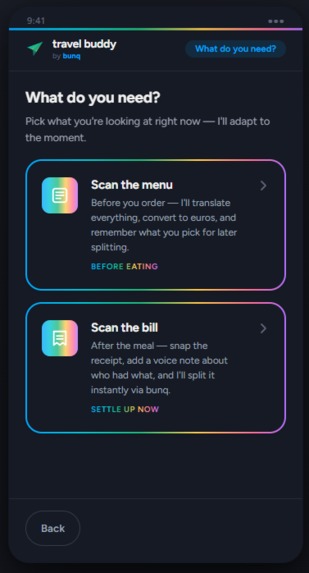
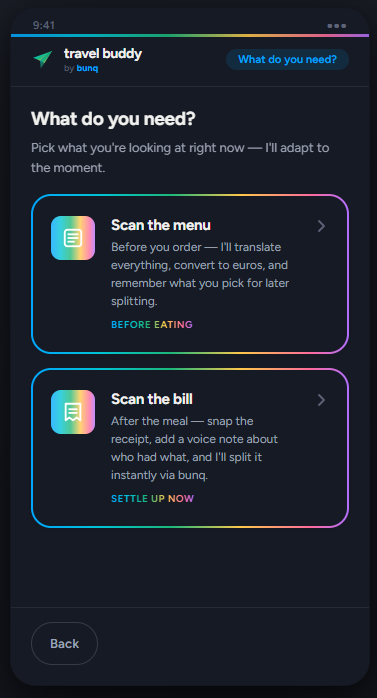
Select what do you need from bunq
-
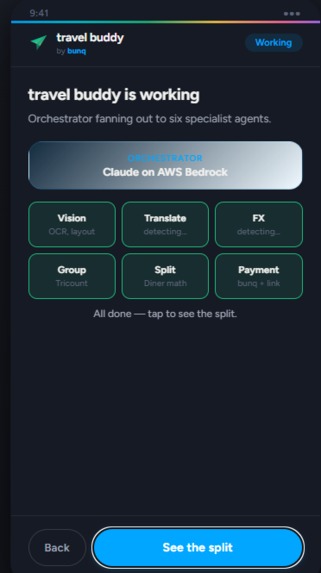
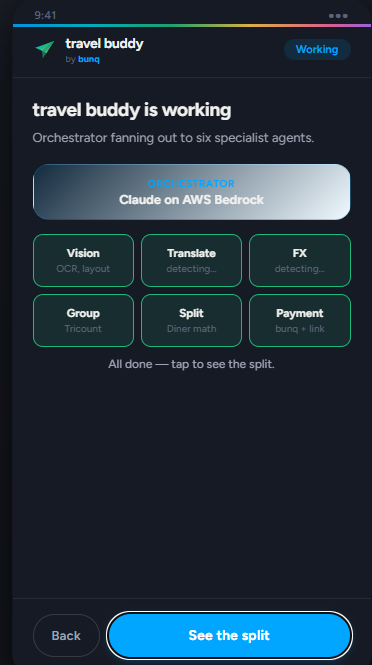
Travel buddy orchestrates all the AI features you need to split your bill with ease
-
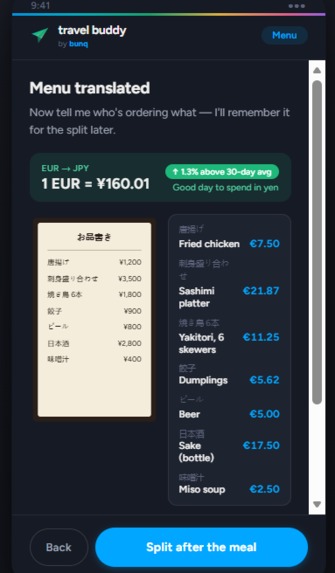
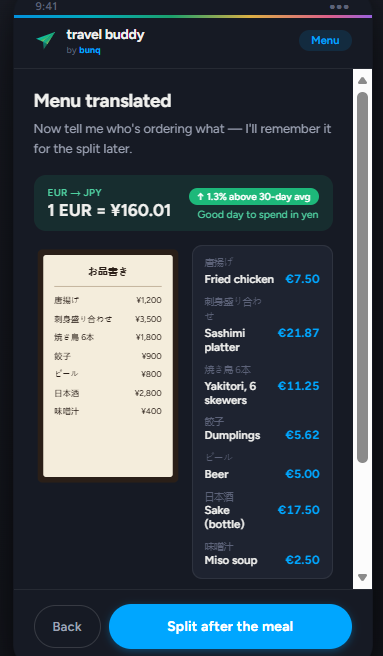
Travel buddy translates the menu and remembers it
-
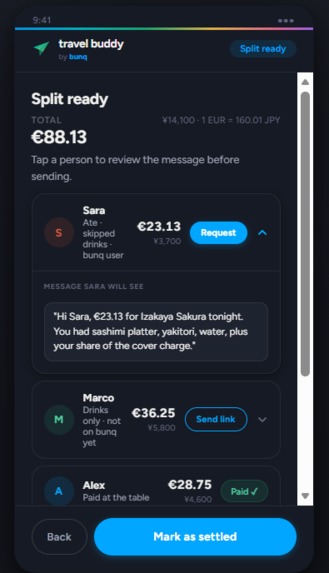
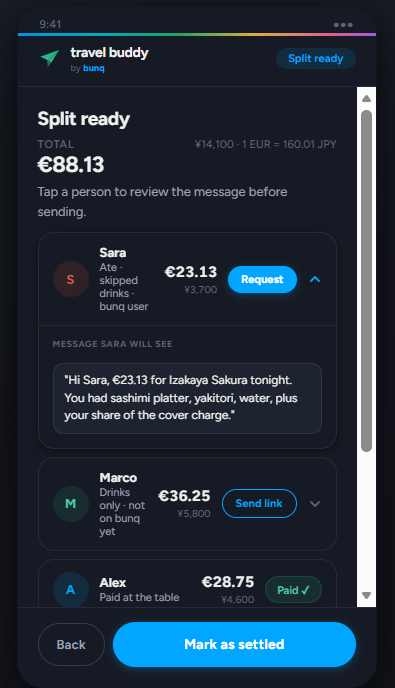
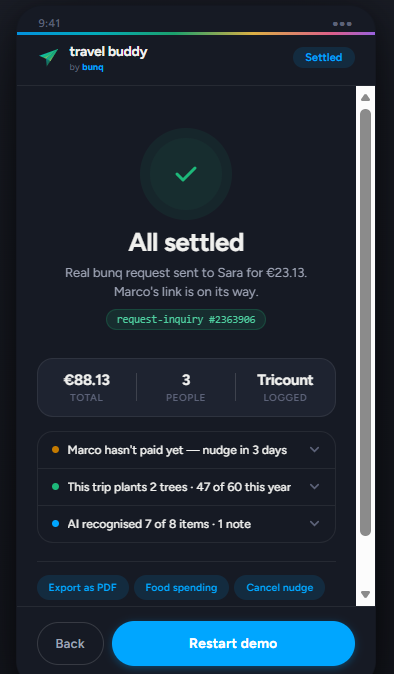
Split done! Now you can send the request to both bunq and not bunq users (They'll see what they are missing)
-
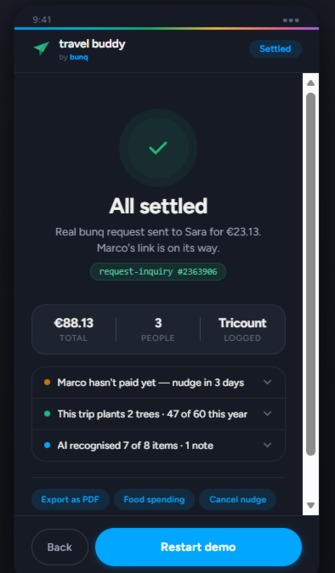
If you have friends in bunq they will receive the request right away via the bunq API.
Inspiration
We've all been there: dinner abroad with friends, the bill arrives in a language you can't read, the currency is unfamiliar, and one friend isn't on your bank. So you juggle four apps: translation, FX, calculator, bill-splitter, to settle one meal. bunq already has the pieces to solve this end-to-end: Tricount for splits, Finn for AI, FX with no markup, a customer base of digital nomads. The pieces have just never been in the same conversation. Travel Buddy is what happens when you put them there.
What it does
Travel Buddy is a multi-modal AI travel assistant living inside the bunq app. It accepts any input the moment gives you — text, photos, video, voice — and turns it into action. Snap a menu. Record a voice note about who's drinking what. Photograph a receipt scribbled in handwriting. Type a question. Travel Buddy understands all of it. Six capabilities, all unified under one trip memory:
Multi-modal capture: Menus, receipts, voice notes, typed messages, even short video — all flow into the same trip context. The system doesn't care which modality you use; it cares about what the moment needs.
Real-time translation: Japanese kanji to English. Spanish handwriting to Dutch. Any of bunq's 38 supported languages, in any direction, without leaving the app. FX with a bunq edge. Live conversion at bunq's rate — no markup, no weekend surcharge — plus an AI-generated recommendation: "today is 1.3% above the 30-day average — good day to spend in yen." You don't have to ask whether today is a good day. The bank already knows. Smart bill splitting. Per-diner math with full context. Voice instruction "Julia didn't drink, Marco only had drinks" becomes a fair split that handles dietary differences, drink rounds, and items not on the original menu (like Japanese cover charges). bunq friends get instant request inquiries; non-bunq friends get a soft bunq invite at the moment of trust.
AI memory and personalized trip profile: Every trip is its own object. Travel Buddy remembers what you ordered, what you spent, who you traveled with, what languages you needed. The next trip starts where the last one left off — your buddies pre-loaded, your preferences already known. Every money-touching travel moment. Beyond the dinner table — taxis, train tickets, flights, attractions, anywhere money flows during a trip. The same multi-modal input pattern, the same trip memory, the same bunq rails underneath. One product surface, one mental model, every moment.
Challenges we ran into
bunq's signed-request handshake. bunq's API is real banking infrastructure: every authenticated call requires an RSA-2048 keypair and a three-step installation → device-server → session-server flow before a single payment can be made.
We implemented the entire handshake from scratch, debugged opaque "Incorrect API key or IP address" errors caused by sandbox resets, and learned the hard way that sandbox API keys are device-pinned. Building the cryptographic plumbing was harder than building the AI on top of it.
Multi-modal stability under demo conditions. Real OCR on every menu, real speech-to-text on every voice note, six concurrent live agent calls, all impressive but fragile. We made deliberate trade-offs: keep vision and voice as polished UI flows backed by structured fallbacks, make translate and chat genuinely live.
Accomplishments that we're proud of
- Two real, live integrations working on stage — bunq sandbox creates actual payment requests, Claude answers actual questions with full trip context
- A multi-modal architecture that genuinely fuses vision, voice, and text inputs into a coherent trip memory
- A product positioning that aligns with bunq's existing strategic assets — Tricount, Finn, veritree, FX — rather than competing with them
- A business case that maps to the three numbers banks measure: customer acquisition, retention, and payment volume — through one feature
- Clean, branded UI
What we learned
Multi-agent AI on banking primitives is genuinely possible today. With Claude through Bedrock and a thin signed proxy, you can compose vision + translation + chat + payments in a single coherent flow. The infrastructure has finally caught up with the ambition.
The hardest part of fintech it's the auth. RSA handshakes, signed requests, session lifetimes, IP pinning, sandbox resets. The model call is 1% of the engineering; the rest is plumbing, security, and patience.
Teamwork matters most when time doesn't forgive mistakes. Under hackathon pressure, every wrong turn costs hours you don't have. Quick decisions, clear ownership, honest communication when something breaks.
What's next for Travel Buddy - . Your AI travel assistant, inside bunq.
More money-touching moments. Every part of a trip where money flows is a natural next surface for Travel Buddy:
Transit: taxis, trains, airport transfers, all paid with the bunq card and logged to the active trip
Flights and accommodation: booking inside bunq, with the cost rolling into the trip's spend ledger
Spending pace alerts: "you're 65% of the way through your Tokyo budget on day 3"
Tax and VAT recovery: automatic extraction for business travelers
Trip insurance: surfaced when bunq sees you've boarded an international flight
Group budget agreements: "we're spending €1,500 in Tokyo total, here's how it breaks down" — set before the trip, tracked throughout

Log in or sign up for Devpost to join the conversation.