-
-
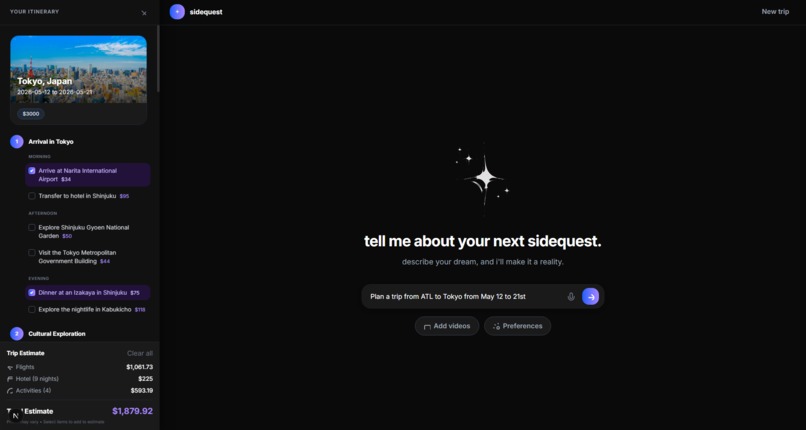
sidequest interface/dashboard
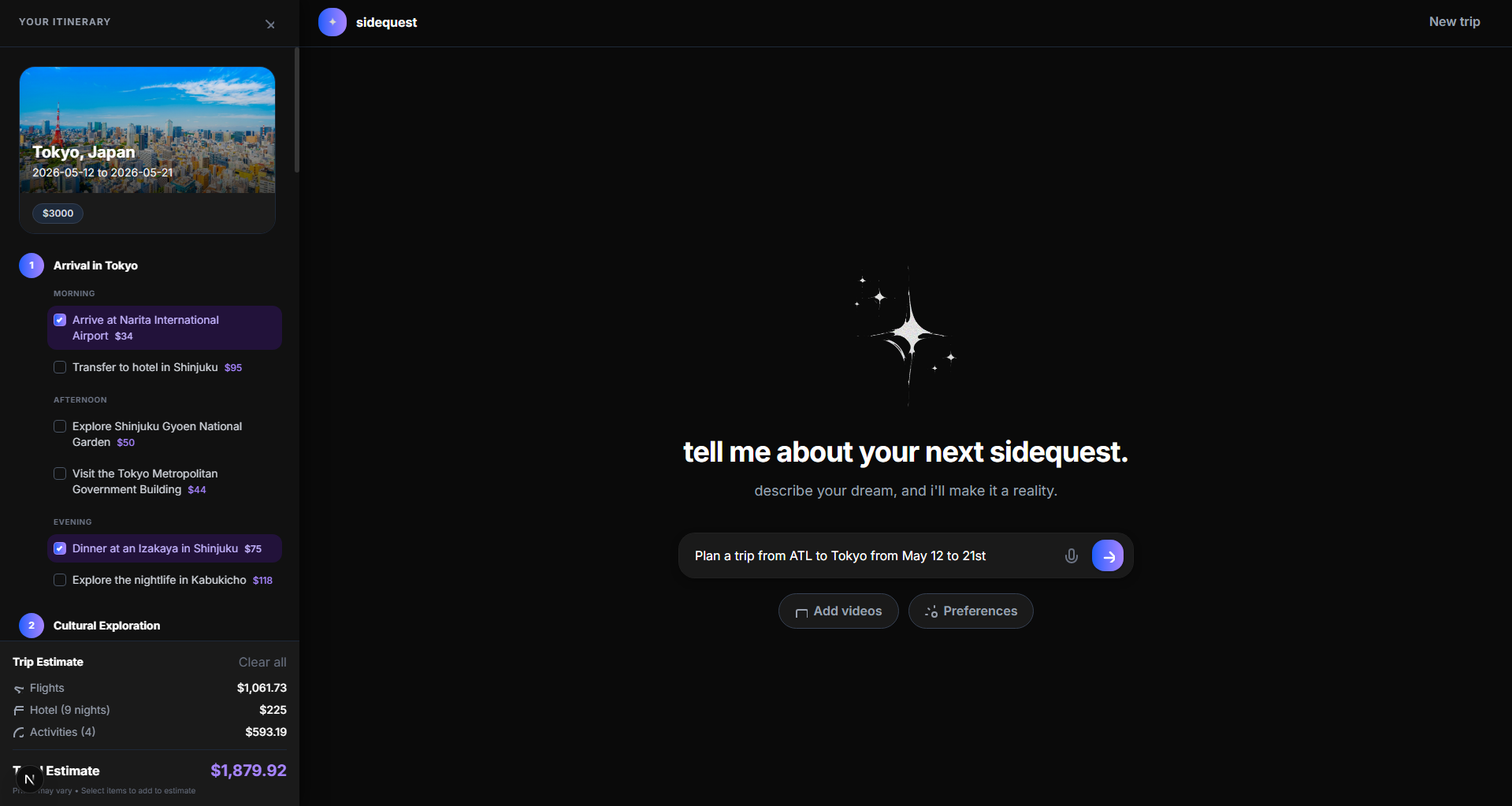
Inspiration
Planning travel is broken. As college students, we’ve experienced how fragmented and time-consuming it is to turn inspiration into an actual booked trip. While 84% of Gen Z use social media for travel inspiration, travelers still spend 8.5+ hours consuming content before they ever book. Platforms like TikTok and Instagram fuel inspiration, but converting that inspiration into flights, hotels, and a coherent itinerary requires juggling dozens of tabs, apps, and price comparisons.
The problem isn’t a lack of information, it’s decision fatigue. We wanted to build something that doesn’t just suggest ideas, but actually executes on them.
What it does
sidequest is an agentic AI travel assistant that plans, refines, and executes trips end-to-end.
Users describe their trip in natural language, or paste in social media travel videos, and sidequest:
- Generates a structured, day-by-day itinerary
- Estimates total trip cost in real time
- Allows users to customize activities and hotel/flight options
- Initiates booking through links for flights, hotels, and activities
Instead of searching and comparing manually, users delegate intent to an AI agent that decides on their behalf.
How we built it
sidequest is built as a web-based agentic AI system optimized for fast iteration and real-world execution.
Frontend:
- Next.js (App Router)
- Tailwind CSS + shadcn/ui
- Responsive layout with a chat interface + live itinerary sidebar
Backend:
- Next.js API routes
- Zod schemas to enforce structured AI outputs
- Stateful itinerary management for iterative planning
AI & Agent Logic:
- OpenAI models used as a goal-driven agent, not a chatbot
- The agent follows a ReAct-style loop:
- Reason about user intent
- Call tools (planning, pricing, discovery)
- Update itinerary state
- Re-plan based on user feedback
Execution Layer:
- Google Places for activity discovery
- Deep-linked booking flows (flights, hotels, activities)
- Real-time cost estimation to support decision-making
Overshoot:
- We used Overshoot to extract locations and geographic signals from TikTok and Instagram travel videos
- Detected places are aggregated across videos and passed into our AI agent as hard planning constraints
- This lets sidequest turn social media inspiration directly into structured, bookable itineraries, closing the loop from discovery → planning → execution
Challenges we ran into
Alternating our API keys when testing without maxing out our usage.
Enforcing structured AI output: LLMs naturally produce prose, so we had to strictly constrain responses to valid JSON and implement retries and validation.
Balancing realism with hackathon constraints: True in-app bookings require enterprise-level partnerships, so we designed flows that are demo-realistic while still honest about scope.
Maintaining state across revisions: Allowing users to iteratively modify plans required careful state management so the agent didn’t “start over” each time.
Time pressure: Building an end-to-end product in under 24 hours required prioritization.
Accomplishments that we're proud of
Built a true agentic AI system, not just an LLM wrapper
Shipped an end-to-end flow from intent → plan → execution
Designed a product that feels immediately usable, not theoretical
Created a polished, judge-ready UI that clearly communicates value
Deployed something we actually want to use and will be using for our future trips
What we learned
Agentic AI is about decision-making and execution, not just text generation
Users don’t want more recommendations, they want fewer decisions, faster
What's next for sidequest
True in-app bookings with payment and confirmation
Scrape web for student discounts to optimize trip spending
Personalized agents that learn user preferences over time
Collaborative trip planning for groups
Mobile app deployment
Built With
- css
- devswarm
- google-places
- next
- openai
- overshoot
- typescript
- wispr-flow


Log in or sign up for Devpost to join the conversation.