Pitch 💡
Travalero integrates Skyscanner API data, Tinder-inspired preference-based matching, and AI assistance via a custom agent to solve the complex problem of finding optimal meeting points for international friend groups. Our Flask backend processes flight availability data through custom algorithms that minimize group travel costs, while our Next.js frontend provides an intuitive interface for preference collection and real-time collaborative trip planning with embedded AI assistance.
What makes our project unique? 🏆
Our project is different from the other Skyscanner Challenge submissions in many ways:
- Custom Qwen Agent Integration -- Our implementation integrates the Qwen large language model agent through a custom Flask endpoint (
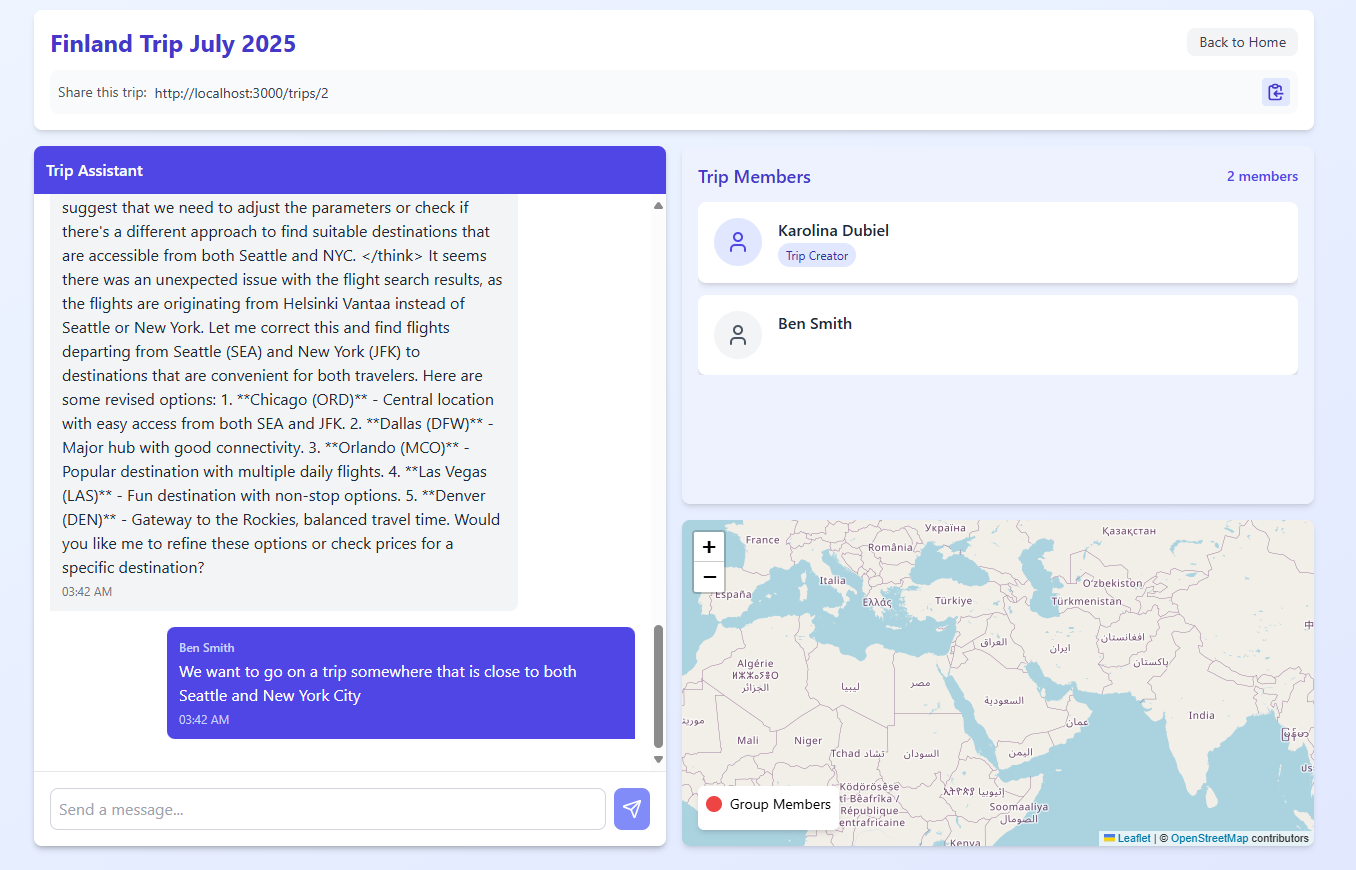
backend/ai.py), enabling intelligent travel recommendations. Within a trip group, each user's travel preferences, stored as JSON in our PostgreSQL database via SQLAlchemy ORM models (backend/models.py), are passed to the Qwen agent for context-aware responses. The agent uses this information to generate personalized recommendations, answering questions about destinations and activities while considering all group members' preferences simultaneously.
For a demonstration of the standalone Qwen agent via Gradio, see this video: https://youtu.be/HtR5K8Tt8zI - Advanced Qwen Algorithm -- We created a custom flight optimization engine (
gradiotest/skyscanner_api.py) that queries the Skyscanner API with the specific date ranges and origin airports of all group members. Our algorithm (find_top_k_full_pathsfunction) computes a comprehensive cost matrix, identifying destinations that minimize the sum of travel costs across all participants. The system intelligently handles multi-leg journeys and self-transfer flights, significantly expanding the range of possible meeting points. - Preference Collection with React-Based Tinder Interface --
- Real-Time Collaborative Architecture -- Our system enables multiple users to interact simultaneously -- like Google Docs! The backend (
backend/app.py) serves as an intermediary, storing all messages in the PostgreSQL database and retrieving them with eager loading via SQLAlchemy to minimize database queries. The chat interface (app/components/ChatInterface.tsx) connects to our custom /api/chat endpoint which forwards messages to the Qwen agent, maintains context across the conversation, and broadcasts responses to all connected clients.
The Basic User Flow 👇

- Users access the login page. We use cookies to authenticate, so no login is necessary! --> The user chooses whether they want to view an existing trip (if one exists) or make a new trip
- Upon clicking "Create Trip", the user undergoes the "Tinder-like" selection system, where the system gathers information including the origin airport, passport, and travel preferences of the user.

- The dashboard loads. From here, the user can access a custom AI agent chat that takes into account the preferences of all users.
 --> The user can invite new friends to the trip with a link, and they will all be able to collaboratively chat with the interface. Any new friend will be prompted to complete the "Tinder-inspired" onboarding upon clicking the link so that their preferences can be collected.
How we built it 🛠️
- Frontend: Next.js 14, React, Tailwind CSS
- UI Components: Custom React components with Lucide icons
- Backend: Flask for API endpoints and server logic
- Database: PostgreSQL with SQLAlchemy ORM
- Authentication: JWT-based auth with HTTP-only cookies
Challenges we encountered 💪
- API Integration: Synchronizing OpenAI API calls with our Flask backend required careful error handling and rate limiting
- Real-time Chat: Implementing scrollable chat interface with proper state management proved technically challenging
- Database Schema: Designing flexible schema to accommodate varied trip details and user preferences required multiple iterations
- Authentication Flow: Balancing security with user experience when implementing JWT authentication
What's next for Travelero ⁉️
- Offline Mode: Implementing data caching for limited functionality without internet connection
- Multi-language Support: Expanding AI capabilities to handle queries in multiple languages
- Trip Sharing: Adding collaborative features for group trip planning with shared access controls
- Custom Recommendations: Enhancing AI model with fine-tuning based on user feedback and preferences
- Integration: Connecting with third-party booking APIs to enable direct reservations within the platform
Built With
- css
- http
- jwt
- lucide
- next.js
- postgresql
- react
- sqlalchemy
- tailwind


Log in or sign up for Devpost to join the conversation.