-
-
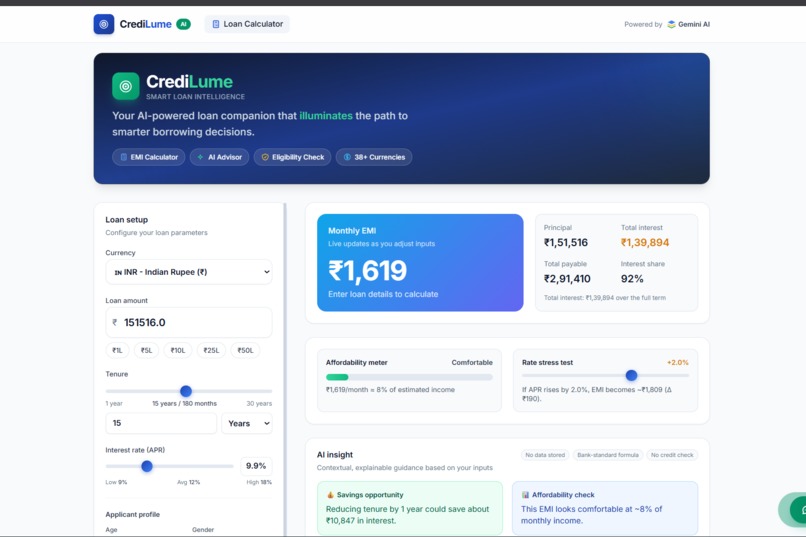
homepage
-
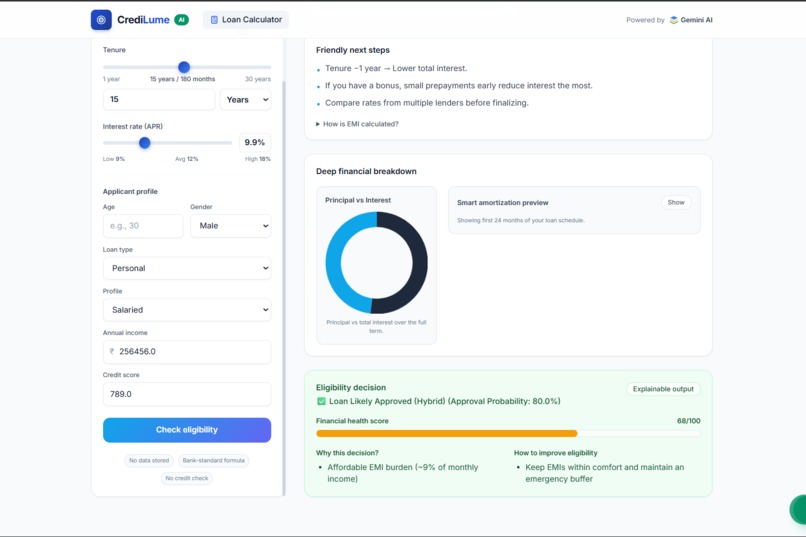
-
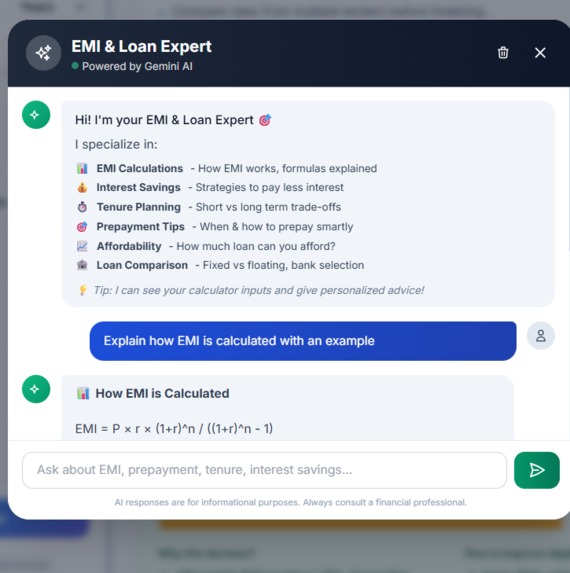
emi-advisor
-
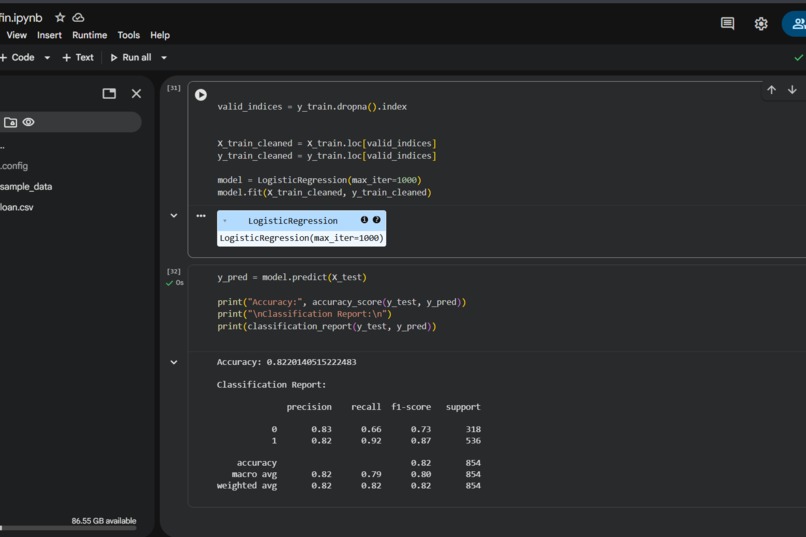
accuracy
Inspiration
For most people, applying for a loan is a leap of faith. You enter numbers, submit forms, and wait—often without understanding whether approval is realistic or whether the EMI will strain your finances. When applications are rejected, the silence is worse than the rejection itself. There’s no explanation, no guidance, and no clear next step. We built CrediLume to replace this uncertainty with clarity. The goal wasn’t just to predict eligibility, but to help people understand their financial readiness before taking on long-term debt.
What it does
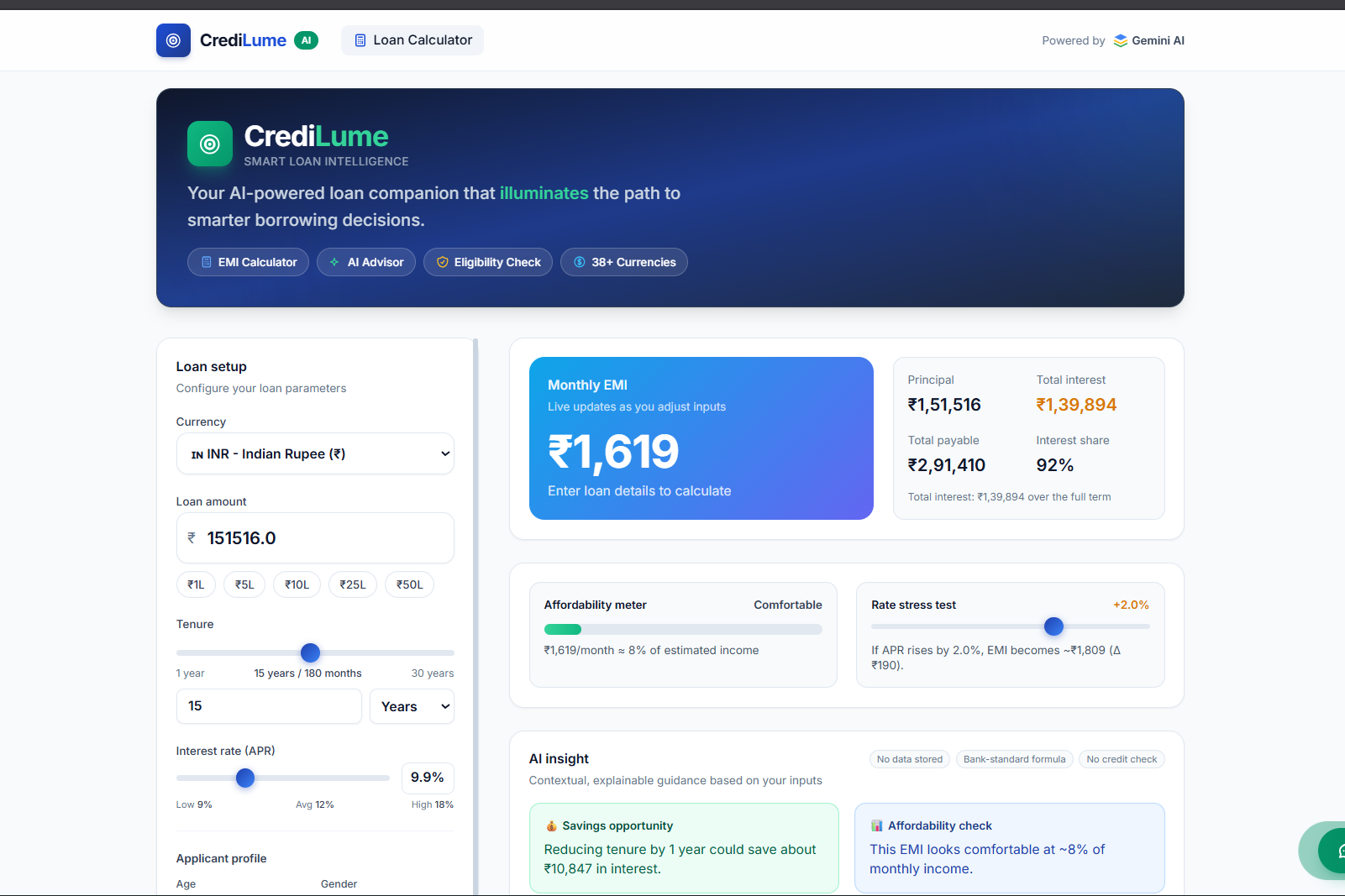
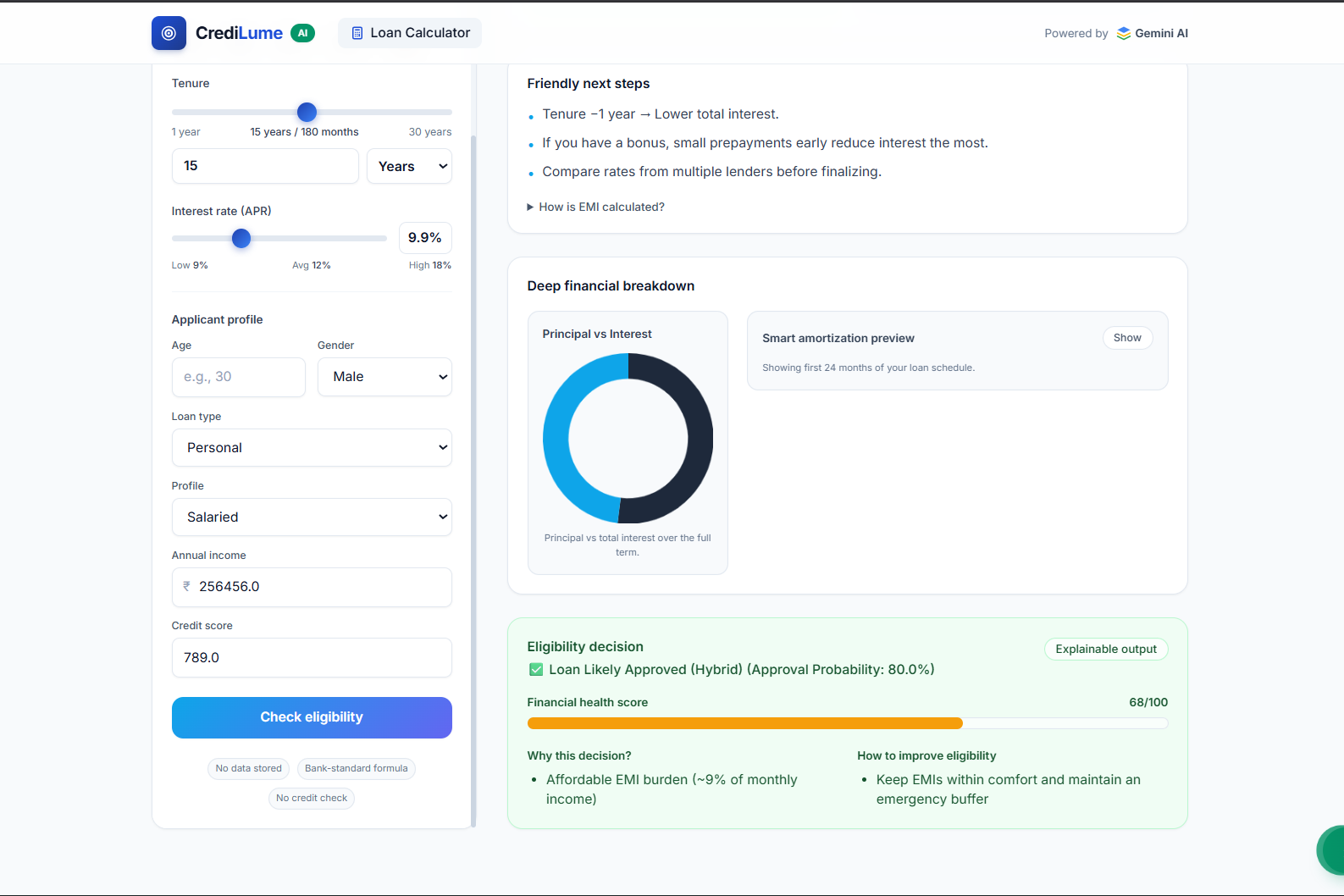
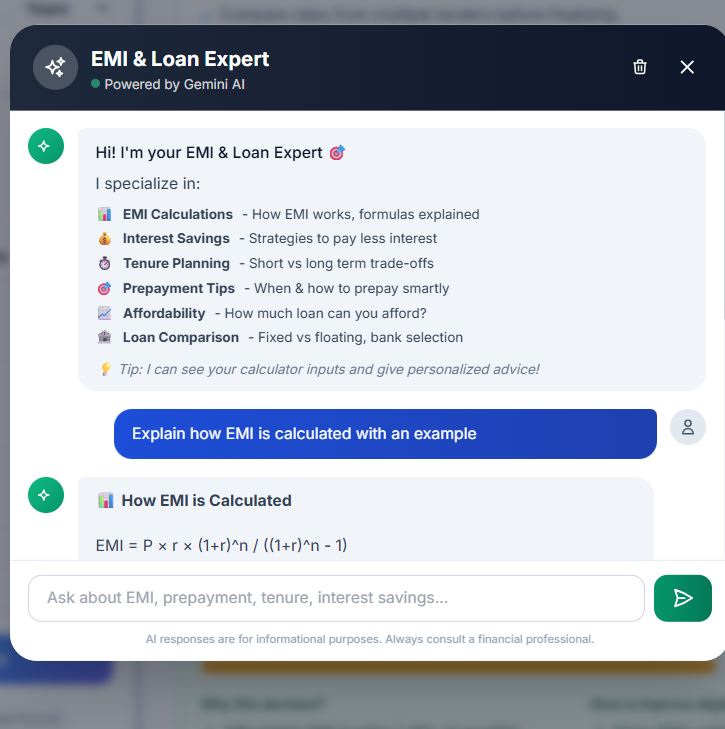
CrediLume acts as a pre-loan decision companion. It evaluates loan eligibility, calculates EMI and total repayment, and explains how these outcomes are influenced by a user’s financial profile. Instead of treating eligibility as a black box, the platform highlights affordability signals like income stability and debt burden, and turns them into clear insights. It also provides practical, realistic suggestions that users can act on immediately. For those who opt in, CrediLume integrates an AI-powered advisor using the Gemini API to deliver more personalized financial guidance without overwhelming the user.
How we built it
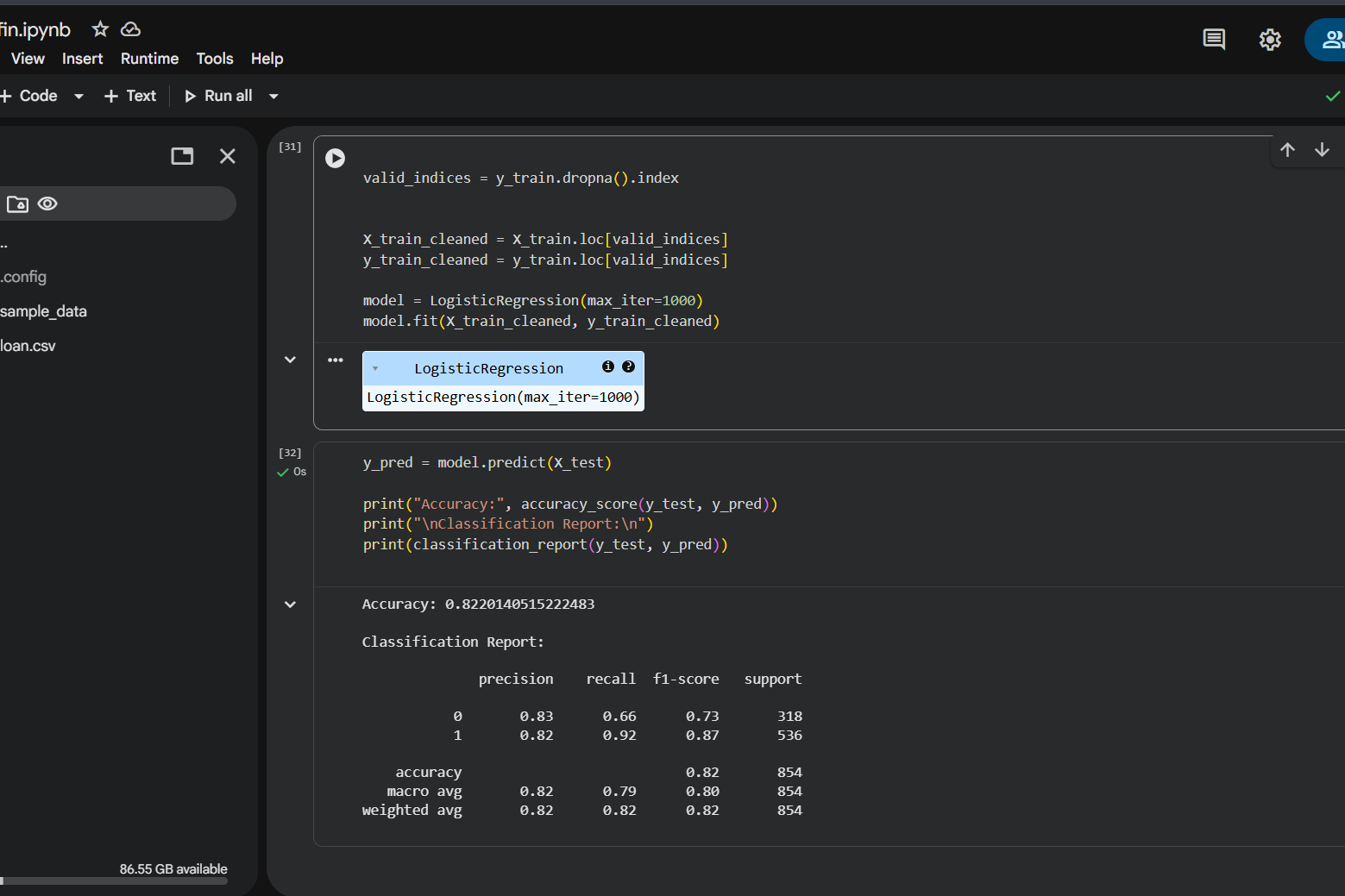
We designed CrediLume as a lightweight yet production-ready web application using Flask, with a simple frontend built in HTML and JavaScript to keep the focus on usability. At its core is a trained machine learning model (loan_model.pkl) supported by structured feature handling (features.pkl) to ensure consistent predictions. The application is served via Gunicorn and deployed on Render, allowing us to test and refine the system in a real deployment environment rather than a purely local setup.
Challenges we ran into
The most challenging part wasn’t building the model—it was designing a system that makes responsible decisions under imperfect, real-world inputs. Financial data is often incomplete, inconsistent, or edge-case heavy, and the system needed to remain stable while still producing meaningful insights. A major focus was ensuring that eligibility logic, affordability calculations, and explanations stayed aligned across different user scenarios. Rather than asking only “does it work?”, we had to continuously ask “does this output make sense, and can a user act on it safely?”
Accomplishments that we're proud of
What we’re most proud of is that CrediLume doesn’t reduce people to a single score or outcome. The platform explains decisions, visualizes affordability through EMI and Debt-to-Income (DTI), and remains functional even without AI-based enhancements. This ensures accessibility while still offering depth for users who want it. Most importantly, the system respects users by giving them information they can actually use.
What we learned
This project reinforced that real-world machine learning is as much about engineering and communication as it is about prediction accuracy. A correct answer is not always a helpful one unless users understand it. We learned that explainability, transparency, and actionable feedback are essential—especially in financial applications where trust matters.
What's next for CrediLume
Next, we aim to strengthen the model by incorporating richer financial signals and expanding beyond static eligibility checks. We envision CrediLume evolving into a proactive financial planning assistant—one that helps users improve their credit readiness over time, not just evaluate it at a single moment.
Built With
- css3
- flask
- gunicorn
- html
- javascript
- numpy
- python
- render
- scikit-learn


Log in or sign up for Devpost to join the conversation.