Inspiration
Picture this: you finish your coffee in DICE, walk up to the Zero Waste Station, and freeze. Is the cup recyclable? What about the lid? Everyone around you is guessing too.
And the answer just changed. On October 1, 2026, Edmonton expanded what goes in the blue bag: coffee cups, chip bags, candy wrappers and foam are now recyclable at home. But on campus, the UofA's bins still send most of those to landfill. Most online guides (and chatbots) haven't caught up.
We wanted something that knows Edmonton's rules as of this month, works for both home and campus, and is honest when it isn't sure.
What it does
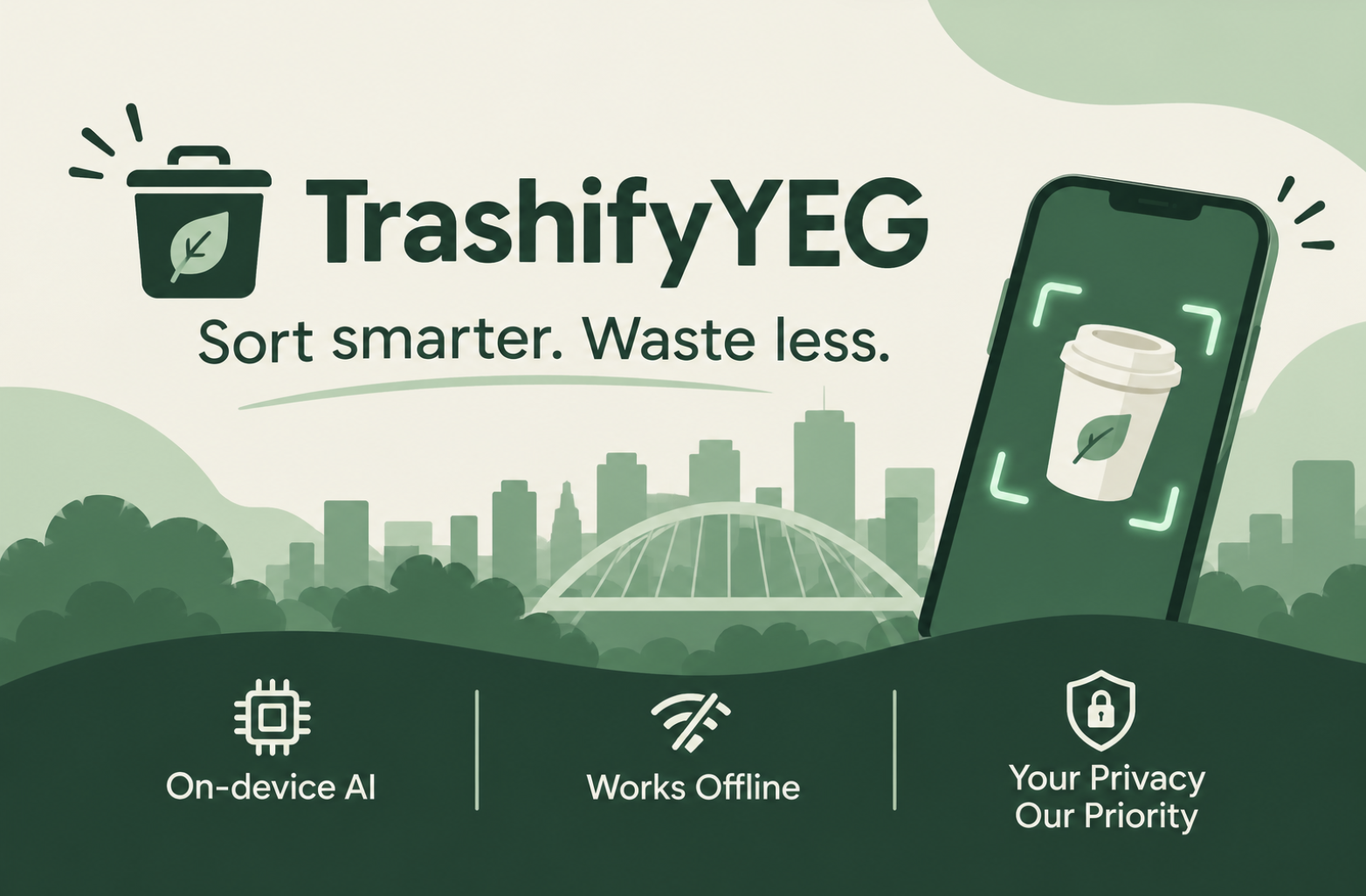
Point your phone at an item, and TrashifyYEG tells you which bin it goes in, why, and how to prep it, with a link to the official City or UofA source.
- Home or Campus: one tap switches between Edmonton's rules and UofA's rules. The same coffee cup goes in the blue bag at home and landfill on campus.
- It asks instead of guessing: if the bin depends on the item's condition, it asks one quick question, like "Is the pizza box soaked with grease?" If it isn't confident, it shows its top 3 guesses and lets you pick.
- Bottle depot reminders: drink containers point you to the depot, with the 10¢ or 25¢ refund.
- Your impact: a personal count of items you've kept out of landfill, plus a faculty leaderboard so Engineering can try to beat Science.
- Private and offline: the AI runs on your phone, so your photo never leaves it. After your first visit, it works without internet.
- No camera? No problem: upload a photo or just type the item.
How we built it
- On-device AI: OpenAI's CLIP model runs right in the browser with Transformers.js. No training needed: we wrote 120 short descriptions for 44 everyday items, and the model matches your photo to the closest one.
- Smart decision step: TrashifyYEG only answers on its own when it's confident and its top two guesses belong in the same bin. Otherwise it asks you. We chose the confidence cut-off by testing, not by guessing.
- Rules engine: we read through City of Edmonton, UofA and Alberta bottle depot pages and turned them into rules for all 44 items, for both home and campus. Every answer links back to its source.
- Accuracy testing: we built a tool that runs the model on labelled photos and reports how often it picks the right item and the right bin.
- Backend: a small Express server with a PostgreSQL database for the faculty leaderboard. It rejects impossible scans and calculates CO₂ itself, so scores are hard to fake.
- Frontend: TypeScript and Vite, designed mobile-first, with bin colours and icons and text so it works for colour-blind users too.
- Hosting: the app is on Vercel; the leaderboard API and database run on our own server.
- Testing: 250+ automated tests, plus browser tests that check accessibility, offline mode and the camera flow on mobile and desktop.
Challenges we ran into
- The rules changed six weeks ago. Old and new City pages sometimes disagreed, and campus rules are completely different. For items where the City isn't clear (receipts, tissues, plastic utensils), we show "Check before you toss" instead of guessing.
- Right item ≠ right bin. The model could be 94% sure something is a pop can, but if its second guess is a food can, those go in different places. So we made it ask in those cases. It asks more often, but it's rarely wrong when it answers.
- Running AI in a browser, offline. Getting the model, a service worker and caching to cooperate on a phone took a lot of trial and error.
- Testing honestly. We didn't have time to photograph items at the venue, so we built a test set of freely licensed photos and clearly labelled where every number came from.
Accomplishments that we're proud of
- 89% right bin from the top guess on our 93-photo test set (freely licensed web photos), and 97% when TrashifyYEG answers without asking.
- It catches its own mistakes: a battery it once confused with a candy wrapper now triggers the "Is this a…?" picker instead of a wrong answer.
- It works in airplane mode after one visit.
- Your photo never leaves your phone. No accounts, no photo uploads.
What we learned
- Recognising an item and knowing where it goes are two different problems. AI is good at the first one. The second needs real, local, cited rules.
- Measure before you tweak. Changes we were sure would help barely moved the accuracy. Testing told us what actually mattered.
- Honesty builds trust. Saying "I'm not sure, is it one of these?" is better than being confidently wrong.
What's next for TrashifyYEG
- Better accuracy: our current test set uses 93 freely licensed web photos. Next, we'll add our own photos of common items to keep improving accuracy, without ever collecting users' photos.
- QR codes on the bins: a QR code on each Zero Waste Station that opens TrashifyYEG straight in campus mode.
- Better CO₂ estimates: weigh common items so the CO₂ savings cover more than just pop cans.
- More cities: Calgary and other cities have their own rules. The app stays the same; only the rules change.
Built With
- axe-core
- clip
- cloudflare
- css
- express.js
- html
- javascript
- node.js
- onnx-runtime
- playwright
- postgresql
- pwa
- python
- service-workers
- shell
- tmux
- transformers.js
- typescript
- vercel
- vite
- vitest
- web-audio-api
- web-speech-api
- web-workers
- zod
