-
-
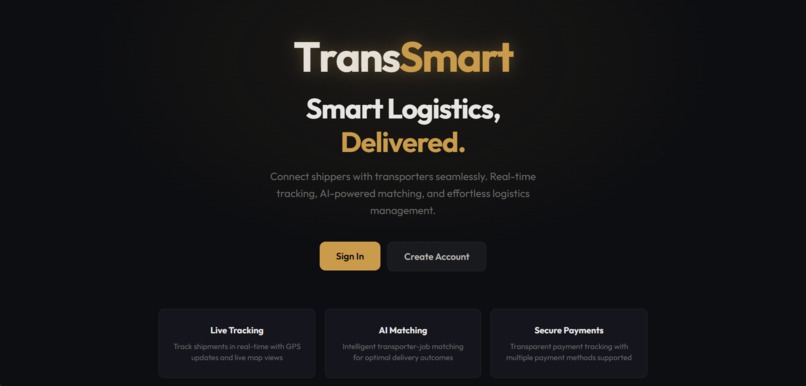
TransSmart
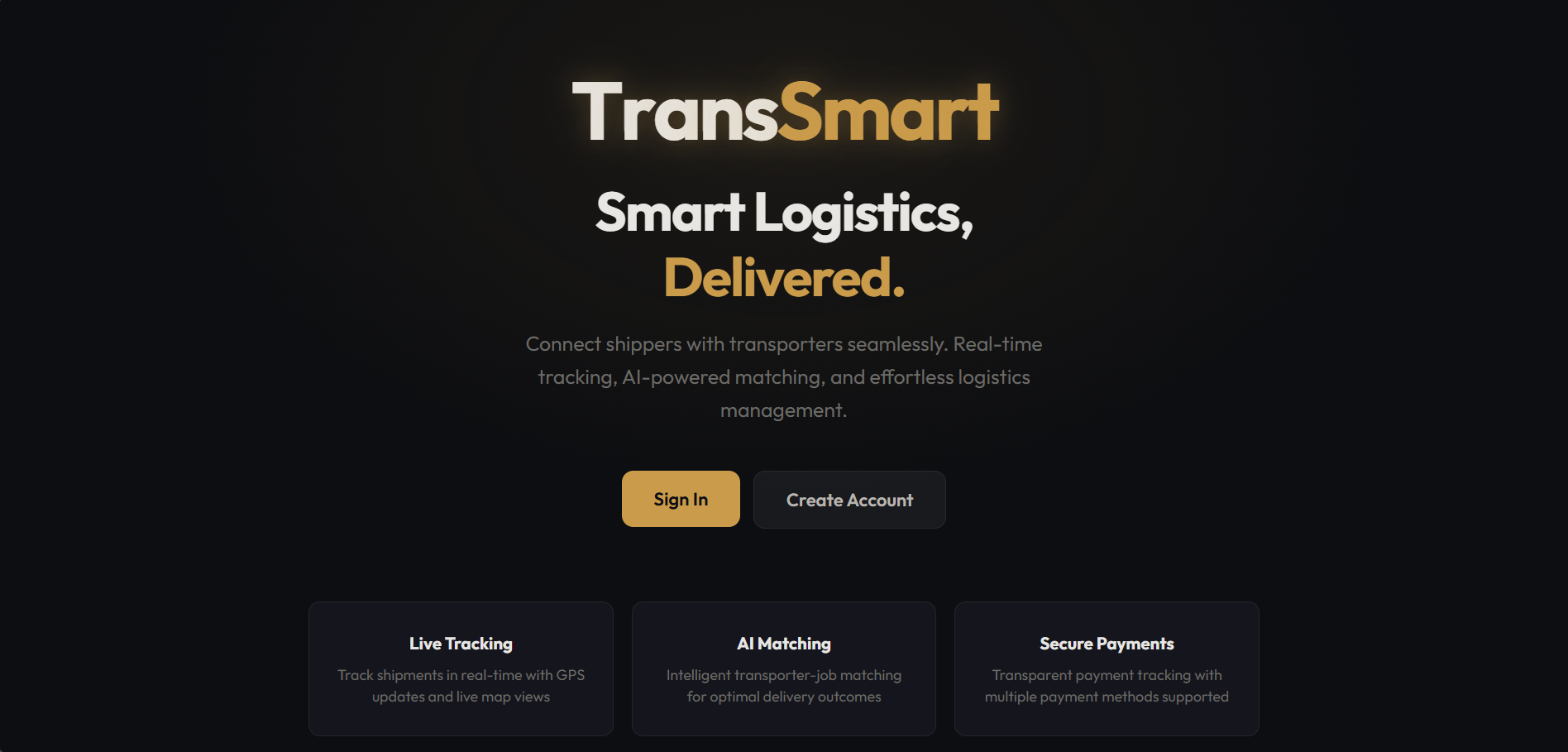
TransSmart – Smarter Routes. Better Logistics
ABOUT THE PROJECT
Modern logistics powers global trade, yet a large portion of the industry still relies on manual coordination, fragmented communication, and inefficient routing systems.
One of the biggest inefficiencies in freight transport is the problem of empty return trips, where trucks travel back after deliveries without carrying any cargo.
This leads to several operational issues:
- Fuel wastage
- Higher operational costs
- Increased carbon emissions
- Poor truck utilization
At the same time:
- Shippers struggle to quickly find reliable transporters
- Transport providers lack consistent job visibility
- Shipment tracking is often unavailable
Our Solution
TransSmart is an AI-powered logistics platform designed to intelligently connect shippers and transporters, optimize delivery routes, and provide real-time shipment visibility.
The goal is to transform traditional logistics into a smart, automated, and transparent digital ecosystem.
INSPIRATION
The idea for TransSmart came from observing how inefficient many logistics workflows still are, even in the digital era.
A common situation in freight transportation is:
- A truck completes a delivery
- The truck returns empty
- Another shipper nearby is looking for transport
Because there is no intelligent platform connecting these needs, valuable transportation capacity is wasted.
We realized that combining:
- Artificial Intelligence
- Real-time tracking
- Smart route optimization
could significantly improve logistics efficiency.
TransSmart was created to bridge this gap and modernize freight coordination.
HOW WE BUILT IT
TransSmart was developed using a modern full-stack architecture optimized for real-time logistics operations.
Frontend
The frontend provides a responsive and intuitive interface.
Technologies used
- React.js for dynamic user interfaces
- Tailwind CSS for responsive design
- Leaflet / Mapbox for interactive map visualization
These tools allow users to manage jobs, track deliveries, and view optimized routes through an interactive interface.
Backend
The backend handles the platform’s core logistics workflows.
Technologies used
- Node.js for scalable server-side runtime
- Express.js for REST API development
Backend services manage:
- Job creation and management
- Truck availability tracking
- Trip lifecycle handling
- Notifications and system updates
- Payment and invoice processing
Database
Logistics data is stored using scalable databases.
Technologies
- PostgreSQL
- MongoDB
Stored data includes:
- User profiles
- Truck information
- Shipment jobs
- Trip history
- Payment records
Real-Time Communication
To enable real-time updates, TransSmart uses WebSockets.
This allows:
- Live truck tracking
- Instant job notifications
- Real-time trip status updates
Routing and Geolocation
Route optimization is powered by modern geospatial tools.
Technologies used
- OSRM (Open Source Routing Machine) for route optimization
- OpenRouteService API for routing data
- Nominatim Geocoding for converting addresses into coordinates
These services generate multiple route options and identify the most efficient path.
AI Integration
Artificial Intelligence enhances logistics decision-making.
TransSmart integrates Groq LLM to evaluate route options and recommend the most efficient route based on factors such as:
- Distance
- Estimated travel time
- Traffic conditions
- Environmental impact
External APIs
Additional external data sources improve route accuracy.
- OpenWeatherMap API is used to incorporate weather conditions into route planning.
Payment Integration
Payments are supported using Razorpay (mock integration).
This enables:
- Digital payment processing
- Automated invoice generation
- Payment tracking
SDG ALIGNMENT
TransSmart aligns with multiple United Nations Sustainable Development Goals (SDGs) by improving efficiency and sustainability in freight transportation.
SDG 9 – Industry, Innovation and Infrastructure
TransSmart introduces an AI-powered logistics platform that modernizes freight coordination through digital infrastructure, intelligent routing, and automated job matching.
SDG 11 – Sustainable Cities and Communities
By optimizing delivery routes and reducing inefficient trips, the platform helps reduce traffic congestion and improves urban logistics efficiency.
SDG 12 – Responsible Consumption and Production
The platform improves truck utilization and reduces empty return trips, minimizing wasted transportation resources.
SDG 13 – Climate Action
Optimized routes and return-load matching reduce fuel consumption and CO₂ emissions, contributing to more sustainable logistics.
WHAT WE LEARNED
Building TransSmart provided valuable experience in developing real-time intelligent logistics platforms.
Key learnings include:
- Designing scalable full-stack architectures
- Implementing real-time communication using WebSockets
- Integrating AI decision systems into logistics workflows
- Working with mapping and routing APIs
- Managing complex logistics lifecycles
We also learned how automation and data-driven systems can significantly improve efficiency in industries that traditionally rely on manual coordination.
CHALLENGES WE FACED
Address Geocoding Accuracy
Logistics addresses are often incomplete or unclear, making location detection difficult.
We improved accuracy by implementing fallback mechanisms and using multiple geolocation services.Route Optimization Complexity
Finding the best route required balancing several factors such as distance, travel time, traffic conditions, and fuel efficiency.
We solved this by combining routing engines with AI-based route evaluation.Real-Time Tracking Stability
Maintaining smooth real-time location updates required a stable WebSocket architecture and efficient event handling.Preventing Job Conflicts
Transporters should not accept multiple jobs at the same time.
We implemented backend checks to prevent drivers from accepting new jobs while already on an active trip.Data Synchronization
Keeping jobs, trips, payments, and notifications updated consistently required careful backend data synchronization.
FUTURE ENHANCEMENTS
To further improve efficiency, scalability, and user experience, TransSmart can be expanded with the following features:
Mobile Application Integration
Develop mobile apps for drivers and shippers with push notifications and real-time tracking.AI-Based Demand Prediction
Use historical logistics data to predict high-demand routes and help transporters plan trips in advance.Offline Mode
Allow limited functionality during poor internet connectivity and automatically sync data once the connection is restored.Advanced Analytics Dashboard
Provide insights on fuel savings, trip performance, driver earnings, and overall logistics efficiency for fleet owners and companies.Blockchain-Based Transparency
Use blockchain technology to secure shipment records and payment transactions, improving trust and reducing disputes.Green Logistics Incentive Program
Introduce rewards for eco-friendly transport practices such as optimized routing and reduced emissions.
CONCLUSION
TransSmart demonstrates how AI, real-time technologies, and intelligent logistics workflows can transform traditional freight systems.
By reducing empty truck trips, optimizing delivery routes, and enabling real-time shipment tracking, the platform creates a logistics ecosystem that is:
- More efficient
- More transparent
- More sustainable
TransSmart represents a step toward the future of AI-powered smart logistics systems.
Built With
- axios
- express.js
- framermotion
- geocoding
- git
- github
- groq
- html5
- javascript
- jwt
- leaflet.js
- map
- mapbox
- mongodb
- node.js
- nominatim
- npm
- openrouteservice
- osrm
- razorpay
- react.js
- socket.io
- tailwind
- ui
- websockets


Log in or sign up for Devpost to join the conversation.