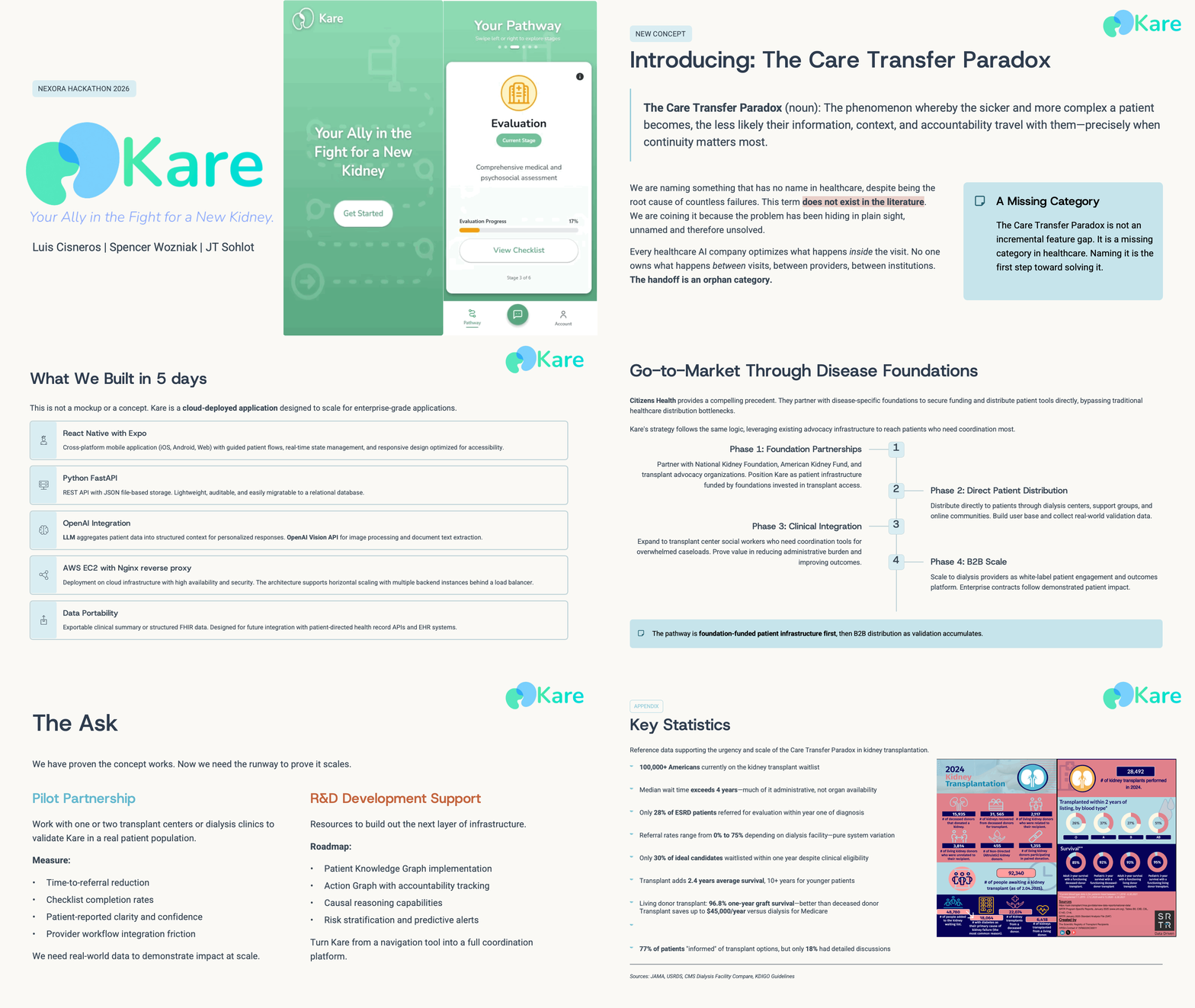


Inspiration
Kidney transplantation offers far better survival and quality of life than long-term dialysis, yet access remains inconsistent and inequitable. Many eligible patients are never adequately informed, referred, or guided through the process.
The problem is not primarily medical; it is structural. Misaligned incentives, fragmented information systems, inconsistent education, and health data locked in institutional silos leave patients to coordinate complex evaluations on their own, often while managing fatigue, cognitive burden, and social barriers.
Kare was inspired by a simple question:
What if patients had a clear map of the transplant journey and control over the data that determines their access to care?
What it does
Kare is a patient-controlled kidney transplant navigation app that helps dialysis patients understand where they are in the transplant journey and what they can do next.
The app provides:
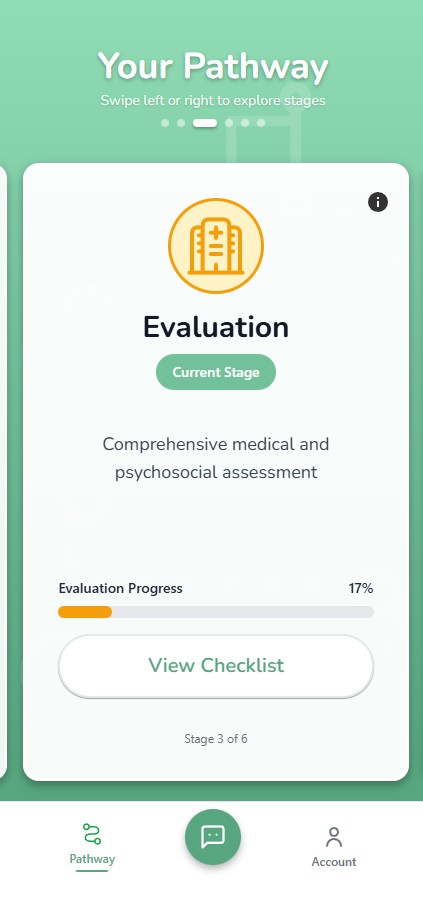
A visual transplant pathway showing each stage from awareness to post-transplant life, with progress computed from patient data
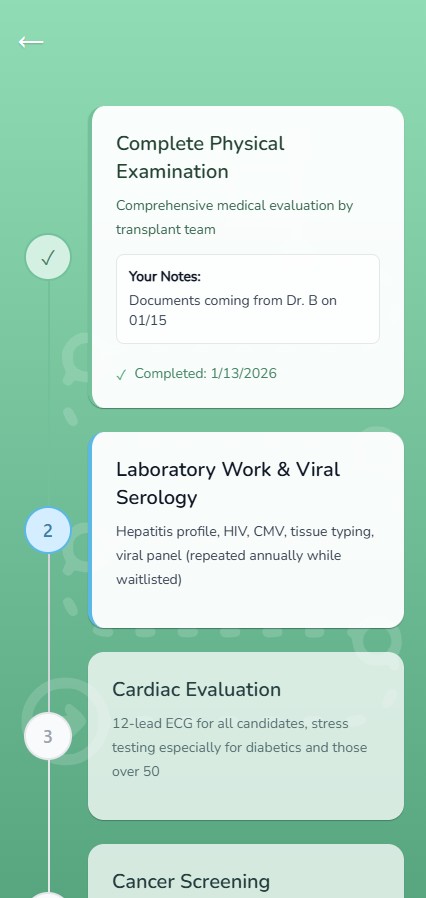
An interactive pre-transplant checklist that tracks required tests, evaluations, and documentation with dependency-aware completion logic
Patient-controlled data tracking, allowing users to organize and reference their own medical records independently of EHR systems
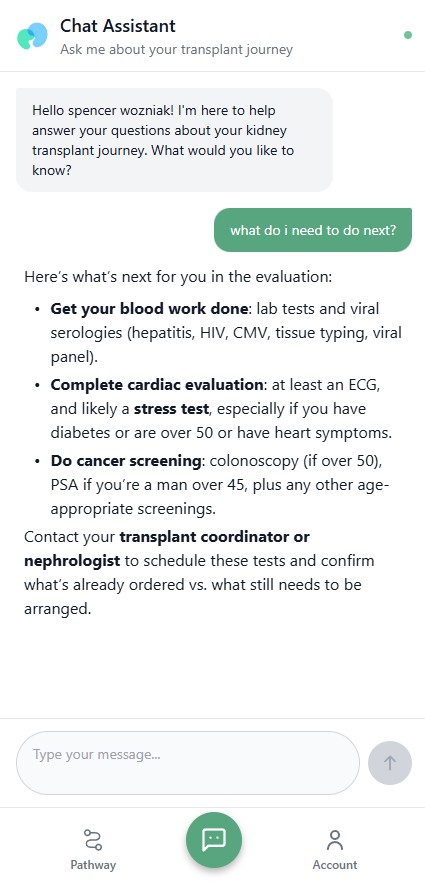
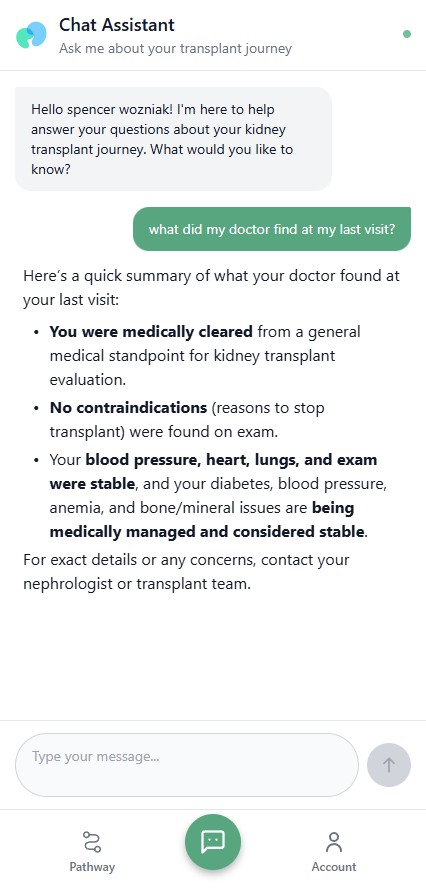
An AI guidance layer that explains eligibility factors, clarifies next steps, and answers questions using context-aware prompts that incorporate pathway stage, checklist progress, and referral status
Kare functions as an independent navigation and data-portability layer, helping patients advocate for themselves and coordinate care when institutional support is limited.
How we built it
Kare is the first vertical implementation of a broader patient empowerment platform built around a longitudinal pathway model.
Pathway Architecture
The transplant journey is modeled as a sequence of milestones:
- Identification
- Referral
- Evaluation
- Selection
- Transplantation
- Post-Transplant
Pathway stage is computed dynamically from questionnaire responses, checklist completion, and referral status using deterministic logic that accounts for temporal dependencies. Patient actions trigger real-time recomputation, updating both the visual pathway and AI context while maintaining a temporal record of the journey.
The system is intentionally EHR-agnostic and facility-independent, reinforcing patient autonomy and data ownership.
Frontend
- React Native + Expo for iOS, Android, and Web from a single codebase
- TypeScript for end-to-end type safety
- NativeWind (Tailwind CSS for React Native) for accessible, low-cognitive-load UI
- React Native SVG for custom pathway visualizations and iconography
- React Native Reanimated for smooth animations and transitions
- Custom navigation system with flow-based handlers for onboarding, assessment, financial, checklist, and referral flows
- Platform-specific optimizations for web (mouse drag scrolling, responsive layouts) and native mobile
Backend
- FastAPI (Python 3.9+) with async REST endpoints
- Pydantic for schema validation and data models
- JSON file-based storage (per-patient files) for MVP independence—no database dependency
- In-memory TTL cache for frequently accessed data to reduce file I/O
- Modular service architecture
- Uvicorn ASGI server for production deployment
AI Guidance
- OpenAI API with real-time streaming responses (Server-Sent Events)
- Structured context aggregation from pathway stage, checklist progress, referral status, financial profile, and patient inputs
- OpenAI Vision API for image processing and document text extraction
- Guardrails to prevent hallucination when data is incomplete
- Explainable, guideline-based responses grounded in the patient's actual state
- Async streaming implementation optimized for deployment behind AWS load balancers
Deployment & Infrastructure
Frontend: The web application is currently hosted on Vercel. Native iOS deployment to the App Store is planned for the near term.
Backend: The FastAPI backend runs on AWS EC2 with Nginx as a reverse proxy as a systemd service for automatic restarts and process management. The architecture supports horizontal scaling with multiple backend instances behind a load balancer.
Development Acceleration
Cursor was used to accelerate development while maintaining human control over clinical logic and safety-sensitive decisions.
Challenges we ran into
Balancing simplicity with completeness: Patients navigating kidney disease may be fatigued, cognitively impacted, or overwhelmed, yet the app must still collect sufficient data to generate accurate pathway guidance.
Designing reliable AI with incomplete data: The same simplicity constraints meant the AI often had to operate on partial or inconsistent patient information. Constructing prompts and decision logic without over-assuming or hallucinating missing context required explicit handling of null values, optional fields, and graceful degradation when data sources were unavailable.
Unstructured data integration: Healthcare data exists primarily in unstructured formats. While Kare accepts document uploads and uses OpenAI Vision API for text extraction, the challenge of parsing and extracting structured information from these sources remains a significant technical hurdle that limits the system's ability to automatically populate patient records.
Cross-platform consistency: Ensuring the React Native Web implementation provided equivalent functionality to native mobile, particularly for file uploads, date pickers, and scrollable lists, required platform-specific abstractions and web-specific workarounds (e.g., mouse drag scrolling, web-safe date pickers).
Streaming AI responses behind proxies: Implementing true streaming (not buffered) for AI responses required careful async/await patterns and explicit event loop yielding, especially when deployed behind AWS load balancers or Nginx reverse proxies that may buffer responses.
Accomplishments that we're proud of
Building a clear, end-to-end visualization of the transplant pathway with deterministic stage computation that updates in real-time as patients complete actions
Turning a traditional checklist into a patient-owned data tracking and portability tool that functions independently of institutional systems
Demonstrating how AI can reduce confusion rather than add complexity through context-aware prompts that ground responses in the patient's actual pathway state
Creating a credible, patient-centric alternative to fragmented education materials and institution-locked portals
Implementing a lightweight, database-free architecture that maintains data portability and auditability while remaining easy to deploy and maintain
Most importantly, we built a prototype that shows how patients can move from passive recipients of care to active coordinators of their own health journey.
What we learned
The biggest barrier to transplant access is not eligibility, it is clarity and coordination. Patients disengage when they cannot see where they are or how to move forward.
We also learned that data portability is foundational. When patients control and understand their own records, they become the hub of care coordination. However, the unstructured nature of healthcare data remains a major technical challenge.
True patient empowerment requires restraint: the goal is not to prescribe, but to make reality understandable and navigable.
What's next for Kare
In the near term, we plan to:
- Make onboarding more conversational by using AI chat
- Improve authentication for production-ready deployment
- Improve financial and SDOH recommendations with location-based filtering
- Migrate to a database (PostgreSQL or MongoDB) to support multi-tenant use while maintaining data portability principles
- Add native iOS and Android app deployments via Expo
Long term, Kare is the first vertical in a broader patient-side navigation platform for complex healthcare journeys. Kidney transplant is the proving ground, but the underlying longitudinal pathway model and context-aware AI are designed to scale across chronic disease and multi-step care pathways.
Our goal is to give patients something the healthcare system rarely does: a clear map, control of their data, and the ability to plan their lives around care instead of being overwhelmed by it.


Log in or sign up for Devpost to join the conversation.