-
-
translate4good
-
agents
Inspiration
The United Nations Convention to Combat Desertification (UNCCD) faces ongoing challenges in translating technical documents across six official UN languages. Standard translation models struggle with domain-specific terminology and nuanced concepts. UNCCD's extensive archive of professionally translated documents provides a unique opportunity to address this challenge. We envisioned an AI-powered solution that would leverage this data to assist translators in producing accurate, contextually relevant translations, easing their workload and promoting consistency across UN documents. Our goal was to build a tool adaptable to various UN agencies and capable of learning and improving over time.
What it Does
Our AI-powered translation assistant aids UN translators by offering accurate translations tailored to UNCCD’s needs. It fine-tunes translations based on feedback, recognizes domain-specific terminology, and provides an interactive workspace where translators can edit, review, and enhance translations. Key features include:
- Real-time translation preview: Translators can view quick translations in real time.
- Edit and improve: Users can adjust translations and apply AI suggestions to improve accuracy, coherence, and terminology usage.
- Glossary Integration: Highlighted UN terms are integrated to ensure high-quality, domain-specific translations.
- Fetch.ai Quality Agents: Ensures tone and consistency with professional UN standards.
- Export Functionality: Easily download the translated document.
This tool is designed to streamline the translation workflow, reduce redundancy, and improve accuracy by learning from translators' corrections over time.
How we Built It
We used the MarianMT model, fine-tuned with UN Parallel Corpora, to handle English-Spanish translations accurately, achieving a high Semantic Similarity mean of 92% in test data. Our solution leverages feedback loops where translators’ edits are incorporated for ongoing retraining, enhancing the model's learning and adaptation to specific UN terminology. We integrated Fetch.ai agents to ensure quality control by checking tone, accuracy, and alignment with UN standards.
The front-end UI is interactive, providing an intuitive experience for translators to edit, view AI suggestions, and highlight key terminology. Currently, we are working on embedding a UN glossary directly into the interface for easy reference.
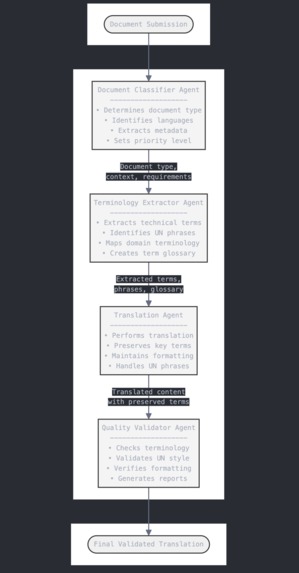
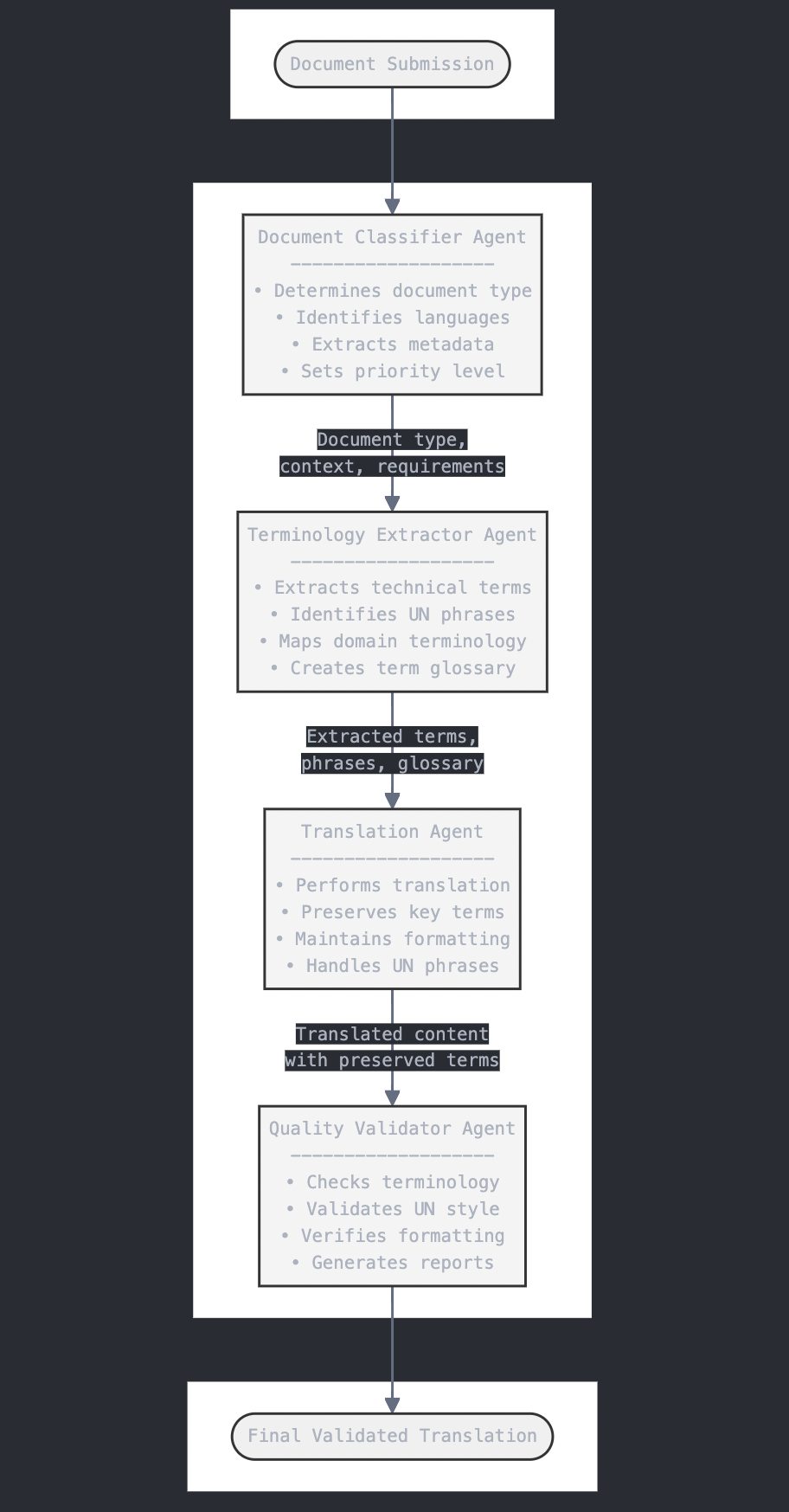
UN Translation System Agents
A specialized system of agents that work in sequence to process UN document translations accurately:
1. Document Classifier Agent
- Purpose: First-pass analysis of documents to determine type (technical, legal, policy)
- Input: Raw text in source language
- Output: Document classification with metadata
2. Terminology Extractor Agent
- Purpose: Identifies and extracts UN-specific terminology and acronyms
- Input: Classified document
- Output: Technical terms, phrases, and acronyms for preservation
3. Translation Agent
- Purpose: Performs intelligent translation while maintaining UN standards
- Input: Text with marked terminology
- Output: Translated content with preserved terms
4. Quality Validator Agent
- Purpose: Ensures translation meets UN quality standards
- Input: Translated document
- Output: Quality assessment and improvement suggestions
Challenges We Ran Into
Throughout development, we faced significant runtime, compute resource, and memory management challenges, especially with large translation samples. Managing adaptive retraining while maintaining low latency proved complex, requiring optimization at various stages of the model and UI development.
Accomplishments that we are proud of
The project successfully met all quality benchmarks, and in blind tests with native Spanish speakers and ChatGPT, our model outperformed general translation solutions in terms of clarity and coherence. We are also proud of the adaptive learning functionality that enables the system to evolve from translator feedback, ensuring an increasingly accurate and efficient workflow.
What I Learned
Developing this solution deepened our understanding of adaptive machine translation in specialized domains and the integration of user feedback loops to enhance model performance. We gained experience in optimizing resource usage for large-scale translation tasks and incorporating semantic evaluation metrics like the Translation Edit Rate (TER) to measure translation quality in real-world scenarios. This project has taught us the importance of user-focused design in building practical AI tools that assist professionals effectively.
GitHub Repository: UN Translation System
Built With
- fastapi
- huggingface
- javascript
- python
- react
- transformers
- typescript

Log in or sign up for Devpost to join the conversation.