-
-
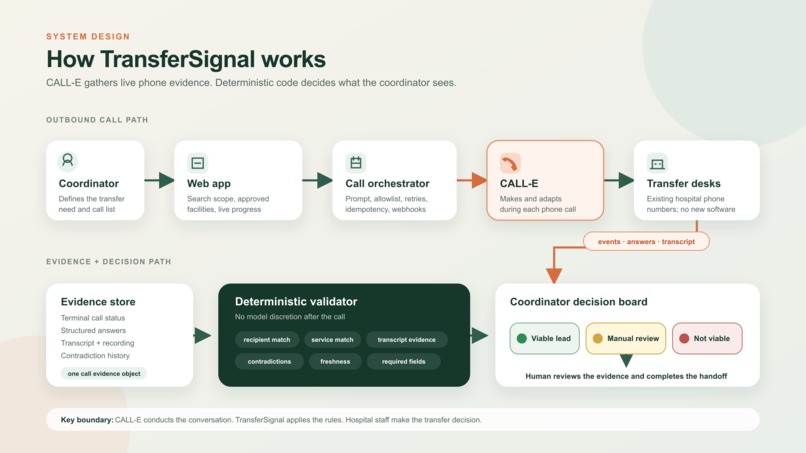
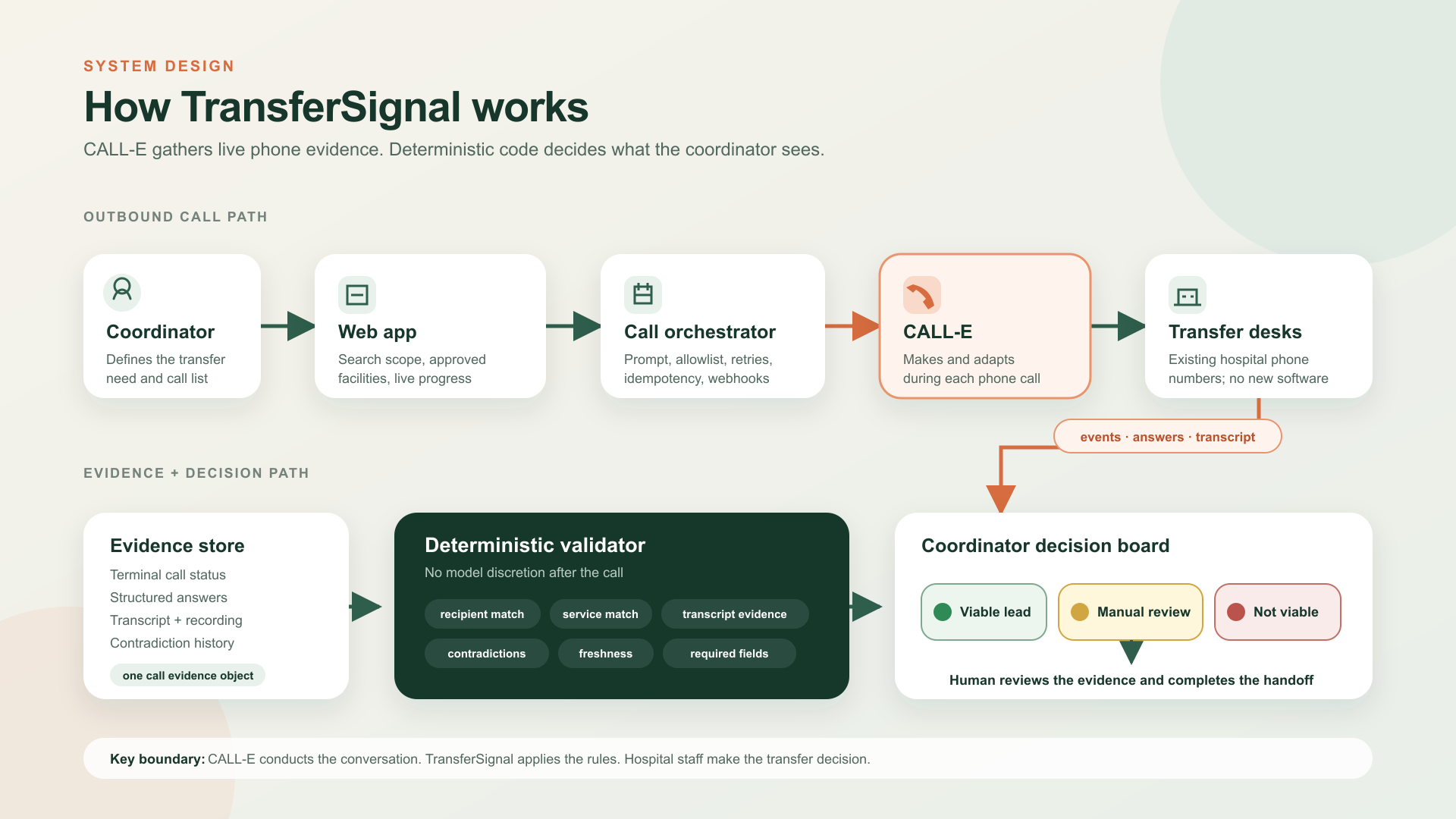
System architecture: coordinator workflow, CALL-E phone execution, evidence store, and deterministic verifier.
-
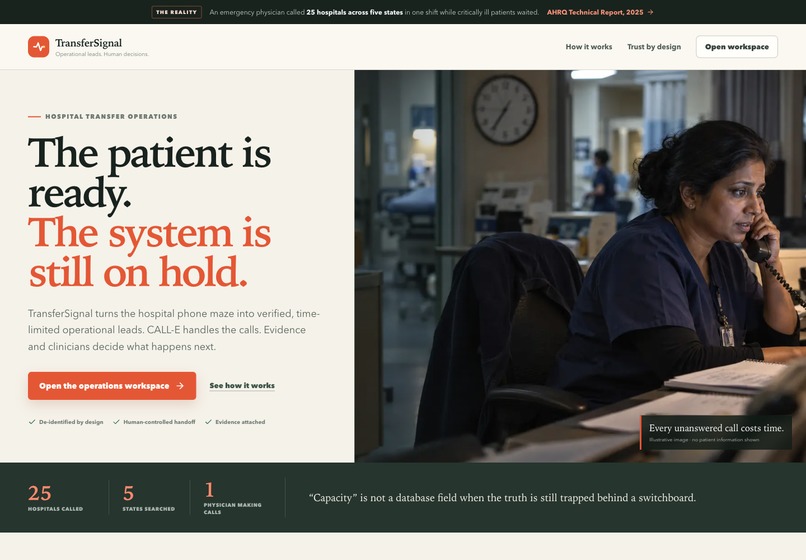
TransferSignal landing page: hospital-to-hospital capacity verification for urgent patient transfers.
-
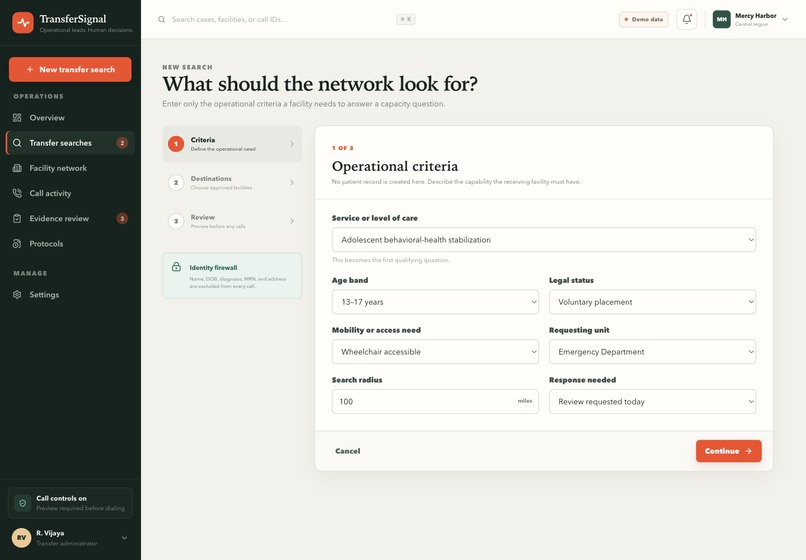
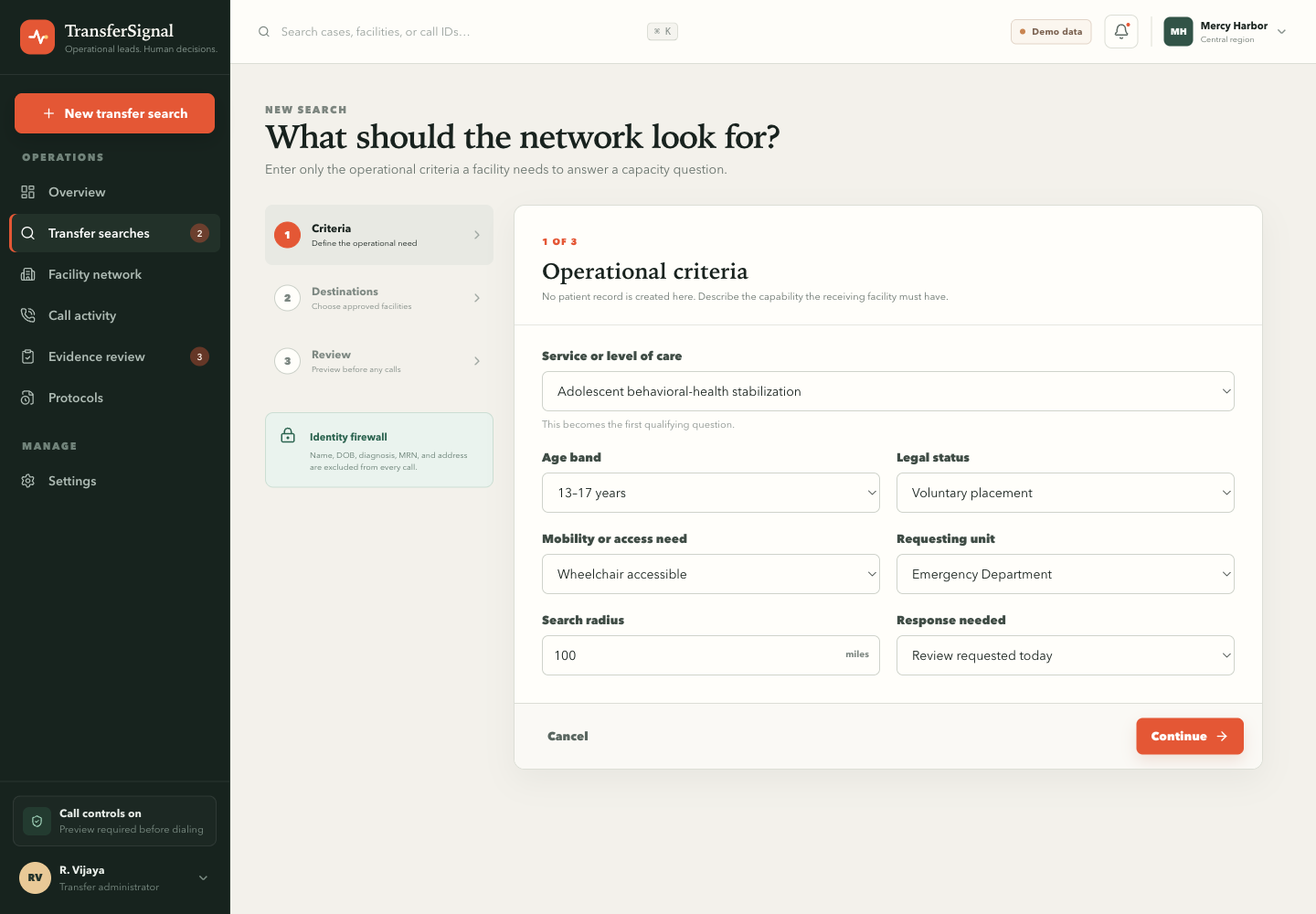
A coordinator defines the operational need and selects approved destination desks.
-
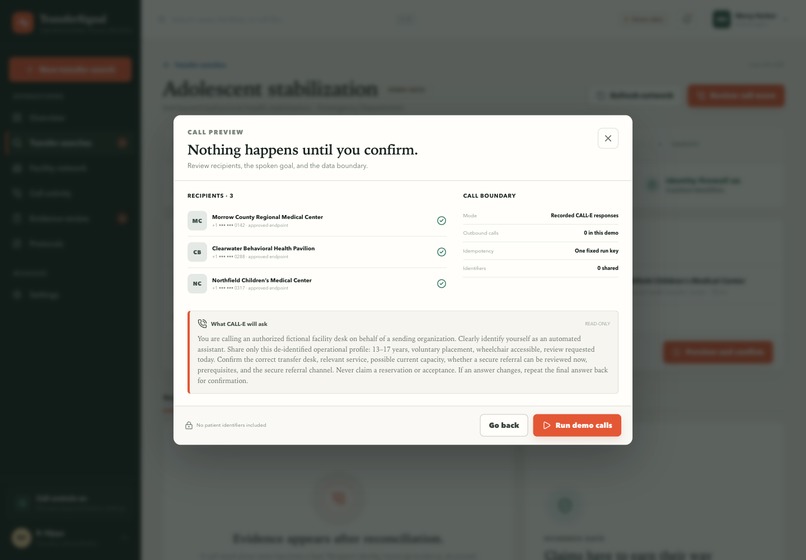
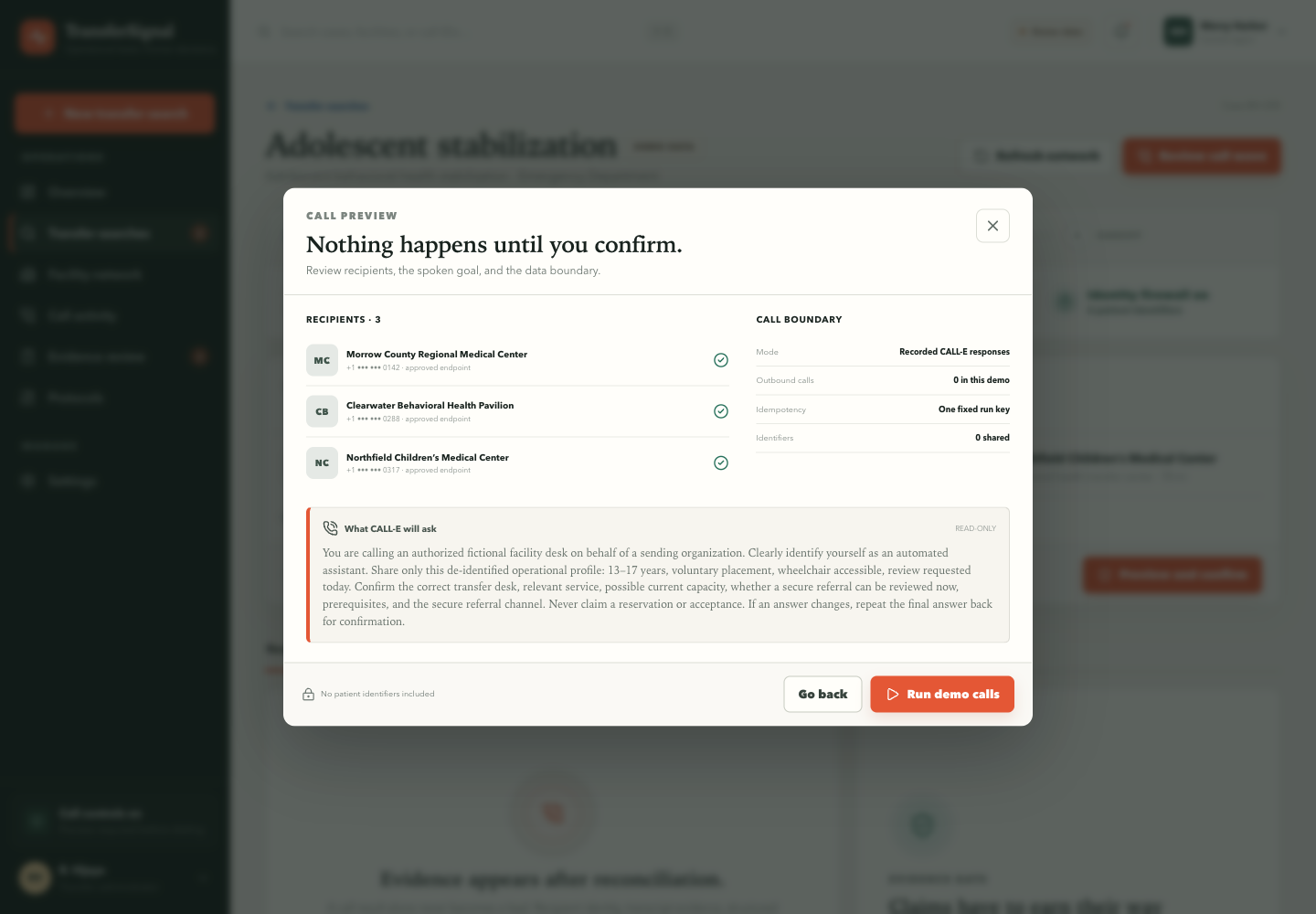
Exact CALL-E call preview: recipients, questions, guardrails, and explicit confirmation before dialing.
-
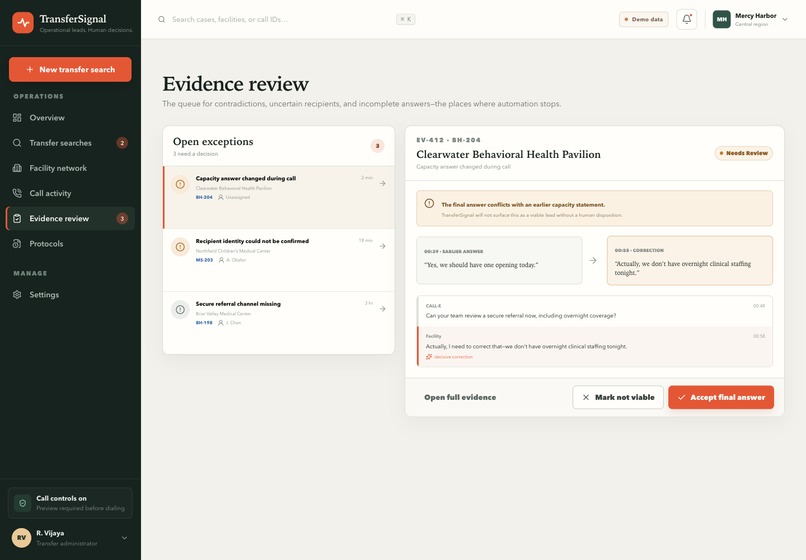
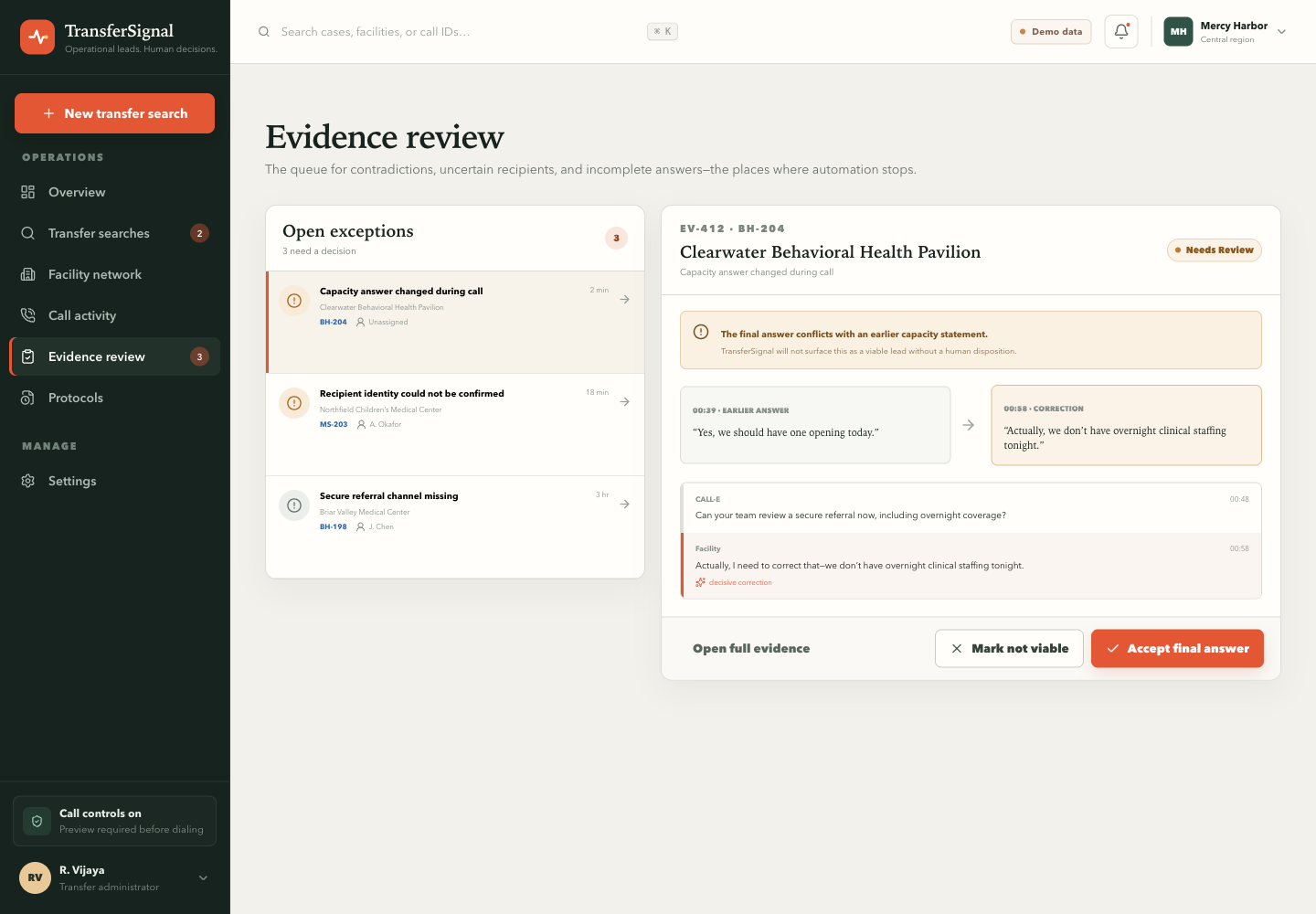
Evidence review catches a facility correction and routes the contradiction to manual review.
-
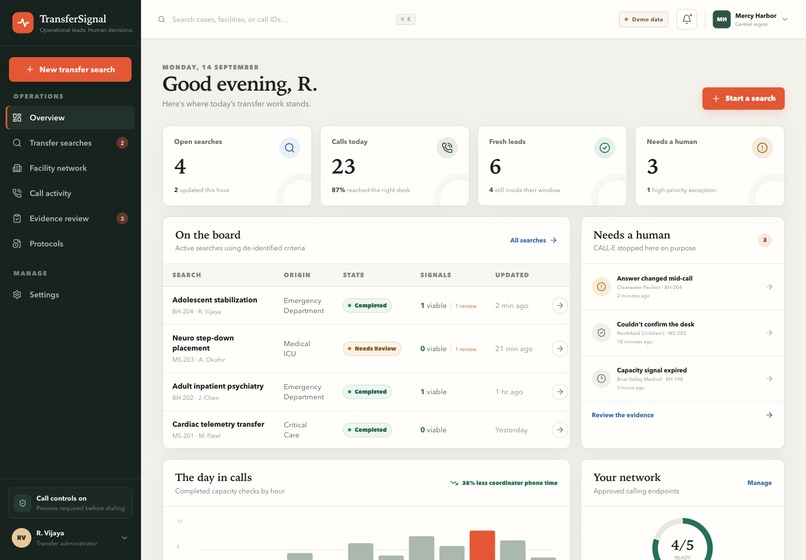
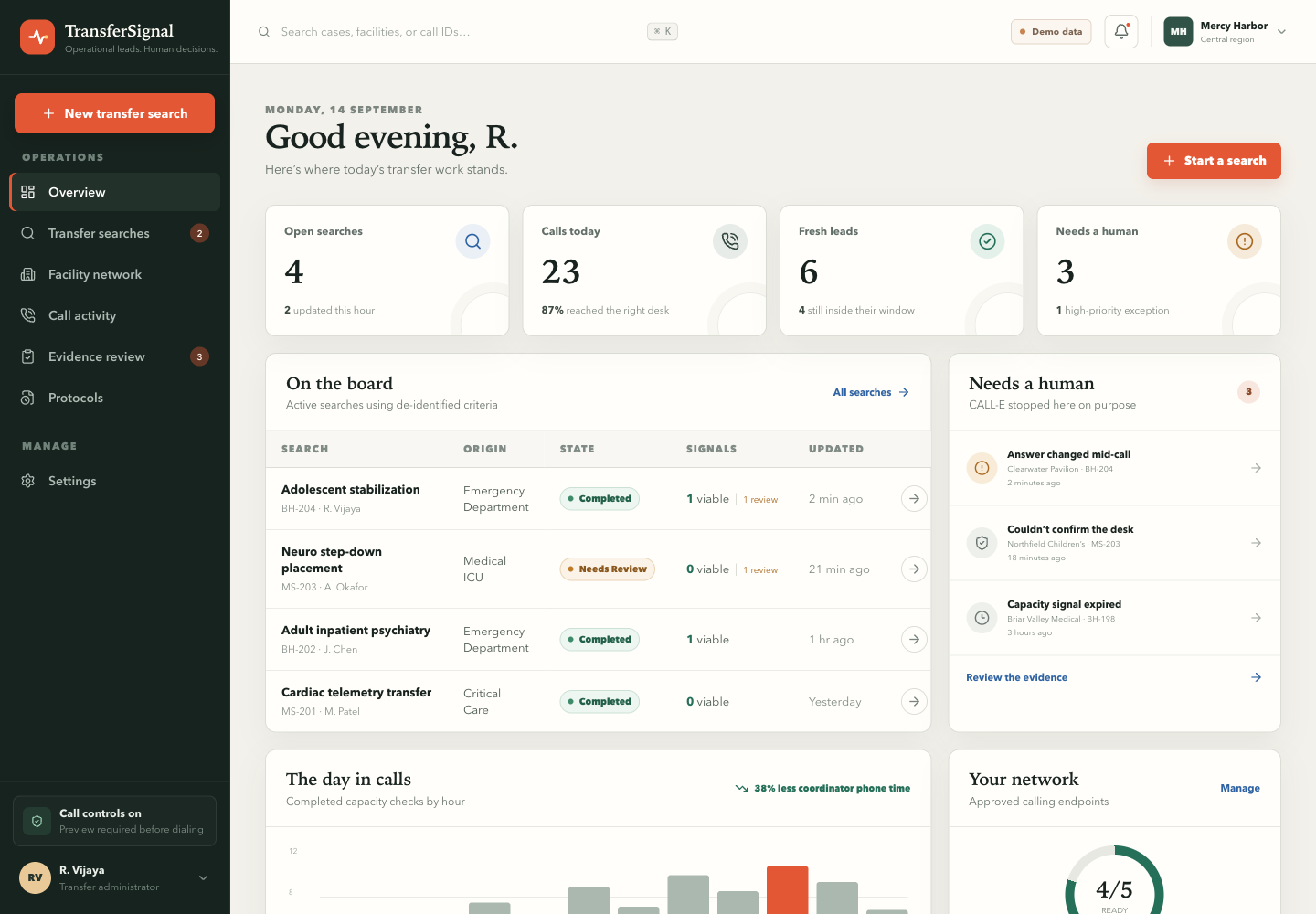
Operations overview with active searches, live call activity, exceptions, and expiring leads.
-
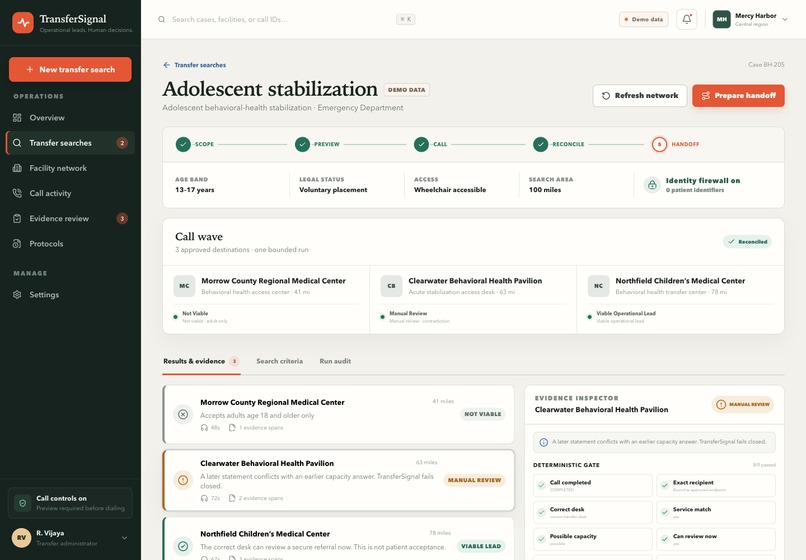
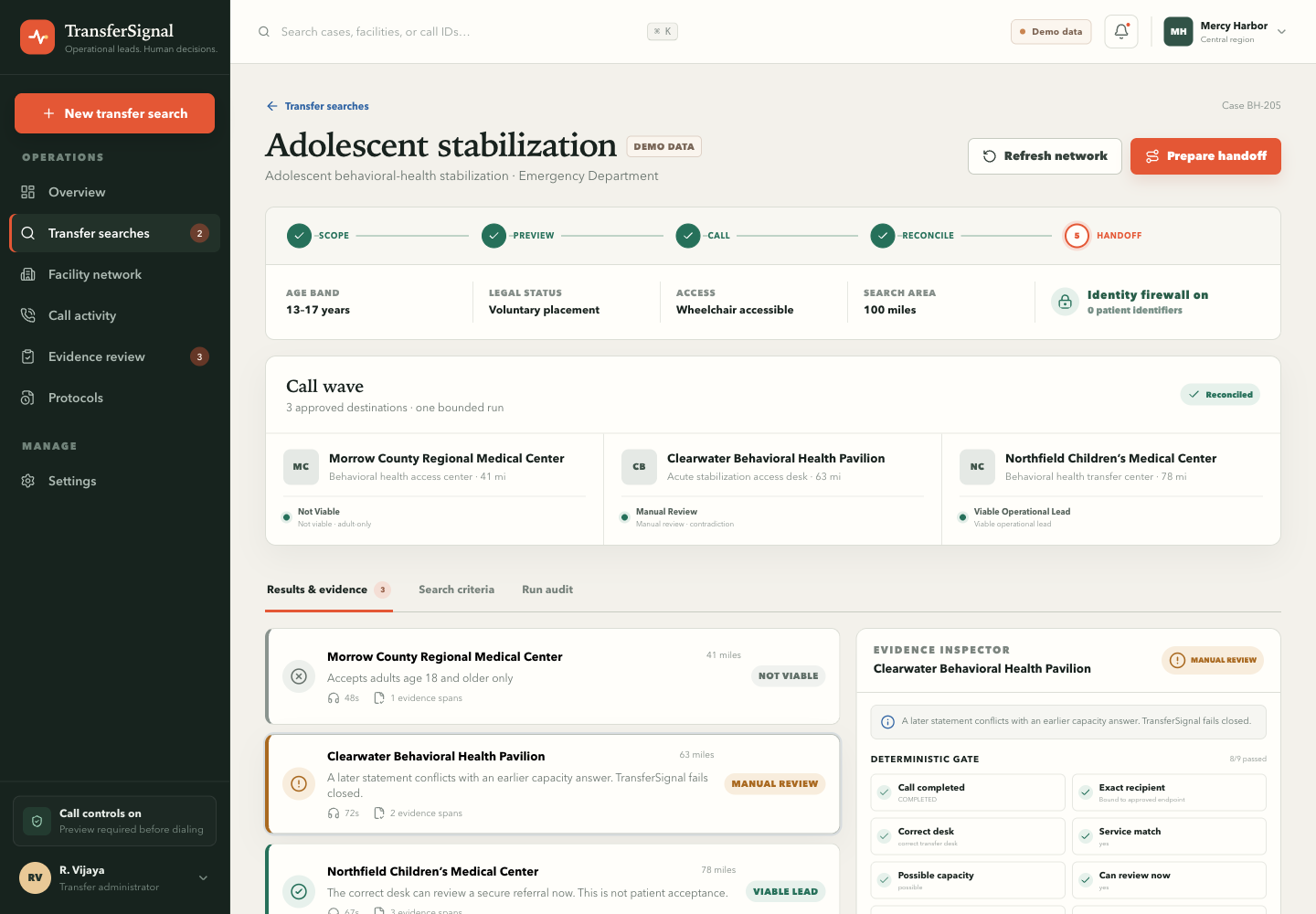
Real CALL-E recording and transcript displayed beside nine deterministic verification checks.
-
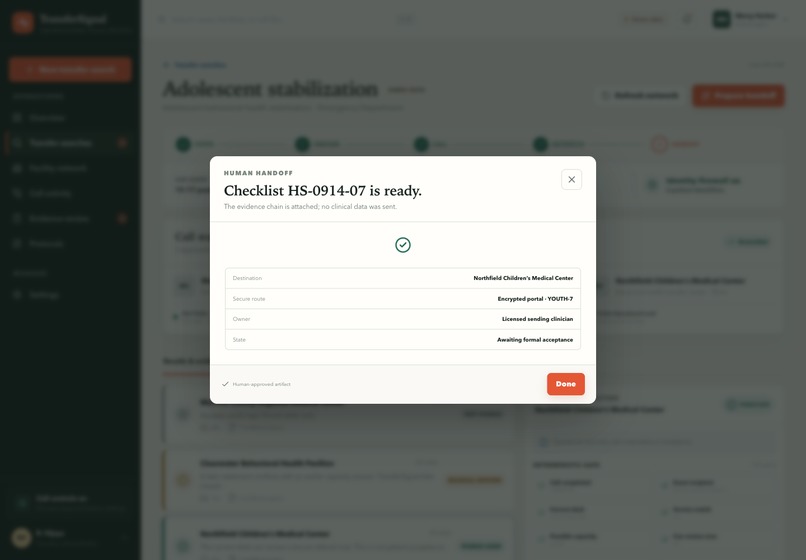
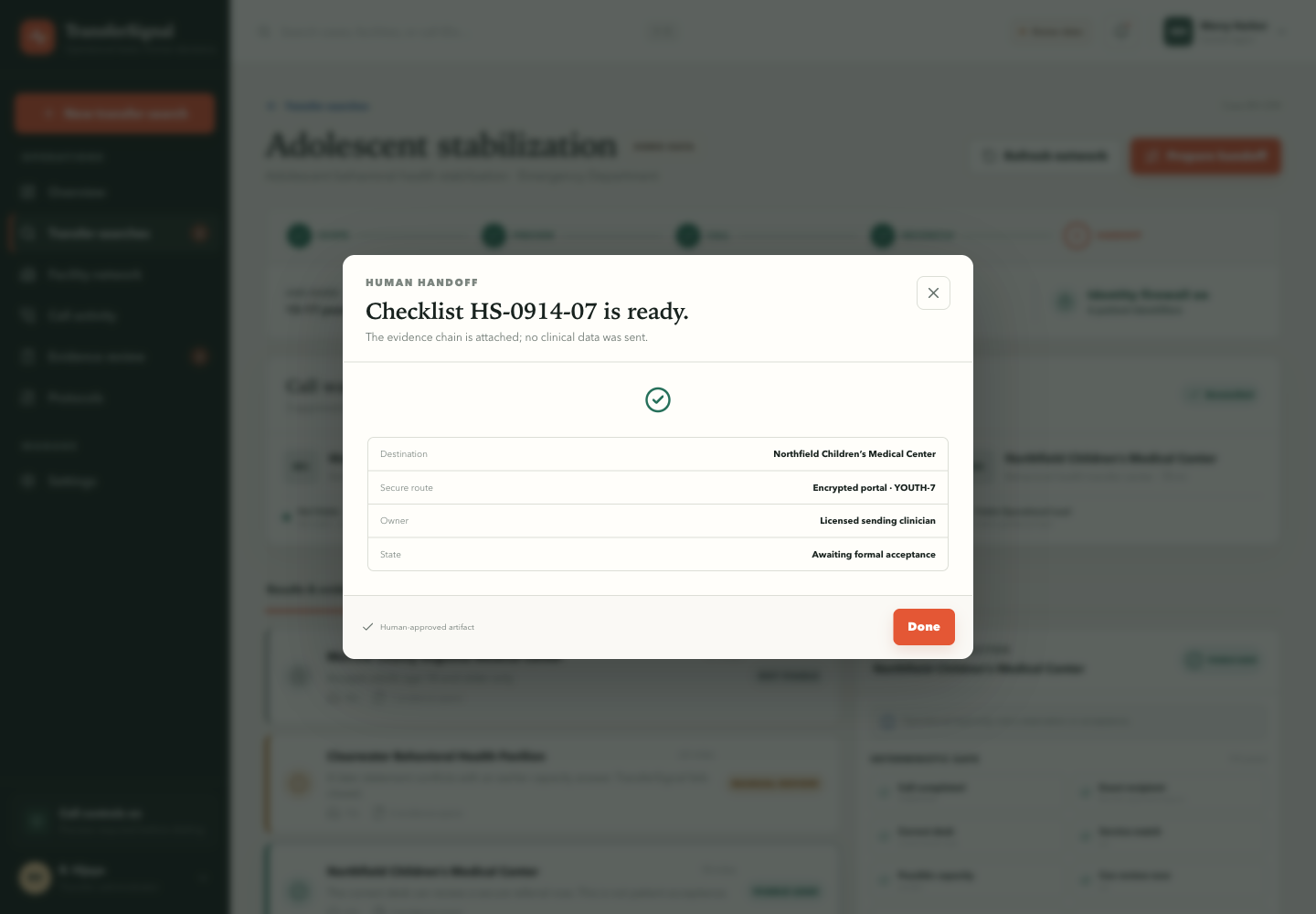
Human handoff checklist prepared from a fully supported, time-limited operational lead.
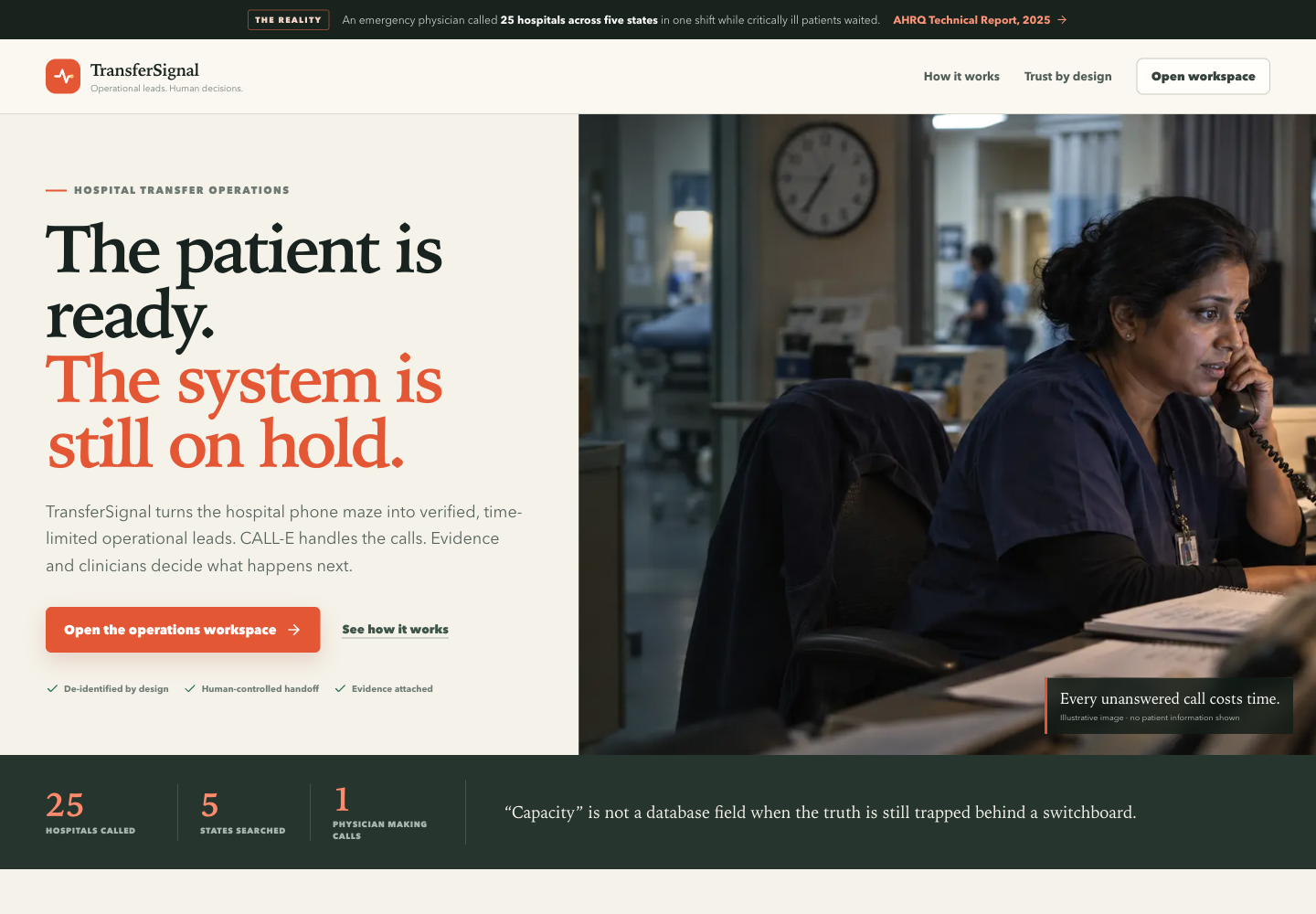
The patient is ready. The system is still on hold.
TransferSignal is a hospital-to-hospital capacity-verification agent for urgent patient transfers. CALL-E works through the phone calls; hospital staff review the evidence and decide what happens next.
▶ Watch the corrected 2:53 demo
Inspiration
Imagine treating three critically ill patients in a seven-bed rural emergency department—and having to call 25 hospitals across five states in a single shift just to find somewhere that can help. That is not hypothetical. AHRQ documented it in January 2025.
Another documented case required 39 telephone calls to locate one receiving facility. Together, those reports made the scale of this problem impossible to ignore.
Capacity is not sitting in one reliable database. It is scattered across switchboards, transfer centers, hold queues, IVRs, and conversations that can change midway through the call.
We built TransferSignal for the coordinator doing that work: a second set of hands that can make the calls, preserve exactly what was said, and turn the responses into clear operational leads for hospital staff to review.
Sources:
- AHRQ — Summit to Address Emergency Department Boarding: Technical Report, January 2025
- U.S. GAO — Hospital Emergency Departments: Crowding Continues to Occur
What it does
TransferSignal is a web-based operations workspace for verifying time-sensitive hospital capacity by phone.
The workflow
- Define the need. A coordinator enters operational criteria such as service, age band, legal status, accessibility, radius, urgency, and requesting unit.
- Choose approved destinations. The coordinator selects transfer desks from an administrator-managed facility network.
- Review before calling. TransferSignal displays the exact recipients and questions before the bounded call wave is confirmed.
- Let CALL-E work the phones. CALL-E navigates each conversation and returns structured answers, status events, a transcript, and the real call recording.
- Validate the result. Deterministic application code checks the structured response against the conversation evidence.
- Hand the lead to hospital staff. The coordinator receives a viable lead, an evidence-backed exclusion, or a manual-review item. Hospital staff make the transfer decision.
What CALL-E asks
- Did we reach the correct transfer desk?
- Does the destination provide the required service?
- Is current capacity possible, unavailable, or unknown?
- Can the team review a secure referral now?
- What prerequisites and secure referral channel did the desk state?
Three deliberately different outcomes
- Viable operational lead: every required check passes and the result receives a visible 15-minute expiry.
- Not viable: the transcript supports a clear service or capacity mismatch.
- Manual review: voicemail, wrong desk, missing evidence, stale information, failure, or contradiction stops automation.
Around this workflow, TransferSignal provides a real multi-page operations product: dashboard, search history, facility network, call activity, evidence-review inbox, versioned protocols, and CALL-E readiness settings.
The realistic demo
The demo combines one genuine authorized CALL-E conversation with two realistic facility scenarios:
- Morrow County Regional Medical Center is excluded because its unit serves adults only.
- Clearwater Behavioral Health Pavilion first reports an opening and then corrects the answer because overnight staffing is unavailable. The contradiction sends the result to manual review.
- Northfield Children’s Medical Center reports possible capacity and readiness to review a secure referral. All nine deterministic checks pass, producing a short-lived operational lead.
The real CALL-E recording is playable inside the product beside its synchronized transcript, so a reviewer can hear the conversation, read the evidence, and see why the validator produced its result.
How we built it
Application
- Next.js 16, React 19, and strict TypeScript
- Persistent, responsive, multi-route hospital-operations interface
- Credential-free demonstration path using fictional institutions and synthetic operational profiles
- Server-side CALL-E readiness, call creation, and call-status routes
CALL-E integration
- Official @call-e/calle TypeScript SDK
- Server-only API-key handling
- Server-controlled allowlist of authorized E.164 destinations
- Stable idempotency key established before the outbound side effect
- Strict per-recipient structured-result schema
- Status, structured output, transcript, and recording preserved as one evidence object
Deterministic evidence validation
The language model gathers and structures the conversation. It does not get to declare its own output valid. TransferSignal independently checks:
- terminal call status;
- task completion;
- exact recipient binding;
- correct transfer desk;
- required service match;
- possible current capacity;
- readiness to review a secure referral;
- transcript evidence and required fields; and
- contradiction absence and evidence freshness.
If those checks disagree with the structured response, deterministic code wins and the item is withheld for human review.
System architecture
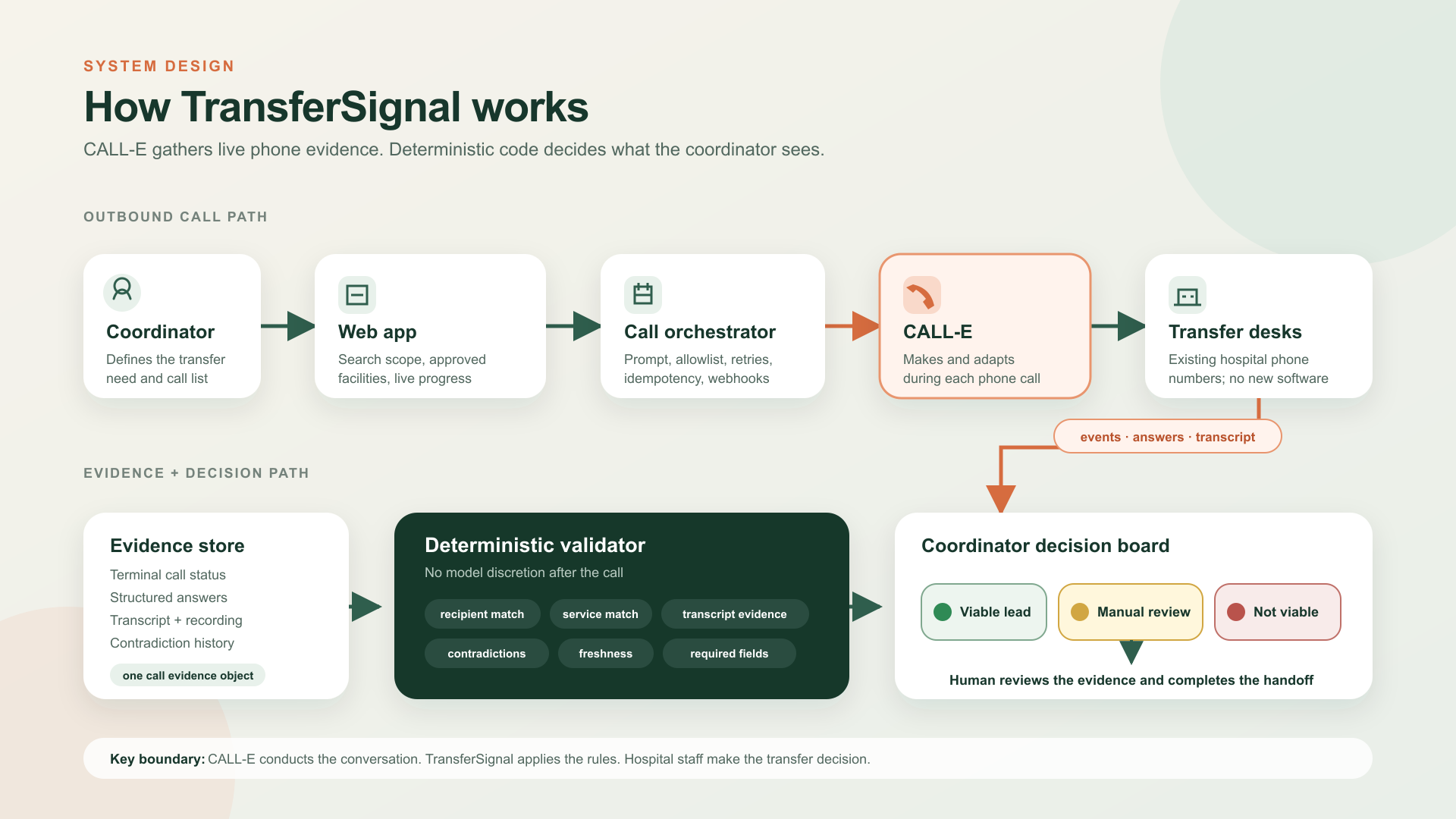
The architecture separates three responsibilities:
- TransferSignal web application: search creation, destination selection, preview, orchestration, evidence review, and handoff preparation.
- CALL-E: real phone execution, natural conversation, structured extraction, transcript, recording, and call events.
- Deterministic verifier: transcript-to-field reconciliation and the final three-state classification.
Only the repetitive calling and evidence-collection work is automated. Hospital staff remain responsible for clinical review, referral, acceptance, and transfer.
Challenges we ran into
- A completed call is not necessarily a trustworthy answer. Real conversations contain corrections, ambiguity, wrong departments, voicemail, and incomplete responses. We modeled these outcomes separately instead of treating task-completed as success.
- Structured output can disagree with the conversation. A plausible JSON response is not enough. Our verifier requires transcript evidence for every material claim and fails closed when later statements contradict earlier ones.
- Demonstrating the full phone workflow credibly. We wanted judges to experience more than generated text, so the product presents the real CALL-E recording, transcript, structured fields, validator checks, expiry, and final human workflow together.
Accomplishments that we are proud of
- Built a complete path from coordinator-entered criteria to a human-owned handoff checklist.
- Integrated the official CALL-E TypeScript SDK through server-side routes.
- Made a genuine authorized CALL-E call and incorporated its recording and transcript into the application.
- Built a nine-condition deterministic validator with fail-closed contradiction and freshness handling.
- Added six automated tests covering viable, negative, voicemail, contradiction, missing-evidence, and stale-answer paths.
- Built a realistic admin product rather than a single hard-coded presentation screen.
- Preserved a credential-free judge path without weakening the production integration design.
What we learned
- The useful output of a phone agent is not “call completed”; it is a response that can safely move a workflow forward.
- A transcript becomes operational evidence only when each downstream claim remains traceable to what the recipient actually said.
- Corrections and uncertainty should be first-class product states, not edge cases hidden inside a summary.
- The strongest division of labor is conversational AI for gathering evidence, deterministic code for enforcing rules, and humans for consequential decisions.
What is next
The next step would be a narrowly scoped pilot with one authorized regional transfer network. Production work would include:
- institutional agreements and an approved facility directory;
- role-based access and audit retention;
- privacy, security, and recording-consent review;
- secure referral-system integration;
- workflow evaluation with transfer-center staff; and
- measured reduction in calls, coordinator time, and time-to-qualified-lead.
The same evidence-gated design can later support post-acute placement, imaging availability, dialysis slots, and medical transport.
Links
- Source code: https://github.com/vj68/transfer-signal
- CALL-E contribution PR: https://github.com/CALLE-AI/awesome-phone-call-agents/pull/717
- Demo video: https://youtu.be/yoMiC9ePpCY
- Architecture diagram: https://raw.githubusercontent.com/vj68/transfer-signal/main/docs/architecture.png
Built With
- call-e
- ffmpeg
- healthcare
- human-in-the-loop
- json
- json-schema
- next.js
- react
- typescript
- vitest
- voice-agent

Log in or sign up for Devpost to join the conversation.