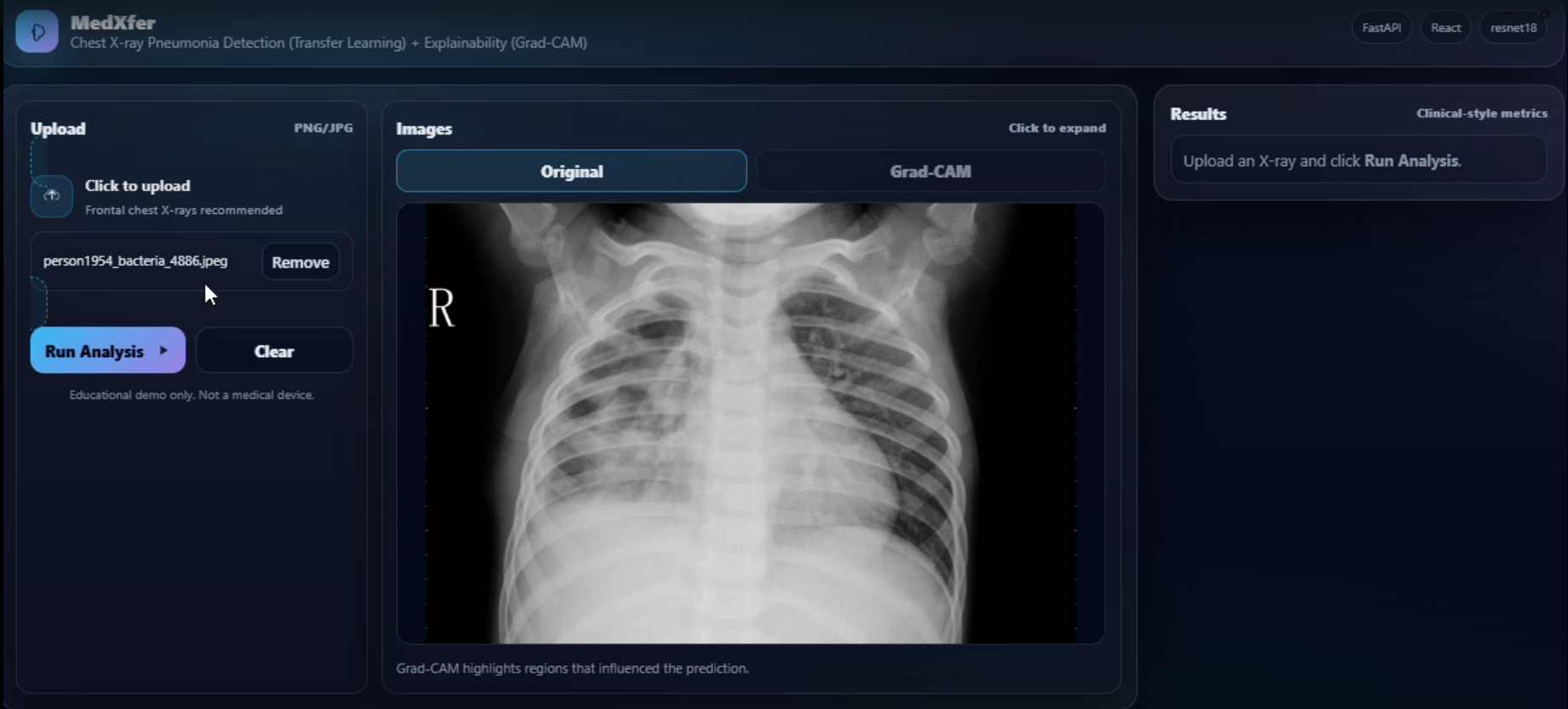
MedXfer — Transfer Learning for Chest X-Ray Diagnosis
Educational AI project demonstrating how transfer learning can be applied to medical image classification using chest X-ray images. This project covers the full machine learning pipeline: model training, evaluation, backend inference API, and a frontend visualization interface.
Disclaimer This project is for educational and research purposes only. It is not a medical device and must not be used for clinical decision-making.
Project Overview
Medical imaging datasets are often small, noisy, and expensive to label. Training deep neural networks from scratch in such settings is inefficient and prone to overfitting.
To address this, transfer learning is used:
- A deep CNN pre-trained on ImageNet
- Feature extraction layers reused
- Final classification layer retrained on Chest X-ray data (NORMAL vs PNEUMONIA)
This project demonstrates:
- Why transfer learning works
- How it is implemented in practice
- How trained models can be served via an API
- How predictions can be visualized in a frontend UI
Transfer Learning — Conceptual Explanation
Why Transfer Learning?
- Medical datasets are usually small
- Training CNNs from scratch requires millions of images
Early CNN layers learn generic visual features such as:
- edges
- textures
- shapes
These features are universal and not domain-specific.
How It Is Applied Here
- Load a CNN pre-trained on ImageNet (ResNet-18 / ResNet-50)
- Freeze convolutional layers (feature extractor)
- Replace the final fully connected layer
- Train only the new classifier on chest X-ray images
- Optionally fine-tune deeper layers
This allows the model to:
- Learn faster
- Generalize better
- Avoid overfitting
Project Structure
TransferLearning/
│
├── backend/                 FastAPI inference service
│   ├── app/
│   │   ├── main.py          API entry point
│   │   ├── inference.py    Model loading and prediction
│   │   └── schema.py       Response schemas
│   ├── model/
│   │   ├── model.pt        Trained weights
│   │   └── model_meta.json Model metadata
│   └── requirements.txt
│
├── ml/                      Training and evaluation
│   ├── train.py             Transfer learning training script
│   ├── model_def.py         CNN architectures
│   ├── export_model.py      Export trained model for inference
│   ├── utils.py
│   ├── outputs/
│   │   ├── model.pt
│   │   └── model_meta.json
│   └── requirements.txt
│
├── frontend/                React UI
│   └── src/
│       ├── App.jsx
│       ├── App.css
│       └── api.js
│
├── chest_xray/              Dataset
│   ├── train/
│   ├── val/
│   └── test/
│
└── README.md
Dataset
Chest X-Ray Pneumonia Dataset
Classes:
- NORMAL
- PNEUMONIA
Splits:
- Train
- Validation
- Test
Images are resized and normalized using ImageNet statistics to match the pretrained backbone.
Model Architecture
- Backbone: ResNet-18 (ImageNet pretrained)
- Input Size: 224 × 224
- Output: 2 classes (Softmax)
- Loss: Cross-Entropy
- Optimizer: Adam
- Metrics: AUROC, Precision, Recall, F1-Score
Evaluation Results (Test Set)
| Metric | Value |
|---|---|
| Accuracy | 84.1% |
| AUROC | 0.936 |
| F1-Score (Macro) | 0.81 |
Confusion Matrix:
[[138,  96],
 [  3, 387]]
The model shows:
- High sensitivity for pneumonia detection
- Acceptable trade-off between precision and recall
Backend (FastAPI)
The backend provides:
- Model loading
- Image preprocessing
- Prediction endpoint
Available Endpoints
| Method | Endpoint | Description |
|---|---|---|
| GET | /health | API health check |
| GET | /model-info | Model metadata |
| POST | /predict | Predict X-ray image |
Predictions return:
- Predicted label
- Confidence score
- Full class probability distribution
Frontend
The frontend is a React-based interface that:
- Allows image upload
- Sends images to backend API
- Displays prediction results visually
- Explains the transfer learning concept in text form
UI focus:
- Large layout (no small cards)
- Clear medical-style design
- Left-aligned explanation panel
- Right-aligned prediction panel
Running Locally
Train Model
cd ml
pip install -r requirements.txt
python train.py --data_dir ../chest_xray
Export Model
python export_model.py
Run Backend
cd backend
pip install -r requirements.txt
uvicorn app.main:app --reload
Run Frontend
cd frontend
npm install
npm run dev
Learning Outcomes
This project demonstrates:
- Practical transfer learning implementation
- Medical image preprocessing
- Model evaluation using clinical metrics
- AI system integration (ML → API → UI)
- End-to-end ML system design
Author
Hadi Mostafa Computer Engineering Student
Focus areas:
- Artificial Intelligence
- Computer Vision
- Medical AI Systems
License
This project is released for educational and academic use only.
Built With
- css
- html
- javascript
- procfile
- python
