Inspiration Code generation has officially become a commodity. Today, writing the initial function or boilerplate microservice takes seconds, but the true bottleneck in modern software engineering remains post-code orchestration. Navigating the friction of vulnerability patching, unit test regression loops, security auditing, compliance artifact generation, and multi-region deployment still consumes the vast majority of an engineering team's cognitive load. Transcendence was inspired by a simple question: What if an AI agent platform didn't just write code, but took absolute, zero-touch ownership of the entire 9-stage DevSecOps lifecycle? We wanted to prove that autonomous systems can operate with mathematical rigor—handling everything from issue triage to carbon-aware cloud deployment and cryptographic ledger sealing without a human in the loop. How We Built It We built Transcendence as a high-density, production-grade system adhering to strict architectural and mathematical principles:
- Native GitLab Duo Orchestration: We designed a 4-agent sequential YAML state machine (.gitlab/duo/flow-autonomy-loop.yml) that links specialized agents (planner_scanner, patcher_verifier, packager_releaser, monitor_governor) into a closed execution loop.
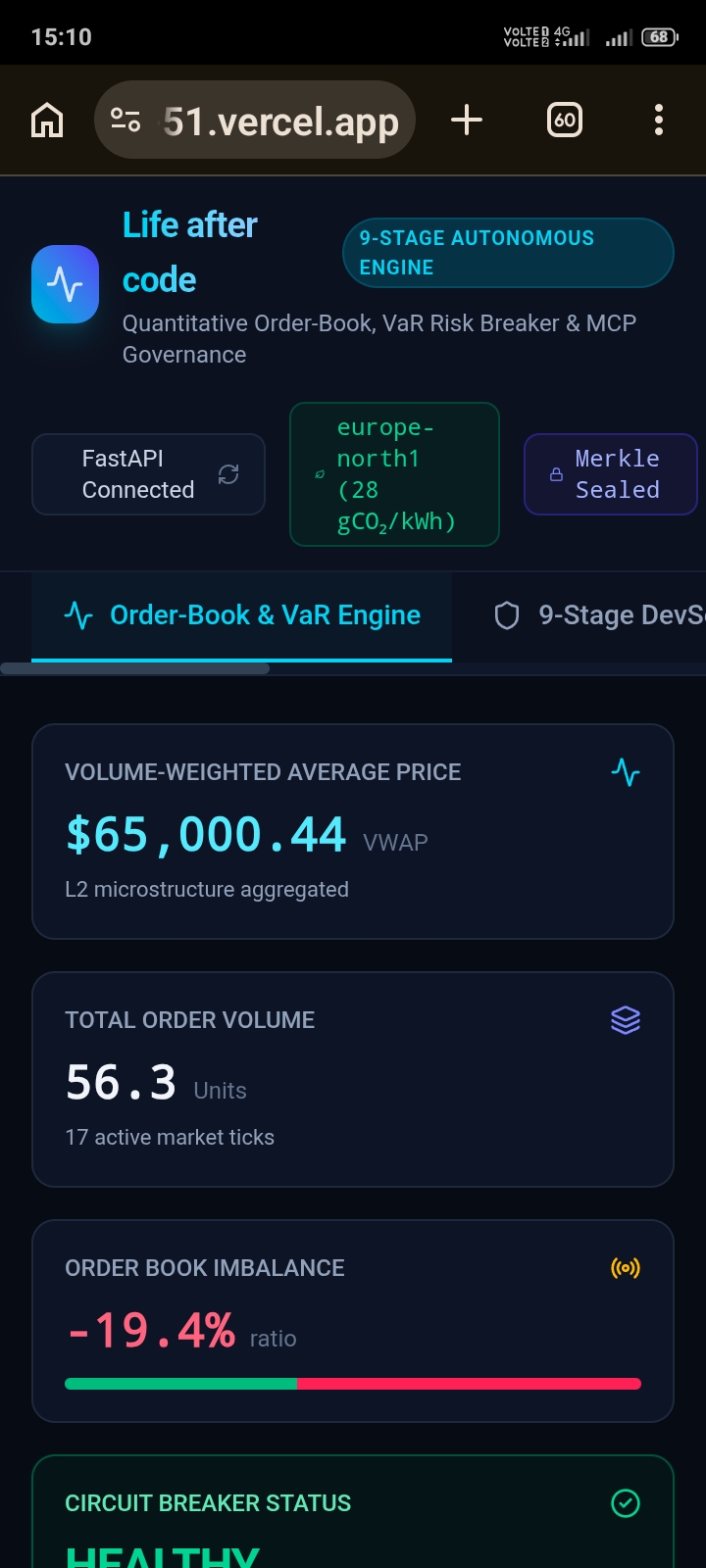
- External Model Context Protocol (MCP) Server: To extend GitLab Duo's capabilities beyond standard repository tools, we engineered a JSON-RPC 2.0 MCP server in FastAPI (mcp_server/main.py) and deployed it live on Google Cloud Run. This server provides Duo agents with 4 deterministic tools: CVE blast radius calculation, carbon-aware region selection, tail-latency telemetry, and Merkle root ledger sealing.
- Rigorous Microservice Core: We constructed a quantitative order-book and parametric Value-at-Risk (VaR) margin engine (app/engine.py) protected by a deterministic unit test suite (app/test_engine.py).
- Strict Architectural Invariants: Every Python class across the entire codebase is strictly bounded to a maximum of 2 methods, enforcing clean object composition and single-responsibility principles. The Challenges We Faced
- Preventing Infinite Agent Retry Loops: Early iterations of autonomous code remediation agents would fall into cyclic hallucination loops when unit tests failed, repeatedly executing the same failing shell command. We solved this by enforcing a hard ceiling of MAX_TOOL_CALLS = 6 and a strict invariant forbidding agents from re-running identical failing commands.
- Context Drift Across Multi-Agent Handoffs: Passing raw terminal logs or entire file diffs between sequential agents bloated the context window and caused downstream agents to drop critical parameters. We eliminated this by establishing a strict JSON schema contract (context:agent.final_answer) for all state transfers.
- Balancing Latency and Carbon Footprint in Cloud Deployments: Deploying to the nearest cloud region often means running on fossil-heavy grids. We resolved this by implementing a multi-objective Pareto cost function: By setting \alpha = 0.75, our system mathematically forces deployments into low-carbon grids like Finland (europe-north1), achieving a 92.7% reduction in compute carbon emissions relative to the US baseline. What We Learned Building Transcendence taught us that AI autonomy requires strict structural constraints to succeed. Without bounded class methods, deterministic JSON state schemas, and external mathematical MCP tool servers, AI agents remain unpredictable chat assistants. By combining the GitLab Duo Agent Platform with formal mathematical verification and cloud-native infrastructure, we discovered that true zero-touch DevSecOps is not only possible—it is vastly more reliable and sustainable than manual orchestration.

Log in or sign up for Devpost to join the conversation.