-
-
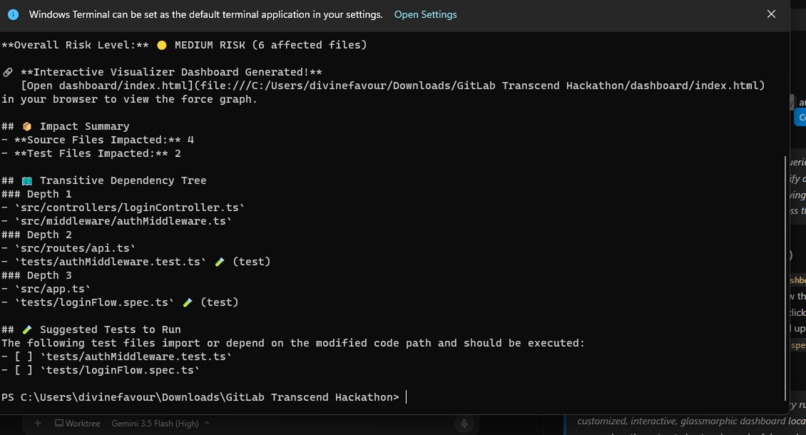
Terminal view
-
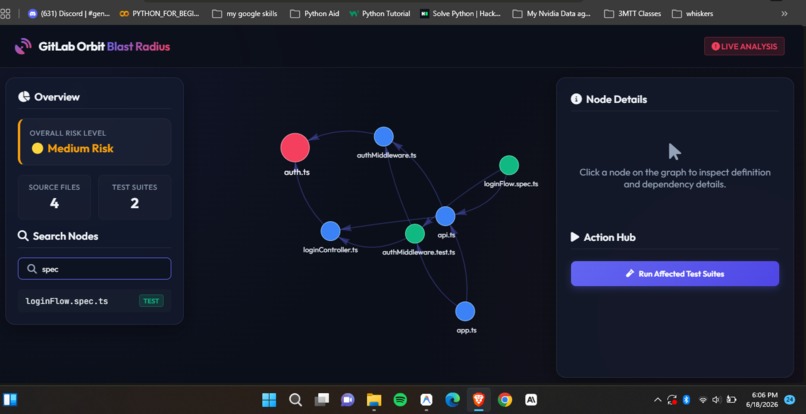
Interactive Visualizer
Inspiration Making code changes in large repositories is risky. One modified file can break dozens of downstream files and tests. We were inspired by the power of GitLab Orbit's local code knowledge graphs to make dependency tracing visual, immediate, and actionable for developers.
What it does It computes the "blast radius" of any modified file. It queries the local code graph recursively (up to 3 levels deep) to list affected source files and test suites. It compiles a gorgeous, interactive glassmorphic visual force-graph dashboard (dashboard/index.html) in your browser and automatically identifies and triggers only the affected test suites to save pipeline compute.
How we built it We built a Python engine that queries the GitLab Orbit CLI (extracting definitions and symbols from the local DuckDB database). It serializes this data and compiles it into an interactive vis-network HTML dashboard. We also wrote a test runner script that auto-detects Node.js, Python, Maven, or Go frameworks to execute tests.
Challenges we ran into Translating recursive graph structures (definitions, imports, and symbols) from a DuckDB database into clean, readable SQL queries that execute instantly in local environments.
Accomplishments that we're proud of Creating a fully offline, lightweight tool that doesn't suffer from context window limitations. The glassmorphic visual dashboard is interactive, responsive, and makes complex dependencies immediately understandable.
What we learned We learned how to leverage structured code graphs (GitLab Orbit) to supply high-fidelity context to AI agents, and how to define custom skills for the GitLab Duo Agent Platform.
What's next for gitlab-orbit-blast-radius We plan to integrate with the remote GitLab API to trigger remote CI/CD pipelines directly from the dashboard, map cross-project blast radiuses, and publish the skill to the official AI Catalog
Built With
- css3
- gitlab-duo
- gitlab-orbit
- html5
- javascript
- python
- vis-network

Log in or sign up for Devpost to join the conversation.