Inspiration
Digital payment systems are fast and convenient, but they are also guarded by invisible limits that users only discover after a transaction fails. Repeated payment blocks, unexplained errors, and temporary restrictions create frustration and uncertainty, especially when users are acting in good faith. The inspiration behind transaction.guard was to shift this experience from reactive to preventive by giving users visibility into their own payment behavior before systems intervene.
What it does
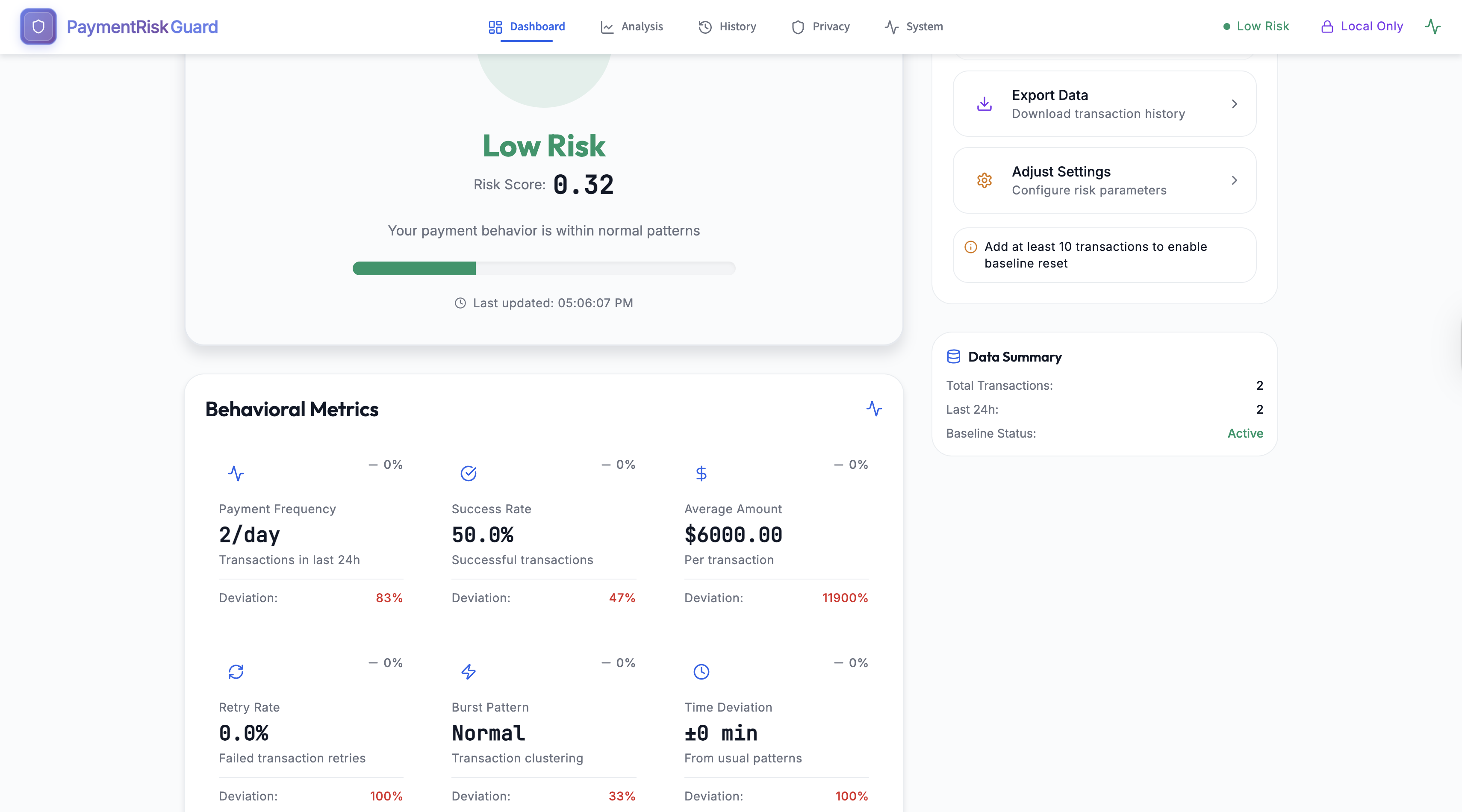
transaction.guard is a privacy first application that passively tracks user approved payment metadata on device and converts it into a real time payment safety score. It analyzes factors such as transaction frequency, retry patterns, failure rates, and short term activity spikes to predict when a user is approaching risky behavior zones. The app provides clear warnings and cooldown suggestions without ever touching money, accessing bank accounts, or integrating with UPI or wallet providers.(note mainly the dashboaed works)
How we built it
We built transaction.guard as a fully local system with no required cloud backend. A lightweight event ingestion layer records abstracted transaction signals, which are processed through rolling time windows and adaptive baselines. The scoring engine combines rule based constraints inspired by known UPI limits with anomaly detection that learns each user’s normal behavior over time. The entire pipeline runs on device, with encrypted local storage and optional privacy noise to prevent sensitive inference.
Challenges we ran into
One major challenge was balancing accuracy with over warning. Being too conservative made the app annoying, while being too lenient reduced its usefulness. Another challenge was designing a scoring system that felt intuitive to users while being grounded in real risk signals. We also had to ensure strict privacy boundaries so the app could never be mistaken for a payment interception or monitoring tool.
Accomplishments that we're proud of
We successfully built a predictive risk model that mirrors backend fraud and rate limiting logic without accessing any protected systems. The application provides meaningful warnings using only locally derived metadata. We are especially proud of achieving this while maintaining a zero integration, zero cloud, and zero financial access design.
What we learned
We learned that many real world system failures are predictable if users are given the right feedback at the right time. We also gained deep insight into how large scale financial systems think about trust, risk, and behavioral consistency. Most importantly, we learned how to design technical systems that are both powerful and ethically constrained.
What's next for transaction.guard
Next, we plan to refine adaptive learning so the payment score adjusts faster to long term behavior changes. We also want to add optional visual analytics that help users understand their habits over weeks and months. In the future, transaction.guard could expand beyond payments into other rate limited digital actions while remaining fully user controlled and privacy preserving.

Log in or sign up for Devpost to join the conversation.