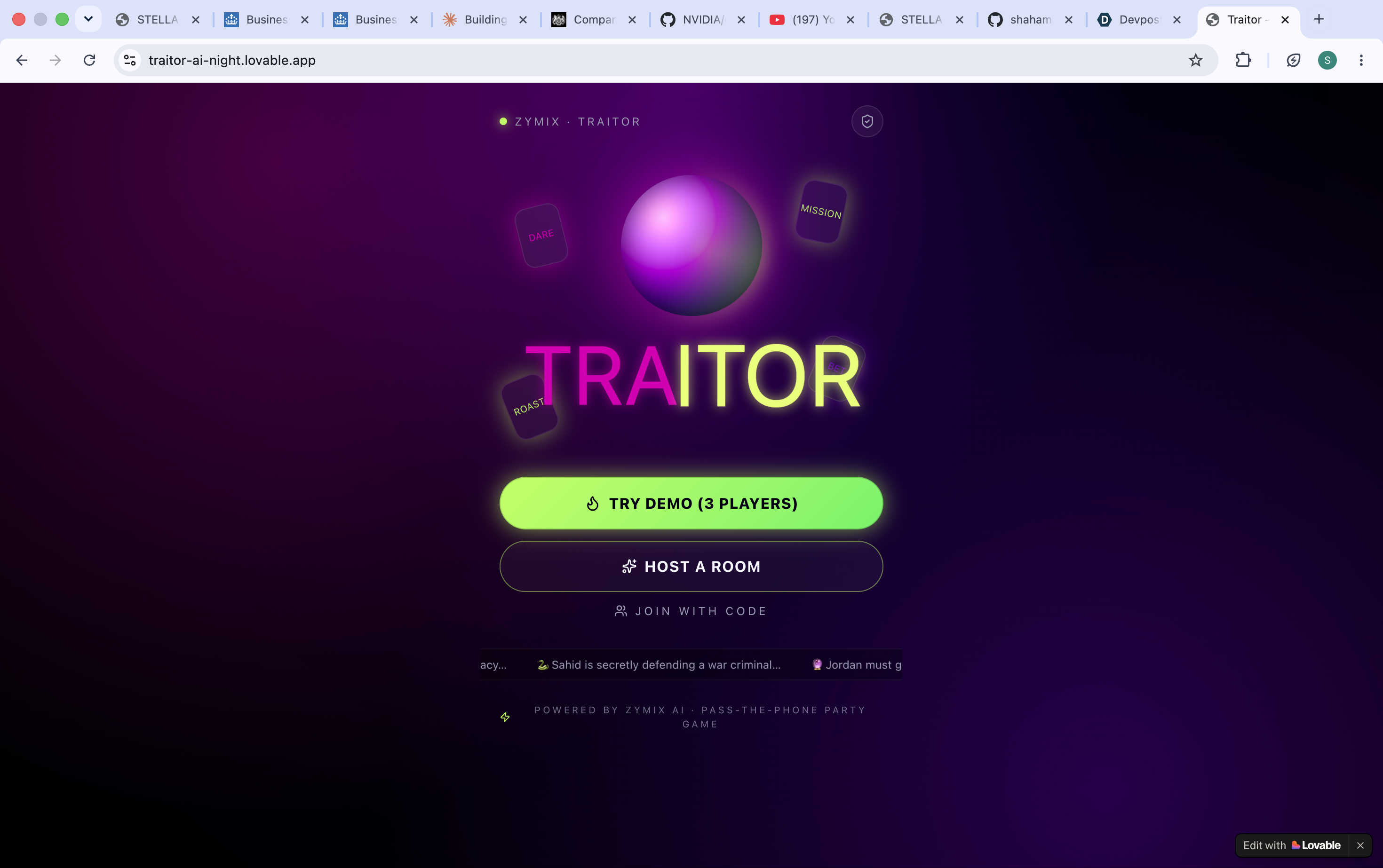
Inspiration This started from the games I actually love playing in real life. I'm a regular at a board game café in Cardiff called Scaredy Cats, and the game that always wrecks the table is Trial by Trolley — you draw absurd cards and have to argue for why your train track full of victims deserves to be spared, while someone plays conductor and decides who dies. It's chaos, it's persuasion, it's everyone screaming at each other. I also love Mafia for the same reason, the manipulation, the bluffing, reading who's lying to your face. Then there's the unhinged side: I'm a fan of NERVE (the film) and those viral "everyone puts a finger on the screen and the loser does the dare" apps you see all over Instagram. The spontaneity, the "oh my god you actually have to do it now" energy. The problem? All of those are either physical games you need to be in a room with the right cards for, or they're shallow random-dare apps with a recycled list written by an intern. None of them know your friends. And our group chats where we actually live are where all the fun goes to die. Forty messages, no decision, nobody does anything. I wanted to build the thing that fuses all of it: the persuasion of Trial by Trolley, the secret-role manipulation of Mafia, the unhinged spontaneity of those dare apps but with an AI that actually knows the people in the room. That's TRAITOR. What it does TRAITOR is a party mini-game for Zymix where an AI ringleader runs your friend group through a night of personalised chaos. You and your friends join one room (scan a code, no download). Everyone secretly feeds the AI a bit of "dirt" inside jokes, who's the dramatic one, who's most likely to text their ex. Then each round:
The Deal: he AI deals a public dare built around a real person ("Sahid, call [friend] and seriously try to sell them your own trainers for £40"). The Whisper: at the same time, the AI secretly whispers a different, conflicting mission to every player ("get the group to gang up on Maya- but never be the one who suggests it"). Nobody knows anyone else's mission. Everyone's quietly manipulating everyone. The Bet — everyone wagers points on whether the dare actually happens. The Proof — you record it on the Proof Cam as a memory + receipt. The Snitch — the AI reveals everyone's secret mission, scores who pulled theirs off, and roasts the round by name. Betrayals exposed. Grudges compound into the next round.
At the end it spits out a shareable roast recap card : the artifact that leaves the room and pulls the next group in. The core twist: most AI party games put the AI between the players as a judge. We made the AI the traitor between the humans. The drama stays human; the puppeteer is the machine. How we built it
Frontend: React, mobile-first, built to feel like a premium super-app mini-game — an "after-dark casino but unhinged" aesthetic, near-black with neon glow, dealt-card animations, a pulsing AI orb that "speaks" in a cocky voice. The AI core: Claude via the Anthropic API generates everything live — the personalised public dares, the conflicting per-player secret missions, the bet questions, and the final roast recap — all using the players' real names and the dirt they fed in. We prompt it to return structured JSON so each piece maps cleanly to the UI. Multi-device flow: host screen + phones joining by code (Jackbox model), so the secret missions stay private on each person's phone while the public drama plays out on the shared screen. Safety layer: a content filter in the system prompt keeps every task fun-not-harmful — no strangers, no money, no genuinely humiliating stuff — plus a no-penalty SKIP on every dare. Zymix integration story: built as a mini-game that runs in Zymix's webview, using the group chat as the lobby, Zymix identity for personalisation, and posting recap reels straight into the short-video feed. It's not a bolt-on — it's a content engine for Zymix's core loops.
Challenges we ran into
Scope discipline. We had a hundred ideas — treasure hunts, NERVE-style betting, finger-dare mechanics — and the hardest thing was cutting. We learned to subtract: one unhinged loop done perfectly beats five half-built ones. Originality pressure. Our first ideas (an AI-image telephone game, an "AI judges your argument" game) turned out to already exist. We had to keep stress-testing concepts against prior art until we found the genuinely new angle: AI as the traitor between players, not the judge above them. Multi-device sync is where party games go to die keeping host and phones in sync without a heavy backend. We sequenced the build so the AI fun was bulletproof first and sync layered on top, so we always had a working demo. Getting the AI's tone right, too tame and it's boring, too far and it's mean. Tuning the ringleader to be cocky and chaotic but never cruel took real prompt iteration.
Accomplishments that we're proud of!!
We built something where AI is genuinely irreplaceable — no static game can hide a personality, deal bespoke conflicting agendas to a real room, and judge live human persuasion. We made the AI a character people react to emotionally, not a chatbot. We landed on a concept that's original after surviving a brutal prior-art stress test. We designed virality into the mechanic itself — the roast recap is the growth loop, the game markets itself. It hits two tracks at once: Entertainment Mini on the surface, Social Vibe (genuine bonding) underneath.
What we learned:
The best party games aren't about more features — they're about one mechanic that creates human drama. AI's job is to fuel that, then get out of the way. Virality isn't a marketing layer you add later; it's an artifact the product generates. Design the screenshot, not the campaign. Personalisation is the whole game. "Do a dance" is boring; "do a dance like [your friend] at last week's party" is unforgettable. Cutting ideas is harder and more valuable than having them.
What's next for TRAITOR??
Deeper personalisation — let the AI learn the group over multiple game nights so grudges and callbacks span sessions. More mission archetypes and an "escalation" mode where the chaos ramps as the night goes on. Real Zymix integration — pulling the actual group graph and posting recaps natively to the feed. Seasons & collectibles — earn artifacts/badges for legendary dares (the treasure-hunt joy, baked in). Themed packs — flatmate edition, course-group edition, sports-team edition. Tuning the safety filter into something we'd be proud to ship to real users at scale.
Built With
- claude
- lovable
- next.js

Log in or sign up for Devpost to join the conversation.