-
-
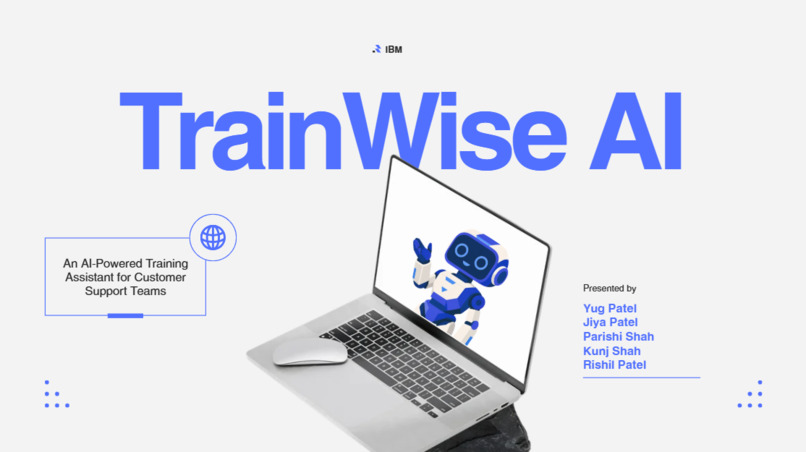
Poster
Trainwise-AI
Inspiration
Educational and training content is increasingly spread across long videos, presentations, PDFs, and documents. Finding one specific explanation often means scrubbing through an entire video or manually searching across multiple resources.
We wanted to make training and learning content searchable, conversational, and instantly accessible.
Trainwise-AI turns videos and learning materials into a unified AI knowledge base where users can ask natural-language questions, receive grounded answers, and jump directly to the relevant source or moment in a video.
What it does
Trainwise-AI is a Retrieval-Augmented Generation (RAG) platform for video and learning content.
Users can organize content into lessons and add:
- YouTube videos
- PDFs
- PowerPoint presentations
- DOCX documents
- Markdown files
- TXT files
For videos, Trainwise-AI automatically downloads the content, transcribes the audio using Whisper, generates a summary, chunks the transcript, creates embeddings, and indexes the information in FAISS.
When users ask a question, Trainwise-AI searches the selected lesson's knowledge base, retrieves the most relevant information, and provides it to a locally running LLM.
Instead of only generating an answer, Trainwise-AI also provides the relevant source and video timestamp, allowing users to verify the answer and immediately return to the original material.
How we built it
Trainwise-AI uses a multi-stage local AI pipeline.
Content Ingestion
YouTube videos are downloaded using yt-dlp, while documents, PDFs, and presentations can be uploaded directly into individual lessons.
Speech-to-Text
Video audio is transcribed locally using OpenAI Whisper. Timing information is preserved so retrieved transcript segments can be connected back to their original location in the video.
Summarization
We use Hugging Face Transformers with facebook/bart-large-cnn to generate concise summaries of uploaded videos.
These summaries provide broader context when answering questions about the content.
Embeddings & Vector Search
Transcript segments and uploaded learning materials are converted into semantic embeddings using all-MiniLM-L6-v2.
The embeddings are stored in FAISS, allowing fast similarity search across the lesson's knowledge base.
Retrieval-Augmented Generation
When a user asks a question, the pipeline becomes:
Question → Embedding → FAISS Search → Relevant Context → Local LLM → Grounded Answer
The retrieved context and content summaries are passed to an Ollama-hosted LLM, which generates an answer grounded in the uploaded material.
Timestamped Video Retrieval
When information comes from a video, Trainwise-AI generates a timestamped YouTube link such as:
youtube.com/watch?v=...&t=125
Users can immediately jump to the exact part of the video where the information was discussed.
Tech Stack
- Python
- Flask
- FAISS
- Sentence Transformers
- OpenAI Whisper
- Hugging Face Transformers
- facebook/bart-large-cnn
- Ollama / Llama 3.2
- yt-dlp
- FFmpeg
- React
- ngrok
Challenges we ran into
One of our biggest challenges was connecting retrieved transcript chunks back to meaningful moments in the original video.
Traditional RAG systems retrieve text, but Trainwise-AI needed to preserve timestamp information throughout transcription, chunking, embedding, retrieval, and answer generation.
Another challenge was supporting multiple types of learning resources while keeping individual lessons isolated. We designed each lesson as its own FAISS-backed knowledge base so users can search a specific topic without retrieving unrelated information.
Running the AI pipeline locally also required balancing model quality, inference speed, and hardware requirements.
Accomplishments that we're proud of
We're especially proud that Trainwise-AI goes beyond simply summarizing videos.
It creates a searchable AI knowledge layer over entire lessons and training resources.
A lesson can contain videos, PDFs, presentations, and documents, and users can search across all of them through one natural-language interface.
We also built the core AI pipeline around locally running models:
- Whisper handles transcription
- Sentence Transformers generate embeddings
- FAISS handles semantic retrieval
- BART handles summarization
- Ollama handles answer generation
This architecture provides greater privacy while reducing dependence on external AI APIs.
What we learned
Building Trainwise-AI helped us understand how the individual components of a complete RAG pipeline interact.
We worked with:
- Semantic retrieval
- Vector databases
- Embedding models
- Speech-to-text
- Local LLM inference
- Context construction
- Video timestamp alignment
- Multi-format document ingestion
One of our biggest takeaways was that an effective RAG system depends just as much on retrieval quality and data organization as it does on the LLM generating the final response.
What's next for Trainwise-AI
We want to expand Trainwise-AI into a more complete AI-powered learning and training platform.
Future improvements include:
- Cross-video reasoning
- Automatic video chapter generation
- Improved citations and source attribution
- Hybrid semantic + keyword search
- Reranking retrieved results
- Image and diagram understanding
- Automatic quiz generation
- Flashcards and study materials
- Learning progress tracking
- Faster GPU-based transcription and inference
Our long-term goal is simple:
Turn hours of training and educational content into knowledge that anyone can access in seconds.
Built With
- css
- html
- javascript
- ngrok
- openai
- python
- react
- whisper


Log in or sign up for Devpost to join the conversation.