-
-
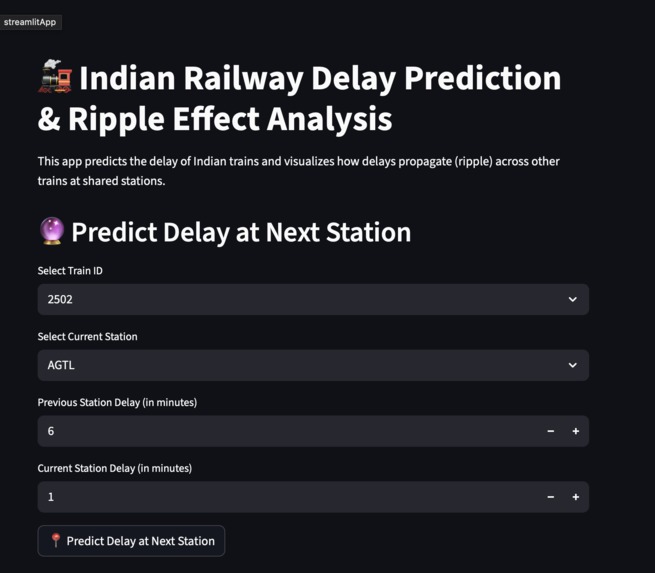
Interface of the streamline web app
-
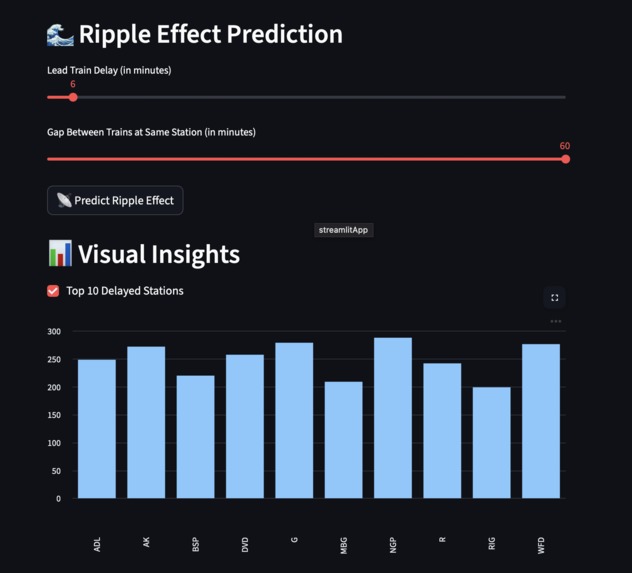
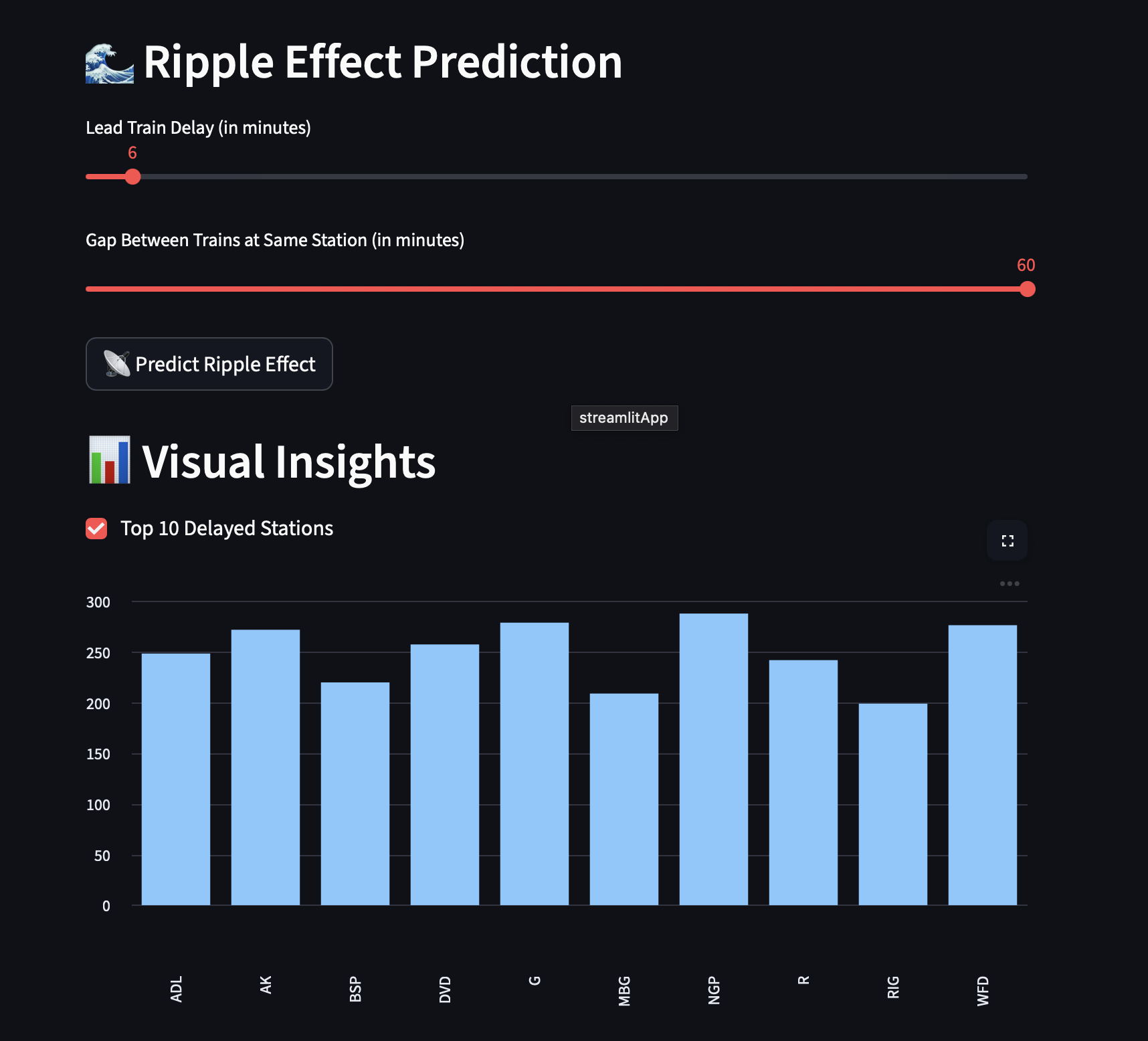
another feature
Inspiration
One day, I was curious about what software engineers at big companies like Amazon and Meesho actually do. While searching, I came across their work in route optimization, delivery time prediction, and logistics tracking. That immediately caught my attention.
Then, I thought about trains. Trains often get delayed, but usually, the updates we receive are reactive-they tell us the train is already late, not that it is likely to be late. Passengers only know after the delay has occurred, which is inconvenient.
That was my moment of inspiration:
What if we could build a system that predicts train delays beforehand, just like logistics companies predict delivery times?
So instead of just reporting delays after they happen, the system could estimate
\( P(\text{Delay}) \) beforehand, giving passengers actionable information in advance.
What it does
Most railway apps like IRCTC, Where is My Train, or RailYatri only notify users after a delay has already occurred. But in real life, a single delayed train can cause a chain reaction — delaying others on the same track or junction.
Our Train Delay Predictor solves this by going beyond simple tracking:
- Predicts train delays in advance – before they actually happen.
- Models ripple effects – estimates how one train’s delay impacts others in the network.
- Identifies vulnerable stations/routes – highlights junctions that often trigger cascading delays.
- Provides actionable insights – useful for both passengers and railway planners.
In short, instead of being reactive like current apps, our system is proactive: it learns from history, detects patterns, and forecasts disruptions ahead of time.
This helps passengers plan smart and travel on time
How we built it
We started by collecting a train running dataset, which contains different train routes along with information like average delay, right time, and delays for different stations along each route. Our model uses:
- Station code
- Delay at previous station
- Delay at current station
With these, it learns patterns and predicts delay at the next station using machine learning models.
This helps us know what is the chance that the train will be late at upcoming stops.
Challenges we ran into
During the project, we encountered several challenges:
-Variation in Train Routes Different trains follow different routes and stop at different stations. Handling this diversity correctly was a key challenge.
-Choosing the Right Inputs We had to carefully decide which inputs (such as previous station delay, current station delay, station codes, etc.) would be most useful for prediction.
-Handling Real-Time Delays The delay at one station directly affects the delay at the next station. Capturing this dependency properly was a non-trivial task.
-Balancing Simplicity and Accuracy We aimed to keep the model simple for ease of implementation, while still achieving a good level of accuracy.
-Small Dataset Issue The dataset we worked with was quite small. Since we had to split it into training and testing sets, we were often unsure whether our chosen methods would generalize well or not.
Accomplishments that we're proud of
Functional Model: Successfully built a working machine learning model that can predict train delays using the given dataset.
Feature Engineering: Identified meaningful input features such as previous station delay and current station delay, which improved prediction quality.
Dependency Capture: Incorporated the effect of delays propagating from one station to the next, which made the model more realistic.
Balance of Simplicity and Accuracy: Designed a model that remains simple and interpretable while still producing reasonably accurate results.
Learning Experience: Gained valuable experience in handling real-world challenges like data variety, small datasets, and sequential dependencies.
What we learned
Handling Limited Data: Gained experience in working with small datasets and making the most out of available information.
Data Preprocessing: Understood the importance of structuring, and selecting relevant features from raw datasets.
Sequential Dependencies: Learned how delays at one station can propagate to the next, and how to model such dependencies.
Model Simplicity vs. Accuracy: Realized that even simple models can perform well if the features are carefully chosen.
Machine Learning Workflow: Strengthened our knowledge of the complete ML pipeline – from problem definition to feature engineering, model building, and evaluation.
What's next for Train Delay Predictor
Expand Features: Add more features that contribute to train delays (e.g., weather, maintenance schedules, track congestion, seasonal demand).
Larger Dataset: Apply the model to a larger dataset covering more routes and longer time spans to improve generalization.
Scalability: Extend the project to a global scale by incorporating data from different countries and train networks.
Advanced Models: Experiment with more sophisticated models (e.g., recurrent neural networks, ensemble methods) to capture complex delay patterns.
Deployment: Develop a real-time prediction system that can be used by passengers and railway authorities.
Built With
- github
- matplotlib
- numpy
- pandas
- python
- scikit-learn
- streamlit


Log in or sign up for Devpost to join the conversation.