-
-
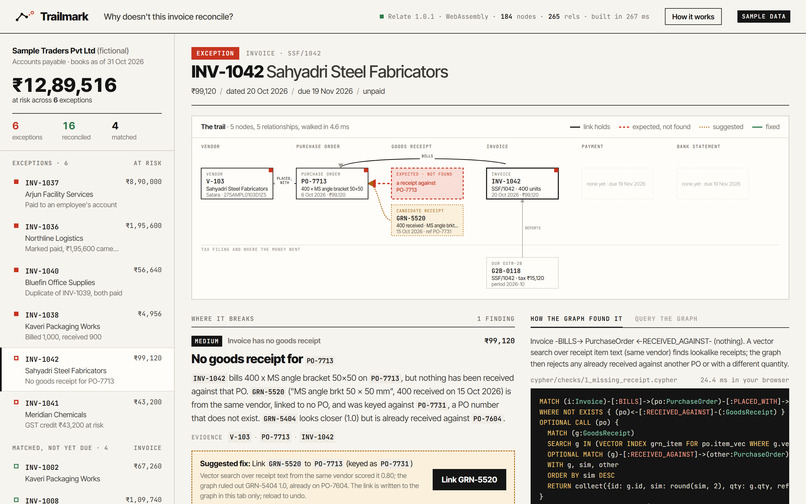
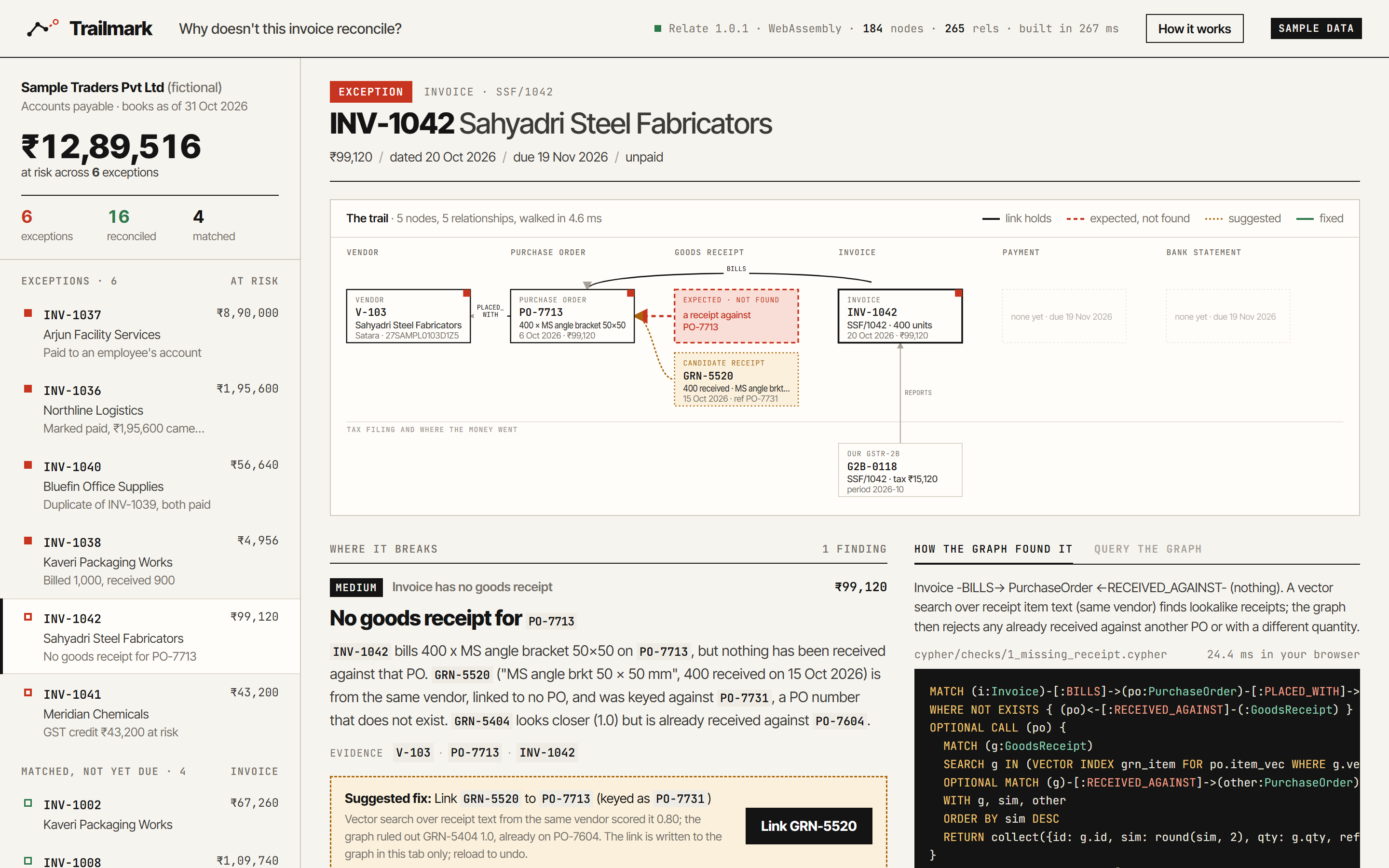
INV-1042: no goods receipt. The dashed red card is the link the trail expects and cannot find (sample data).
-
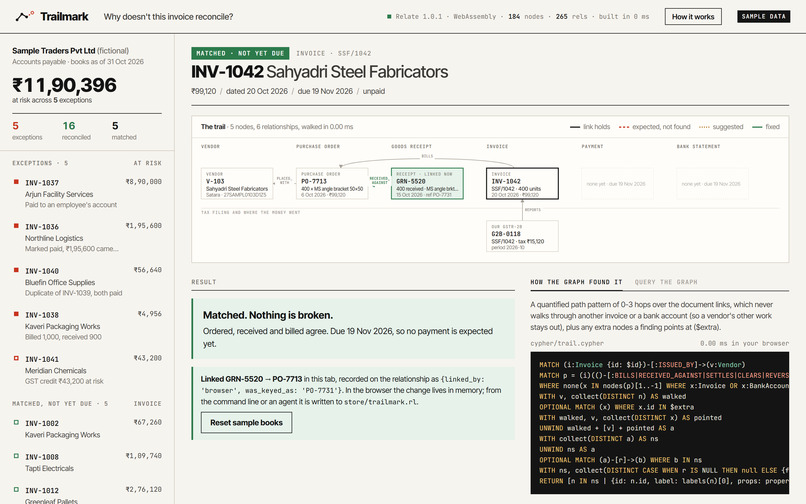
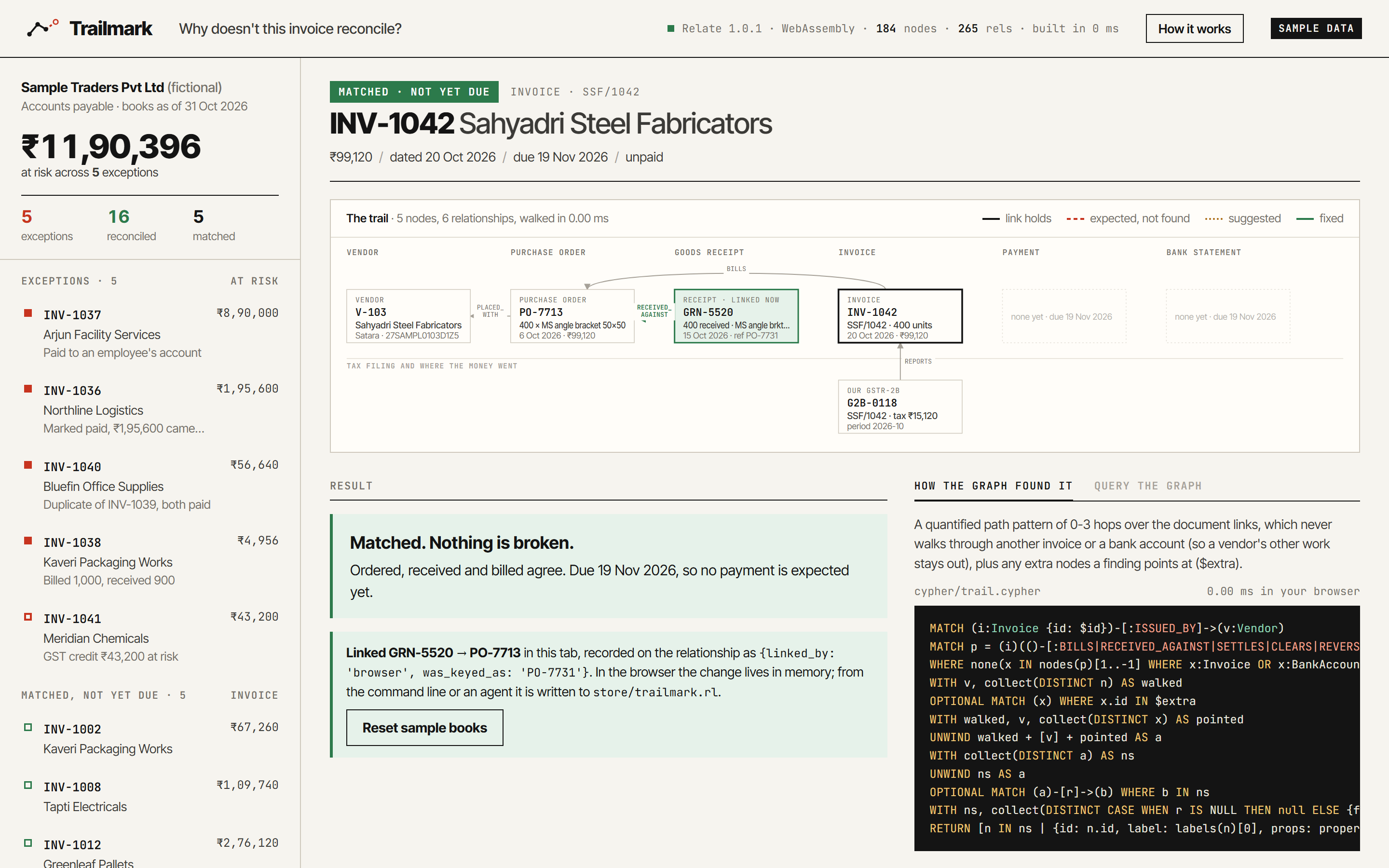
After one click: GRN-5520 linked to PO-7713, the trail holds and ₹99,120 leaves the at-risk total.
-
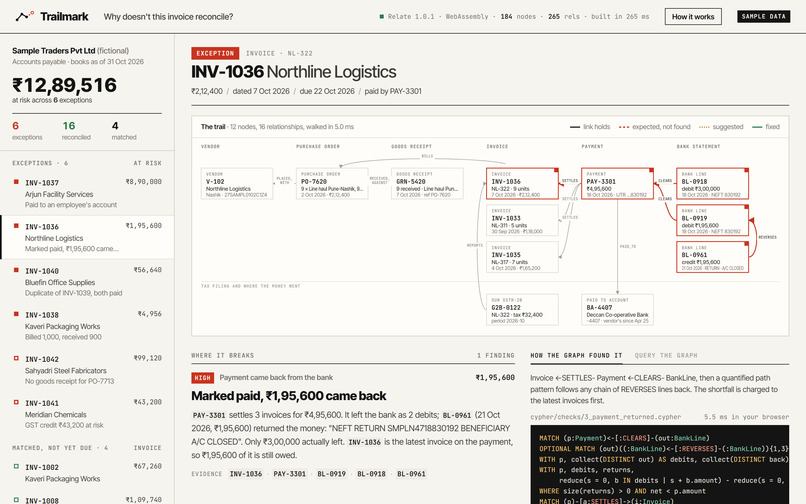
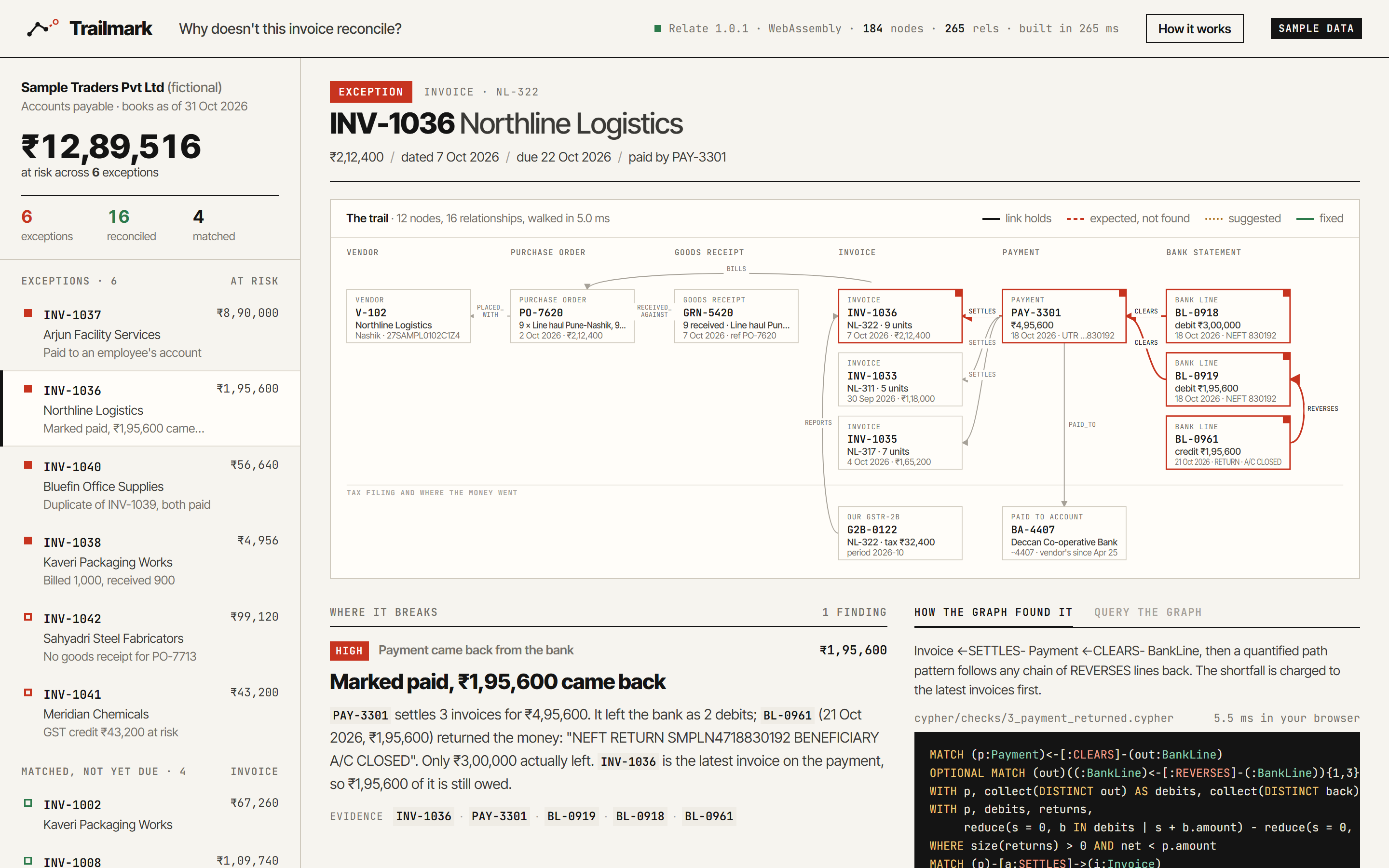
INV-1036: one payment, three invoices, two bank debits, one returned. The books still say paid.
-
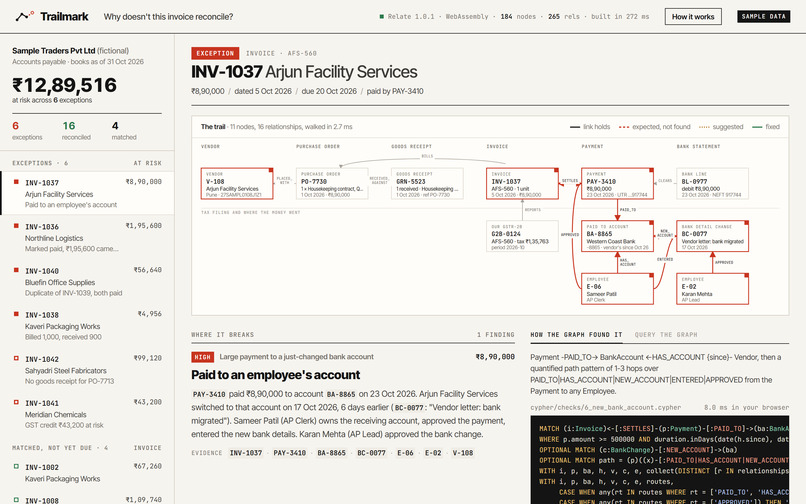
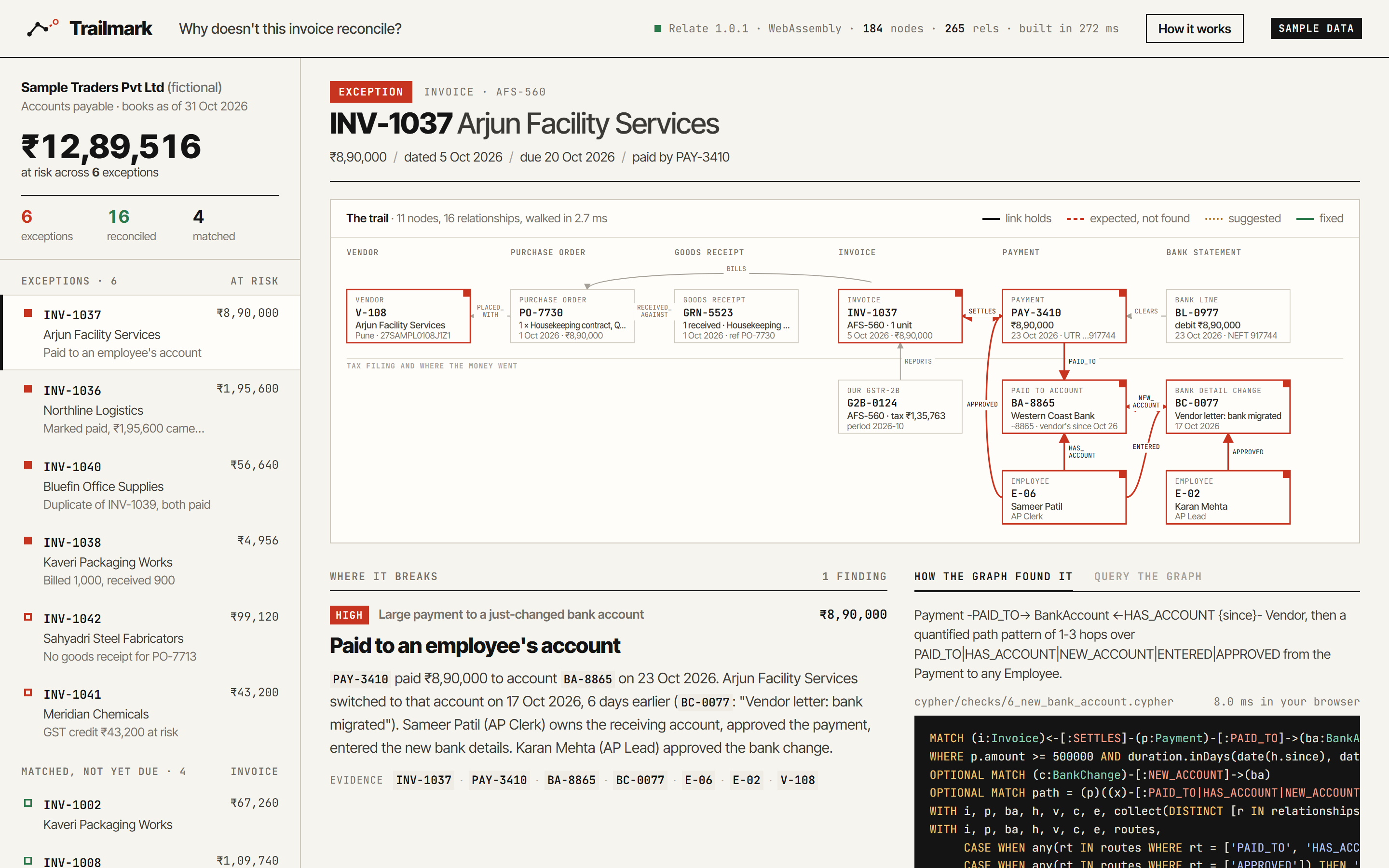
INV-1037: ₹8,90,000 paid to a just-changed account owned by the AP clerk who entered it and approved the payment.
Live demo (runs in your browser): https://automationbot24x7.github.io/trailmark/ · Code (MIT): https://github.com/Automationbot24x7/trailmark · Relate store: store/trailmark.rl in the repo
All data is invented sample data: vendors, people, GSTINs, bank accounts and amounts.
Inspiration
I work in finance automation. At every month-end, accounts-payable teams answer the same question for hundreds of invoices: why doesn't this one reconcile? The answer is never on one ledger. It sits across the purchase order, the goods receipt, the invoice, the payment, the bank statement and the GST return, so someone opens five spreadsheets and follows the trail by hand. That trail is a graph, and the breaks that cost money only show up when you can walk it.
What it does
Trailmark loads the AP ledgers into one Relate graph and runs six checks. Each check is a plain Cypher file, and each returns the broken link, the amount at risk and the nodes that prove it:
- Invoice with no goods receipt. A vector search over receipt descriptions finds lookalike receipts from the same vendor. The graph then rules out the one already received against another PO, and points at the receipt keyed against a PO number that doesn't exist. One click (or one agent tool call) links it, and the invoice turns green.
- Billed more than was received. Many receipts and many invoices are summed across one PO.
- Marked paid, but the money came back. One payment settles three invoices, leaves the bank as two debits, and one debit is returned. A quantified path pattern follows the reversal chain.
- The same invoice paid twice (BOS/889 and BOS-889), each copy with its own payment and bank line.
- Tax credit claimed, but the supplier never filed. The invoice is missing from our GSTR-2B while the supplier's other invoices are present.
- A large payment to a just-changed bank account that belongs to an employee. Every 1-3 hop path from the payment to our own people: the same AP clerk entered the new bank details, approved the payment and owns the account.
You can use it in four ways, all on the same store:
- a browser view, where Relate runs as WebAssembly in the tab
- a Python CLI (
scan,explain,link) - an MCP server for AI agents, with five tools: reads are read-only, and the one guarded write records who linked what and why
- Relate's own CLI or
relate serve --mcp
What connects to what
(:PurchaseOrder)-[:PLACED_WITH]->(:Vendor), (:GoodsReceipt)-[:RECEIVED_AGAINST]->(:PurchaseOrder), (:Invoice)-[:BILLS]->(:PurchaseOrder), (:Payment)-[:SETTLES {amount}]->(:Invoice) (many-to-many), (:BankLine)-[:CLEARS]->(:Payment) (one payment can be several debits), (:BankLine)-[:REVERSES]->(:BankLine), (:GstrLine)-[:REPORTS]->(:Invoice), (:Payment)-[:PAID_TO]->(:BankAccount)<-[:HAS_ACCOUNT {since}]-(:Vendor|:Employee), (:Employee)-[:APPROVED|ENTERED]->(...), (:BankChange)-[:NEW_ACCOUNT]->(:BankAccount). That is 184 nodes and 265 relationships, built from 13 flat CSV ledgers by linking on the keys an accountant uses: PO number, bank reference (UTR), and GSTIN plus invoice number.
How we built it
- Relate, single-file mode:
store/trailmark.rlis one period's books in one file you can hand to an auditor. The embedded Python library builds it and opens itread_onlyfor every read. Relate's CLI andrelate serveopen the same file. - Cypher features used: quantified path patterns,
SEARCH … VECTOR INDEX … SCORE ASinside anOPTIONAL CALLsubquery,EXISTS {}subqueries, uniqueness constraints andduration.inDays. - Text vectors: small and deterministic (hashed character trigrams), so no model or API key is needed.
- Browser: the browser view uses Relate's WebAssembly build. It rebuilds the graph from an export of the store and runs the very same
.cypherfiles. - Agents: a small stdio MCP server exposes the domain tools, and
.mcp.jsonalso registersrelate serve --mcp stdio --read-onlyfor raw Cypher. - Testing: seven end-to-end tests run in CI on Windows, macOS and Linux.
Challenges we ran into
- A plain three-way match is not a graph problem. It is fixed-depth joins. So every scenario depends on many-to-many or variable-length structure: split and returned payments, partial receipts, duplicates, and people around the money. The README puts the Cypher next to the SQL it replaces.
- The WebAssembly build cannot open a
.rlfile. The page rebuilds the graph from an export of the store instead. - Relate allows one process per store. The CLI and the agent server open short-lived connections, read-only wherever possible.
Accomplishments that we're proud of
- The missing-link view: the link the trail expects and cannot find is drawn as a dashed red "expected, not found" card, so the answer is visible rather than buried in a report.
- Vector search and the graph together: vector search proposes candidate receipts and the graph rules them out or in.
- Easy to try: it runs from a fresh clone with one dependency, or in the browser with none.
What we learned
Relate makes "a graph per job" practical: a few hundred kilobytes, one file, millisecond queries, and the same Cypher on a laptop, in a browser tab and behind an agent's tools.
What's next
- importers for real ERP exports (Tally, SAP, Zoho Books)
- more checks: TDS deducted but not deposited, vendor-to-vendor circular payments, partial credit notes
- a bulk "close pack" that writes every finding into the store as
(:Finding)nodes, so auditors can query them
AI use
This project was built during the contest period by a solo builder with significant help from an AI coding assistant (Claude Code, by Anthropic). The assistant wrote most of the code, Cypher, sample-data generator, tests and documentation under my direction. I chose the use case, defined the accounting scenarios and reviewed the results. The product itself contains no AI model: every finding comes from Cypher over the graph. The sample data is invented.
Reused code
- Relate (Apache-2.0):
relate-dbfrom PyPI, and the unmodified@relate/relate-wasm1.0.1 package vendored inweb/vendor/relate-wasm/. - Fonts: Inter Tight and JetBrains Mono (Google Fonts).
- Everything else was written for this hackathon.
Built With
- cypher
- github
- javascript
- mcp
- neo4j
- python
- relate
- svg
- webassembly
