Trailer Forge
Inspiration
Filmmakers, editors, and marketing teams spend countless hours reviewing raw footage, organizing dailies, and manually assembling high-impact promotional trailers.
Creating a compelling trailer is more than simply selecting good shots. It requires precise temporal pacing, carefully timed transitions, emotional storytelling, and synchronization between visual moments and sonic peaks such as impacts, risers, and swells.
We built Trailer Forge as an intelligent, non-linear editing (NLE) co-pilot that helps bridge the gap between a creative concept and a structured, production-ready edit.
By transforming narrative scripts, storyboards, and text-based footage descriptions into visual cuts, synchronized sound cues, and structured edit lists, Trailer Forge enables creators to rapidly prototype and plan cinematic trailers.
What It Does
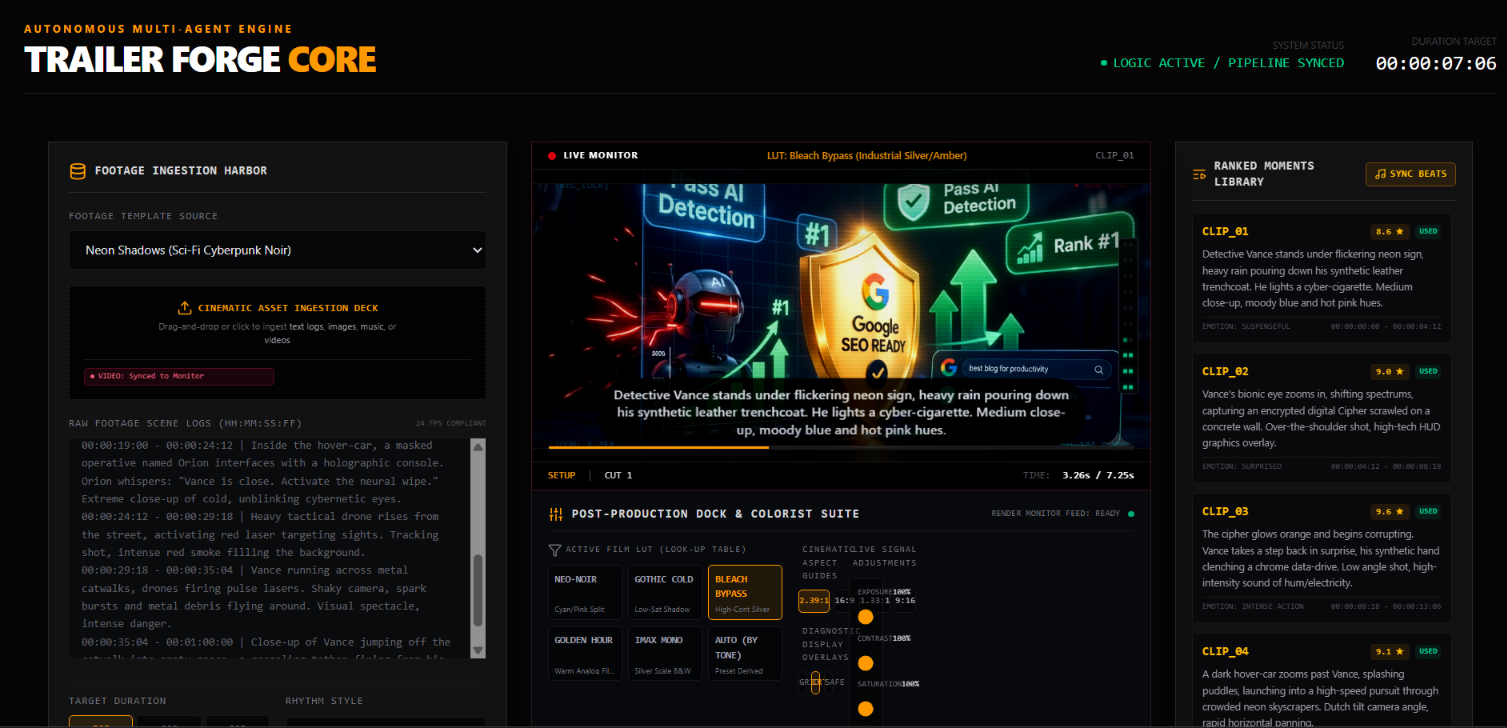
Trailer Forge is an interactive, browser-based AI film-editing workspace designed to streamline trailer pre-visualization, pacing analysis, and rapid editing prototyping.
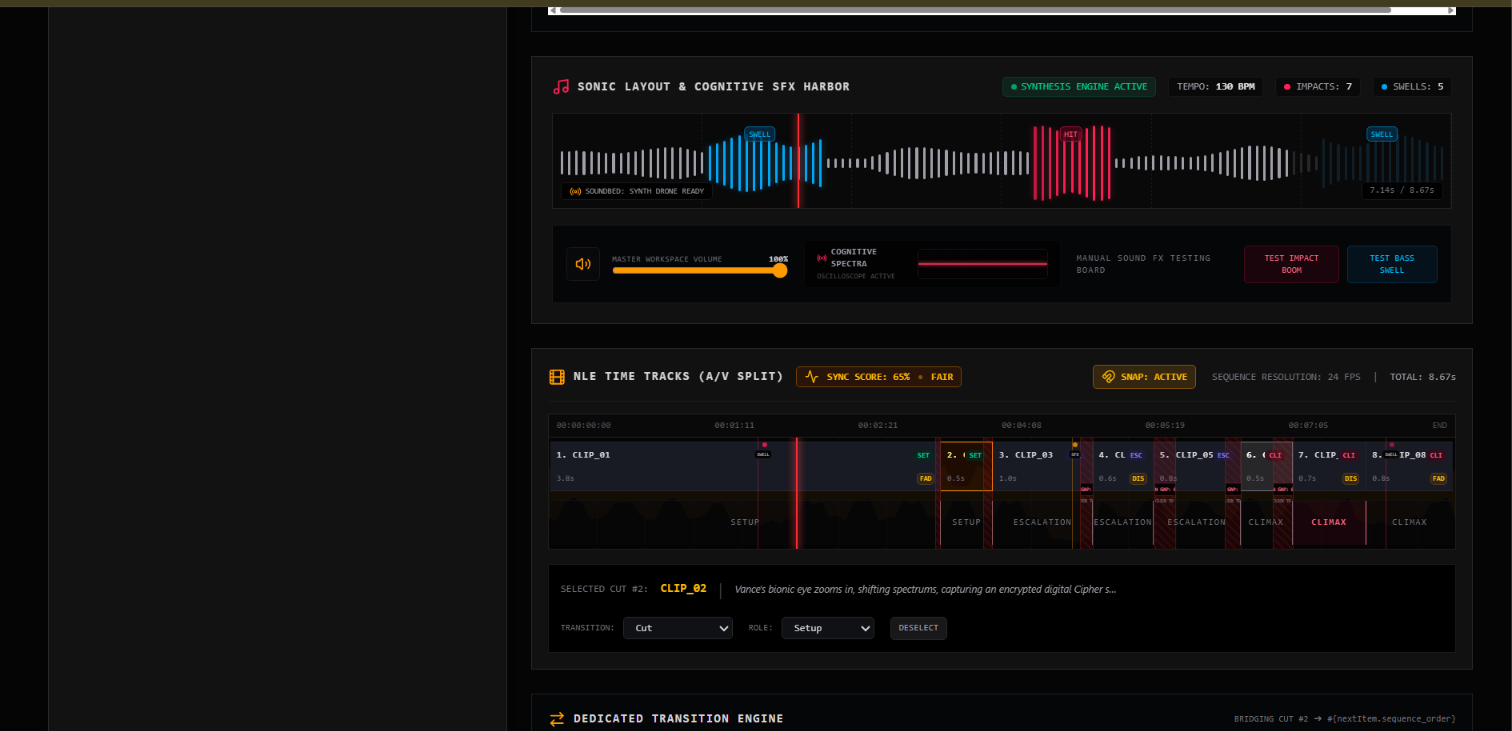
🎬 Premiere-Style Multi-Track Timeline
Trailer Forge provides an interactive multi-track editing timeline inspired by professional NLE software. Creators can visualize:
- Video cuts
- Scene transitions
- Audio tracks
- Sound effects
- Impact points
- Dramatic swells and risers
- Frame-accurate timeline positions
A synchronized playhead allows creators to understand how visual and audio elements interact across the timeline.
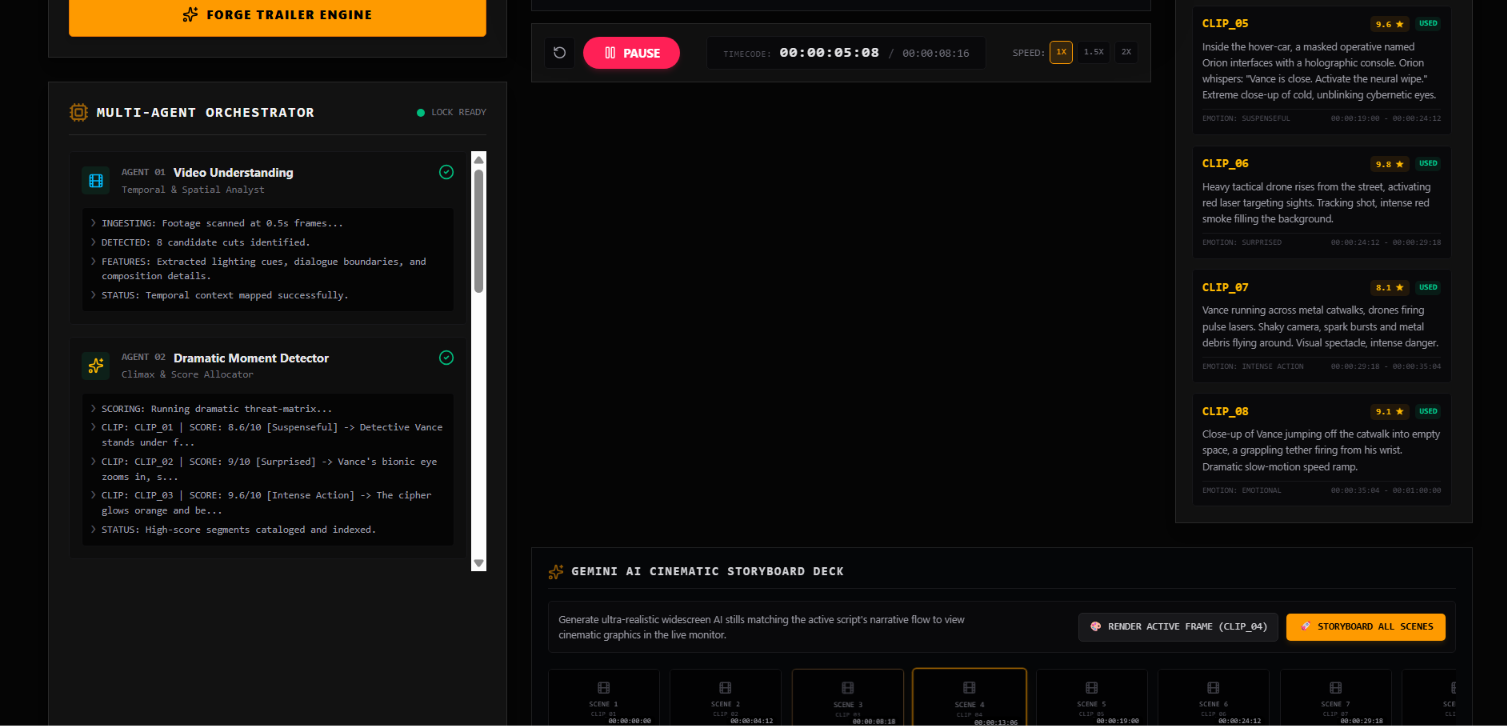
🖼️ Dynamic AI Storyboard Rendering
Trailer Forge integrates Gemini API models server-side to transform edit descriptions into cinematic storyboard frames.
Instead of working with abstract text alone, creators can visually preview the atmosphere, composition, and narrative intent of individual shots directly within the editing workspace.
🔊 Synchronized Sound Design Engine
Trailer Forge maps sound-design structures to visual timeline events.
Creators can preview and adjust:
- Dramatic risers
- Audio swells
- Impact hits
- Transition cues
- Sonic peaks
This allows visual transitions and sound moments to be coordinated for greater cinematic impact.
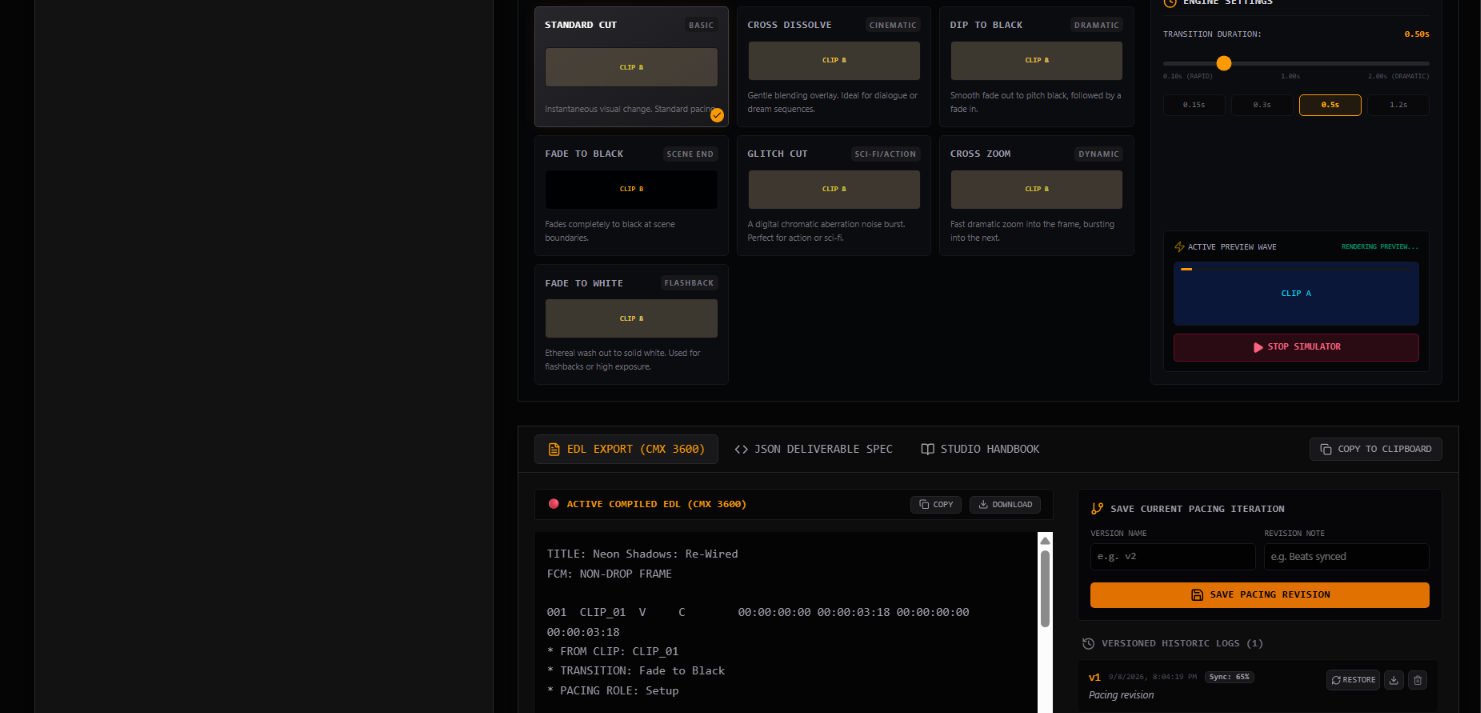
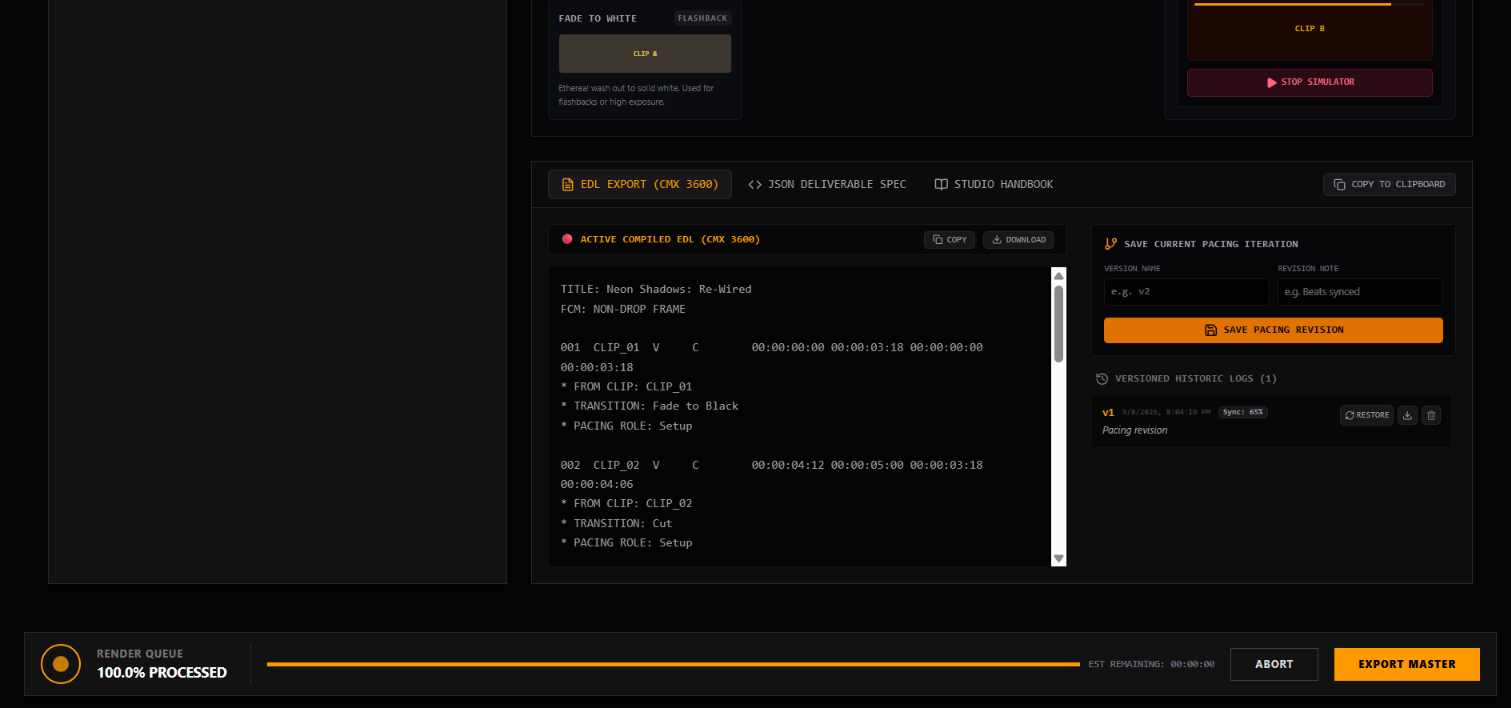
📄 Industry-Standard EDL & JSON Compiler
Trailer Forge dynamically generates and parses structured Edit Decision Lists (EDLs) and JSON edit data.
This makes it possible to take the planned structure and continue the editing workflow in professional tools such as Adobe Premiere Pro, DaVinci Resolve, and Avid Media Composer.
📚 Comprehensive Studio Handbook
The application also includes an integrated reference handbook covering:
- Trailer pacing principles
- Visual cutting techniques
- Sonic patterns
- Transition structures
- Editorial strategies
- Cinematic storytelling concepts
This gives creators both the tools and the editorial knowledge needed to make better trailer decisions.
How We Built It
Trailer Forge is a full-stack web application built using modern web technologies.
Frontend Architecture
The frontend was built with:
- React
- TypeScript
- Tailwind CSS
- Motion-based animations
The interface uses a dense, high-contrast visual design inspired by professional editing software.
Real-time playhead tracking, timeline interactions, and responsive animations are managed through carefully optimized React state and references.
Backend Services
A custom Node.js/Express backend securely manages:
- AI image generation requests
- Image asset orchestration
- Server-side processing
- API communication
Gemini API Integration
Trailer Forge uses the @google/genai TypeScript SDK on the server side to generate contextual cinematic storyboard visuals based on custom edit descriptions.
This allows textual creative ideas to become visual representations directly inside the editing environment.
Audio Synthesis & Timing Engine
The timing engine tracks playback coordinates and maps audio milestones against visual timeline positions.
This enables the system to provide real-time feedback on relationships between:
Visual Cut → Transition → Sound Cue → Sonic Peak
Challenges We Ran Into
⏱️ Temporal Precision in Web Playback
Synchronizing an active playhead with multiple video tracks, timeline cards, video-player states, and custom audio layers was one of our biggest technical challenges.
We used careful state management and React references with micro-tick tracking to minimize layout jitter, timing inconsistencies, and audio delays.
📝 Mapping Script Text to Spatial Cut Lists
Converting general narrative descriptions into mathematically structured timeline segments required us to establish precise rules for:
- Scene boundaries
- Duration ratios
- Cut timing
- Transition points
- Timeline positioning
The challenge was translating creative language into deterministic editing structures.
🎨 UI Density Optimization
Professional editing software contains a huge amount of information within a relatively small interface.
Our challenge was to represent complex editing information without making the interface overwhelming.
We solved this by using structured visual grouping, carefully calculated spacing, high-contrast elements, and compact timeline components.
Accomplishments That We're Proud Of
🎞️ High-Fidelity Timeline Experience
We built a responsive, interactive multi-track NLE-style editing interface that brings professional editing concepts directly into the browser.
⚡ Instant Visual Prototyping
Trailer Forge can transform text-based creative descriptions into structured storyboard layouts and visual scene concepts with minimal interaction.
🧩 Clean Architecture
We optimized the application architecture by removing redundant components and maintaining a lightweight, type-safe, and modular codebase.
🔗 Creative-to-Technical Pipeline
One of our biggest accomplishments is connecting creative storytelling with structured editing data.
A creator can move from:
Script → Scene Description → Storyboard → Timeline → Sound Cues → EDL/JSON
within a single workflow.
What We Learned
📐 Spatial Math in CSS
Building a dense professional editing interface with Tailwind CSS taught us how important calculated spacing, proportional layouts, border-radius relationships, and visual hierarchy are for maintaining readability.
🎵 Pacing Hierarchy
We learned that trailer pacing can be represented through structured patterns rather than being purely subjective.
Editorial concepts such as the Rule of Threes, contrast cuts, escalating shot durations, and synchronized sonic peaks can be translated into algorithmic timing rules.
🤖 Combining AI With Creative Workflows
We also learned that AI becomes significantly more useful when it is integrated into an existing professional workflow rather than being treated as a standalone chatbot.
Trailer Forge uses AI where it provides the most value: visual ideation, scene interpretation, and creative pre-visualization.
What's Next for Trailer Forge
🎬 Direct XML & AAF Exports
We plan to expand our export system beyond EDL and JSON by supporting native XML and AAF formats.
This would enable more direct timeline reconstruction inside professional editing software such as Premiere Pro and DaVinci Resolve.
🤖 Multi-Agent Script Analysis
Our next major step is introducing a multi-agent architecture capable of analyzing complete scripts.
Specialized agents could:
- Segment entire scripts into scenes
- Identify characters
- Detect emotional peaks
- Analyze scene transitions
- Identify potential trailer moments
- Recommend shot structures
- Generate optimized cut layouts
🔊 Interactive Audio Waveform Previews
We plan to add visual waveform analysis for uploaded and generated audio.
This would allow editors to align visual cuts and timeline markers precisely with:
- Beat drops
- Impacts
- Risers
- Musical peaks
- Dialogue moments
The Vision
Trailer Forge is designed to evolve from an NLE co-pilot into an autonomous AI film editor.
Our long-term vision is a system where a filmmaker can provide a script, footage, or creative brief and receive an intelligent, editable trailer structure that combines:
Story Understanding + Visual Selection + Cinematic Pacing + Sound Design + Production-Ready Edit Data
Instead of replacing filmmakers, Trailer Forge aims to give them an intelligent creative partner that handles the repetitive technical work while keeping the final creative decisions in human hands.
Built With
- animation
- api
- audio
- css
- css3
- decision
- edl
- express.js
- gemini
- html5
- javascript
- json
- motion
- node.js
- react
- rest
- tailwind
- typescript
- web

Log in or sign up for Devpost to join the conversation.